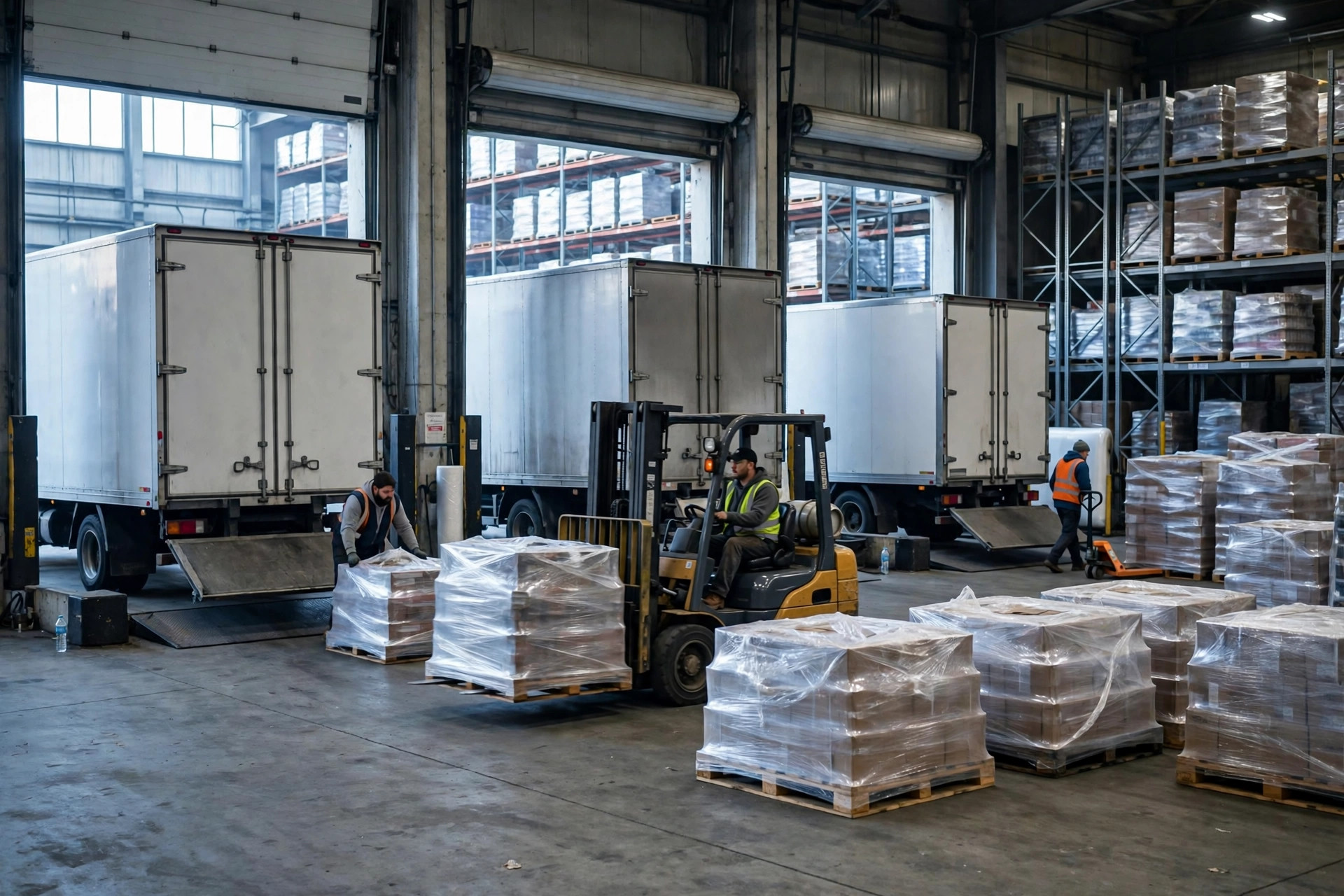
Ask a warehouse crew how many stretch wrap layers a pallet needs and you will get a confident number. Ask them why, and the confidence evaporates. The honest answer is that there is no single number, because the question is wrong. The right question is: what is this load afraid of? Falling apart, tipping, sliding sideways, or shaking itself loose on the road? Different fears call for different stretch wrap layers, and one number applied to every pallet is how damage reports get written.
Let me start with the principle, because once you see it, the rest falls into place. Stretch film does not work by dressing the pallet. It works by turning a stack of separate boxes into one elastic unit. Think of it like a splint with give in it: the film's rebound pulls the whole load together so that when the forklift starts, brakes, or turns, the boxes move as one body instead of each going its own way. You can think of the layers as the thickness of that splint, and stretch tension as how tightly it is strapped on. Judge one without the other and you are prescribing a dose without checking the medicine.
I saw the first half of this lesson in a consumer-goods contract warehouse in Guangdong last summer. A pallet of tissue paper arrived at the customer's site with the top two cartons leaning off to one side, one corner creased. The first instinct on the floor was that the pallet had been under-wrapped, but when they counted, the layer count was generous. The failure was at the top: the last wraps sat loosely around the rim of the top cartons, so the top layer slid on the first hard brake and took the rest of the stack's confidence with it. The fix cost almost no extra film. The crew added a wrap and a half at the top and let the film ride slightly above the top cartons, catching their upper edge. Top-layer sliding complaints stopped after that. Same total layers, force applied in the right place, completely different result.
The opposite mistake showed up at a beverage distributor's warehouse in eastern China. Water pallets were wrapped to a heavy-load standard, and they were rock solid. But customers started complaining about unpacking: the film was wound so tight and thick that cutting it open nicked outer cartons, and some of those nicked cartons came back as returns. When the warehouse trimmed the middle wraps and kept the reinforcement at the base and the top, damage did not bounce back, and the unpacking complaints fell away. Film is not insurance. Buy too much of it and it turns into cost and hassle of its own.
How Many Wrap Layers? Start With How the Load Fails
Every load has a preferred way of failing, and that is where your layer decision should start. A tall, light load fails at the top first. A short, heavy load tends to shift sideways as a block when the truck turns. Smooth-surfaced cartons, the kind with glossy film or plastic outer packaging, fail by layers sliding over each other. A mixed, irregular pallet fails at the corners, where uneven pressure lets one corner work loose and the rest follows. Each failure mode wants reinforcement in a different place: tall loads need the top closed properly, heavy loads need the base and waist held, slippery loads need even containment across the whole stack, and irregular loads need the corners squared away before film ever touches them. Film cannot fix a badly built pallet; it can only hold a well-built one together.
Then there is a variable people forget to ask about: how far is this pallet going, and how many hands will touch it? A pallet that only moves inside the warehouse needs to survive a few starts and stops. A pallet going out on a long haul, with a transfer in the middle, has to survive sustained vibration and repeated handling. Before you settle the stretch wrap layers, ask how far it travels and how many times it gets handled. The answer changes the decision.
The Dividing Line for Wrap Layers: A Table by Load Type
The table below is field practice from several warehouses, not a lab standard and not a vendor datasheet. Use it to set direction, then adjust for the film you actually run and how it feels in the hand. The layer counts are reference ranges for the whole pallet; the reinforcement column matters at least as much as the count.
| Load type | Reference layers | Reinforce here | Film cost vs. damage trade-off |
|---|---|---|---|
| Tall and light, household paper cartons | Medium-high | Top closure, waist | Moderate film cost, guards against top sliding |
| Short and heavy, beverages and dense goods | Medium | Base, waist | Moderate film cost, guards against sideways shift |
| Smooth surfaces, film-wrapped packaging | High | Even coverage, top closure | Higher film cost, buys layer grip |
| Mixed, irregular pallets | High | Corners, top closure | Higher film cost, fix uneven stacking first |
| Short in-house moves only | Low | Base, waist | Low film cost, no need for outbound standard |
There is one dividing line to remember when using this table. If the stack is visibly leaning or the layers are badly misaligned, do not reach for more film. Fix the stacking first. Film holds a square stack together; it cannot hold up a stack that was never stable to begin with. Paying for extra layers to cover up bad stacking is the most expensive form of laziness I know, because you pay the film cost and still get the damage.
Tension deserves its own paragraph. Hand wrappers often go by feel, and the feeling says tighter is safer. It is not. Over-stretched film keeps pulling on the load, denting carton walls and, in bad cases, deforming carton corners during transit. Under-stretched film just lies on the load doing nothing, which is wasted money. A usable floor check is to push the middle of the wrapped stack with your palm. The whole load should sway slightly as one body, not let a single carton slide on its own. The film surface should look flat and snug, without large loose wrinkles. A carton that slides alone, or a wrinkled film face, means the wrap is not doing its job. Corners already dented inward mean you went too far the other way.
More Layers Are Not More Safety
Here is the counterintuitive part, and it is the heart of the whole subject. Past a certain point, each extra layer adds very little holding power, while film consumption, unpacking time, and the risk of nicking cartons during cutting all keep rising. The benefit curve flattens; the cost curve does not. Where those two curves cross is where you should stop. Beyond that point, more film is not more safety. It is just more expensive.
I have no patience for the idea that layer count equals diligence, as if wrapping more proved you cared more. Diligence shows up in judgment: what this load fears, how far it travels, how many hands touch it. Answer those and the layer count settles itself. Fail to answer them and all the extra film in the world is just money spent on peace of mind, and peace of mind is the most expensive thing in the warehouse.
The maintenance trap sits in the same place. In warehouses with automatic wrappers, parameters can sit untouched for months while the film batch changes, the main product mix changes with the season, and the old settings quietly stop fitting. Damage creeps up until someone discovers the film batch changed and the old setting no longer fits. My rule is simple: whenever the film batch changes, the main product mix changes, or the season turns, re-check the wrap. Run one pallet on the current settings, push it, look at the film face, and ask the people who unpack whether anything new is annoying them. A few minutes of checking beats processing a damage claim.
The floor check you can use tomorrow is this. After wrapping a pallet, confirm the top closure catches the upper edge of the top cartons. Confirm the base holds the bottom layer. Push the middle of the stack and check it moves as one body. Look at the film face for flat, snug coverage without large loose wrinkles. If all four pass, the pallet will probably travel fine. If one fails, fix that one spot instead of blindly adding layers to the whole pallet.
Whether the money was well spent comes down to one number: whether damage complaints on consecutive outbound batches of the same goods have gone down. Film cost is the visible cost. Damage, rework, and customer complaints are the invisible ones. Add both together and the quality of your layer decision shows up.
By Da Liu, Automation Engineer