Ask ten warehouse managers how often OSHA requires pallet racking to be inspected and nine will give you the same answer: once a year. The tenth might add that there is an official "annual inspection" requirement. Both answers point to the same comforting idea — that somewhere in the federal regulations, a line exists that says "inspect your racks annually." No such line exists. The search for an official pallet racking inspection frequency ends not with a number, but with a question you have to answer yourself: can your inspection program defend itself when an OSHA compliance officer walks in?
What the regulation actually says: 1910.176 and the general duty clause
The regulation most directly touching rack safety is 29 CFR 1910.176, "Handling materials – storage, use and disposal." Its operative language is brief: storage of material must not create a hazard to employees (1910.176(a)), and stored materials must be stacked, blocked, and secured against sliding or collapse (1910.176(b)). The word "inspection" does not appear. No frequency is specified.
Rack-related citations are actually built on a broader instrument: Section 5(a)(1) of the OSH Act, the general duty clause, which requires employers to keep the workplace free of recognized hazards likely to cause death or serious physical harm. Its defining feature is elasticity — it prescribes outcomes, not procedures. On the question of inspection frequency, OSHA has effectively delegated the definition to industry consensus and to the judgment of the inspector standing in your aisle.
What the citation data reveals about inspection frequency
OSHA's citation records are public, and they explain the agency's logic better than the regulatory text does. Two cases are enough to make the point.
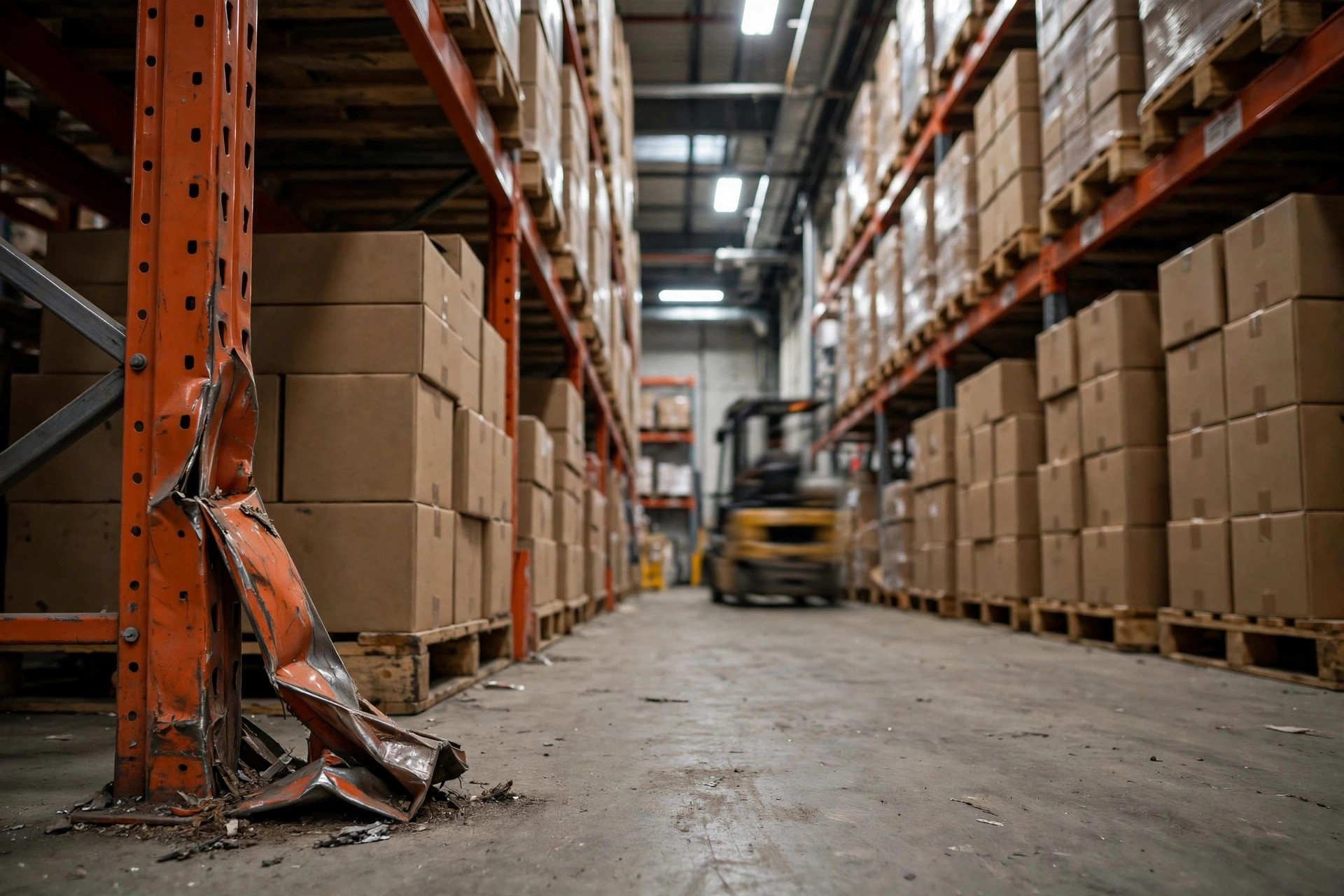
In 2016, a Family Dollar distribution center received a serious citation under Section 5(a)(1). What the inspector found was not a collapse: it was six dented structural brace members — one in aisle 14, four in aisle 19, one at rack 64/77 — with 60 employees working in those aisles daily. The penalty was $12,471, issued December 13, 2016. The signal is direct: OSHA does not wait for a collapse. Visible, unrecorded, unaddressed structural damage is itself a recognized hazard.
A 2017 case ended worse. At one facility, the bottom beam had been removed along the entire length of a rack run to allow double-stacking of totes. With the beam gone, each bay's rated capacity fell from 21,100 pounds to roughly 6,400 pounds — yet all 34 bays were loaded above the reduced capacity, and more than 20 percent carried twice the rated load. On November 27, 2017, the rack collapsed catastrophically. The citation, again, was issued under the general duty clause. The lesson here is different: unauthorized reconfiguration is more dangerous than impact damage, because it changes the structural assumptions the rack was designed around.
Together, the two cases reveal OSHA's actual inspection logic. The agency does not grade your inspection frequency. It asks three things: was the damage found in time, was it addressed once found, and did actual use drift away from the design conditions?
Pallet racking inspection frequency: what the industry standards say
Where the regulation is silent, industry consensus fills in. The Rack Manufacturers Institute (RMI) states in its official FAQs that the rack system owner should establish and implement a program of regularly scheduled inspections, performed by a qualified person familiar with rack design and installation — and that, as a minimum, inspections should be performed at least annually (RMI official FAQs, via Modern Materials Handling). Note the word "minimum": the annual inspection is the floor, not the ceiling.
ANSI MH16.1, the U.S. consensus standard for the design, testing, and utilization of industrial steel storage racks, provides the technical foundation beneath that consensus. OSHA repeatedly references it in citation records to define what counts as a "recognized hazard" and what counts as a feasible fix. OSHA writes no rack technical standards of its own, but it treats the industry standard as its enforcement yardstick.
A British comparison is instructive. The UK's HSE recommends an annual expert inspection by a SEMA-approved racking inspector, and expects every warehouse to designate a Person Responsible for Racking Safety (PRRS) who handles routine checks, damage reporting, and repair tracking. The British and American systems converge on the same architecture: high-frequency, low-depth internal checks layered with low-frequency, high-depth professional inspections.
The three-tier inspection schedule: what to actually do
Combining RMI's guidance with common U.S. 3PL practice, a defensible program typically has three tiers — the practical answer to the pallet racking inspection frequency question:
| Tier | Frequency | Who | What to check | Output |
|---|---|---|---|---|
| Daily walk-through | Each shift / daily | Forklift operators, floor staff | Visible impact marks, dislodged or deformed beams, pallets overhanging beams, missing safety pins, blocked aisles | Immediate escalation of anything abnormal |
| Monthly detailed check | Monthly | Designated safety lead (PRRS role) | Every upright, beam, and brace row by row; footplates and anchors; load capacity plaques; rack plumb; damage graded red-yellow-green | Signed checklist and remediation log |
| Annual professional inspection | Yearly | Third-party specialist or qualified person | Full structural assessment, capacity verification, reconfiguration review, immediate unload orders for red zones | Formal inspection report and action list |
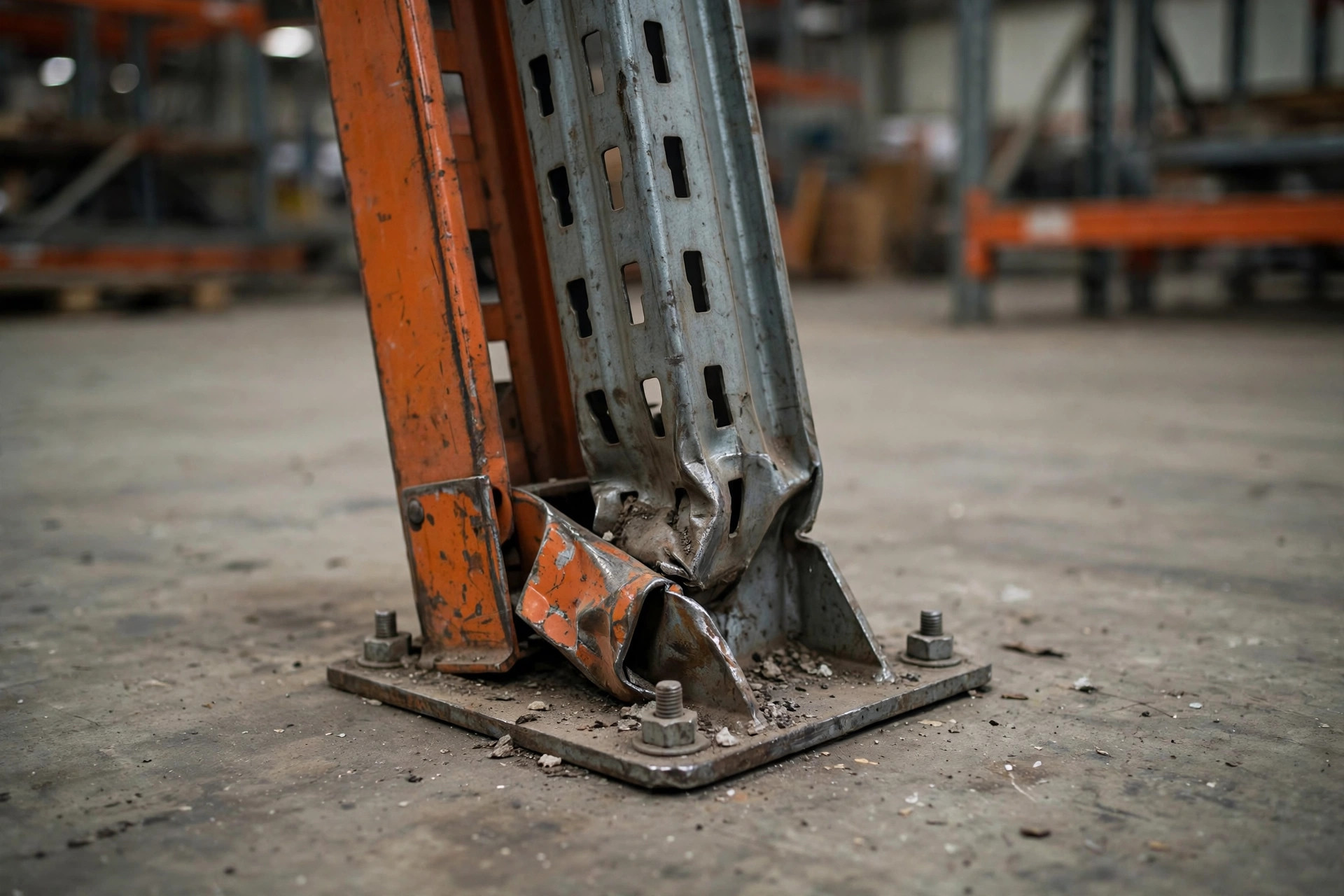
One more rule belongs to no calendar: after any forklift strike, seismic event, or rack reconfiguration, inspect immediately. RMI emphasizes this specifically — impact damage is often hidden, and waiting for the next scheduled round can be too late.
What an OSHA inspector actually asks for: the records checklist
Once you understand this logic, the inspector's document requests stop being mysterious. They typically ask for five things:
- Inspection records: was the program executed as planned, who signed, what was found.
- Damage remediation logs: was found damage graded, fixed on time, were red zones unloaded and isolated immediately (a 2020 citation against Zenith Logistics rested on exactly this — damaged racks in aisle 15F were not isolated until repaired).
- Load plaques: does every rack system display its maximum permissible load, as RMI expects.
- Reconfiguration records: have beam heights, levels, or positions changed, and was there an engineering review (see the Commonwealth case).
- Forklift training records: 1910.178(l) requires operator training, and impact damage usually starts there.
One detail deserves attention: records are valuable not because they prove you inspected, but because they prove you found problems and fixed them. A checklist full of "all clear" entries impresses an inspector less than a log showing three findings and three fixes.
The counterintuitive part: why no fixed inspection frequency is a trap, not freedom
Back to the original question. OSHA's silence on frequency looks like freedom for the employer; in substance, it reverses the burden of proof. Under a prescriptive rule, doing the required thing on schedule is generally enough. Under the general duty clause, there is no line at which compliance is guaranteed — the inspector can always ask: "You believe this frequency is adequate. What is your basis?" The stakes: in 2026, OSHA's maximum penalties remain at 2025 levels — $16,550 per violation for serious violations, $165,514 per violation for willful or repeated ones (source: osha.gov; no inflation adjustment for 2026 after the federal funding lapse disrupted BLS data).
That leads to the counterintuitive conclusion: the most common compliance posture — one third-party annual inspection per year — is precisely the most fragile. It bets the entire defense on a single yearly snapshot, while rack damage accumulates continuously. In the Family Dollar case, six bent braces did not appear in one day; they were bent one by one across the 364 days between annual inspections, with nothing recorded in between. A program with monthly detailed checks, immediate escalation, and a remediation log stands on firmer ground with OSHA — even without a glossy annual certificate.
So the real question was never "how often." It is whether your system can answer three questions: how fast is damage found, how fast is it fixed once found, and is there evidence of both. Answer those three, and the frequency table writes itself.
An open question
Rack inspection is approaching an interesting inflection point. The combination of vision AI and cheap sensors is making continuous monitoring technically feasible — upright lean and beam deflection could, in principle, be captured in real time. When inspection shifts from calendar-driven to event-driven, does today's frequency table become obsolete? And further: when technology makes "detection" nearly instantaneous, will OSHA's general duty clause effectively require companies to adopt it — because "feasible abatement" itself has been redefined by technology? The answers may rewrite the rules of rack compliance within the next five years.
By Dr. Chen, Supply Chain Researcher