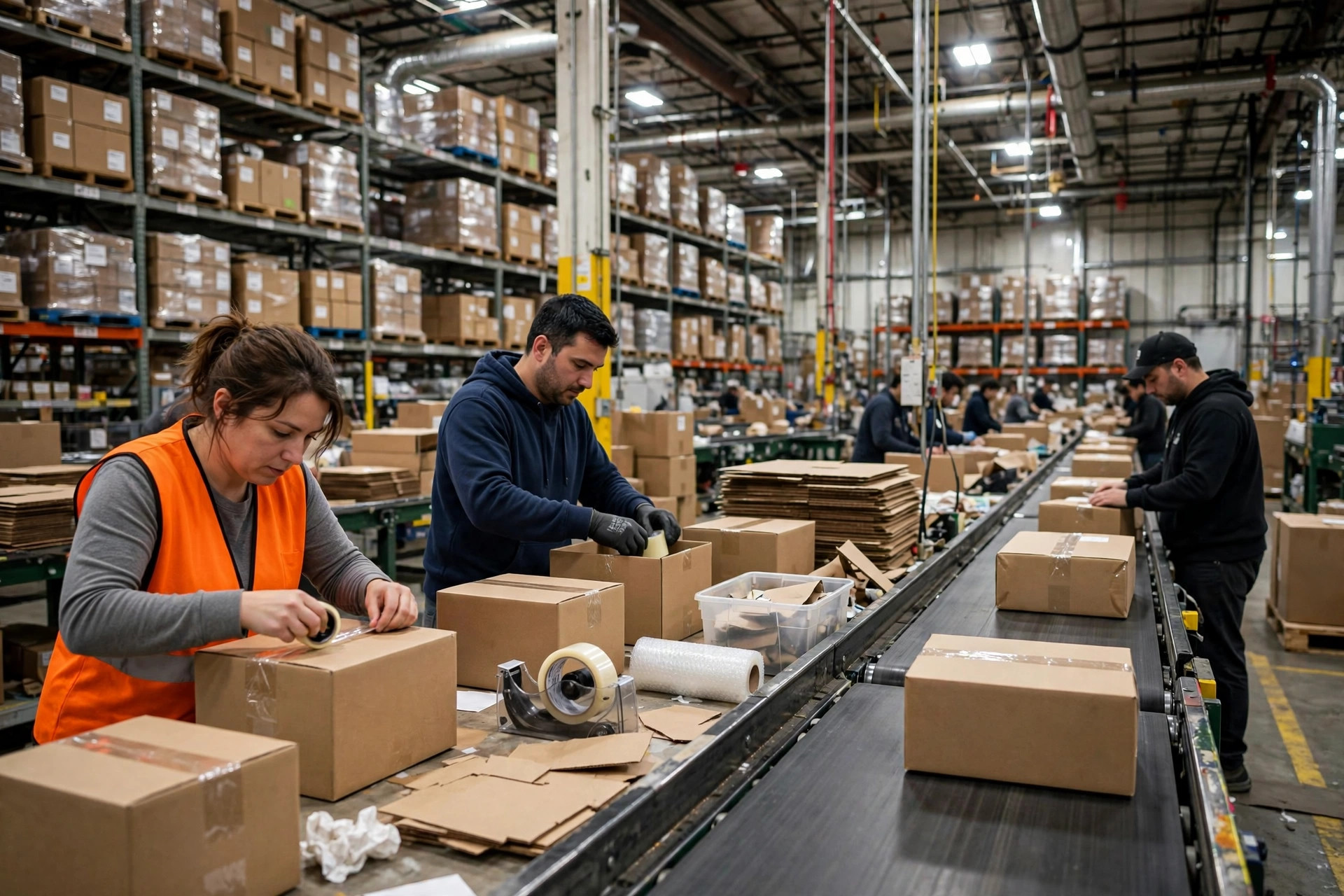
A 5-lb package ships from a Los Angeles warehouse to a customer in New York. Print the label under your own UPS account, then print the same shipment under your overseas warehouse's negotiated parcel account — and the two labels routinely come out a couple of dollars apart. Pocket change per order? At 3,000 orders a month, that "pocket change" is seven, eight thousand dollars.
I saw it firsthand during the 2024 peak season, sitting in a 150,000-square-foot overseas warehouse in Ontario, California, reconciling a client's freight statements. Same service level, same zone — two labels, dollars apart. Since then, whenever a client asks whether they should ship small parcels on their own carrier account or their warehouse's, I make them run the math first.
Same Box, Two Very Different Labels
The gap is no mystery: the two accounts sit on completely different volumes. Your own UPS account gets whatever discount UPS negotiated with you based on your volume. The warehouse's account rides on the combined volume of every client in the building — then the warehouse adds its own service margin and resells the rate to you.
Which leads to the first counterintuitive point: a high-volume seller's own negotiated rate can actually beat the warehouse's rate, while a small seller's own account is usually just the published rate or a token discount — so riding the warehouse's aggregated discount is the better deal. Actual discount levels vary wildly by account and change often, so treat any specific percentage you find online as stale. Go by the carriers' current published policies.
One thing first-timers miss: the warehouse's "parcel account" is rarely just UPS. Most overseas warehouses hold negotiated accounts with UPS, FedEx, and one or two regional carriers, and the packing-station software auto-selects the cheapest option per order. Your own account usually locks you to a single carrier. You start one carrier short.

Discounts, Terms, and Claims — Where the Gap Really Comes From
Discounts get all the attention, but three other dimensions decide the real cost.
Payment terms. On your own account, the carrier bills you directly — typically weekly, straight out of your company account. On the warehouse's account, the warehouse fronts the freight and bills you monthly alongside storage and handling. For a cash-strapped seller, that's real, interest-free float. But the float isn't free: its cost is baked into the rate you're quoted. You just never see the line item.
Claims. Lost, damaged, delayed — who files, who follows up, and how fast the money lands are two completely different experiences. On your own account, you run the claims process yourself: documentation, evidence, follow-ups, measured in weeks. On the warehouse's account, the warehouse files in bulk — and a client tendering tens of thousands of parcels a day carries real weight with a carrier, so success rates and turnaround are usually better. The catch: the payout lands in the warehouse's account first and gets passed to you. Reconcile it line by line.
Flexibility — and who holds your data. This is the own account's biggest edge. Every label, tracking event, and proof of delivery lives in your own system — ShipStation, Shippo, your ERP — so switching warehouses, auditing a dispute, or answering an angry customer is one query away. On the warehouse's account, your shipping history lives with them. Moving to a new warehouse means re-integration and data migration. I've watched sellers stay with a mediocre warehouse for two extra years because the switching cost felt too high. That's not loyalty; that's lock-in.
How to Run the Math Yourself
The method is simple: run three months of your real shipment data through both channels. Pick representative orders — near, mid, and far zones, covering your main weight bands — price them both ways, look at the per-order gap, and multiply by your monthly volume.
But the label gap alone misses three hidden line items. First: does the warehouse mark up the rate? Some warehouses add a few points on top of their own discount. Ask directly and bake the markup into the comparison. Second: the value of the payment terms. A monthly settlement from the warehouse is roughly 30 days of interest-free credit — price it at your own cost of capital. It's not trivial. Third: the claims differential. Take your last twelve months of loss and damage rates and multiply by the difference in claim success rates between the two channels. That number surprises almost every seller I show it to.
And one thing most people forget: your own account's negotiating power moves with your volume. The discount you negotiated at 3,000 orders a month deserves a revisit at 8,000. Carrier reps have annual targets; growing volume you don't renegotiate is money left on the table. The warehouse account works in reverse — your growth fattens the warehouse's total volume pool, so ask them to sharpen your rate too. The sellers who ask often get.
My Verdict: Which Account, When
No hedging — here's the rule.
Steady volume in the thousands of orders per month and growing, with someone on your team who can negotiate with carriers, manage billing, and chase claims — use your own account. Volume is leverage, and at that scale the warehouse's convenience isn't worth its markup.
Just starting out, a few hundred orders a month, volumes swinging wildly, or a two-person team with no bandwidth for logistics detail — use the warehouse's account without shame. You get the big-client discount, flexible terms, and someone else running claims. The hours you save go into product and traffic, where the return is higher.
In between? Run both. Put your stable, high-volume lanes on your own account; run new-product trials, remote zones, and rush replenishments through the warehouse's account. Two channels keep each other honest — the warehouse won't dare pad the markup, and the carrier knows you have an alternative.
One last thing, and it belongs in the contract before you sign: some warehouses require you to ship on their account — no own-account labels, period, citing operational consistency. If you can live with it, fine. If not, walk away early, because this clause causes every downstream fight. Get four things in writing — account policy, markup percentage, billing terms, and the claims process. Never handshake on these.