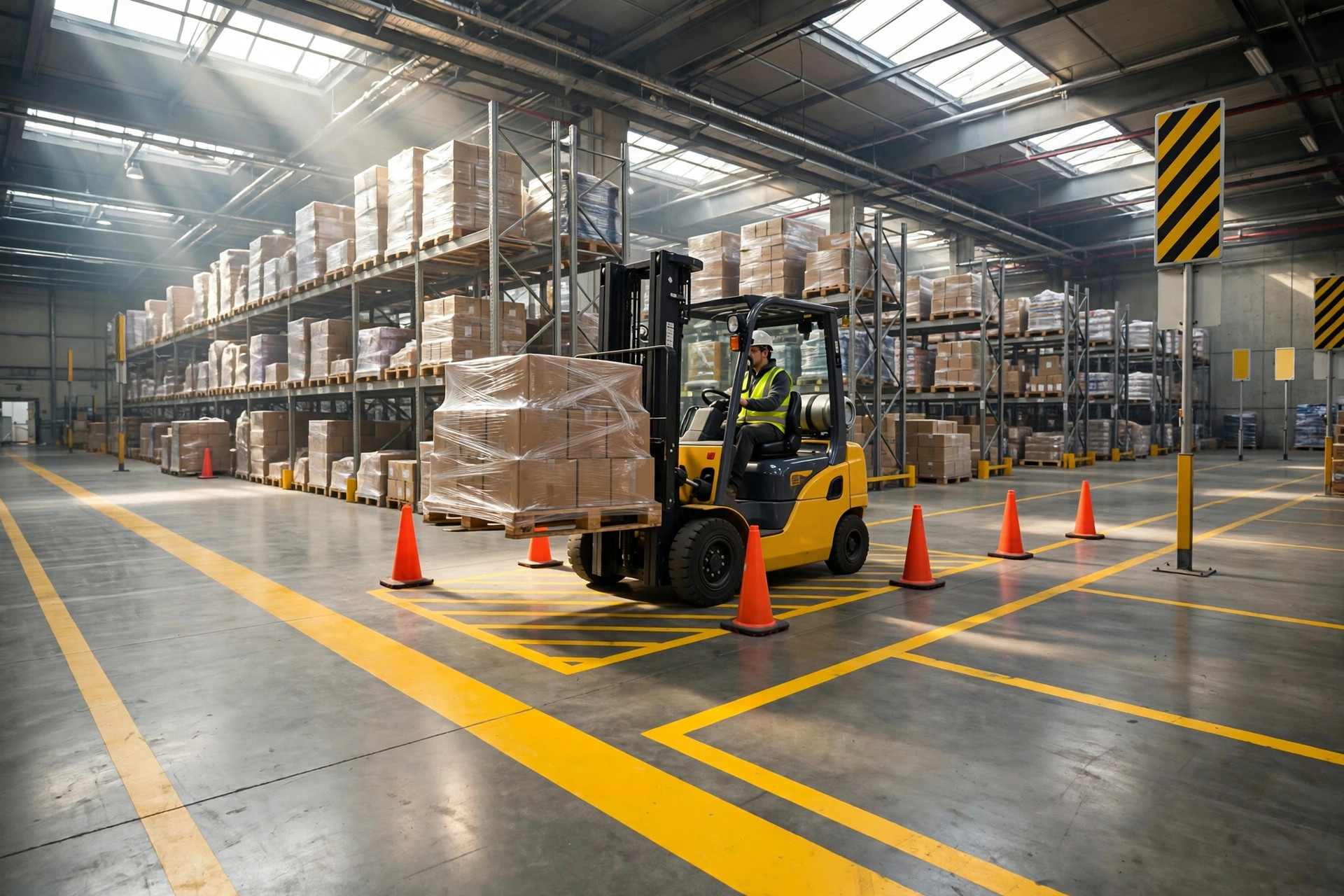
Here's the unwritten rule of OSHA inspections, and it took me twenty years in supply chain to learn it cold: the compliance officer decides whether you're getting cited in the first thirty minutes. The citation isn't written in the accident report. It's written in the first impression.
Let me give you the verdict up front. Warehouses get cited for the same five things, every time — forklifts, aisles, fire extinguishers, hazard communication, and racking/sprinklers. In fiscal year 2026, powered industrial trucks (29 CFR 1910.178) drew 1,379 citations, the 7th most-cited standard in the country. Translation: the inspector walks into your warehouse with a list already in hand.
I Sat Through One of These in Fontana. The Process Cost More Than the Fine.
Summer 2024. A 3PL doing e-commerce fulfillment in Fontana calls me at night — an OSHA inspector had walked in at 2 p.m. The trigger was a complaint from a former employee. And that's the part people miss: most surprise inspections start with a complaint, not a random visit. Warehousing (NAICS 493110) also sits on OSHA's targeted enforcement list, so don't count on flying under the radar.
The inspector stayed all afternoon. He asked for three things: forklift operator training files, the last year of injury logs (the OSHA 300), and the monthly fire extinguisher inspection records. Then he walked the floor twice and took over forty photos.
Five citations came out of it: four operators with expired training evaluations, no refresher done (1910.178(l)); a pedestrian aisle in receiving blocked solid by pallets (1910.37(b)); nine of twelve extinguishers with no monthly inspection records (1910.157(e)(2)); no SDS on file for the cleaning chemicals (1910.1200); and top-of-rack product stacked within a foot of the sprinkler heads (1910.159(c)(10) requires a minimum of 18 inches of clearance below sprinklers).
Four of the five were paperwork. The owner told me afterward that the fine wasn't the painful part — it was the two months that followed: abatement reports, a follow-up visit, the lawyer, and two half-days of stopped operations while everyone played tour guide. You can negotiate a citation — you have 15 working days to request an informal conference, and he got the total cut by more than forty percent. But nobody gives you back those two half-days of lost production.
Every fix has two sides. On one side, OSHA fines are real money: after January 15, 2026, a serious violation runs up to $16,550 per violation, and a willful or repeated one up to $165,514 — unchanged from last year, no inflation bump this time. On the other side, fixing each of those five citations cost a fraction of the fine. That's the math worth doing.
The Five, One by One
| The citation | The standard | The fix | Rough fix cost | Max fine per serious violation |
|---|---|---|---|---|
| Missing forklift training files | 1910.178(l) | A file per operator (training date, evaluator, refresher due date); refresher evaluation at least every 3 years | $150–$300 per operator | $16,550 |
| Blocked aisles / exit routes | 1910.37(b) | Floor striping, a staging time limit in receiving (e.g., nothing sits on the floor more than 4 hours), clear aisles before end of shift | A few hundred dollars | $16,550 |
| No monthly extinguisher checks | 1910.157(e)(2) | An inspection tag on every unit, signed once a month, photo on file | Basically zero | $16,550 |
| Missing hazard communication | 1910.1200(e) | A written program, an SDS binder, new-hire training; don't forget the cleaning crew and the battery charging area | Half a day of labor | $16,550 |
| Sprinkler clearance / damaged racking | 1910.159(c)(10); General Duty Clause 5(a)(1) | A max-height line on the top level, impact guards on uprights (see below) | Tens to hundreds of dollars | $16,550 |
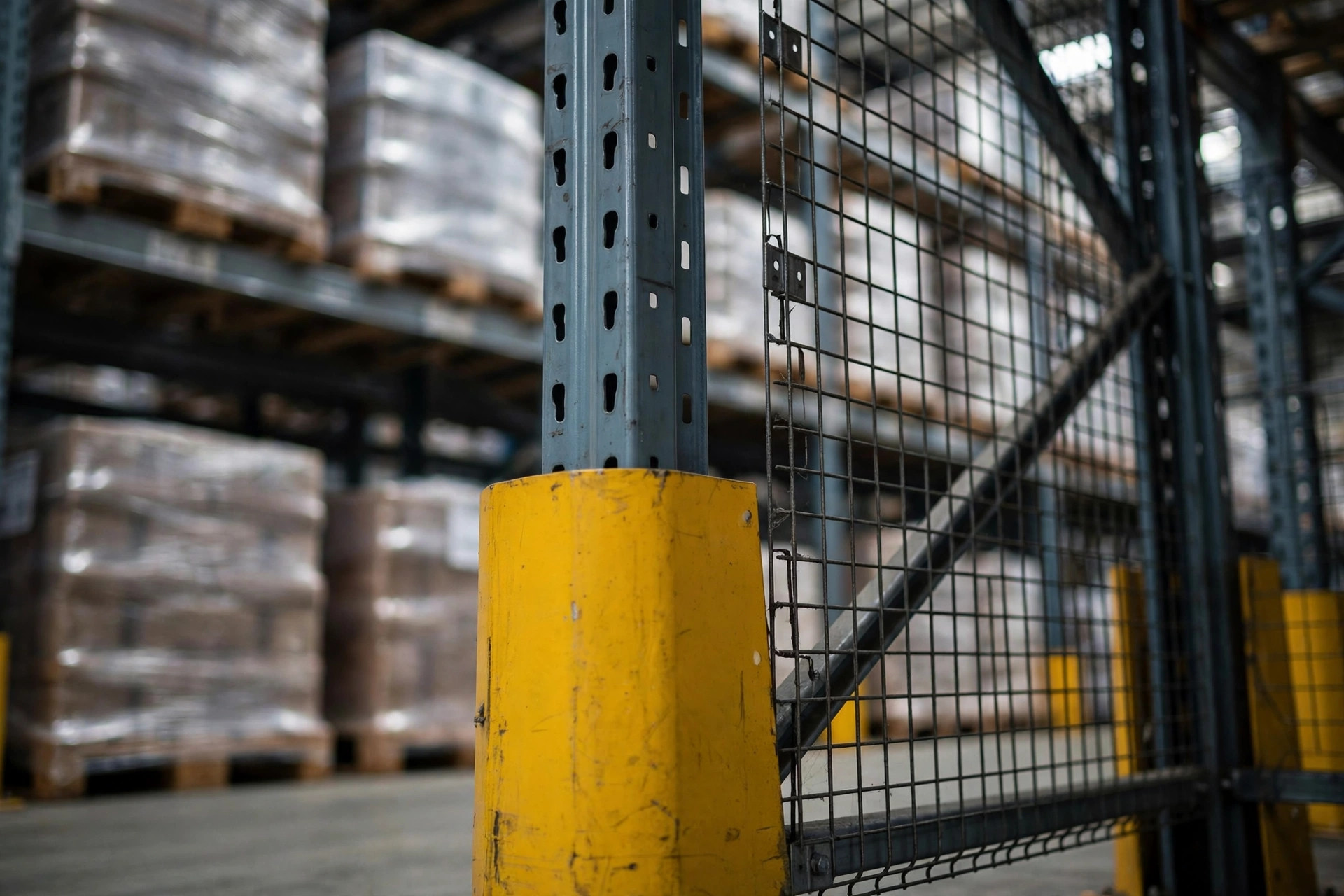
Two things worth adding. On forklifts: OSHA has published figures of roughly 85 forklift-related deaths and 34,900 serious injuries per year in the U.S., with about 70 percent of those accidents preventable through proper training. The inspector isn't picking on you — he's following the bodies. On racking: OSHA has no rack-specific standard. Inspectors cite damaged or unanchored racking under the General Duty Clause, Section 5(a)(1), pointing at the industry standard ANSI MH16.1 and the manufacturer's load ratings. A bent upright counts.
One detail decides the size of the check: get cited for the same thing twice and it becomes "repeated" — up to $165,514 per violation. The first one is tuition. The second one is a stupidity tax.
The Other Trap: Racking Is Not Furniture
Late 2023, a cold-storage 3PL in Ontario. A forklift clipped an upright and bent it. Nobody reported it. Two months later that whole row was visibly leaning. OSHA never came — the insurance company's risk engineer found it. Same logic, though: once an upright deforms past the manufacturer's tolerance, the load rating of the entire row is void. Several tons of product hanging over nothing.
The fix is embarrassingly simple: a monthly rack walk. Bent, rusted, or missing bolts — photo it, log it. Any upright that's been hit gets its row unloaded before it's evaluated. Here's the trade-off: an impact guard costs tens of dollars, a row of racking costs thousands, a collapse costs — you do the math. Too many owners treat racking like furniture: buy it, forget it. Inspectors and insurers both treat it like a structure. Guess whose view wins.
The Uncomfortable Truth: Stop Spending Money Where the Inspector Can't See It
I've seen too many owners spend their safety budget on the shiny stuff: a multi-thousand-dollar safety management system, phone-app check-ins, AI cameras, beautiful demos. Meanwhile the forklift refresher files are empty and nobody has signed an extinguisher tag in three months.
Flip it around: the system isn't useless — the order is wrong. The inspector's eyes look at two things: the paper (files, records, signatures) and the first impression (aisles, stacking, signage). The paper costs nothing. The floor costs a few hundred dollars. Spend thousands on the system first while the paper is still empty, and the citations land anyway.
So my playbook has always been a little contrarian: compliance spending isn't a cost, it's insurance — but get the coverage amount right. Spend the small money first on the first impression and the paperwork, and those two cover more than eighty percent of your citation risk. The remaining twenty percent is where systems and technology belong. Reverse the order and the money is wasted while the fines arrive on schedule.
Next time you walk into your own warehouse, don't look at the KPIs first. Stand at the door and ask yourself one question: if the inspector were standing exactly where I am right now, what would they see first?
By Lao Mi, Supply Chain Veteran (20 yrs)