
Promo Freebies Must Be Real SKUs in Your OMS: Bundles, Threshold Gifts, and Inventory Deduction
Here's the conclusion up front: every promotional freebie must exist in your OMS as an independent SKU — with a code, inventory, and cost — flowing through the order as a proper order line. Never as a note on the order. Never as "the warehouse will figure it out."
I've seen this exact failure three times. Every time, it looked like "no big deal" before peak season, and every time, someone cried over the reconciliation afterward.
Why is it this serious? Three sentences: the warehouse can't see notes, so freebies get missed; inventory deduction has no object to deduct from, so you oversell; finance has no cost bucket, so the books don't tie. One little word — "free" — and fulfillment, inventory, and finance all take the hit. Below is the step-by-step. Every step is executable as written.
Step 1: Give the Freebie a Proper Identity
Create a virtual SKU in the OMS item master. Four fields, all mandatory:
-
Coding rule: GIFT- prefix plus campaign code, e.g. GIFT-2024BF-001. Anyone can tell at a glance which campaign it belongs to, and next year's campaign won't collide with it.
-
Cost: record the purchase or standard cost, even if it's pennies. Finance needs to accrue promotion expense at month end. No cost, no accrual — and your gross margin is fiction.
-
Attributes: flag it "not for individual sale" and "non-returnable." I watched a client forget the sale lock; shoppers bought the freebie as a $9.90 "product" — 2,000 units — during peak. Free turned into fire-sale. There were tears.
-
Lifecycle: deactivate and archive the moment the campaign ends. More freebie SKUs is not better. One client accumulated 80+ historical gift SKUs nobody cleaned up, and the promotion rule engine took 20 seconds per evaluation. IT spent a week finding the cause.
-
Quantity planning: once the SKU exists, stock it at projected orders × gift trigger rate × 1.2 safety factor. Where does the trigger rate come from? Last year's actual rate for similar campaigns. No history? Start conservative at 30% and adjust after the day-one review. In 2023 a client stocked gifts at 100% coverage and ended peak with two pallets of leftovers sitting in a corner until they expired. Freebies are money too.
Step 2: Bundles and Threshold Gifts Are Two Different Configurations
People configure "buy one get one" and "free gift over $299" as if they were the same thing. They're not. In the OMS, these are completely different logic:
| Bundle (buy A, get B) | Threshold gift (spend X, get Y) | |
|---|---|---|
| Where it's configured | Item master: BOM / kit relationship | Promotion rule engine: threshold condition + gift mapping |
| When it triggers | At order entry, no calculation | Only when the order meets the amount/quantity threshold |
| What the WMS receives | Order line already includes the gift line | OMS appends the gift line during order split |
| Classic failure | Wrong BOM — bought A, got C | Threshold basis never agreed: net vs. list price, agents fight customers |
One warning on thresholds: net-paid amount or list price? Does a return reduce the threshold? These three sentences must be nailed down in the campaign brief. I've seen this pit three times — marketing says "over $299," the OMS calculates on net paid, customer service promises on list price, and on peak day the complaint queue explodes while the warehouse is caught in the middle.
After configuration, confirm two things on the WMS side. First, the gift line must appear as its own visible line on the pick task, with its own pick location. A gift must never share a pick action with the main product, or the pack station can never reconcile. Second, the pack station needs a verification step: when the order is scanned, the system pops the gift line separately, and the packer scans the gift barcode before the order clears.
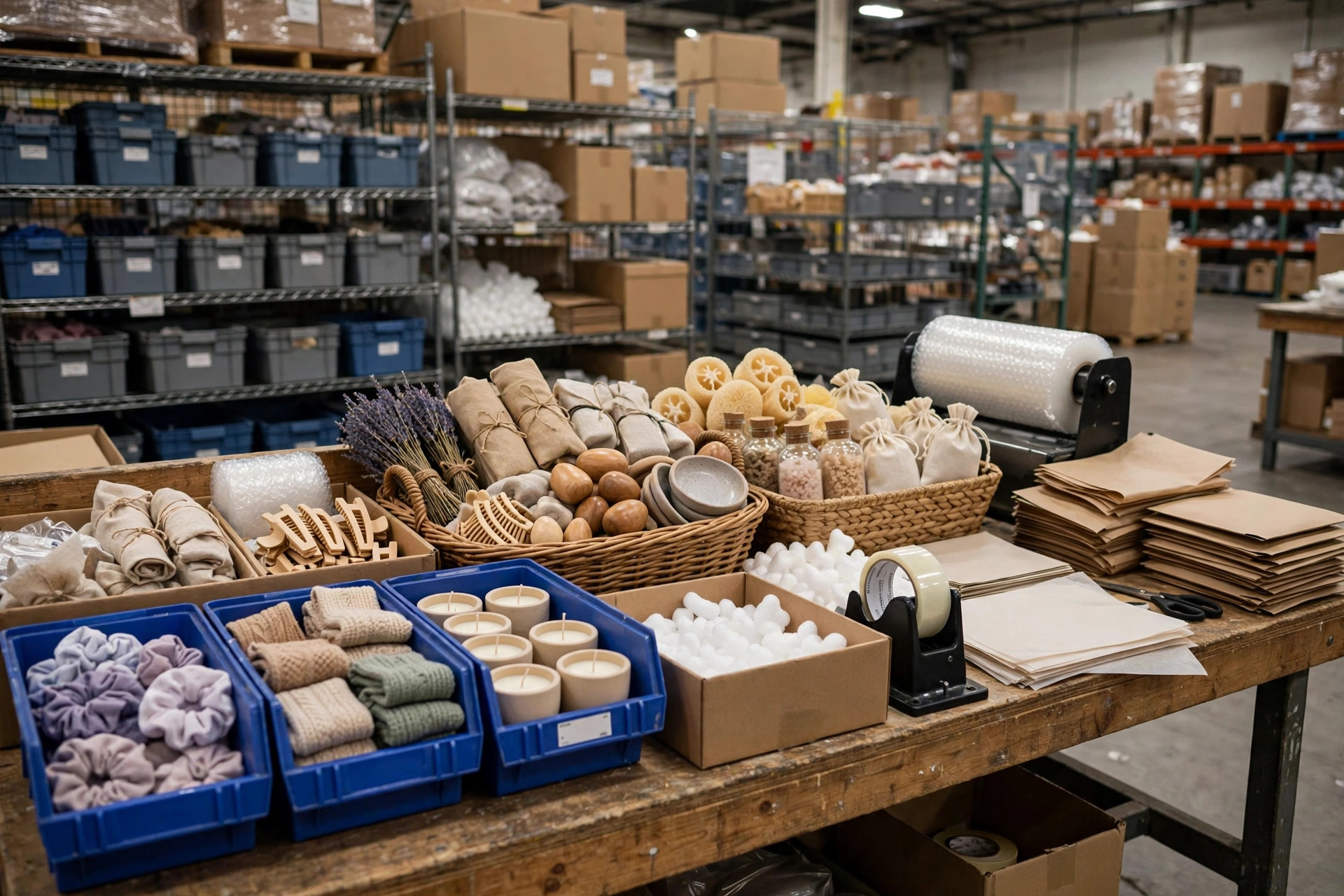
That extra scan costs about 3 seconds per order, but it drives the miss rate to near zero. During peak, pack stations live and die by the second — those 3 seconds are worth it, because reworking one order costs ten times more.
Step 3: When Does Inventory Deduct — Reserve at Order or Deduct at Ship?
This is the most argued-over point in gift logic. Here's the trade-off table, straight:
| Reserve at order placement | Deduct at shipment | |
|---|---|---|
| Oversell protection | Strong — inventory locked in real time | Weak — dangerous during peak |
| Inventory flexibility | Locks stock; cancellations need release logic | High — nothing tied up |
| System complexity | Must handle release on cancel/partial ship | Simple |
| My recommendation | Use this for all gifts | Only for unlimited, pure-traffic gifts |
A true story. In 2024, a beauty client added "free full-size sample over $299" three days before peak. To save time they chose deduct-at-shipment — and never created a gift SKU at all, just wrote it in the order notes. Day one, the gift overshot by 3,000+ units: orders flowed in, nobody watched gift inventory, and by ship time there wasn't enough. The warehouse missed 1,700 orders, customer service got crushed, and emergency re-shipping burned a small fortune in courier fees.
The rescue: build the virtual SKU overnight, switch to reserve-at-order, have the OMS batch-append gift lines to all placed-but-unshipped orders, and run emergency pick waves in the WMS. We were at it until 4 a.m. So remember: gifts always reserve at order placement. I've seen this pit three times. I don't want a fourth.
Night-Before-Go-Live Checklist: Four Failure Points
One more project story first, because nine out of ten clients leave returns out of their first gift-logic design.
That same 2024 beauty client: gift logic ran smoothly, then finance found gift costs overshooting at the post-peak review. A week of digging, and the root cause was almost funny: shoppers bought the main product, got the gift, then returned the main product within the 7-day window — and kept the gift. No rule required returning it; the warehouse only inspected the main product on returns. Over a month, 900+ gifts walked out the door for free.
So the returns rule must be nailed down in the campaign brief. My fixed template offers three options: ① main-product returns must include the gift, missing gift deducts its cost; ② gift stays, but the refund equals net paid minus gift cost; ③ gift is too cheap to chase — just let it go. Any option works, but all three parties (marketing, customer service, finance) sign off, and it goes into the OMS return-reason codes. Gray areas are where money leaks. Zero tolerance for vagueness.
The night before peak, check these four off one by one. Don't sleep until all four are green:
- Is the gift SKU's "not for sale" lock on? (Remember the 2,000-unit lesson in Step 1.)
- Are gifts stored in separate locations from main products? Mixed storage means cycle counts never tie out — every variance lands on the gift, and it only gets messier.
- Is the threshold basis aligned across all three parties? Marketing, customer service, and the OMS config must all mean the same "$299."
- Are last campaign's gift SKUs deactivated? If not, the rule engine may resurrect them and start giving them away again.
One counterintuitive note to close: plenty of bosses think "it's just a freebie, why manage it so tightly?" The opposite is true. A mispicked main product can be returned or exchanged. A freebie with no identity in the OMS? You'll never know how many you missed or overshot. At the post-peak review, gift costs get allocated, margin drops two points, and the boss finally asks — by which time it's too late.
One more angle most implementation consultants miss — the finance view: gift cost belongs in the "promotion expense" account, not blended into cost of goods sold. That cost price from Step 1 is for finance. After peak, finance multiplies gift SKU shipped quantities by unit cost and books it to promotion expense in one entry. With the account right, the boss can finally see what the campaign really cost in traffic acquisition. Half of many companies' "customer acquisition cost" is hiding inside freebies, never counted on the books.
Tomorrow, go check whether your OMS has any "note-style freebies." If it does, fix it before peak. Don't wait until the warehouse is calling your phone at midnight — and you remember this article.
By Lin Xiao, WMS Implementation Consultant