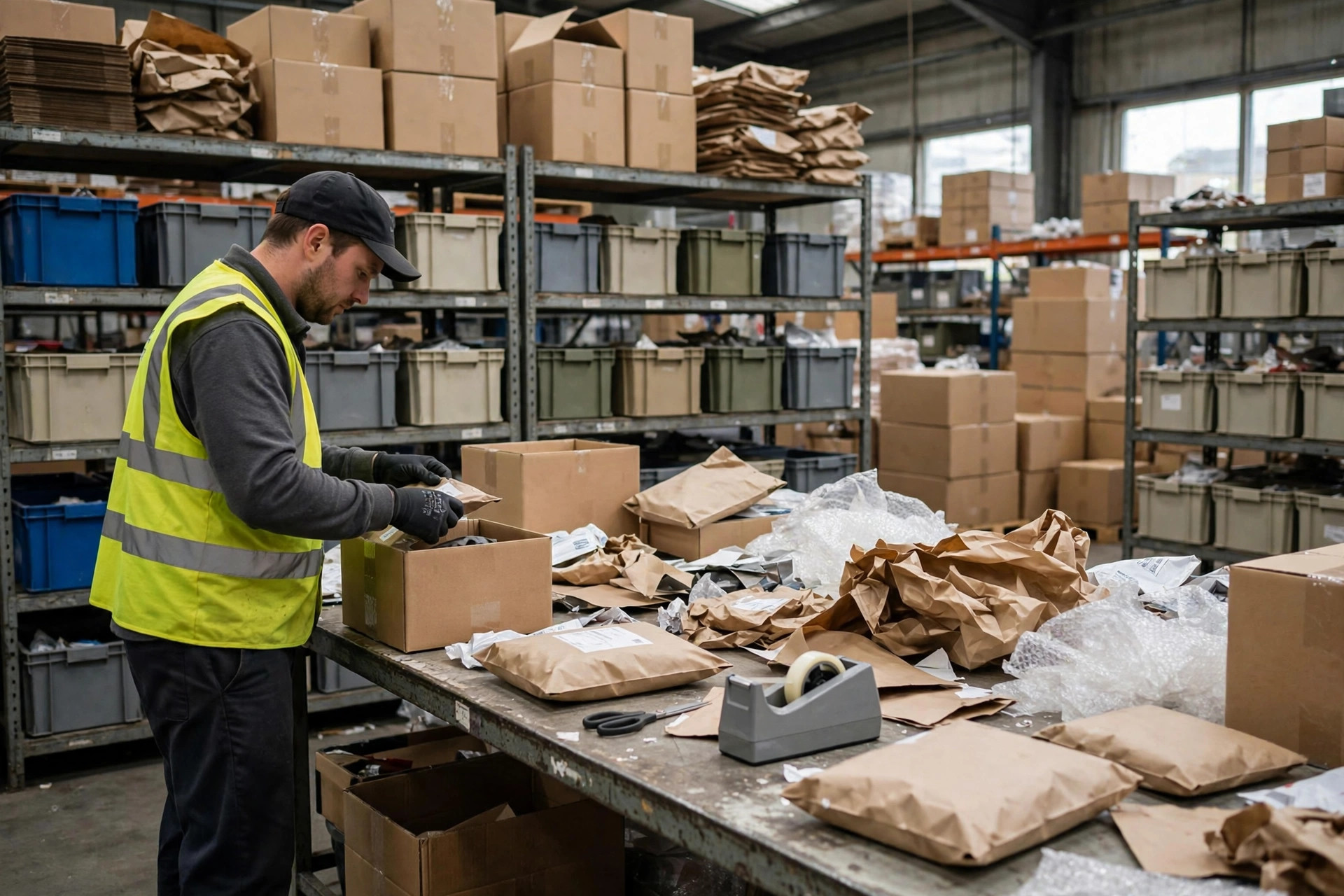
Bottom line first: in an OMS exchange order process, the exchange has to be its own document type, running alongside returns and replacements with hard locks between them. Not a return order with a note saying "exchange for red." I have seen this exact failure three times. Every time it blew up about two months after go-live: replacements shipped before originals came back, differences never settled, no reconciliation.
Why the OMS Exchange Order Process Cannot Live Under the Return Order
Teams designing an OMS exchange order process take the shortcut: exchange becomes a return subtype, reason "exchange," comment "exchange for red, size M." Week one looks fine. Week two falls apart.
A return ends with money going back, an exchange with a different product arriving, a replacement with the same product shipping again. Three endings, three state machines.
In 2023, a Dongguan home goods brand doing 800 orders a day ran exchanges at about 6 percent, roughly 48 a day. Exchange rode on the return order, auto-closed when the refund went out. Refunds went out, no replacement shipped, 31 of 48 customers called in furious. We spent a night shift splitting exchange out and backfilling 31.
Counterintuitive judgment first: the most dangerous step is not reverse logistics, it is shipping the replacement early. Teams rush the new unit out while the original is still in transit. The customer keeps the new unit and never sends the old one back — that order just became a giveaway. Decide at design time: speed with an accepted loss rate, or safety with ship-after-inspection, tiered by product value.
The Four Business Forms Inside an OMS Exchange Order Process
Exchange is not one business case, it is four. The OMS needs an exchange_type field.
- Same-SKU replacement: wrong size or color, same item, same price. Inbound passes inspection, then replacement ships.
- Different-SKU exchange: the wanted item is out of stock, so the customer picks another. The replacement needs a fresh pick task.
- Exchange with additional payment: customer upgrades and pays the difference. Collect first, then ship. Unpaid means the replacement stays locked.
- Exchange with partial refund: customer downgrades and gets money back. Refund only after inbound inspection passes, never at approval time.
Every exchange order hangs under the original order, original_order_id mandatory. No link, no reconciliation. I repeat this three times in every design review.
OMS Exchange Order Process, Step by Step: From One Customer Sentence to Six System Actions
The customer says "I want a different color." The agent clicks "start exchange." Six actions follow, each mapping to a field change. Miss one, the flow has a hole.
Step 1: Create the exchange order, lock the original. exchange_order created in "pending review." Original flips to "exchange in progress," locked against a second exchange or refund. One open exchange per original order.
Step 2: Review and calculate the price difference. Compute price_difference. Upgrades produce a payment task. Downgrades produce a pending refund record, not executed yet.
Step 3: Generate the reverse logistics order. The exchange spawns a linked return_shipment. Customer gets a pickup code or return address. Tracking writes back live.
Step 4: Inbound inspection. The WMS inspects the inbound unit; the result writes back to the OMS. Pass, and the exchange moves to "ready to ship replacement." Fail (damaged, wrong product, missing accessories), and it goes to manual handling.
Step 5: Ship the replacement. replacement_shipment is created, then pick, pack, ship. For upgrades, payment is a hard precondition, enforced by the system.
Step 6: Close and reconcile. After the replacement is signed for, the exchange moves to "completed," the original order updates, and difference records are archived. Month-end, finance pulls every linked document by original_order_id.
Customer words map to system actions like this:
- "I want a different color" → same-SKU exchange, new order linked by original_order_id.
- "That one is out of stock" → cross-SKU exchange, exchange_type = cross-SKU, fresh pick task.
- "I will pay the difference" → upgrade exchange, price_difference > 0, replacement locked until paid.
- "Refund me the rest" → partial-refund exchange, price_difference < 0, refund held until inspection.
- "I already shipped the old one back" → register reverse tracking, return_shipment linked.
- "I got the new one, I am not sending the old one" → exception flow, manual handling and recovery.
Three Document State Machines, Side by Side
The most important table here. Whether the three flows collide comes down to whether it exists in the OMS.
| Dimension | Exchange order | Return order | Replacement order |
|---|---|---|---|
| Endpoint | Old back, new delivered | Unit back, money back | Same unit shipped again |
| Trigger | Customer wants a swap | Customer does not want it | Missing, wrong, damaged, lost |
| Original order | Mandatory original_order_id | Mandatory original_order_id | Mandatory original_order_id |
| Money | Difference collected/refunded | Full refund | Usually none |
| Inventory | Inbound + outbound | Inbound receipt | Outbound shipment |
| Close | Replacement signed for, settled | Refund done, inbound in | Replacement signed for |
| Coexist? | — | Mutually exclusive, close one first | Mutually exclusive, close one first |
Mutual exclusion is the key: for one original order, only one of the three documents can be open at a time. A customer files an exchange, then calls back: "forget it, just refund me." Service closes the exchange first. Enforced by a hard block. Without it, both documents run on their own, and inventory and money go wrong together.
Inventory Handling: Reservation and Release Timing Is the Whole Game
In an OMS exchange order process, inventory is the part most teams overlook. They watch document statuses, ignore reservation timing, then find the replacement cannot ship.
Three rules. Memorize them:
- Do not reserve replacement stock at application time; reserve after approval. The customer may change their mind, and early reservation locks sellable stock. Reserve
reserved_stockonly after approval. - When the inbound unit passes inspection, release the reservation and convert it to a real outbound shipment. Pass is the release signal. Fail means the reservation stays until manual handling resolves it.
- Route the inbound unit by inspection result. Resellable units return to sellable stock, repair-needed units go to pending stock, scrap goes to loss. Sending inbound units straight to sellable stock without inspection is the most common source of fake inventory.
Worked example: 100 exchange orders a day, average replacement value 200 dollars (example). If replacements ship early and inbound loss runs at 5 percent (example), daily loss is 100 × 5% × 200 = 1,000 dollars. Run this math at kickoff with your own trailing three months of real exchange data.
The Failure Checklist: Go-Live Night Checklist
I have seen this exact failure three times, so before every go-live night the team ticks through this list.
- Replacement shipped before inbound arrived: high-value goods wait for inspection; low-value goods may ship early with a loss-rate threshold that auto-switches to receive-first.
- Price difference unsettled at close: upgrades need payment before shipping; refunds execute only after inspection passes.
- Exchange and original amounts do not match: finance reconciles by original_order_id. Original amount equals collected amount plus refund plus difference. A one-cent gap alerts.
- Lost reverse shipment, unclear ownership: assign by tracking history. Lost after pickup means a carrier claim. No pickup record means the exchange waits for proof of shipment.
- Duplicate exchanges on one original order: the lock must cover every entry point — console, portal, bulk API. Locking only the console is the same as not locking.
- Original status never written back after close: the state machine needs the "exchange in progress" to "completed" write-back link. Without it, every status report is wrong.
In early 2024, a Shenzhen small-appliance client missed the duplicate-exchange item on go-live night. The portal had no original-order lock, one customer filed three exchanges in a day, and all three replacements shipped. Two were recovered, one was lost — a machine worth over 600 dollars (example amount). Since then, that item is red-bolded in my checklist.
Five Questions to Ask an OMS Vendor
Do not judge the exchange flow by the demo. If the vendor cannot answer these five questions, the module is probably a renamed return order:
- Is the exchange order an independent document type with its own state machine?
- Can an unclosed exchange order and return order exist on the same original order at the same time? (Correct answer: no, hard system block.)
- Is price-difference settlement a configurable hard precondition for shipping the replacement?
- Can inbound inspection results write back to the OMS automatically and drive status transitions?
- Can finance pull the full money trail for all three flows by original order number in one click?
Five out of five, the module is usable. Miss two or more, negotiate the implementation fee separately — a second round of development is very likely.
By Lin Xiao, WMS Implementation Consultant