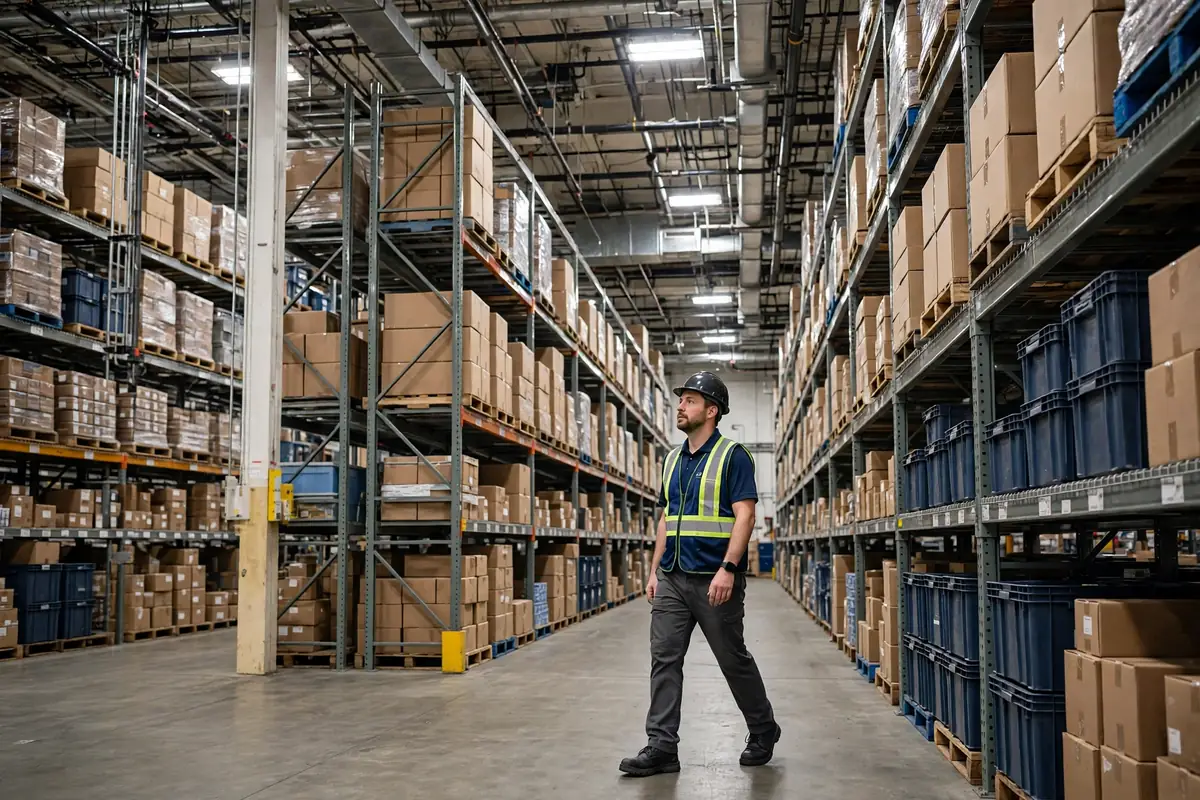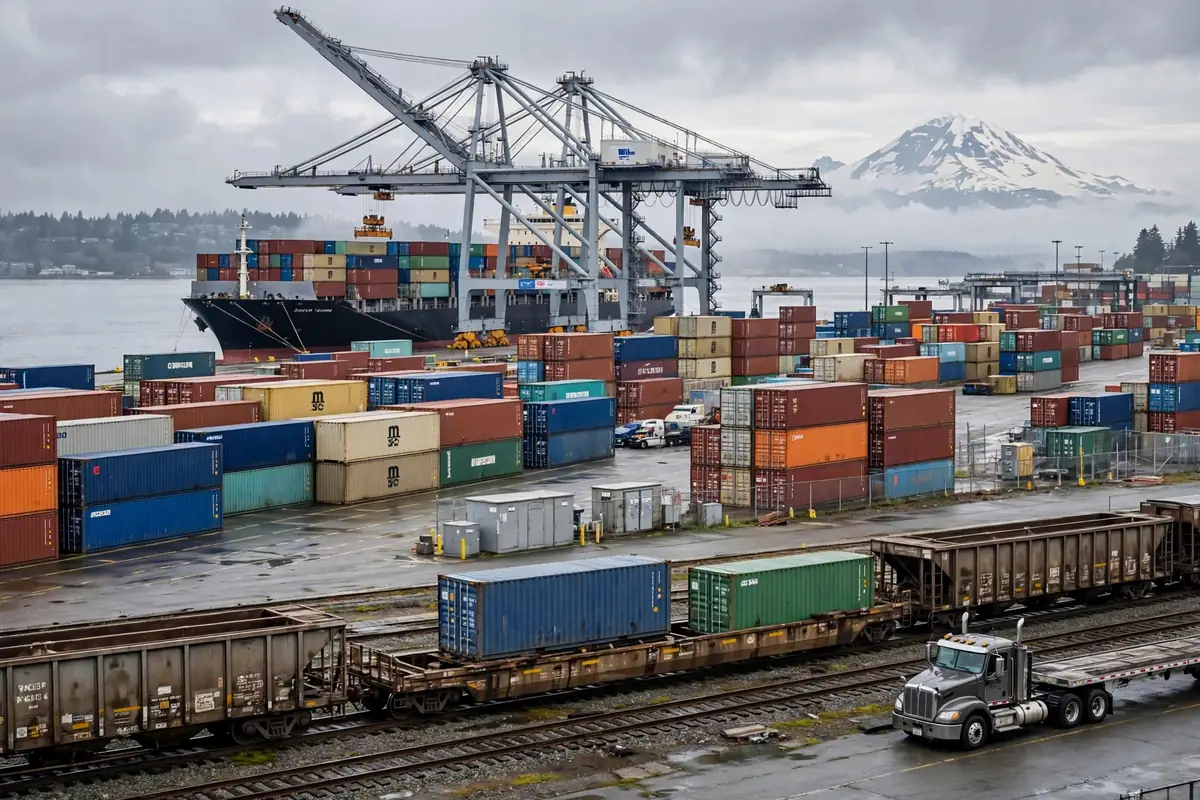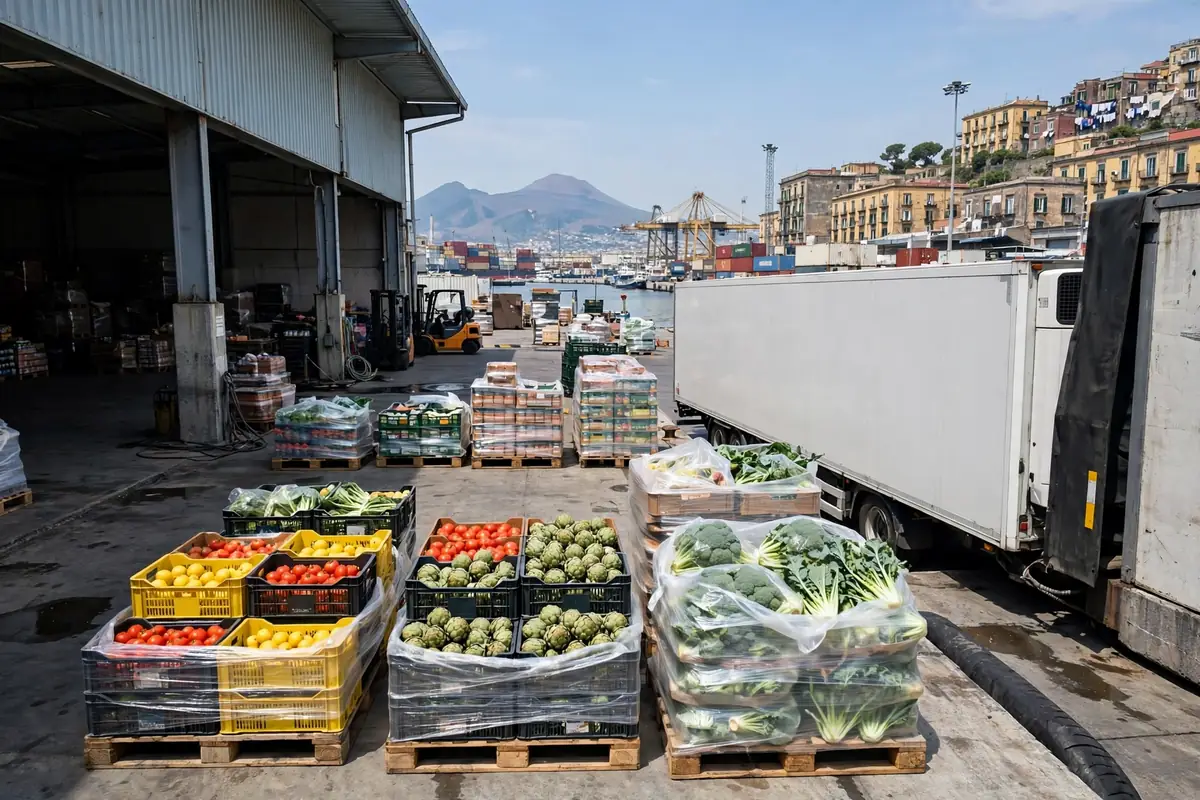
Any serious discussion of naples italy warehouse logistics should not begin with rent. Naples is the capital of Campania and one of the principal port cities of southern Italy, and the value of warehousing there depends less on the price per square metre than on a prior structural question: given the persistent imbalance between northern and southern Italy in manufacturing, import flows and consumption, which goods, which orders and which delivery promises can a southern node credibly take over from a northern warehouse — and which can it not?
According to the long-run pattern in port and regional economic data, Italy's manufacturing and import distribution have historically concentrated in the north, with Milan and Lombardy forming the densest warehouse network and deepest third-party logistics market. The south, however, retains a substantial population, a distinct consumer market and a food and agricultural sector of national significance. A Naples facility was never a candidate to replace a Milan-area warehouse. The real question is division of labour: where the boundary sits, and how it shifts by category.
Phenomenon and structure: naples italy warehouse logistics, underestimated and overestimated at once
Naples is underestimated when decision-makers measure the south with northern instruments. Carrier density, the number of warehouse providers and the supply of automated facilities are indeed thinner in the south, and the analysis often stops there. Naples is overestimated when the opposite error occurs: an observer sees a port and comparatively lower operating costs and assumes that one southern warehouse can serve Sicily, Puglia and Calabria in full, overlooking both the Apennine barrier to east–west road movement and the fact that southern order density frequently cannot sustain high-frequency trunk routes. Both errors share a common origin. Node capability is treated as a static property, rather than as something that only becomes meaningful inside a specific flow structure.
In network terms, the road position of Naples has a clear directionality. Northbound motorway connections run to Rome and onward to central and northern Italy; southbound connections extend into Calabria; eastbound routes cross the Apennines toward Puglia's cities and ports. This geometry makes Naples strong in north–south distribution — replenishing Campania's own consumer market and the coastal and inland towns of the south — while east–west regional coverage must be verified route by route and cannot be inferred from map distance. On the port side, Naples handles container, ro-ro and regional services, and for imports whose final destination is southern, clearing and warehousing locally avoids a recognisable inefficiency: freight travelling north to Milan only to be shipped south again. That backtracking appears in accounts as linehaul cost, and in service terms as a systematic loss of one to several days.
Cargo decides the building: naples italy warehouse logistics and the food cold chain
The warehouse logic of Naples cannot be separated from the cargo base of Campania. The region is an important centre of Italian agriculture and food processing, with tomato products, olive oil, wine, buffalo mozzarella and citrus fruit generating stable flows, a significant share of which carry explicit requirements for temperature control, shelf-life management and batch traceability. Such cargo does not primarily need large ambient floor space. It needs refrigerated and frozen zones, dock scheduling matched to production rhythms, and collection patterns aligned with processing plants rather than with generic distribution timetables.
Illustrative scenario one: a southern food distributor places ambient dry goods and chilled products in a single conventional warehouse, relying on refrigerated vehicles held on site during the summer peak. In the worked example, energy cost and spoilage rise together, and a modest increase in daily order volume produces dock congestion. The failure is not principally one of equipment; it is a design failure at project stage, where the cold-chain requirement was treated as an annex to an ambient warehouse contract rather than as a separate warehousing decision requiring its own site, temperature zones and dock logic.
Illustrative scenario two: an imported consumer goods company holds all Italian stock near Milan and replenishes southern stores over long linehaul distances for years. In the worked example, it forward-stocks high-frequency southern lines in Naples while keeping slow movers and national balancing stock in the north. Average fulfilment distance for southern orders falls materially, but total inventory rises and an inter-warehouse transfer discipline must be built. Placed side by side, the two scenarios show that cold-chain and distribution gains in the south are never free; they are purchased with inventory dispersion and management complexity, which is precisely why the decision requires calculation rather than intuition.
| Decision dimension (framework) | Northern warehouse only (Milan area) | Naples plus northern dual-node | What to test |
|---|---|---|---|
| Southern order fulfilment distance | Long, trunking south | Primarily local dispatch | Southern order share and frequency |
| Total inventory | Centralised, lower | Dispersed, higher | Forward-stock fast movers only |
| Food cold-chain fit | Southern-origin goods travel north | Local collection and distribution possible | Origin of goods matters more than destination |
| Management complexity | Single site, simpler | Transfers and reconciliation required | Avoid dual-node without systems support |
| Import routing | Southern-destined cargo may backtrack | Naples entry can feed the southern site directly | Split bills of lading by destination region |
The table deliberately offers no universal answer. Its function is to move the debate away from unit rent and toward structural variables: the southern share of orders, the temperature requirements of the range, and the geographic origin of goods. Where two of the three point south, a dual-node model deserves detailed costing. Where all three are weak, a northern warehouse supplemented by third-party southern distribution is often the more honest configuration.
Drawing the boundary with the north: what should move south, and what should not
The workable principle is segmentation by turnover and time sensitivity rather than by category alone. High-frequency southern consumer lines, time-sensitive food products, and imports entering through southern ports with clearly southern destinations are candidates for Naples. National slow movers, high-value goods requiring concentrated security and specialised equipment, and balancing stock for highly dispersed national demand are generally better held in the mature northern network. The boundary is also seasonal. Food production cycles and the southern tourist season raise southern volumes in predictable windows, so forward-stocking ratios should rise and fall with the calendar; a fixed year-round split, written once into a contract, is a quiet and common reason dual-node projects underperform their business cases.
This leads to a counter-intuitive judgement. The ceiling on the value of a Naples warehouse is set not by the size of the southern market, but by the transfer discipline between the northern and southern sites. The most common losses in dual-node systems are not rent differentials; they are unstructured inter-warehouse transfers, duplicated safety stock and inventory records that no longer agree. Without a single inventory view and explicit transfer triggers, the more active the southern site becomes, the higher total system inventory climbs. In other words, transfer rules must precede the southern warehouse. Reverse the order, and the new facility itself becomes a source of cost.
A further point requires equal calm. The third-party warehousing and transport market in the south is less deep than in the north, which raises single-provider dependency risk in Naples. Backup capacity, peak-season capacity guarantees and data interface clauses therefore carry more weight in a Naples contract than in an equivalent Milan negotiation. This is not a defect of the southern market; it is an objective consequence of network maturity, and it should be priced into contracts in advance rather than discovered during a peak-season failure.
Trend judgement: how the southern node's position may evolve
Over the medium term, two trends merit observation. First, as importers become more sensitive to the cost and time losses of backtracking, destination-based splitting of import gateways is likely to continue increasing, which gives Naples a structural — rather than merely cyclical — basis for warehousing demand as a southern entry point. Second, tightening European cold-chain and food-traceability rules raise the bar for origin-region warehousing; compliant cold-chain nodes should capture a disproportionate share of southern growth, undifferentiated ambient space should not. Both trends point in the same direction: competition among southern facilities will move away from floor area and headline price, toward temperature capability, transfer coordination and compliance.
For a company considering southern Italy, the questions that matter are slower ones. Has the southern share of its flows crossed the threshold at which a local node can be justified? Do food flows require warehousing close to origin? Can the organisation sustain dual-node transfer discipline? If naples italy warehouse logistics is debated only at site level, the conclusion stays fragile; placed inside Italy's north–south economic geography, the answer becomes clearer — and remains, instructively, different for each firm — why network design resists any single template.
By Dr. Chen, Supply Chain Researcher