We had a client who makes wiring harnesses. Last year he set up a distribution warehouse in Morocco, and before signing the contract he told me something I still remember: "Susan, I have run the numbers on Morocco automotive parts warehouse logistics. The warehouse rent is thirty percent cheaper than Eastern Europe. This deal is a sure win." Six months later he called me in a very different tone — the rent was indeed cheaper, but the carmaker's production line had stopped for half a day because one harness connector was missing, and the claim had landed on his desk.
The carmaker's math was never about the rent line. In automotive parts logistics, rent is the most honest item on the invoice. The bites come from the places you cannot see: one stockout claim, one emergency air freight bill, one shipment held outside the port because a customs document was wrong. This piece lays the Morocco numbers out in the open so you can see them before you sign.
First, the lay of the land. The center of Morocco's automotive industry is Tangier. Renault's plant there employs around 6,000 people, surrounded by 87 tier-one suppliers, and about 82% of the plant's output is exported to 63 destinations. What does that mean? It means Tangier is not a "cheap warehouse" location. It is an industrial cluster shipping to European markets every single day. Your warehouse is not an island. It is one link in that chain, and if one link breaks, the whole line shakes.
Morocco Automotive Parts Warehouse Logistics: The Port and the Warehouse Are One Bill
A lot of people talk about Morocco and only talk about rent, skipping the port entirely. For auto parts, that is the first mistake. The gateway is Tanger Med, which handled 161 million tonnes and 11.1 million TEU in 2025 — the largest port in Africa. Your parts come from Europe and go back to Europe, and almost all of them pass through this port. The port's efficiency is your warehouse's efficiency. A vessel berthing one day late means one more day of safety stock you have to carry.
That is exactly where our wiring harness client went wrong. His warehouse was in a Tangier industrial zone, not far from the port — a reasonable choice on paper. But his process ran like this: cargo arrives at the port, clears customs, gets trucked to the warehouse, received, put away, then picked and shipped against the carmaker's call-off schedule. Each step looked fine on its own. Strung together, it was slow. Once a customs document was missing a stamp and the cargo waited an extra day and a half outside the port. The warehouse roster had no standby crew, so the goods arrived during a night-shift handover and putaway slipped another half day. Then the carmaker changed its call-off, and a small connector did not ship in time. The line stopped for half a day.
Nobody in that story made a big mistake. The mistake was in the design: port, customs, warehouse, and delivery were managed as four separate vendors, and nobody owned the whole stretch from vessel berthing to part-on-the-line. In automotive parts logistics, the contract should lock end-to-end lead time, not the rent per square meter. Saving thirty percent on rent means nothing when one stockout wipes it out and then some.
Here is another number that explains how this market works. OMSAN, a Moroccan automotive logistics provider, holds around 44% of the country's automotive logistics market and moves roughly 240,000 vehicles a year. In other words, the leading players in Morocco have already built the whole chain — finished vehicles, parts, and port connections — as one service. A newcomer trying to compete on price alone will not beat that local knowledge of port rhythms, customs, and shipping schedules. My advice is blunt as always: when you enter Morocco, find a partner who knows the local ground, hand them the port and customs leg, and focus your energy on the warehouse and the call-off schedule.
Where You Put the Warehouse Decides the Math in Morocco Automotive Parts Logistics
I have seen two ways to choose a warehouse location. One is to look at the price per square meter and rent the cheapest. The other is to look at the total cost of getting each part onto the production line. For auto parts, only the second one counts.
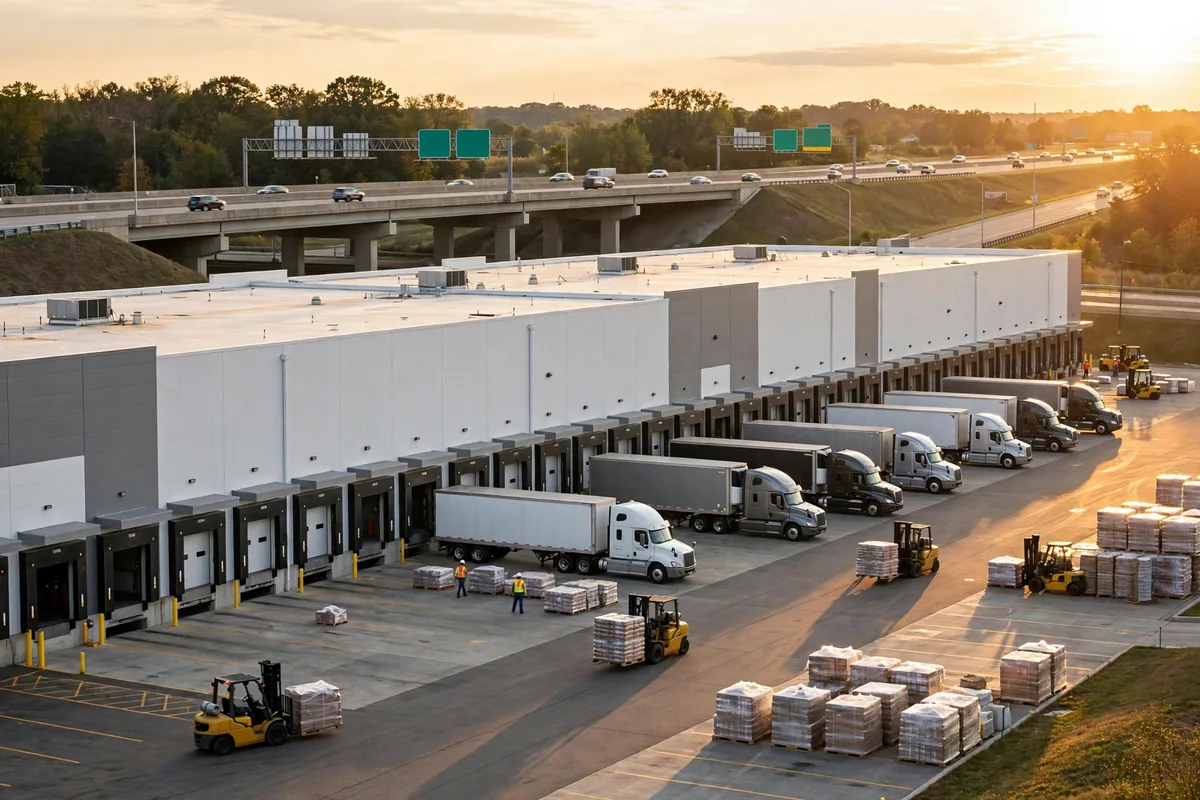
A useful benchmark for a Tangier warehouse is DACHSER's facility there: 5,500 square meters with 7,000 pallet positions. Think about what that scale means. It is not a big shed for stacking goods. It is a distribution center designed around the auto industry's rhythm — high-frequency small batches, shipping on the carmaker's call-off schedule, with room to push an urgent order to the front of the queue. If your warehouse is designed only around "how many pallets can we stack," you will find out in the first month that the goods went in fine and coming out is the problem.
The table below is a hypothetical example, putting "cheapest rent" and "no stockout" on the same page. The figures are round illustrative numbers built on typical cost structure, to show the structure only — not a real quotation:
| Option | Hypothetical example | Risk |
|---|---|---|
| Cheapest warehouse, a bit farther from the plant | Monthly rent saving worth roughly one mid-range car | Longer delivery leg; when the call-off changes, there is no time to react |
| Warehouse near the plant and the port, pricier rent | A higher monthly rent bill | Port-to-warehouse and warehouse-to-line are both short; stockout risk drops visibly |
| Mid-priced warehouse plus a safety stock and emergency capacity budget | More cash tied up in inventory | When customs slips or a call-off jumps, there is a cushion |
The counterintuitive point of that table: in automotive parts logistics, the most expensive warehouse is often the cheapest option. A warehouse that costs more per square meter but sits close to the plant and the port, and ships in step with the carmaker's call-off schedule, saves you a stockout claim and several emergency air freight bills — and those savings cover the rent difference many times over. The other way around, one stockout claim can swallow a whole year's rent savings. After years of signing 3PL contracts, I have watched too many clients fight over a few dollars per square meter at signing, and nobody mentions those few dollars once the stockout claim arrives.
Safety stock deserves its own word too. It is not simply "keep more goods." What to stock, how much, and where to put it depends on how critical each part is: stock more of the parts that stop the line, and keep them where they are easy to reach; stock less of the generic parts and replenish them on a normal cycle. The cash tied up in safety stock is a real cost. What it buys is no stockout. There is no standard answer to that trade-off — it has to be worked out case by case, from your customer mix and how much the call-off schedule swings.
When You Negotiate the Contract, Ask These Three Questions
Finally, some inside knowledge that only the vendor side usually shares. In Morocco automotive parts warehouse logistics, the most valuable clauses in a contract are rarely on the price page. They are these three questions:
Next time you negotiate a contract, remember to ask these three. First: from vessel berthing to part-on-the-line, who owns the end-to-end lead time, and how are delays compensated? Do not let the port, customs, warehouse, and delivery each own one leg, with nobody owning the whole journey. Second: when the carmaker's call-off changes suddenly, what is the response time for an urgent order, and how is rush picking charged? Auto call-offs change without warning, and if the contract does not cover it, every urgent order costs extra. Third: what is the liability cap on a stockout claim, and what does the insurance actually cover? Ask that one out loud and the other side knows you are not a beginner — the padding in the quotation tends to come down on its own.
The Morocco opportunity is real: the cluster is in Tangier, the port is the largest in Africa, and the carmakers' export volumes speak for themselves. But it is an opportunity for people who have done the whole calculation, not for people who only looked at the rent. Thirty percent cheaper rent sounds wonderful. One stockout, and the whole calculation changes. Have you turned to the lead time and claims pages of that Morocco warehouse quotation in your hands?
By Susan, 3PL Sales Director