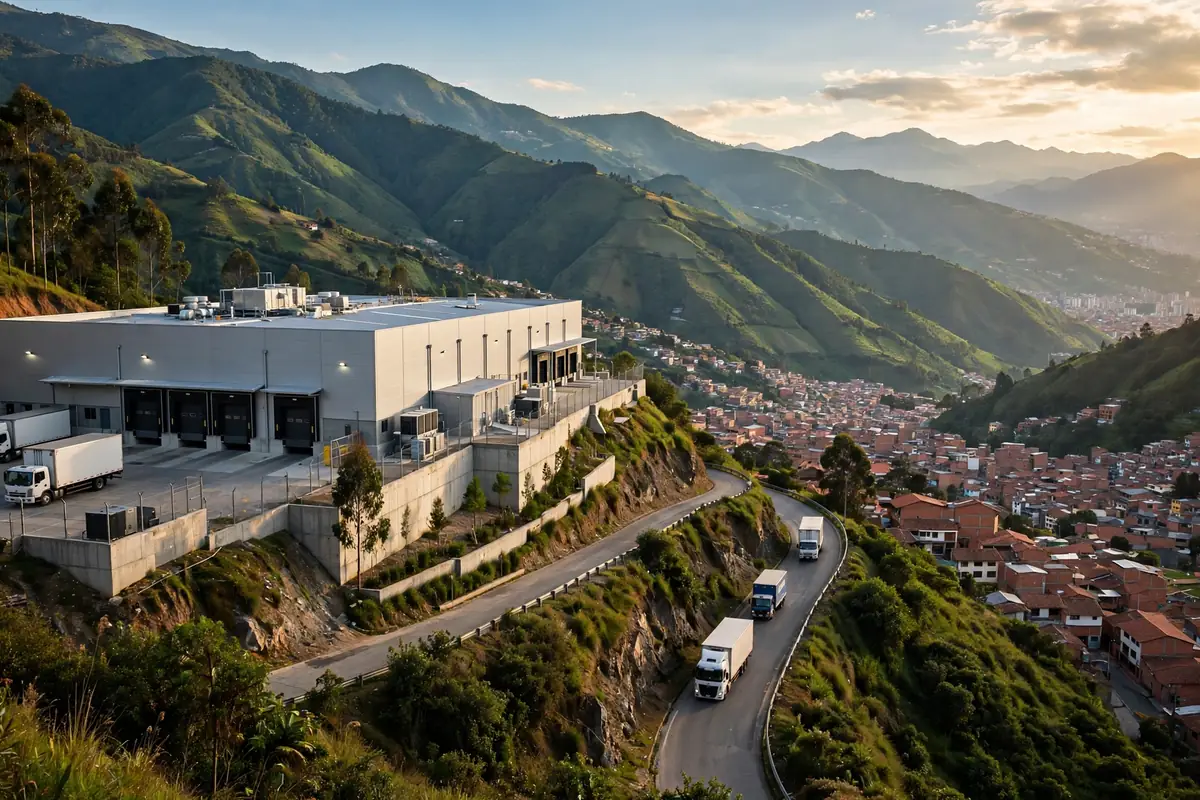
Let me tell you, the first time I hauled freight into Medellin, I sat on a mountain ramp for almost two hours. On the map it looked close. On the road, everything was switchbacks and slow climbs, and when one truck slows down, everyone slows down. After all these years on the road, I learned this the hard way: medellin warehouse logistics is not about rent first. It is about how a truck gets in and how a parcel gets out. Medellin is the capital of Antioquia and a long-standing industrial and textile center in Colombia, and e-commerce has grown fast around apparel and home goods. But the city sits in a valley, and that terrain changes every calculation.
Medellin warehouse logistics starts with the mountain road
Medellin sits in the Aburra Valley, with slopes on both sides. Put a warehouse on a steep street and it may look close to customers, but ask a larger truck to climb, turn, and dock there every day and drivers will push back fast. I saw this with a textile shipper in 2022. He rented a small site in the north of the city because his old customers were nearby. Containers coming from the port had to wind into town, the dock was narrow, and in the rainy season the ramp got slick. Unloading took half a day. Whatever he saved on rent, he paid back in waiting time and extra handling.
That tells you the first test for any site: can the vehicle you actually use get in, turn, dock, and leave in peak hours and in the rain? Drive the route yourself. Check turning space, dock access, and grades. Photos from a broker will not tell you this.
A second case stuck with me. In 2023, a seller shipping home goods from China started with one older warehouse inside the city, thinking proximity would mean fast delivery. Once volume rose, low ceilings and narrow aisles broke the operation. Picking was all manual carts, and a few hundred orders a day during peak turned into chaos. He later split the stock: bulk and slow movers moved to a park-style warehouse toward Rionegro outside the core, while a small in-city site kept only best sellers. Replenishment ran on scheduled small trucks. Returns got easier, picking got calmer, and total handling improved even though he now ran two sites.
Two ports, two trade-offs: Cartagena vs Buenaventura
For inbound freight, most shippers look at Cartagena on the Caribbean side and Buenaventura on the Pacific side. In rough distance, Buenaventura is in the four-to-five-hundred kilometre range from Medellin, while Cartagena is in the six-hundred-plus kilometre range. Buenaventura looks closer. On mountain roads, I tell you, kilometres lie.
| Option | What it generally offers | Best for | Watch out for |
|---|---|---|---|
| Buenaventura | Shorter overland leg, Pacific routing | Asia-linked cargo where sailing fits | Mountain disruption, rain and road works can stretch transit |
| Cartagena | Major Caribbean port, broad sailing choices | Cargo needing more sailing options | Longer inland leg and more time in transit |
| In-city warehouse | Closest to shoppers, fast last mile | Best sellers, returns handling | Higher occupancy pressure, hard truck access |
| Suburban park warehouse | Better docks and room to stage | Bulk, reserve stock, slow movers | Extra shuttle leg into the city |
Here is the counterintuitive part: the closer port is not always the faster or more reliable door. The road from Buenaventura crosses mountains, and rain, landslides, or road works can add half a day or more without warning. Cartagena is farther, but if the sailing is steadier and clearance connects cleanly, the total door-to-warehouse time can be more predictable. Do not decide on line-haul price alone. Add clearance waiting, days of stock tied up in transit, and stock-out risk. Rates and schedules change, so check the latest carrier and port information before you commit.
How to split city and suburban space in Medellin warehouse logistics
My advice to shippers is never city or suburb. It is city and suburb, with a clear division of labour. Keep fast movers and return-heavy items in a small city site. Keep bulky goods, reserve stock, and slow movers in a suburban park where docks and staging actually work. Connect the two with scheduled shuttles, not ad hoc calls. Ad hoc transport is where cost and confusion grow.
Last-mile delivery also needs local thinking. Motorcycles are a normal part of delivery in Medellin, and for light parcels they often beat a small van in traffic and on slopes. Apparel and small accessories fit that model well. Bulky, fragile, or high-value goods do not. Split orders by rule at intake: light and low-risk to the motorcycle network, larger or signature-critical orders to vans. Do not leave that call to a busy dispatcher at noon.
For sellers entering from China, start small and prove the lane. Run one port, one warehouse setup, and one delivery model end to end. Time every leg for real, from clearance to shelving to final delivery, then scale what worked. Tax and customs rules in Colombia change, so confirm import steps with a reputable local broker and follow the latest official policy.
An old road saying goes like this: you drive fast only on roads you know. Warehousing is the same. Learn the slopes, the ports, and the rainy-season habits of the route, and the numbers will start to make sense. The cheapest warehouse a truck cannot reach is not a saving. It is a hole you dug for yourself.
Returns deserve the same planning. Apparel and footwear in Medellin carry naturally higher size-related returns, and if every return has to travel back to a suburban site before anyone inspects it, the customer waits longer and the seller rating suffers first. I watched a women's footwear team learn this in the 2024 peak season. Marketing drove strong orders, but returns piled up unsorted in the warehouse, and staff could not tell quickly what could go back on sale. They later carved out a small returns area inside the city site: same-day receipt, same-day inspection, refurbishment for resale where possible, and bulk transfer of the rest to the suburban warehouse. The loop became much faster without adding a third site.
Labour is the other hidden line. Commuting in a mountain city is more exposed to weather and traffic, so a site that looks efficient on a map can be hard to staff for evening or peak shifts. Before signing, ask other operators nearby how hard hiring is and visit at shift change. That ten-minute observation tells you more about turnover risk than any brochure. Storage conditions matter too. Medellin has a mild climate, but rainy-season moisture is tough on textiles, cartons, and small electronics. Check drainage, ventilation, and roof condition before you admire the office. Keep stock off the floor on pallets, and do not save pennies on moisture protection that protects a whole batch.
By Shifu Zhao, Trucking Veteran (15 yrs)