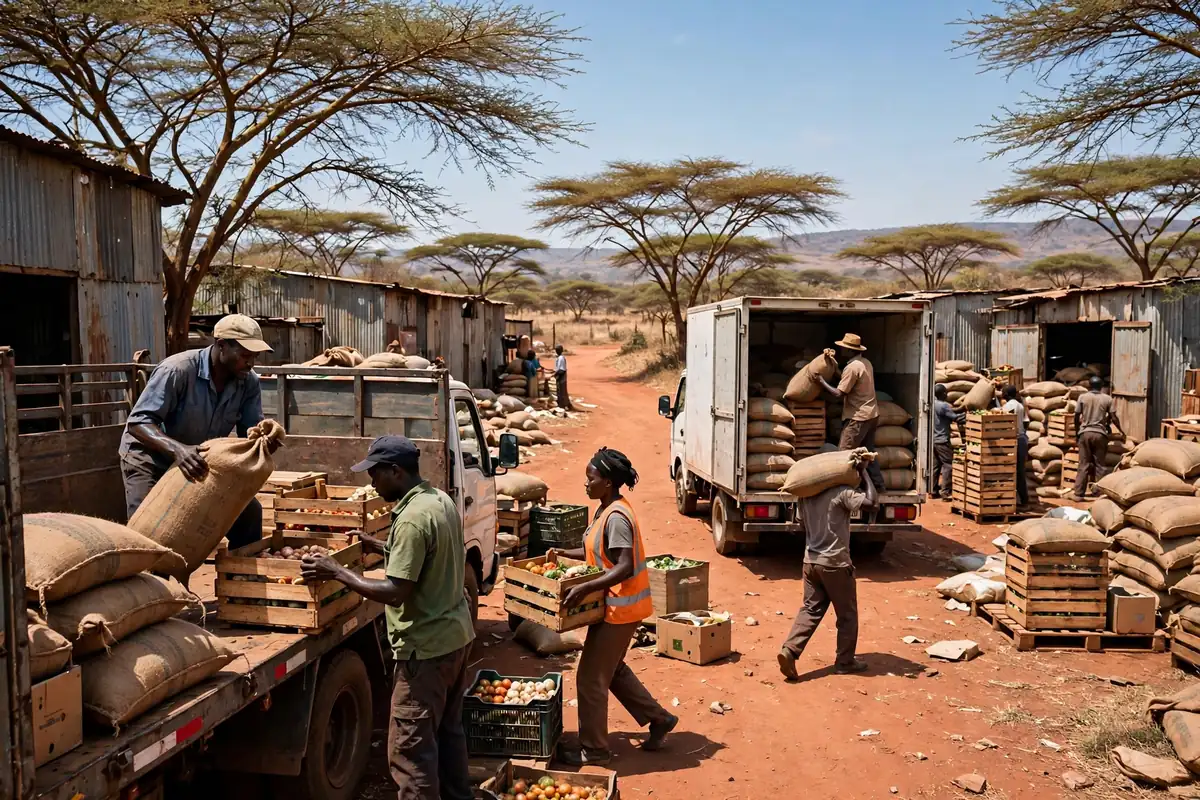
We had a client who came to Zambia for the first time in 2023 and asked me one question before anything else: what is the rent per square metre in Lusaka? I told him to ask a different question first: which port is your cargo coming through? The most common mistake in lusaka warehouse logistics is pricing only the warehouse while ignoring the borrowed port, the long inland haul, and the border in between. Lusaka is Zambia's capital and its main consumption and distribution hub, but Zambia is landlocked. It has no seaport of its own, so every inbound shipment starts with a corridor decision.
Lusaka warehouse logistics starts with the corridor, not the rent
That first client sold home goods and light building materials. Chasing the lowest quote, he pushed everything through a single corridor. In peak season one shipment spent more than ten extra days on the road, the warehouse ran dry, and local dealers called every day. Then he asked me about air freight to plug the gap. I told him, gently, that the air bill would eat the savings he thought he had made, twice over. A cheap corridor that is not reliable is not cheap. It is risk sold to you in a tidy quote.
In practice, shippers usually compare three gateways: Durban in South Africa to the south, Dar es Salaam in Tanzania to the northeast, and Beira in Mozambique to the east. In broad distance terms, Beira is the closer option, roughly in the one-thousand kilometre range, while Durban and Dar es Salaam are both much farther, approaching the two-thousand kilometre range. Actual routing, border conditions, and transit times vary a lot by season, congestion, and carrier, so confirm the latest picture with your carrier and local clearing agent. What I can give you here is the decision logic, not a fixed number.
| Corridor | General character | Often fits | Ask in the contract |
|---|---|---|---|
| Durban corridor | Mature southern route, links well to South African supply | Cargo bought in or routed via South Africa | Who owns border waiting time and variance |
| Dar es Salaam corridor | Northeastern route via Tanzania | East Africa-linked cargo, some mining-related flows | How port waiting and line-haul handover are split |
| Beira corridor | Shorter inland leg to the east | Time-sensitive cargo with flexible volume | Sailing and capacity stability, rainy-season road risk |
Here is the counterintuitive part: the shortest corridor is not always the lowest total cost. Beira is closer, but if your volume is irregular and sailings do not connect, waiting to consolidate is also money. Durban is farther, but if your suppliers, consolidation, and backhaul all sit on that lane, the whole movement can run smoother. Compare door-to-warehouse cycle time and its variance, not just the line-haul rate. A volatile corridor forces more safety stock in Lusaka, and the cash tied up in that stock is a real cost your salesperson will not volunteer.
Copperbelt demand and the empty backhaul in Lusaka warehouse logistics
The second client story cuts the other way. A supplier of tools and mining consumables set up only in Lusaka in 2024, assuming the capital would cover the country. His steadiest orders, it turned out, came from the Copperbelt to the north, Zambia's mining heartland around Kitwe and Ndola, with regular, repeat demand. Trucks went north full and too often came back empty, and the cost per order looked ugly. He blamed our rate until I split the outbound and return legs on one page. The empty return was not a driver problem. It was a network design problem.
The lesson is simple: do not draw your Zambia network by population alone. Draw it by freight flows. If half your demand sits in Lusaka and half in the Copperbelt, price two designs honestly: one Lusaka warehouse plus line-haul delivery, versus a Lusaka main site plus a small forward stocking point near the Copperbelt, even if that point is just a modest cross-dock area with a local 3PL holding fast-moving consumables. Then look for any compatible backhaul, even at thin margin. A lightly loaded return still beats an empty one.
The same logic decides city versus park warehousing. A site closer to Lusaka's commercial areas suits fast, frequent small orders, but expansion room and heavy vehicle access can be tight. Park and industrial sites on the edge of the city usually offer better yards and docks for reserve and bulky stock, at the price of a longer last mile and weaker urgent delivery. Split by category: fast movers close in, bulky and reserve stock in the park. Quoted rents vary widely by location, so budget from real local quotes, not scattered online numbers.
Clearance is where contracts quietly matter most. Landlocked cargo crosses more than one border, and one mismatch in documents, origin, or classification can park a truck at a border post. While it waits, you save no rent and you still run out of stock. Insist on a shared pre-check: the 3PL, the clearing agent, and the warehouse working from the same document list, with an estimated arrival shared before the truck reaches Lusaka so dock and labour are ready. If a provider cannot do that coordination, put a question mark next to the low price.
That is what lusaka warehouse logistics really rewards: not the lowest rent, but the cleanest join between corridor, freight flow, and clearance. Next time you negotiate a contract, remember to ask these three questions. One: how is door-to-warehouse cycle time defined, and who owns it when variance spikes? Two: who carries the empty backhaul cost, and what matching or consolidation plan reduces it? Three: when clearance slips, how fast do we hear about it, and how do dock planning and safety stock respond? Ask those three first, then talk unit price, and a low quote will have a much harder time leading you by the nose.
One more negotiation trap deserves a mention: the small fee lines. I have seen clients celebrate a clean storage and handling rate, then get a bill where waiting time, overtime unloading, repacking, and detention added up to the painful part. Those charges are not automatically unfair. Peak overtime and a truck held at the dock do cost money. The point is to define them before they happen: what is included, what is billed separately, what triggers it, and where it caps. Slow-moving stock needs the same treatment. Agree in advance when ageing stock triggers an alert, and who decides whether it gets promoted, transferred, or returned. In a landlocked market, inventory that stops moving quietly eats every saving you negotiated at the front end.
By Susan, 3PL Sales Director