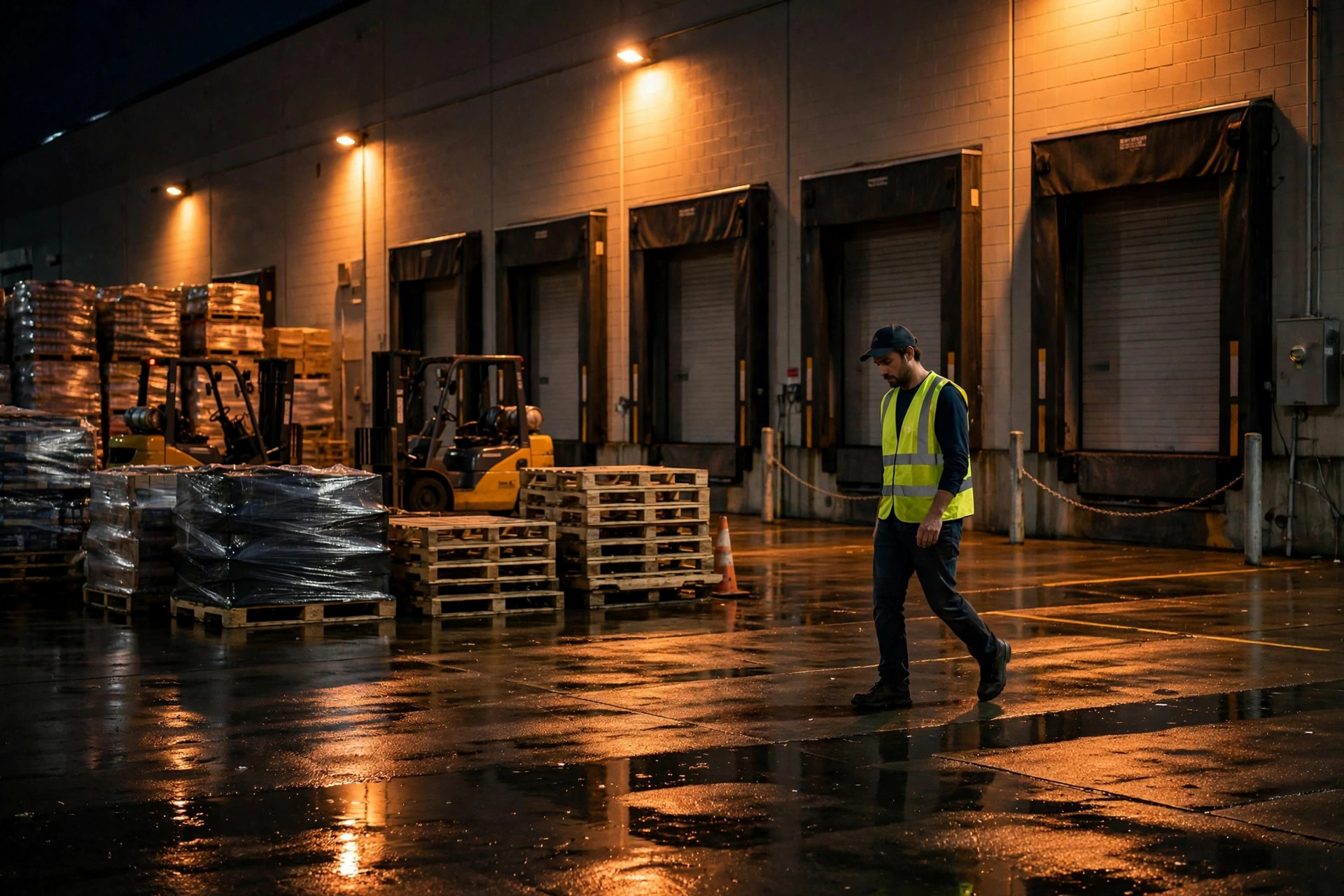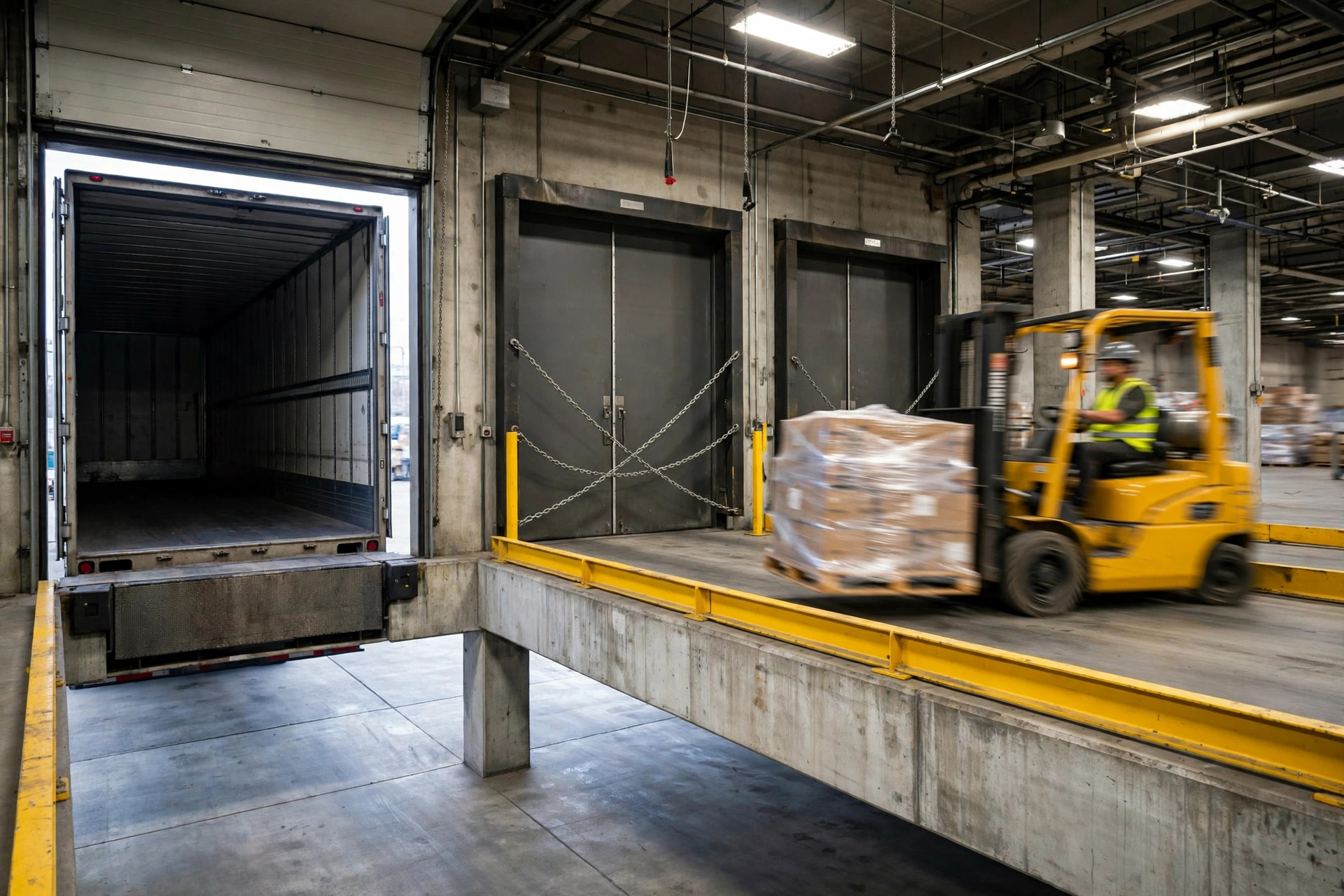
It was 4:30 on a Thursday morning, night shift not quite over. I was on the dock watching a forklift load a container, still mulling over our loading dock fall protection retrofit, when someone yelled behind me: "Watch out!"
I turned around. One of our guys was walking backward, dragging strapping material, and his heel was already past the dock edge. The man next to him grabbed a fistful of his shirt. That's the only reason he didn't go over. My back was drenched in sweat. Our dock sits a little over four feet off the ground. A fall from there doesn't kill you, but a broken leg is the best-case outcome.
Most warehouses look the other way on dock edges. When things get busy, you hang a chain across and call it done. But OSHA doesn't grade on effort. Here's the famous "4-foot line" in OSHA 1910.28, and how we finally made our dock edges compliant.
What OSHA 1910.28's 4-Foot Line Actually Says
Let me break the regulation down in plain language. OSHA 29 CFR 1910.28(b)(1) is blunt: any unprotected edge with a drop of more than 4 feet (about 1.2 meters) must have a fall protection system. A standard American loading dock sits right on that line — I measured ours at 4 feet 2 inches. That means if your dock edge is exposed with no protection, you're over the line.
You get three choices, and only three: guardrail systems, personal fall arrest systems, or safety nets. On a working dock with people and forklifts moving all day, personal fall arrest is a non-starter — nobody is going to strap into a harness to move boxes — and safety nets are a non-option. So in practice there's one road: guardrails.
And a guardrail isn't two pipes welded together however you like. 1910.29 pins down the specs:
- Top rail at about 42 inches, plus or minus 3 inches;
- Top and mid rails must withstand a 200-pound (about 890 N) outward or downward force without budging;
- No burrs, no snag points, and the post spacing and mid-rail details are all spelled out.
I know what you're thinking: does a chain across the dock count? I'll be straight: no. A chain sags, the top height is wrong, and a 200-pound tug pops it loose. To an inspector, that's the same as nothing. We used to hang chains too — until something happened that changed our minds for good.
Close Call Number One: A Chain Can't Stop a Man Walking Backward
November 2024, peak season, 130-plus trucks a day through our dock. Night shift was short-handed, so a few temps got sent to the dock to help. One kid was sliding loaded pallets sideways, walking backward with his eyes on the pallet. The chain was at his waist. His back hit it, the hook snapped open with a pop, and he tipped backward — hanging half off the dock, saved only because a veteran grabbed him.
Nobody got hurt. I didn't sleep that night. The next morning I ripped that chain down and threw it away. Here's the thing: a chain's real danger isn't that it's non-compliant — it's that it makes everyone feel protected when nobody is. A friend in safety compliance walked our floor afterward and said it best: "You don't have no protection. You have a placebo."
Close Call Number Two: An OSHA Inspector Asked Me Three Questions
March 2025. The warehouse next door had an injury, and OSHA was doing walk-throughs in our area. They came into ours too. The inspector wasn't in uniform, just wandered the dock, then asked me three questions:
One, what's the drop at this dock edge? I said a little over four feet. Two, what's the protection now? I said swing safety gates — open during loading, closed otherwise. Three, how are people protected while the gate is open? I said our rule is simple: no one stands within two meters of an open edge unless a trailer is backed in, and the shift lead enforces it.
He nodded, measured the top rail, shook the gate frame, and left. No citation.
I only passed because we'd done the work the year before. If that chain had still been hanging there, that day would have gone very differently. I won't quote a fine amount — OSHA's penalty schedule changes regularly, check the latest on their official site — but one serious citation would cover compliant gates for our whole dock twice over, with money left. You do the math.
Three Compliant Options — Pick by What Your Dock Actually Looks Like
The regulation says "pick one of three" and stops there. We have 18 doors and have tried all three. Here's the real-world comparison — costs are ranges from our 2024–2025 installs; check current pricing from your supplier:
| Approach | Rough cost per door | Pros | Cons | Best for |
|---|---|---|---|---|
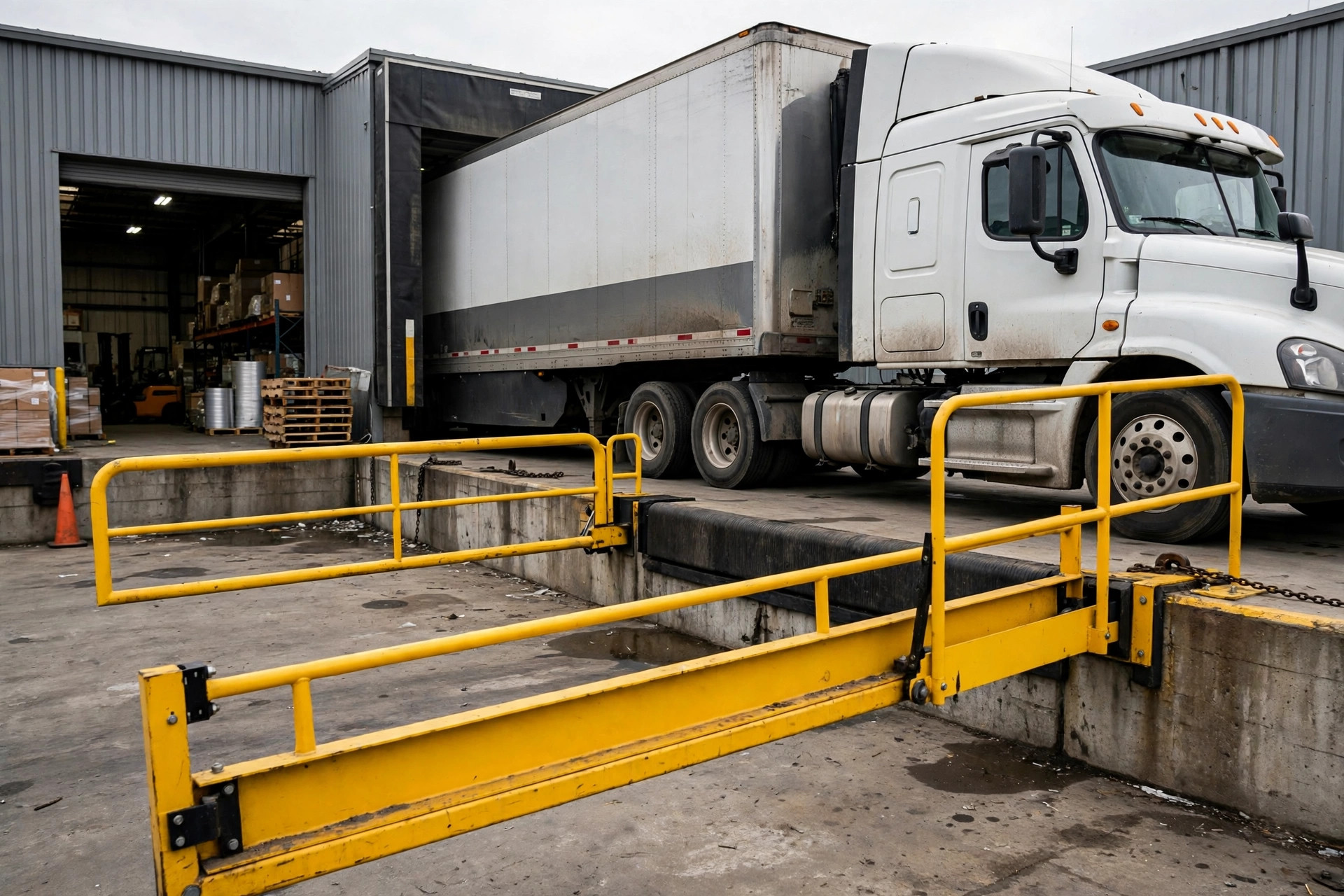
| Fixed guardrail + swing gate | A few hundred to low-thousands of dollars | Toughest; inspectors love it; stays closed to block people and stray forklifts | Fixed gate width — awkward for oversized freight; needs swing clearance | High door count, standard freight, heavy forklift traffic |
| Lift-out / removable guardrail | A few hundred dollars | Remove it entirely when you don't need it; cheap | Removed rails end up lost or piled in a corner; workers get lazy about reinstalling | Doors you rarely use, changing freight profiles |
| Expandable scissor gate | Around a thousand dollars | Opens and closes in 5 seconds, one-handed; takes no space | Rollers jam with age — needs regular oiling | Doors with constant foot traffic, frequent open/close |
I'll be straight: none of these is perfect, and the wrong pick is worse than none at all. We started cheap with removable rails everywhere. During peak season, every removed rail ended up stacked in a corner collecting dust, and the dock edges stood bare. We ended with swing gates on the 12 busiest doors and scissor gates on the 6 quiet ones. The removable rails all went back to the vendor.
Here's a counter-intuitive take: a lot of guys say guardrails just get in the way. Honestly? It's not the guardrail that's in your way — it's your choice of guardrail. Swing gates and scissor gates were designed exactly for "protect people and still get the work done." Compliance and efficiency aren't enemies here. You just didn't match the tool to the job.
What We Do Now — Our Fixed Routine
I've told you the scene and how the problem surfaced. Now here's what our warehouse actually does today. Steal it:
First, color-code every door. Green doors: swing gates, normally closed, opened only for loading. Yellow doors: scissor gates for foot traffic. Red doors: long-unused doors, guardrails locked shut. Tags hang on every frame. New hires learn the colors on day one.
Second, one iron rule: no trailer, no open gate. A swing gate opens only when a truck is backed in and the trailer body covers the edge. No truck, gate stays shut. Open it without one and you're writing an incident report. It's in the SOP, and the shift lead checks every morning at start-up.
Third, a 10-minute self-check every month. This list is taped to the dock office wall, and the shift lead signs it monthly:
- Is every top rail still around 42 inches? Any bent from impacts?
- Do the swing gate hinges and latches move freely — open with a push, lock shut?
- Are any scissor gate rollers jamming? Do they need oil?
- Has any guardrail been "temporarily" removed and never put back?
- Do the new hires know the red-yellow-green system?
Fourth, set rules with the drivers too. A lot of close calls come from drivers: truck not parked yet and people are already crowding the edge. Our rule now: drivers stay in the cab until the shift lead blows the whistle after loading. They grumbled at first. We had two shouting matches. Then everyone got used to it. Honestly? Arguing with a driver is fine. What's not fine is an accident that takes away your chance to argue.
One Reminder for Fellow Operators
The biggest trap in dock fall protection isn't money. It's luck. A chain, a "be careful" — that's all luck. Grab a tape measure this weekend and check your dock height. You'll know in ten seconds.
Three things: measure your actual drop — know if you're over 4 feet; look at what's on the edge right now — chains and ropes count as nothing; and don't redo everything at once — start with the two or three most dangerous doors, then roll it out.
Three years, two close calls, one walk-through — 18 doors compliant. Worth it? You decide.
By Chen Feng, Warehouse Operations Manager