Start with the ledger, because sentiment does not pay rent. Leipzig Halle Airport handled 1,383,319 tonnes of cargo in 2024, roughly 1.38 million tonnes, down 0.6 percent year on year. It is Germany's second-largest and Europe's fourth-largest cargo airport, with the most cargo flights of any airport in the European Union. Translate that into warehouse language: a building here is not a storage box, it is a night-shift factory chained to a flight schedule. Sellers and forwarders ask me whether a Leipzig warehouse is cheap enough to justify. Wrong question. The right question is whether the rent you save covers the night labor, the shuttle trucks, and the discipline of living next to an airport. Money spent without that breakdown is money spent badly, and I have seen the invoices to prove it.
The foundations first. The airport sits in Schkeuditz, about 18 kilometers from both Leipzig and Halle. DHL Aviation moved its European hub here from Brussels in 2008, making this DHL's largest hub worldwide, the main hub for AeroLogic, and one of Amazon Air's bases. DHL has extended its partnership with the airport through 2053, and two new DHL cargo terminals opened in 2016 lifted handling capacity by about 50 percent. Add those facts together and you get one conclusion: this is not a passing boom, it is a night-freight machine locked in by decades-long commitments. A warehouse built around it does not buy square meters. It buys a seat on that machine's timetable.
The Leipzig Halle Night Rhythm: Why the Warehouse Hugs the Airport
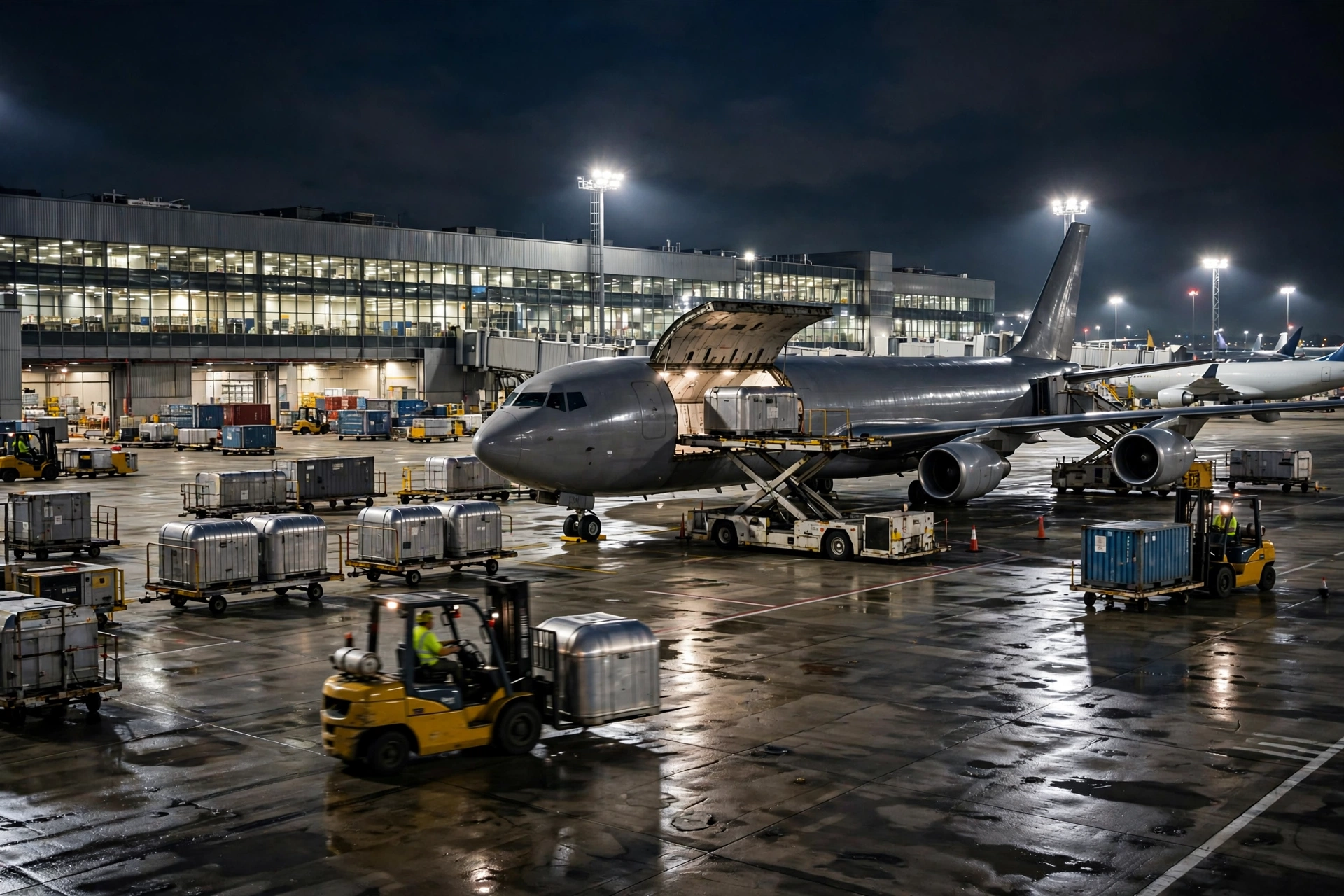
Watch one DHL night and the location logic explains itself. DHL handles about 2,000 tonnes of cargo and roughly 350,000 shipments every night here, flying to more than 50 destinations, with about 80 to 90 freighters landing each night, Monday through Friday. Aircraft arrive in the dark, freight is sorted before dawn, and linehaul is airborne by morning. So an airport-side warehouse peaks not at noon but between late evening and the early hours. Receiving, breakdown, build-up, and tendering all have to land inside that window. Miss the wave and your cargo sleeps an extra day, and an extra day in air freight is not a delay, it is a downgrade you sold to your customer at full price.
Run the shuttle math on a simple scenario, with illustrative numbers you should replace with your own quotes. Suppose a warehouse sits far enough from the airport that each tender run loses the tight connection to the night sort. The freight then misses the wave, delivery slips a day, and the seller absorbs the service hit in marketplace performance and repeat orders. That loss never appears in the rent comparison, which is exactly why cheap remote warehouses keep winning spreadsheets and losing money. In leipzig halle air cargo warehouse logistics, distance from the fence is not a geography question. It is an insurance question: every extra kilometer thins the policy that protects your departure window.
Labor is the second line item people misprice. A night warehouse does not staff like a day warehouse. Its peak compresses into a few hours, so you either carry a permanent night crew, a fixed cost that idles in the off-season, or you flex with shift premiums, a variable cost that spikes exactly when everyone else is hiring too. I have reviewed a forwarder's budget that priced labor at day-shift rates for a Leipzig air cargo operation. The first peak season tore through it. Not fraud, not bad luck: a wrong cost category. What you are actually buying with night labor is certainty during the few hours when the hub earns its living, and certainty at 2 a.m. has never been the cheap line in any ledger I have audited.
There is physical proof that the big players run the same math. DHL Supply Chain built a new 34,000 square meter carbon-neutral logistics center beside the airport, with about 55,000 pallet positions. That ratio, 55,000 positions in 34,000 square meters, is a high-turnover design, not a store-it-and-wait design. Shorter shuttles across tens of thousands of truck movements a year, plus European customers who score suppliers on carbon, make the long-term account balance. The carbon-neutral build is not decoration; in European tenders it is a scoring line, and losing points there costs contracts you never hear you lost.
Leipzig Halle vs Frankfurt: One Table, Two Different Ledgers
The comparison sellers and forwarders actually agonize over is Leipzig against Frankfurt, so here is the table I give clients. Neither column wins outright; the winner is whichever ledger matches your freight.
| Factor | Leipzig Halle | Frankfurt |
|---|---|---|
| Hub character | Night-freight hub, most cargo flights in the EU | Large passenger-and-cargo gateway, broad airline network |
| Best-fit freight | Express, e-commerce air freight, time-sensitive distribution | High-value cargo, multi-airline routing, complex lane combinations |
| Warehouse rhythm | Night waves, early-morning peak | Waves spread out, calmer daytime handling |
| Cost drivers | Airport-side site, night labor is the swing variable | Fiercer competition for land and labor, higher all-in cost |
| Main risk | Dependence on one hub's night timetable, tight night labor market | Peak-season fights for capacity and ground resources |
Now the part that surprises people. Cargo ranking is not the deciding variable; rhythm fit is. If your freight is produced during the day and physically cannot make Leipzig's night wave, then 1.38 million tonnes a year has nothing to do with you, and every euro spent sitting beside that airport is wasted. If your freight is born to fly at night, warehousing it somewhere that adds a day of shuttle is the real waste. Match the rhythm first, negotiate rent second.
Close with a break-even you can run tonight. Illustrative scenario, replace the figures with your own quotes: a warehouse handling 3,000 tonnes a month. Option A, beside the airport, carries assumed fixed costs of 90,000 euros a month and shuttle costs of 8 euros per tonne, so 24,000 euros, for a total of 114,000 euros. Option B, a remote site, carries assumed fixed costs of 70,000 euros and shuttle costs of 22 euros per tonne, so 66,000 euros, for a total of 136,000 euros. The airport-side option is 22,000 euros cheaper per month before you count a single missed wave. The break-even is just as clean: the 20,000 euro fixed-cost gap divided by the 14 euro per-tonne shuttle gap means that above roughly 1,429 tonnes a month, the airport site wins; below it, the remote site plus shuttles wins. That is the whole decision framework: know your monthly tonnage, compare it with the break-even, and stop arguing from gut feeling.
The Leipzig ledger has three keys: the night wave, the shuttle distance, and your monthly tonnage. When all three line up, a warehouse here is money spent on the cutting edge. When they do not, Europe's fourth-largest cargo airport is simply somebody else's busy night. Cost analysis is not about finding the cheapest building. It is about refusing to pay for advantages your freight will never use.
By Lao Zhou, Logistics Cost Analyst