The first time I heard the name Khorgos, I figured it was some tiny border town at the edge of the map. Then my own cargo sat there for four days while customers messaged me every morning. That is when I learned what this place really is: the west gate for Chinese goods heading to Europe. The gate is open. That does not mean everyone walks through it smoothly.
Plenty of sellers hear "China-Europe Railway Express" and assume it is a safe bet: faster than ocean, cheaper than air, just book it and forget it. That was me on my first shipment through Khorgos. Everything was fine leaving Xi'an. Then the cargo reached the border and sat for three full days. Not lost, not seized, just waiting: for flatcars, for paperwork, for the containers ahead of it. After that shipment, I sat down and worked out the real math of this route, line by line.
First, What Khorgos Actually Is
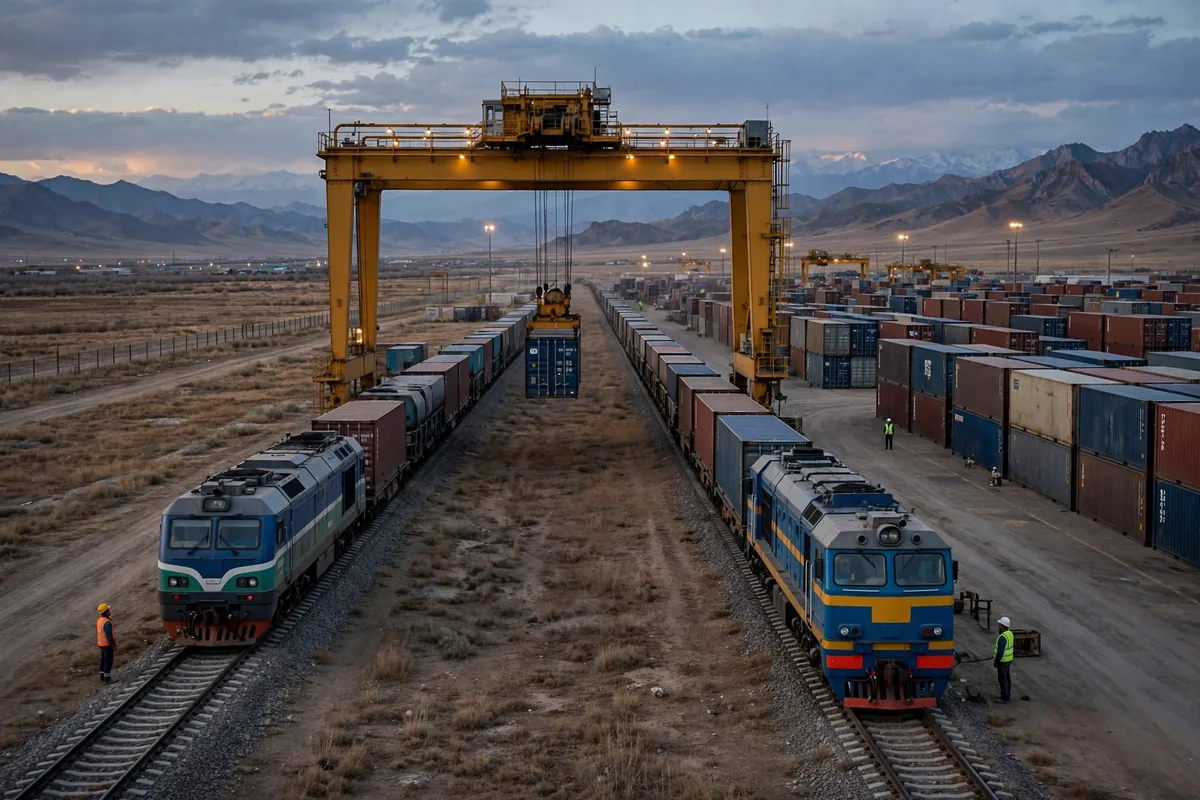
Khorgos sits in Ili, Xinjiang, right against Kazakhstan, with Altynkol on the Kazakh side. The rail port only opened in late 2012, with the first regular trains crossing on December 22, 2012. The whole point of this place comes down to one word: gauge change.
China runs on standard gauge, 1,435 millimeters; Kazakhstan inherited the Soviet broad gauge, 1,520 millimeters. A train rolling up to the border cannot keep going. Every container has to be lifted off the Chinese flatcars and set down on Kazakh flatcars, and at the Polish border it happens all over again. One China-Europe train goes through at least two physical transfers.
Here are the numbers. Through November 4, 2026, Khorgos rail port had cleared more than 8,000 China-Europe and China-Central Asia trains this year, carrying over 13.80 million tonnes of cargo, averaging about 27 trains a day, on 91 routes reaching 46 cities in 18 countries. Add Alashankou, the other Xinjiang rail port, and the two together passed 15,052 trains through October 23, 2026, with 30.58 million tonnes. In 2024, 19,000 China-Europe trains ran, and the cumulative total passed 110,000 trips by June 2025. This is not a niche corridor. It is a main artery.
Khorgos carries another title: as of 2024, it is the world's second-largest dry port. Next door sits the China-Kazakhstan Khorgos International Border Cooperation Center, founded in 2005, covering 608.56 hectares, where visitors can enter visa-free for up to 30 days. In November 2023, the China (Xinjiang) Pilot Free Trade Zone was inaugurated, with a Khorgos area inside it. In the first three quarters of 2026, Khorgos port handled 35.58 million tonnes of import and export cargo, the most of any Xinjiang port. A rail port, a bonded zone, a free trade zone, and a cooperation center stacked in one place. Sellers have a lot of tools here; the catch is knowing what each one is for.
The Gauge Change: 47 Minutes to Lift, 24 Hours to Get Through
The transfer itself is fast. A gantry crane lifting a container from one train to another takes as little as 47 minutes of lifting. Average inbound gauge-change time at Khorgos is now about 2 hours, and a train with clean paperwork can clear in under 30 minutes. Sounds great, right?
In reality, total processing often takes 24 to 36 hours. Three things eat the time. First, waiting for broad-gauge flatcars. More containers head west than flatcars come back east, so when the flatcars run out, your container sits in the yard, sometimes for two to five extra days. Second, paperwork. Pre-arrival electronic declarations clear fast. Anything that needs a correction burns a whole day. Third, inspection. Get picked for an X-ray or an open-box check, and add another half day to a day.
On November 3, 2026, at 5 p.m., a train bound for Lodz, Poland rolled out of Khorgos and pushed the port past 8,000 China-Europe trains for the year. That same week, a Shenzhen seller I know had home goods on this route. Xi'an to Duisburg took 18 days terminal to terminal, and 3 of those days were spent waiting at Khorgos. Three days out of eighteen, nearly twenty percent of the trip, burned at the border. His words: "The train runs faster than I expected. The standing around lasts longer than I expected."
Here is the counterintuitive part: the slowest thing at the border was never the 47-minute crane lift. It is the queue you cannot see. People calculate transit as "Xi'an to Duisburg, 16 to 21 days" and forget to ask whether their cargo is a full container, whether the paperwork was filed in advance, and whether peak season has flatcars running short. Less-than-container-load cargo has it worse. It waits for consolidation, and if the train is not full, your boxes sit in the border warehouse until the next departure.
The Bonded Zone and the Consolidation Hub: Stage First, or Ship Direct?
The Khorgos Comprehensive Bonded Zone is the tool sellers most need to understand. Cargo enters the zone first, which counts as entering the country without a formal import. Inside the zone you can sort, repack, relabel, and consolidate, then ship when the orders are ready. Cross-border e-commerce models run through here, with tax rebates and consolidation handled inside the zone. The zone's e-commerce operation area moves home appliances, clothing and footwear, hardware, electronics, and daily goods out by truck daily.
But the bonded zone is not a cure-all. My advice splits three ways. First, a full container going straight to Europe, cargo ready, paperwork ready: do not enter the zone. It adds a procedure and a day or two for nothing. Second, several small shipments that need to be consolidated, or cargo from different suppliers that has to be combined: go into the zone, consolidate there, and load the train once everything is together. Third, cargo that needs to be split between domestic distribution and export: do the split inside the zone, where transfers do not trigger repeat declarations.
The consolidation hub idea works the same way. Inland hubs like Xi'an, Zhengzhou, and Wuhan now run scheduled departures toward Khorgos. In 2026, Khorgos already had four scheduled routes running every week. Sellers should stop guessing which day to ship and just line up with the scheduled departures. Cargo that rides the schedule spends the least time waiting at the border.
The Khorgos Cost and Time Trade-Off for Sellers
Now the bottom line. The table below is an illustrative example built on typical 2026 industry levels, not a quotation. The lane is Xi'an to Duisburg, one 40-foot high-cube container:
| Mode | Transit time (illustrative) | Cost ranking | Best for |
|---|---|---|---|
| Ocean | About 30 to 40 days | Lowest | No rush, low value, bulky goods |
| China-Europe rail via Khorgos | 16 to 21 days | Middle | Mid-value goods, tight listing windows |
| Air | About 5 to 7 days | Highest | High value, urgent orders, light goods |
The decision is three questions. First, what is the cargo worth? Rail hits its sweet spot when a 40HQ holds roughly $35,000 to $180,000 of goods. Below that, ocean usually wins; above it, air starts making sense. Second, what happens if you arrive a few days late? Chasing a Black Friday or Christmas listing window means the border wait belongs inside your plan, not under "unexpected." Budget three border days and be pleasantly surprised if it is one. Third, is the cargo ready? If not, do not rush to book. Stage it in the bonded zone and ship when it is whole. That beats watching it sit at the border.
One more hard truth: do not gamble on an empty border in peak season. From September to November, even 27 trains a day gets tight, and a flatcar shortage can mean two to five days of waiting. My approach: ship two weeks early in peak season, or split volume through Alashankou. Both ports serve the same border. Betting everything on one crossing is the dumbest move on this lane.
What works for me, tested on my own shipments: file paperwork in advance, ship full containers direct, line up with scheduled departures, and ship two weeks early in peak season. Follow those four rules and my Khorgos border dwell time this year has stayed under a day per shipment. The west gate is open. The real question is whether you know how many people are queuing behind it.
By Ah K, E-commerce Seller (5 yrs)