According to the Food and Agriculture Organization, Kenya exported 129,706 tonnes of avocados in 2024, worth about 160 million dollars, making it one of Africa's largest avocado exporters. Yet in the same period, disruptions in the Red Sea nearly doubled transit times to Europe and pushed freight rates up, and Kenya's export volumes fell noticeably in 2025. The story of the Kenya avocado export warehouse cold chain starts with that contrast: the fruit grows beautifully in the highlands, and the losses happen on every leg between the tree and the ship.
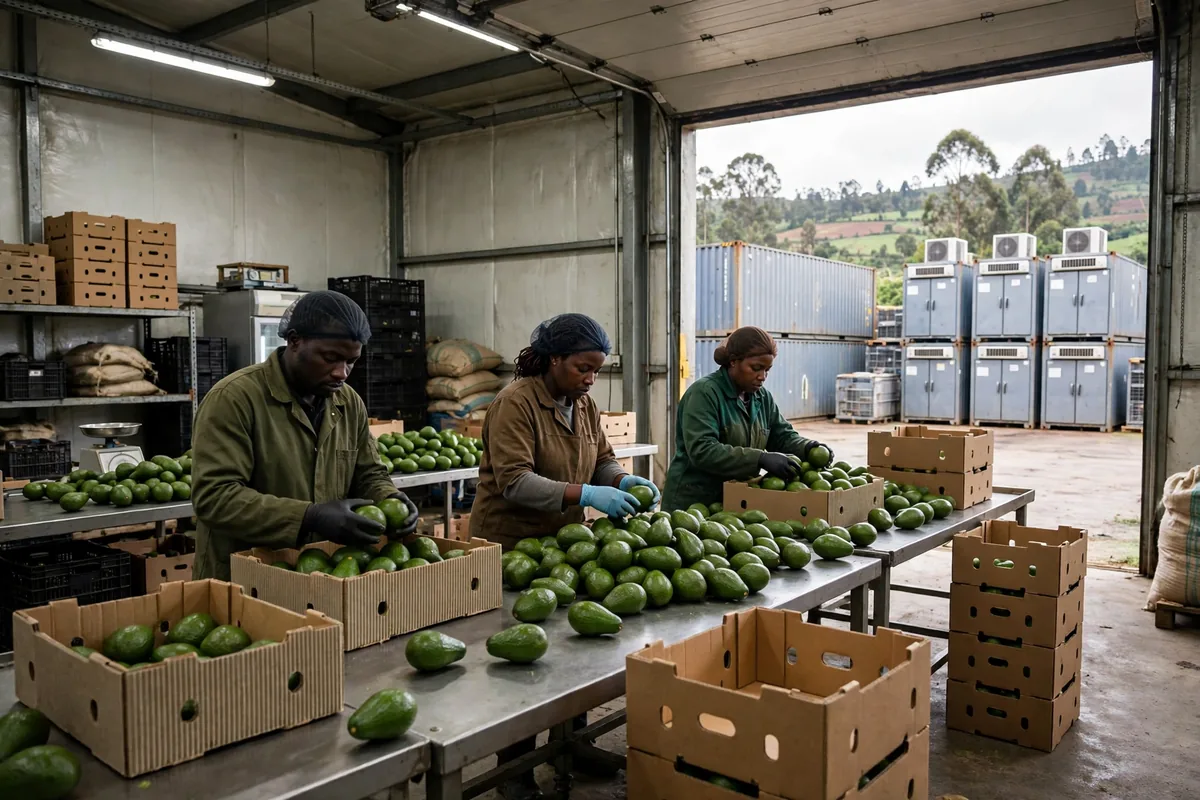
Kenya's avocados grow mainly in the central highlands and around Mount Kenya, in Murang'a, Kiambu, Nyeri, Kirinyaga, and Meru counties, at altitudes of 1,000 to 2,100 meters, with Hass as the main export variety. After harvest, the fruit travels by road to packhouses near Nairobi for grading, packing, and pre-cooling, then about 480 kilometers overland to the Port of Mombasa, where it loads into reefer containers bound for Europe. Break the cold chain once anywhere along that route, and days of shelf life disappear, while the buyer pays on the ripeness at arrival.
During the peak season of 2024, a packhouse night shift in Murang'a County ran into a classic break. A truckload of Hass picked in the afternoon arrived with field temperatures above 26 degrees Celsius, then waited more than two hours in the grading queue, so the fruit was still warm at the core when it finally reached the pre-cooling room. Industry practice calls for pre-cooling to start within six hours of harvest, with forced-air cooling taking 8 to 12 hours to bring the pulp down to 6 to 7 degrees. That night pre-cooling started half a beat late. The shipment looked fine at loading, but the fruit softened early in Europe and the whole container was downgraded. This case is an illustrative scenario, with its timings and temperature ranges drawn from published post-harvest practice: pre-cooling delayed by a few hours only shows its damage weeks later.
The First Test in the Kenya Avocado Export Warehouse Cold Chain: Six Hours After Harvest
Avocado is a climacteric fruit. It keeps breathing after picking, releasing ethylene, and the warmer it sits, the faster it ripens. Pre-cooling exists to strip field heat away quickly and slow that breathing down. The accepted practice is to start pre-cooling within six hours of harvest, keeping the pulp temperature below 26 degrees Celsius in the field and on the road to the packhouse. Forced-air cooling is the best-suited method for avocado, typically taking 8 to 12 hours to reach 6 to 7 degrees at 90 to 95 percent relative humidity.
The target temperature depends on the variety. Hass is held at 5 to 7 degrees early in the season and 4.5 to 5.5 degrees late in the season. Fuerte suits 6 to 8 degrees, for no more than three weeks. Here is the first counterintuitive point: colder is not better. Below the right range, the fruit suffers chilling injury, the flesh turns grey-brown, and it never ripens properly at destination, looking sound on the outside and unsellable once cut. Even the stopping point matters: cooling should end when the pulp is about 2 degrees above the target storage temperature, leaving a margin against chilling in the cold room.
The reality in a packhouse is that pre-cooling capacity never keeps up with peak-season harvest. Fruit queues for the cooling room, and every hour of waiting burns an hour of shelf life through respiration. The fix is not simply building more cold rooms. It is scheduling: harvest in batches by maturity, queue by time of entry, and pre-cool the warmest fruit first. When capacity runs short, protect the export containers and let domestic fruit wait a step. That trade-off should be decided before the peak season, not improvised on a night shift.
Inside the Controlled-Atmosphere Container, the Bill Is Respiration
Pre-cooled fruit loaded into a reefer container faces a second test: controlled atmosphere. Long ocean voyages commonly use CA reefers that lower oxygen to 2 to 5 percent and raise carbon dioxide to 3 to 10 percent, slowing the fruit's respiration. Under those conditions Hass can be stored for five to six weeks, enough for the voyage from Mombasa to Europe. But controlled atmosphere is not a preservation spell. It is a respiration account: too little oxygen and the fruit respires anaerobically, producing off-flavors; too much carbon dioxide and the flesh browns. Both gases must stay inside their ranges, and drifting to either side causes damage.
After the Red Sea disruption of 2025, that respiration account became harder to balance. Rerouted vessels took longer, so a CA program designed for five weeks had to hold for six or more. Some exporters responded by harvesting early, at lower maturity, hoping the fruit would ripen slowly on the ship. But fruit picked with insufficient dry matter never ripens well in Europe either, and poor eating quality brings rejections. The maturity gate is policed by Kenya's Agriculture and Food Authority, which opens and closes the sea-export season each year based on a nationwide maturity survey. The sea season generally runs from late February to around October, and when export-ready supply runs short late in the season, sea harvesting closes early. The system itself tells exporters not to pick immature fruit to catch a sailing.
At Mombasa, the Kenya Avocado Export Warehouse Cold Chain Is Only Half Done
The Port of Mombasa is Kenya's single great gateway for avocado exports, with 3,000 to 4,000 reefer containers leaving every season. The most likely break at the port looks like waiting for a vessel, but it is really the dozens of hours a container spends in the yard. A reefer plugged into power holds its temperature. The danger is a delayed sailing, too few power points, or a container baking in the sun while its internal temperature creeps upward. Temperature fluctuation damages avocado cumulatively: one swing will not show immediately, but uneven softening and local rot at arrival leave the buyer with a single conclusion, that this shipment failed.
| Shipping method | Suitable for | Relative cost in this hypothetical example | Shelf-life cost |
|---|---|---|---|
| Sea freight, CA reefer | Large volumes, regular orders | Baseline, 1x | Uses five to six weeks of shelf life |
| Sea freight, standard reefer | Shorter routes, Middle East markets | About 0.9x | Shorter shelf life, higher risk |
| Air freight | Small lots, premium orders | About 8 to 10x | Almost no shelf life consumed |
This table is a hypothetical example, with costs shown only as orders of magnitude, not as any real quotation. Sea freight is Kenya's workhorse because volumes are large and costs are low, but it bets everything on controlled atmosphere and an unbroken chain. Air freight costs far more, yet it buys time, delivering fruit with its shelf life nearly intact. Neither mode is right or wrong in itself. The question is arithmetic: does the order's selling price cover air freight, and does the buyer's ripeness specification allow the shelf life that sea freight consumes? Put cargo that should fly into a sea container, and the freight saved comes back multiplied in downgrade claims.
From the central highlands to the Port of Mombasa, every link in the Kenya avocado export warehouse cold chain answers the same question: can the fruit's ripening clock survive until a European shelf? As uncertainty on the Red Sea route becomes the norm, does this industry need faster ships, or fruit that stores longer? The answer probably lies neither in the cold room alone, but somewhere between harvest standards in the orchard and the number of power points in the port yard.
By Dr. Chen, Supply Chain Researcher