Start with the principle. India spice export warehouse storage fights exactly three enemies: moisture, cross-odor, and time. Think of spice as a sponge that breathes. Whatever is in the warehouse air ends up in the spice. When humidity rises, clumping, mold, and aroma loss arrive in that order. In 2022 I walked a Kerala exporter's warehouse with a client and found black pepper and cardamom on neighboring pallets separated by a single aisle. Open a cardamom bag and it already carried the pepper's punch. That lot had to be downgraded to a channel that did not care about aroma, and the price gap ate the profit on a whole container. The first principle of India spice export warehouse storage is isolation: moisture isolated from water vapor, aroma isolated from other spices, and time isolated by lot control.
India Spice Export Warehouse Storage and the Dew Point Problem
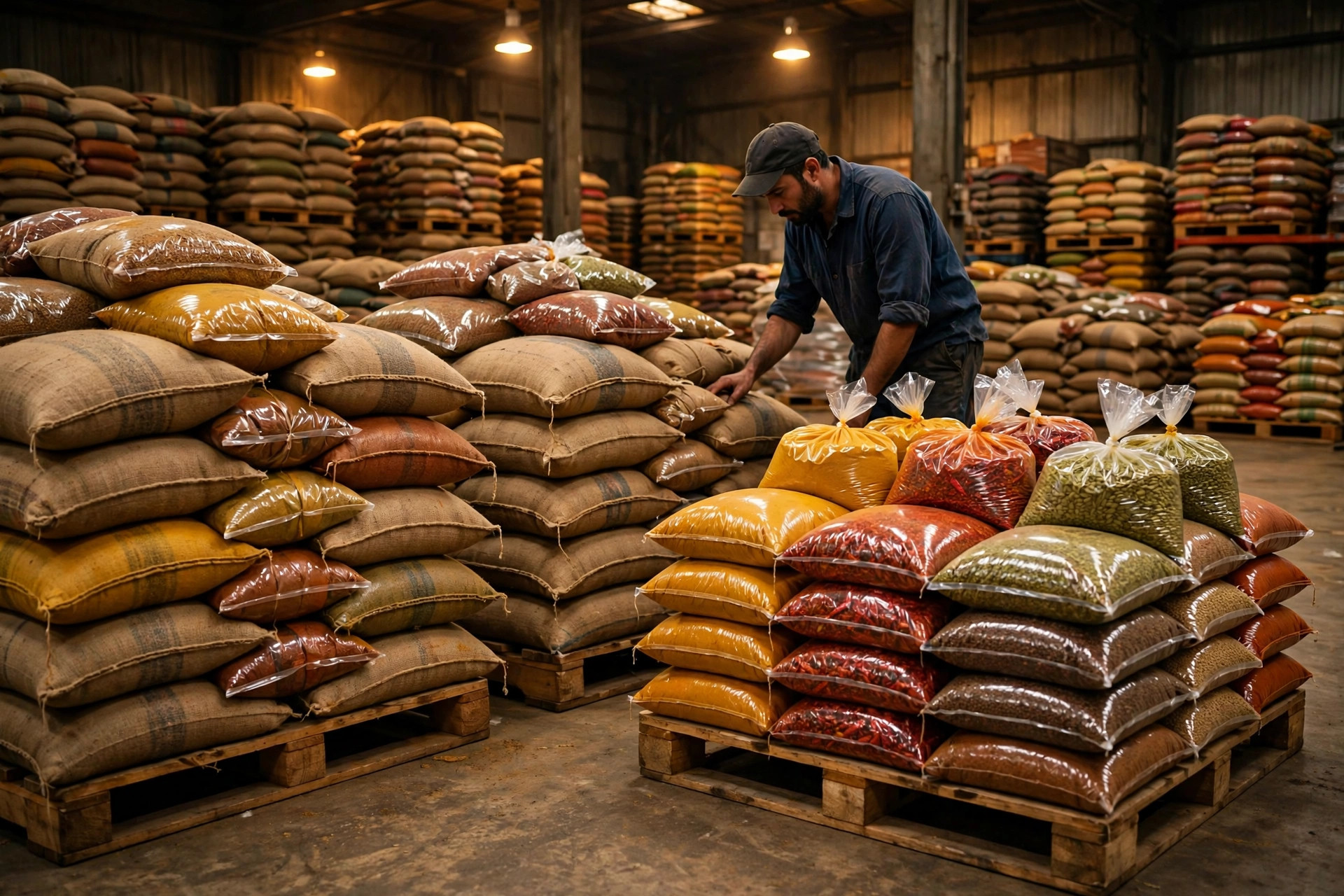
Most people manage moisture by putting a few dehumidifiers in the warehouse and relaxing when the hygrometer looks good. That is like watching a thermometer and calling it a diagnosis. What actually matters is the dew point. At night the temperature falls, vapor in the air condenses on the inside of the bag, and the outside of the bag looks dry while the inside is already damp. A Kerala warehouse in monsoon season runs above thirty degrees by day and drops toward twenty-five at night, and that swing is enough to condense water inside an unlined woven bag. The fix has three layers: a roofed, sun-shielded building outside; pallets kept off the floor and off the walls in the middle; and a moisture-barrier liner inside the bag, sealed, with ventilation gaps left between stacks.
Whether the moisture money is worth it comes down to one number: the loss from one downgraded container divided by a year's moisture-control spend. If the ratio is above one, the spend pays. In every client I have run this for, the ratio rarely drops below three. Moisture control is small money against a large loss.
Cross-Odor: Strong Smells Get Their Own Zone
Spices differ enormously in odor strength. Black pepper, clove, and cumin are offensive players; turmeric and coriander seed are mild. You can think of it as putting perfume and garlic in the same refrigerator: eventually everything in the fridge tastes like one thing. The dividing line is simple. Strong-odor spices get their own zone, separated by a solid wall or at least a buffer of several meters, and the ventilation must not share return air, because shared return air carries odor evenly from one zone to another. An underestimated odor source is pallets and forklifts. A wooden pallet that carried clove and was never cleaned will pass its smell into a cardamom bag. Strong-odor categories need dedicated pallets, cleaned before any category change. In 2023 an exporter lost a whole cardamom shipment this way: the buyer detected an off-odor, rejected the lot, and the exporter ate the freight and inspection cost.
India Spice Export Warehouse Lots: Time Measured in Aroma, Not Dates
Spice does not have a switch that flips at expiry. Aroma leaks away gradually. Lot control therefore means first-in, first-out, but not by arrival date alone. It must be by origin lot and processing date. The same cardamom processed a week earlier and a week later can differ by a whole grade in aroma strength. In the warehouse I run one lot per pallet with its own label carrying three numbers: origin, processing date, and arrival date, and outbound picks sort by processing date, not arrival date. That detail saved one client whose late-2022 processed cumin arrived after early-2023 processed stock. Picking by arrival date would have shipped the newer stock first and left the older stock aging until it had to be downgraded. Switching to processing-date order cut inventory dwell by nearly a third.
A second real lesson came in the 2023 monsoon, when a small roof leak sat directly above a stack of turmeric powder. The woven outer bags looked fine; opened, the top dozen bags had already caked. The loss was small, but it exposed a gap: roof, wall, and drain checks were not on the daily inspection sheet. The exporter added a weekly roof, corner, and drain check, twice weekly in monsoon season, and never had a repeat. Inspection is the cheapest layer of the whole moisture system, and skipping it wastes every other layer.
The Selection Line and the Maintenance Traps
When does a spice warehouse need full climate control, and when is an ordinary warehouse with moisture protection enough? The line is drawn by value and odor sensitivity. High-value, high-sensitivity spices such as cardamom and saffron justify climate control, because the cost spread over each kilogram still leaves margin. Bulk, low-value spices such as black pepper and turmeric do not: ordinary storage plus liners and zoning is enough, and climate control would push cost above what the market pays. I will be blunt about the pseudo-requirement here: vendors push full nitrogen preservation for spice warehouses, and it sounds impressive, but nitrogen only makes sense for a handful of very high-value spices. Putting bulk spice under nitrogen is like storing potatoes in a vault.
The maintenance traps are three, and all of them are boring. Dehumidifier filters uncleaned for three months lose half their capacity with nobody noticing. A torn moisture liner never gets patched, and the tear is a water channel. A temperature and humidity logger runs out of battery, and the gap in the record lands exactly in monsoon season, so when something goes wrong there is no evidence. One monthly maintenance sheet with three checkboxes, filters, liners, loggers, beats any expensive equipment nobody maintains.
| Comparison | Ordinary warehouse plus moisture zoning | Climate-controlled warehouse |
|---|---|---|
| Best for | Bulk spices (black pepper, turmeric) | High-value sensitive spices (cardamom, saffron) |
| Core spend | Liners, zoning, ventilation | Temperature and humidity control plus backup power |
| Biggest risk | Monsoon condensation, pallet cross-odor | Equipment failure with record gaps, cost spread too thin |
| Decision test | Downgrade loss divided by moisture spend above 1 | Per-kilogram cost must not eat the margin |
India spice export warehouse storage has no magic. Isolate moisture, isolate odor, isolate time with lots, and check the dew point instead of the hygrometer reading. Whether the money is worth it comes down to one number: how much downgrade and rejection loss falls, divided by what you spent on isolation.
By Da Liu, Automation Engineer