Fall 2021, a 120,000-square-foot 3PL warehouse outside Ontario, California. The tenant was in auto parts, so the floor always held a few dozen drums of hydraulic oil and cutting fluid. Late on a Friday afternoon, a forklift clipped a pallet on a turn. The 55-gallon drum on top rolled off, its lid cracked against a rack upright, and hydraulic oil started running across the concrete toward the low side of the building. Within ten minutes it reached the storm drain by the parking lot.
The shift supervisor did the right thing first: grab the absorbents. But the bag of universal pads he carried over covered barely half the spill. The pads ran out before the oil did. The warehouse had no containment berms, and nobody thought to block the drain inlet. Once the oil entered the drain, it was gone. Monday morning, the environmental inspectors showed up — that drain fed the municipal storm system, and nobody could say how far the sheen had traveled. The fine ran five figures, and that was before the bill from the professional cleanup contractor.
I have remembered that incident for years. Not because of the fine, but because nothing in the whole chain was a mystery. Nobody was ignorant. Everything was just under-stocked and under-practiced. Spill response was never a chemistry contest. It is a contest of whether the right stuff is in the right place and whether anyone has actually touched it.
What the Law Actually Asks For
Two agencies, two sets of rules. Neither is deep, but both matter.
On the OSHA side there is 29 CFR 1910.120, the HAZWOPER standard. The core requirement is simple: if your warehouse stores hazardous materials, the employer must have a written emergency plan, and employees must know who to call, where to rally, and who is qualified to clean up a release. Note that word — qualified. The standard does not want an untrained picker charging at a chemical spill. In too many warehouses the emergency plan lives in a filing cabinet and nobody can tell you which page lists the assembly point. That is exactly what an inspector will ask about.
On the EPA side there is the SPCC rule, 40 CFR 112, which covers oil. The threshold is concrete: facilities with 1,320 gallons or more of aboveground oil storage, or any single container of 660 gallons or more, need a spill prevention plan. Do the math and you will see how low that bar is — twenty-four 55-gallon drums puts you over it. A mid-size auto parts or lubricants distributor crosses that line without trying. The plan has to spell out how oil stays out of waterways: storm drains, sewer inlets, the sloped apron by the dock door. Those are the spots an inspector's eyes go to first.
I will not recite the legal text here; read the regulations themselves for that. My verdict is this: the law never asked how many cases of pads you bought. It asked whether you have a written, practiced response logic. Absorbents are the cheapest part of that logic. Do not economize there.
Three Colors of Pad — Don't Buy the Wrong One
This is the most practical section in the whole piece. Absorbent pads come in three materials, and the color is the industry's common language. Buy the wrong color and you bought the wrong function.
White pads absorb oil and repel water. Polypropylene, tossed onto water, pulls the oil off and leaves the water alone, soaking up roughly 20 to 25 times its own weight. Hydraulic oil, motor oil, diesel — white is the answer. One detail people miss: white pads degrade in sunlight. Store them away from UV or they turn brittle within a year.
Yellow pads are for chemicals and water-based liquids — acids, bases, water-based cleaners. The material stands up to corrosive chemistry that can dissolve white or gray pads outright.
Gray pads are the generalists. They absorb a bit of everything and excel at nothing. Coolant mixed with oil and wash water, a floor where you cannot tell what leaked — gray is your stopgap.
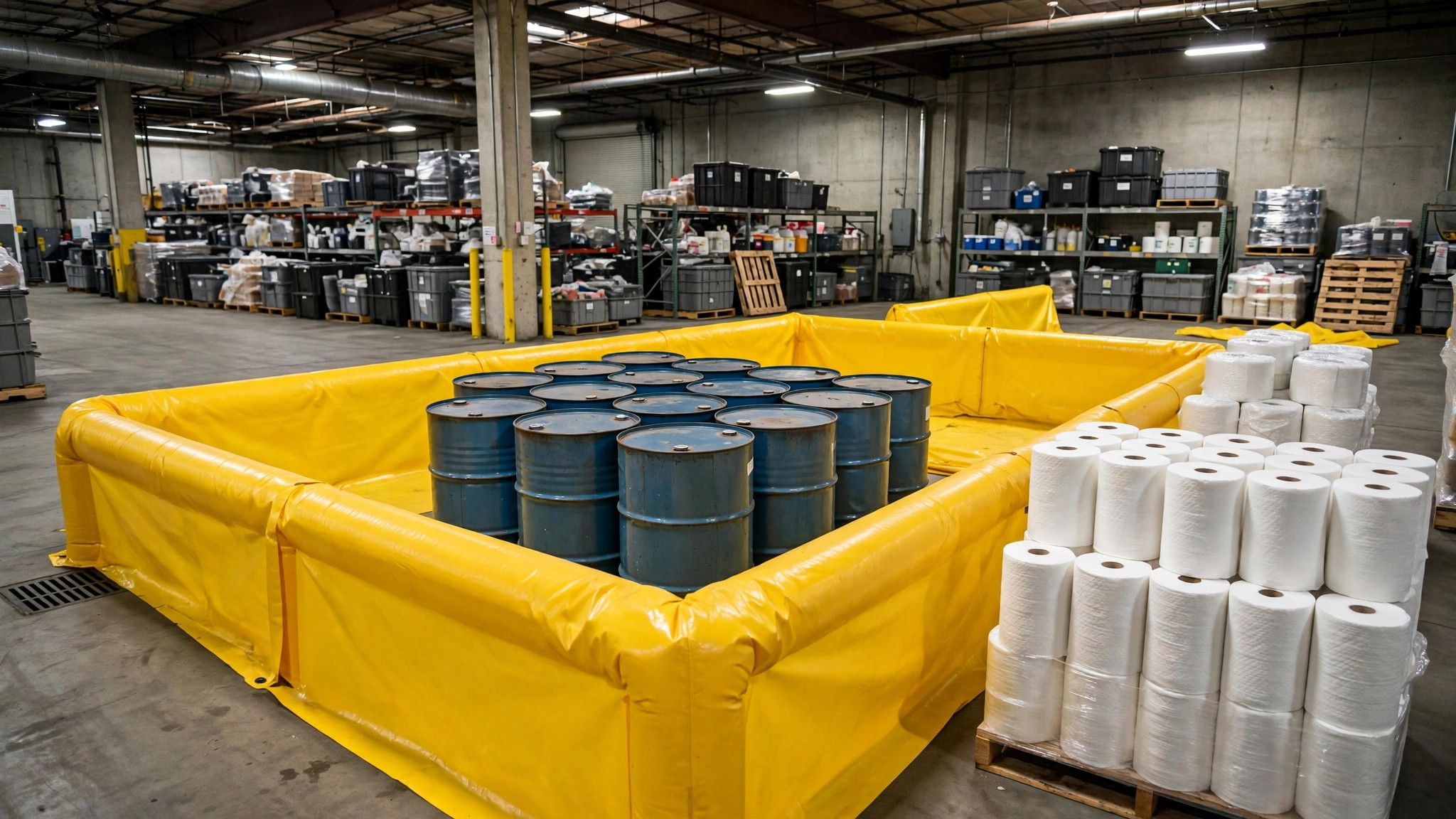
Form factor matters too. Socks are long tubes for ringing a spill and stopping the spread. Pillows are flat and slide under equipment and into the gaps between drums. For wide floor spills, lay down flat pads one sheet at a time. Berms are a different animal — those bright yellow foam or inflatable barriers that sit folded until you need them, then ring the drum storage area and draw a circle the spill cannot cross. Neutralizers handle acids and bases: spread them on, neutralize, then clean up.
I learned the color lesson the expensive way. Years ago I specced an all-gray universal kit for a client, figuring one SKU was simpler. Then thermal oil leaked onto a floor that had been mopped the day before — standing water everywhere. The gray pads went down and drank the water and the oil together, saturating in minutes while most of the oil sat there untouched. We just stood around it. Since then my rule has been absolute: any area with a known oil inventory gets white oil-only pads, and gray pads live only where nobody can predict what will leak. Separate the colors and nobody grabs the wrong one in a hurry.
How Much, and Where: My Rule of Thumb
The regulations will not tell you how many cases to buy. Here is the back-of-the-envelope method I have used for over a decade, and it holds up.
First, the quantity: size your absorbent capacity at 1.5 times your largest single container. If you store standard 55-gallon drums, plan for roughly an 82-gallon release. Why the extra half? Because real spills are never a drum emptying itself politely. The liquid runs everywhere, and part of every pad goes toward floor water and grime — efficiency takes a hit. That 1.5 multiplier came from being educated by reality, not from any standard I can cite.
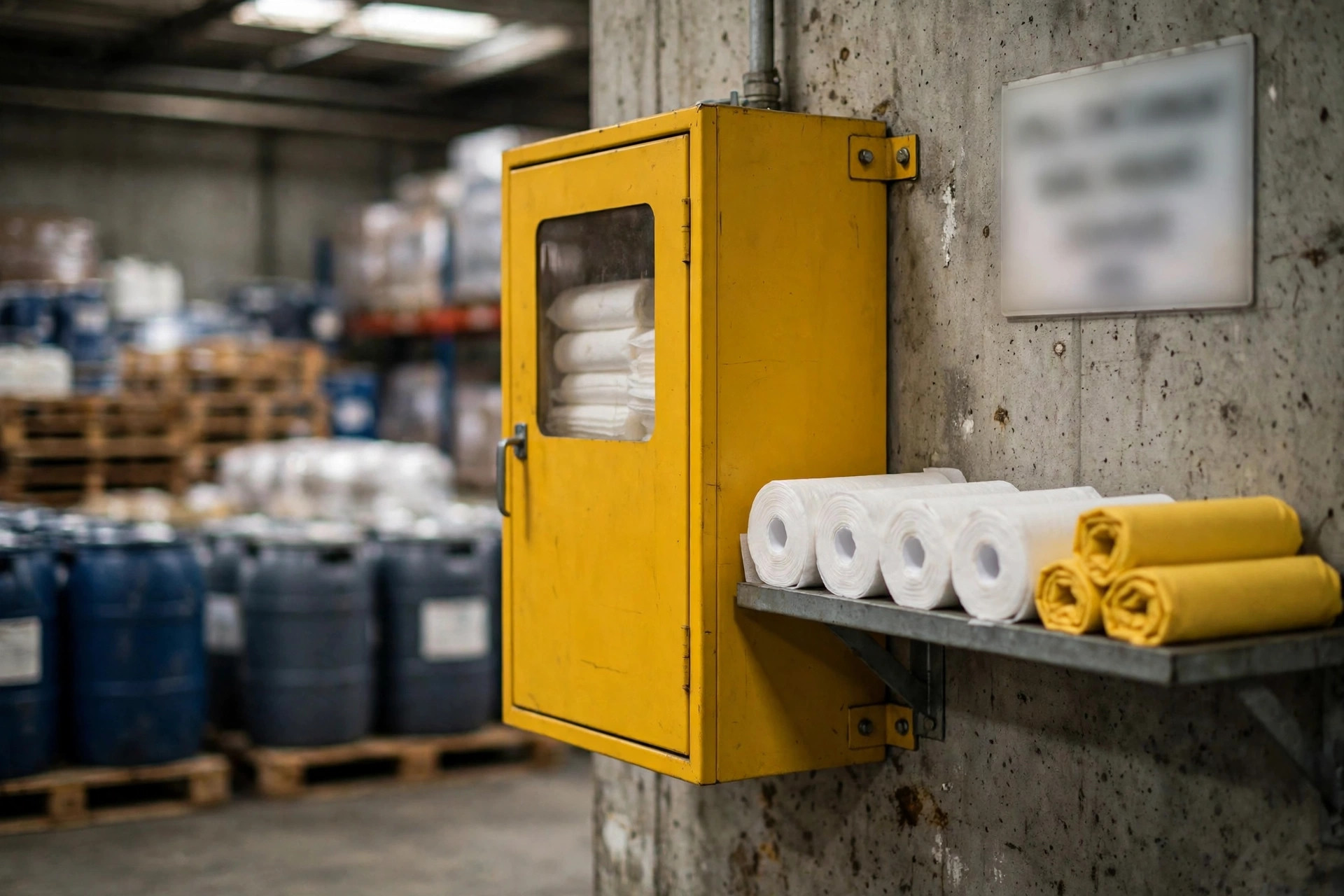
Second, the locations: every hazmat storage area gets a complete spill kit — pads, socks, gloves, goggles, disposal bags, all in one box, not scattered across three shelves. Then check three high-risk spots for an extra kit each: near storm drain and sewer inlets, at the loading dock, and along the travel path drums take in and out. In that Ontario incident, a kit hanging by the drain inlet would have changed the entire outcome.
For placement I give clients a "30-second rule": from anywhere in the storage area, you should be able to reach a kit within 30 seconds. That is my practice standard, not a legal requirement — I want to be explicit about that. Hang kits on the wall with clear signage. Do not lock them in a cabinet; nobody has patience for a key during a spill. Place them along the spill's likely path: know which way your floor slopes, where the liquid will run, and put the kit upstream of that line. And inspect every six months. Pads absorb ambient moisture, gloves age, packaging breaks down. A kit is not a buy-it-once asset.
Drills Are Not Theater
Stocking the gear is half the job. The other half is people.
My recommended cadence for clients is twice a year: one tabletop walkthrough, one hands-on drill. The tabletop runs the plan against the floor map — who finds it, who reports, who grabs the kit, who blocks the drain, who makes the call. The hands-on drill uses a bucket of water (never real oil), on a timer, to see how fast the team can ring it. The first drill almost always goes badly: someone cannot find the kit, someone grabs gray pads for "oil," someone watches from the sidelines. That is the point. Drills exist to fail safely.
Keep four things on record: the date, the scenario, who participated, and what went wrong plus the fixes. When OSHA visits, training and drill records are always on the checklist. A few years of continuous drill logs says more than ten speeches about how seriously you take safety. No records at all, and the inspector's mental scale tips against you before the walkthrough even starts.

One thing you can do tomorrow: before you leave today, walk your warehouse and find the spill kit nearest your hazmat area. Open it. Are there enough pads? Are the gloves still in there? Is the packaging intact or damp? If you cannot locate it within three seconds, it effectively does not exist. A spill will not wait until you are ready. It only rewards the people who already were.