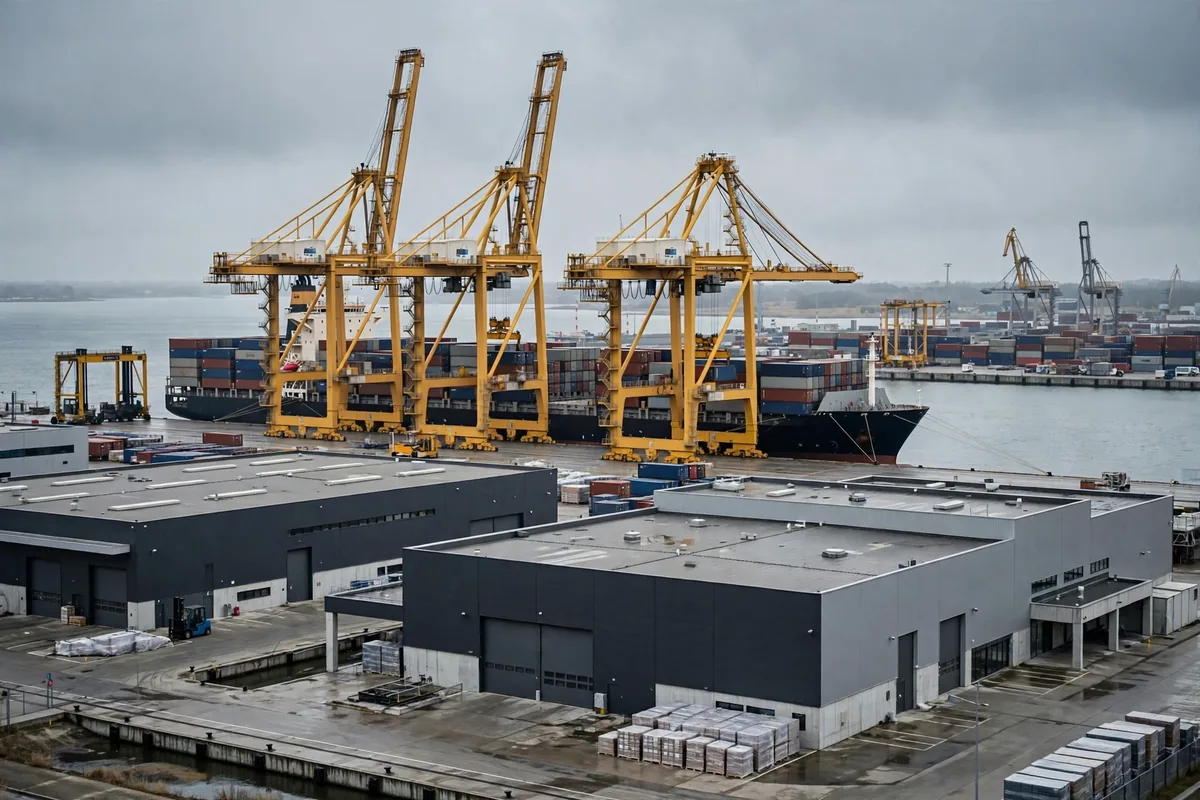
Let me start with the verdict, because Gdansk port warehouse logistics rewards people who do the math early and punishes people who fall in love with a map. Being close to the ship does not mean being close to the customer. Gdansk is Poland's largest port and a genuine deep-water gateway on the Baltic, with the Baltic Hub terminal able to handle ocean vessels directly. That is a real advantage. It is not, by itself, a warehousing strategy.
I have seen too many sellers hear "direct call, no transshipment" and sign for the closest warehouse they can find to the quay. The containers clear fast, everyone celebrates for a day, and then the bills start arriving from the line-haul to Warsaw, Prague, Bratislava, and Budapest. The first mile was cheap. Every mile after that was expensive. Trade-offs work like that: you never remove a cost, you move it.
Gdansk port warehouse logistics: direct call versus transshipment
The case for a direct ocean call is straightforward. A container that comes straight into Gdansk avoids an extra handling cycle in Hamburg or Rotterdam and avoids waiting for a feeder connection. For higher-value goods or products where a week of delay means a missed sales window, that certainty is worth paying for. Fewer touches also means fewer chances for a box to sit in the wrong yard at the wrong time.
The case against betting everything on direct calls is just as real. Hamburg and Rotterdam have denser sailing schedules. In peak season, frequency can beat geography. In autumn 2023, a Shenzhen seller of small appliances put all of his peak inventory on direct sailings to Gdansk and planned to distribute from a small portside shed to Warsaw and Prague. The sailing slipped, the portside space filled, and he paid for emergency moves to overflow space he had never inspected. The lesson was not that direct calls are bad. The lesson was that he had one entry point, one warehouse, and no fallback. The next season he split the flow: launch products on direct calls, replenishment stock through the larger northern European hubs into an inland warehouse. Less elegant, far more reliable.
A second case cuts the other way. In 2024 I walked warehouses with a Zhejiang auto-parts supplier who assumed Warsaw was the obvious answer because it is the capital and the biggest labor market. When we mapped his actual customers, many were in northern Poland and spread across Central Europe. Hauling every container south to Warsaw and then sending freight back north and west was pure backtracking. He ended up with a small portside site for devanning and cross-docking, and a larger inland site for inventory and picking. Neither site alone was the answer. The network was.
Use this rule: if your volume is stable, you can book early, and delay is expensive, prioritize the direct call. If your volume swings and you need schedule density as insurance, accept transshipment and go straight inland. Do not pay for a portside warehouse just to admire how close your containers landed.
Gdansk port warehouse logistics: portside speed or inland reach
Most first-time comparisons fail because they compare only rent. Rent matters, but ask for current local quotes and treat any number you read online as indicative only; do not budget on someone else's old deal. The decision should be made on total landed and distributed cost, and on what work the building actually has to do.
| Factor | Portside warehouse near Gdansk | Inland warehouse toward Warsaw |
|---|---|---|
| Container pull and devanning | Short dray, fastest turnaround | Adds an inland leg before work starts |
| Best role | Cross-dock, break-bulk, project cargo | Main inventory, picking, returns |
| Space profile | Often smaller, better for flow-through | Larger options, better for deep stock |
| Reach into Central Europe | Works, but line-haul planning is critical | Generally stronger carrier choice toward Warsaw and Central European capitals |
| Labor and services | More seasonal pressure at peak | Deeper labor pool and 3PL bench |
| Watch-out | Stock stuck far from final demand | Paying inland haul on freight that never needed to go south |
Read that table with your own order map in hand. If most demand is in northern Poland, or you move full pallets and heavy freight, portside can be the main act. If your demand is scattered across Poland, Czechia, Slovakia, and Hungary, and you live on parcel and LTL networks, the inland building should hold the inventory. My counter-intuitive advice for most Chinese sellers entering Central Europe is this: make the inland site your main warehouse and give the portside site a job, not the inventory. Devanning, inspection, palletization, and short-term staging belong near the port. Picking depth, returns processing, and safety stock belong near the demand and the carrier network.
There is a corridor from Gdansk toward Warsaw and onward into Central Europe, by road and rail. The corridor existing on a map is not the same as your warehouse running it well. When you tour a site, ask how many departures a day run to Warsaw, how freight for Czechia, Slovakia, and Hungary is consolidated, what the cut-off times are, and what happens in peak weeks when volume doubles. A warehouse that is slightly more expensive but departs twice a day will outperform a cheap warehouse that misses today's line-haul and quietly ships tomorrow.
Season and winter deserve blunt honesty. Peak season in Europe is a system-wide squeeze: port, line-haul, warehouse labor, and parcel networks all tighten at once. Capacity you have not reserved in advance is capacity you do not have. Winter on the Baltic coast also asks for buffer in outdoor handling and road schedules. Do not copy a domestic China lead-time promise and paste it onto a Baltic winter. Build the promise from the carrier's actual cut-offs and the warehouse's actual staffing plan.
So how should a seller make the first move? First, treat Gdansk as a northern gateway for Poland and Central Europe, not as a dot that automatically serves five countries well. Second, start flexible. Prove the full loop — customs, devanning, distribution, and returns — before you commit to a long lease or a self-operated site. Third, split roles if your volume justifies it: a lean portside function and a proper inland distribution center will beat one compromised building trying to do both jobs badly.
That is the whole game with Gdansk: the port gives you an excellent front door, but warehouses make money or lose it in what happens after the door closes.
By Lao Mi, Supply Chain Veteran of 20 Years