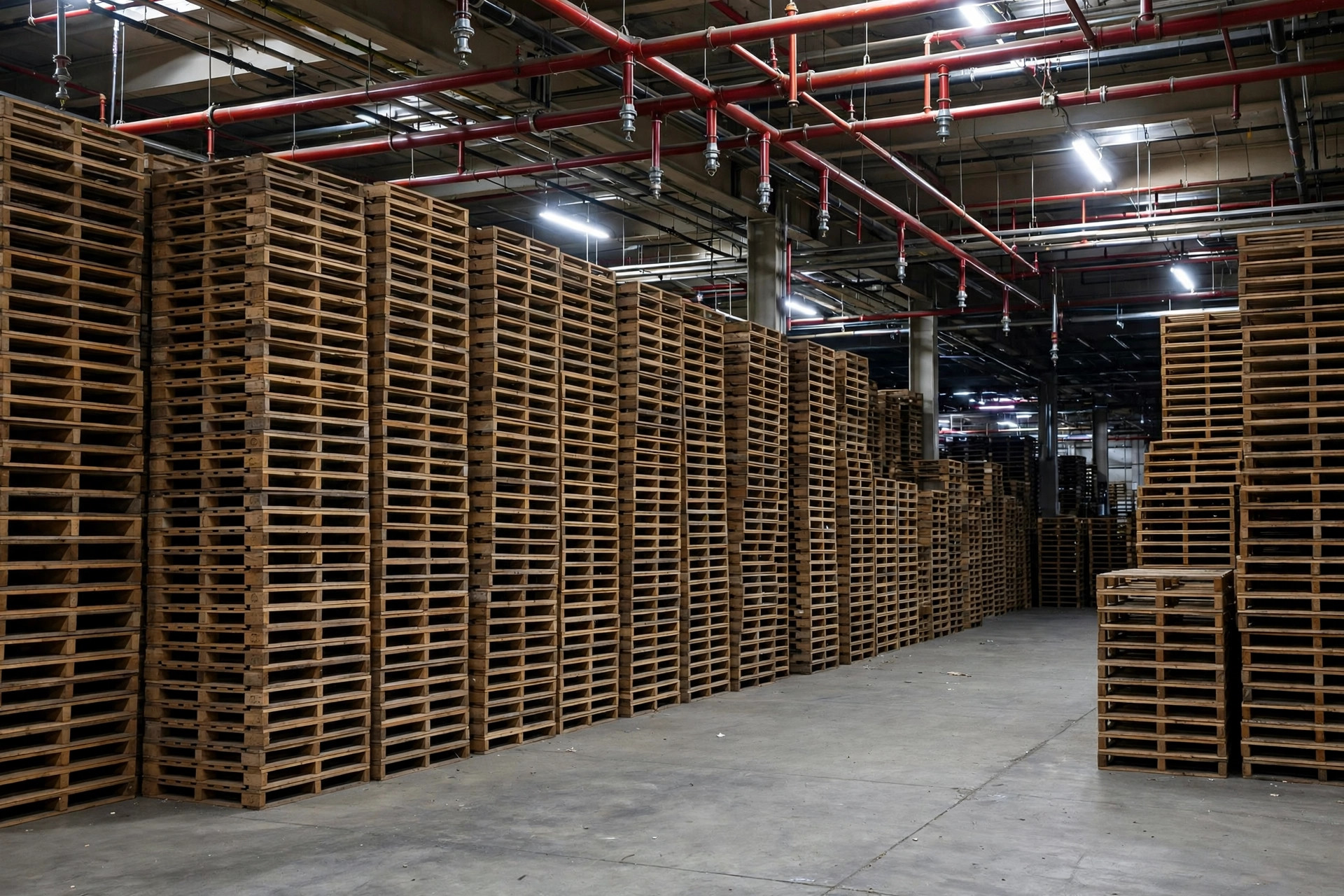
Last month I did a walkthrough at a 120,000-square-foot distribution center in Fontana. The battery charging area was squeezed into a corner by the receiving dock, pallets stacked behind the chargers, dried acid stains on the floor nobody had bothered to clean. The ops supervisor told me, "It's always been like this. Nothing's ever happened."
I didn't argue. But "nothing has happened" is not the same as "nothing is wrong." A charging area is one of those places in a warehouse that nobody manages day to day — until it becomes a headline. OSHA has a dedicated section for it: 29 CFR 1910.178(g), covering battery charging installations. Let me walk through it item by item: what the rule checks, how to fix it, and what procrastination actually costs.
Bottom line up front: you can bring a charging area into compliance in one focused afternoon. Don't wait for the citation. The fine costs many times more than the fix.
How Much Ventilation Does Hydrogen Really Need?
Lead-acid batteries give off hydrogen gas while charging. That's chemistry, not negligence, and you can't engineer it away. Hydrogen's lower explosive limit (LEL) is 4% — at that concentration in air, a spark can set off an explosion. OSHA 1910.178(g)(2) requires charging facilities to have ventilation adequate to keep flammable gas concentrations well below the LEL.
The phrase "well below" is doing the heavy lifting there. In practice, most warehouses handle this with exhaust fans above the charging area or by keeping the charging area in open or semi-open space where hydrogen can disperse naturally. Hydrogen is lighter than air, so it accumulates at the ceiling — ventilation has to work at the top, not at floor level. The worst setup I ever saw: a charging area inside a small enclosed room, door kept shut, three chargers running at once. That wasn't a charging area. It was a bomb waiting for a shift change.
How do you know your ventilation is enough? There's a rough field test: walk in during peak charging and hang around for a minute. If the air smells sharp or feels stuffy, your ventilation is probably inadequate. The serious version is hiring an industrial hygienist to measure hydrogen concentration once and keeping the report on file. That money is well spent — if something ever goes wrong, that report is your proof of due diligence.
One more thing people miss: nothing in the charging area should be able to make a spark. 1910.178(g) requires "no smoking or open flame" signage to be posted in the charging area. Posted — not "mentioned in orientation once." The first thing an inspector looks at is the wall. No sign, that's a citation. Put it at the entrance where people actually see it, letters big enough to read from the aisle, not on the back of a charger.
And the cables. Charging cables lying on the floor get run over by forklifts, the insulation cracks, and exposed conductors in a hydrogen-rich environment are exactly the spark source the rule is trying to prevent. My rule: every charging station gets a cable hook or a spring retractor, and cables go back on the hook after every charge. No dragging. Put it on the shift handoff checklist — the supervisor glances at it once a day. Done.
Where Does the Eyewash Actually Need to Go?
Handling electrolyte means handling sulfuric acid, and acid in the eyes is an emergency measured in seconds. OSHA 1910.151(c) requires flushing facilities wherever there's a risk of corrosive injury, reachable within 10 seconds. ANSI Z358.1 turns that into something enforceable: the eyewash or shower must be within a 10-second walk, on an unobstructed path, with a steady, continuous water flow.
What does 10 seconds mean? Roughly 50 feet at a normal walking pace. But the key word is unobstructed — there can't be a badge-access door between the charging area and the eyewash, no weaving around pallets. That Fontana warehouse I mentioned? Their eyewash was 100 feet away in a restroom, behind two doors. Functionally, that's the same as not having one.
My recommendation: mount the eyewash station within 10 to 15 feet of the charging area, line of sight. Then test the water flow weekly and log it. Water that sits in eyewash pipes grows bacteria, and flushing your eyes with contaminated water is a second injury on top of the first. Testing is simple: run it for three minutes, write it in the logbook. Five minutes a week.
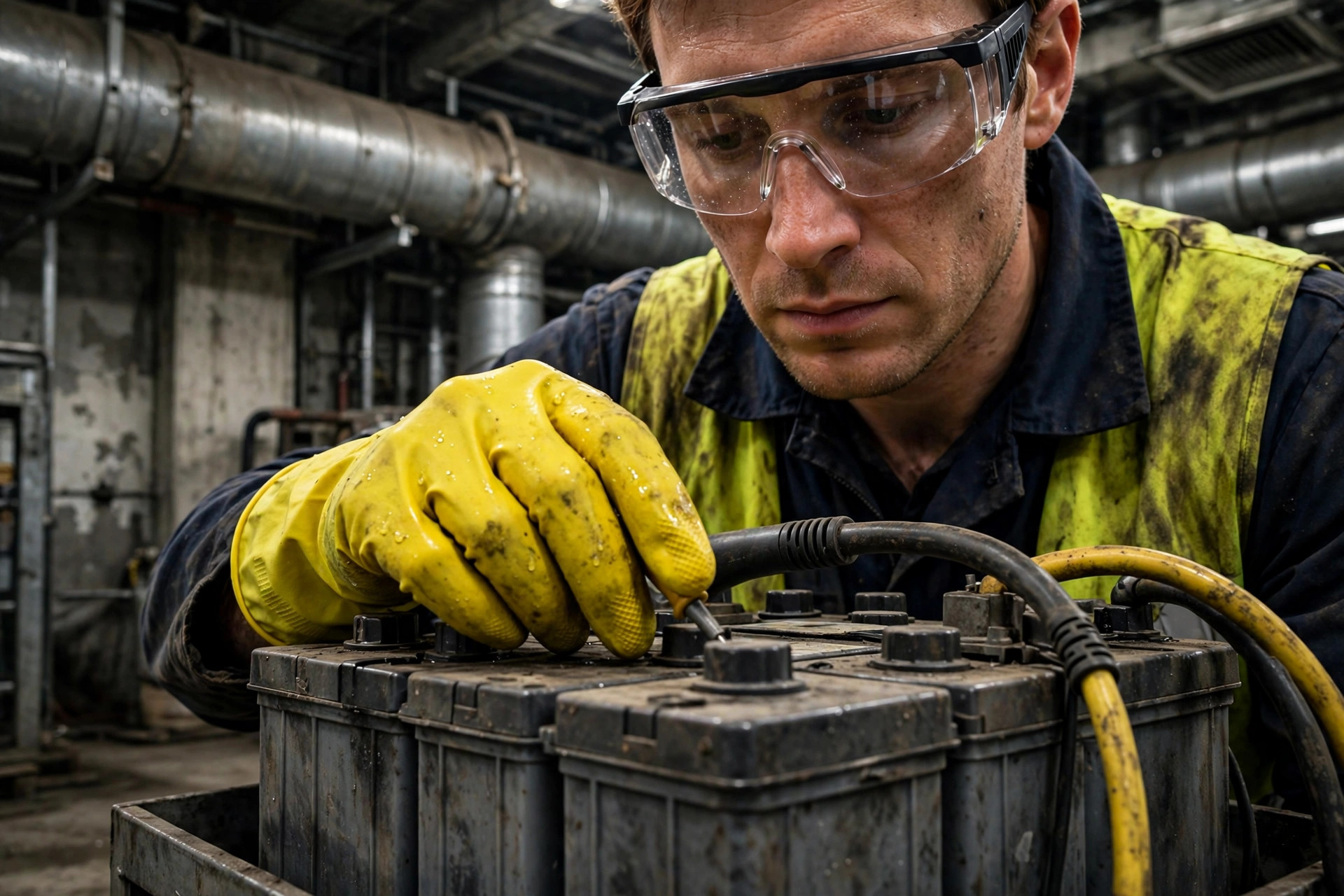
On PPE, the standard kit is: splash-proof goggles, acid-resistant gloves, and an acid-resistant apron. Note "splash-proof goggles" — not regular safety glasses. Standard safety glasses have gaps on the sides, and acid doesn't care about your compliance paperwork; it goes straight through the gap. Gloves should be long enough to cover the forearms. A lot of people skip the apron because it gets in the way, especially when topping off electrolyte — which is precisely the most dangerous step. My rule: hang a full PPE set by the charging area door. Whoever goes in to work wears it. The supervisor checks once a day and restocks what's missing.
If There's a Fire, What's the First Move?
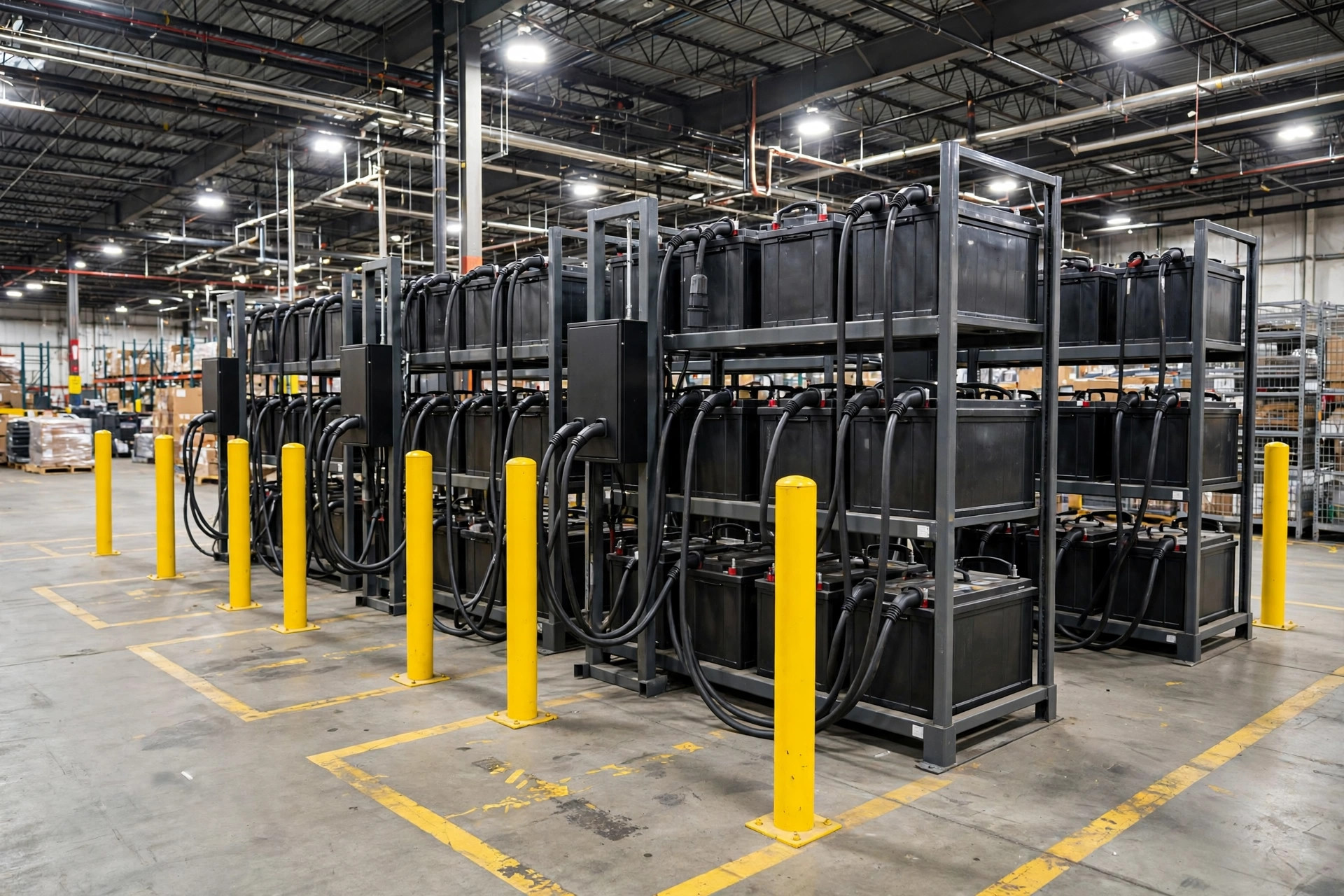
Start with the chargers. A charger is electrical equipment in a high-traffic zone, and 1910.178(g) expects charging equipment to be protected against physical damage. Forklifts moving in and out of the charging area will hit a charger eventually — it's a matter of time, not chance. The fix is cheap: bollards in front of the chargers, or mount the chargers on racks or walls where a forklift can't reach them. A bollard costs tens of dollars. A smashed charger with live conductors costs considerably more.
Then there's electrolyte level and specific gravity checks. OSHA doesn't mandate these directly, but they're the fundamentals of battery maintenance, and they tie back to safety: a battery charged with low electrolyte overheats, and overheating accelerates hydrogen off-gassing. Check levels at least weekly — electrolyte should cover the plates, top off with distilled water only. Tap water minerals damage the plates. Check specific gravity with a hydrometer; the target range comes from the battery manufacturer's spec sheet, not from your gut.
One sequencing detail that trips up a lot of people: add water after charging, not before. Electrolyte expands during charging — if you top it off before a charge, it overflows, and now you have acid all over the floor. This gets done wrong constantly. Call it out explicitly in training.
How do you handle an acid spill? Keep neutralizing agent on hand — baking soda is the standard. When a spill happens: PPE on first, cover the spill with baking soda, wait until the fizzing stops, then clean it up. Never just hose it down — acid running into the drain is an environmental violation, and the heat of dilution can cause secondary burns. Keep a spill kit in the corner of the charging area, labeled, and check every few months that the baking soda hasn't caked up from moisture.
And the fire question: electrical fires can't be fought with water. Keep a dry-chemical or CO2 extinguisher within easy reach of the charging area, and make sure people know where it is and how to use it. But the first move is always the same: kill the power. Mark the charger's disconnect switch clearly so anyone can find it in a panic. Cut power first, fight the fire second. Write that sequence into the emergency plan, post it on the charging area wall, and drill it once a year. One drill is enough for people to remember.
Now the trade-off nobody wants to talk about: most warehouses treat the charging area as "find a corner, plug it in," and stuff it into whatever space is least in the way. I think that's exactly backwards. A charging area should sit where ventilation is good, the eyewash is close, and there's room for vehicle protection — even if it takes more square footage. Get the location right and every compliance item becomes easy. Get it wrong and every item is a workaround.
Here's a checklist you can print and tape to the charging area door tomorrow:
- Ventilation is clear above the charging area; enclosed spaces have mechanical exhaust
- "No smoking or open flame" sign posted at the entrance, visible from the aisle
- Eyewash within an unobstructed 10-second walk; water flow tested this week
- PPE (splash goggles, acid-resistant gloves, acid-resistant apron) complete and undamaged
- Chargers protected by bollards or mounted out of forklift reach
- Electrolyte levels above plates; checked this week
- Baking soda / neutralizing agent on hand, not caked from moisture
- No uncleaned acid stains or standing water on the floor
Eight items. Check them off one afternoon. Don't wait for the inspector.