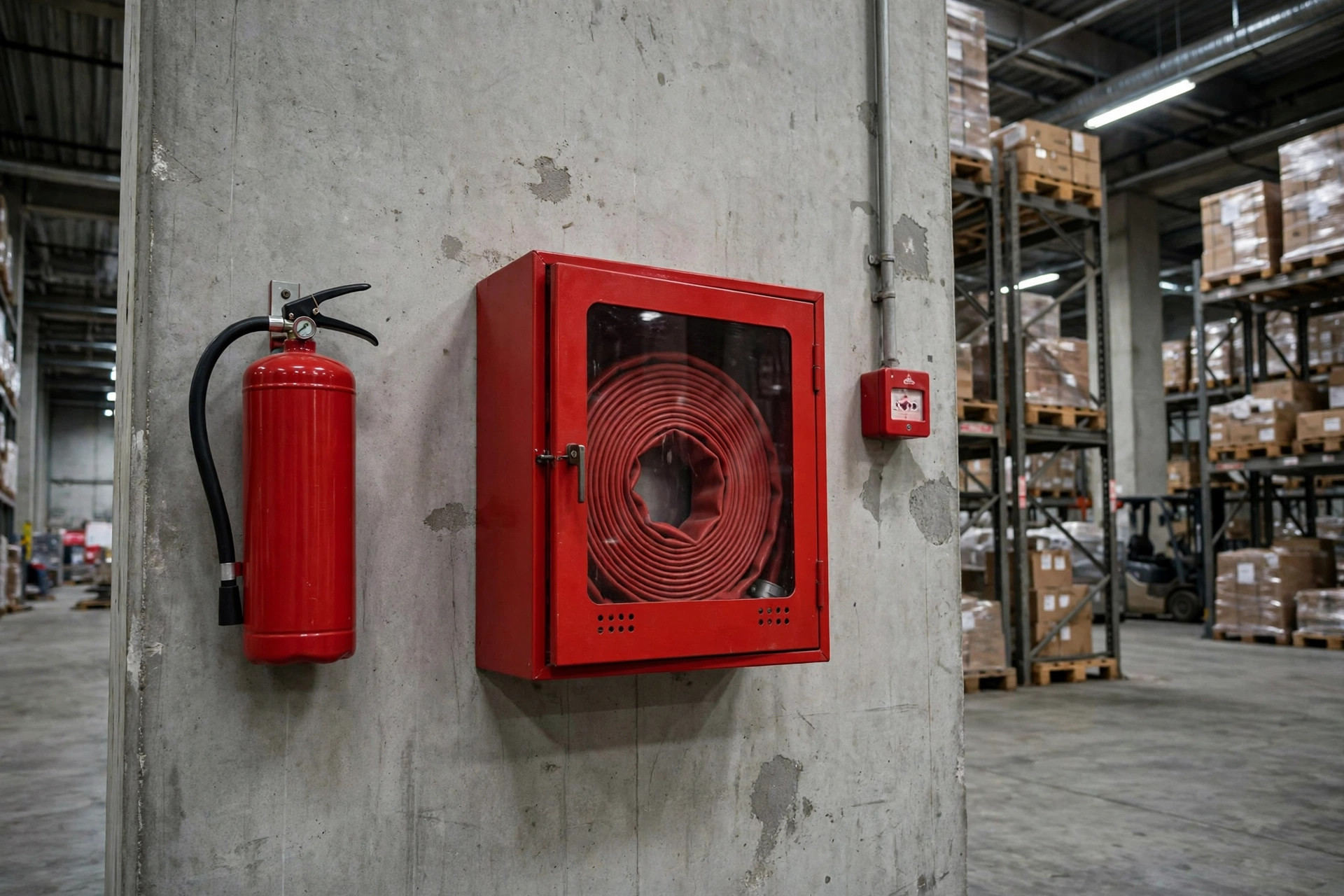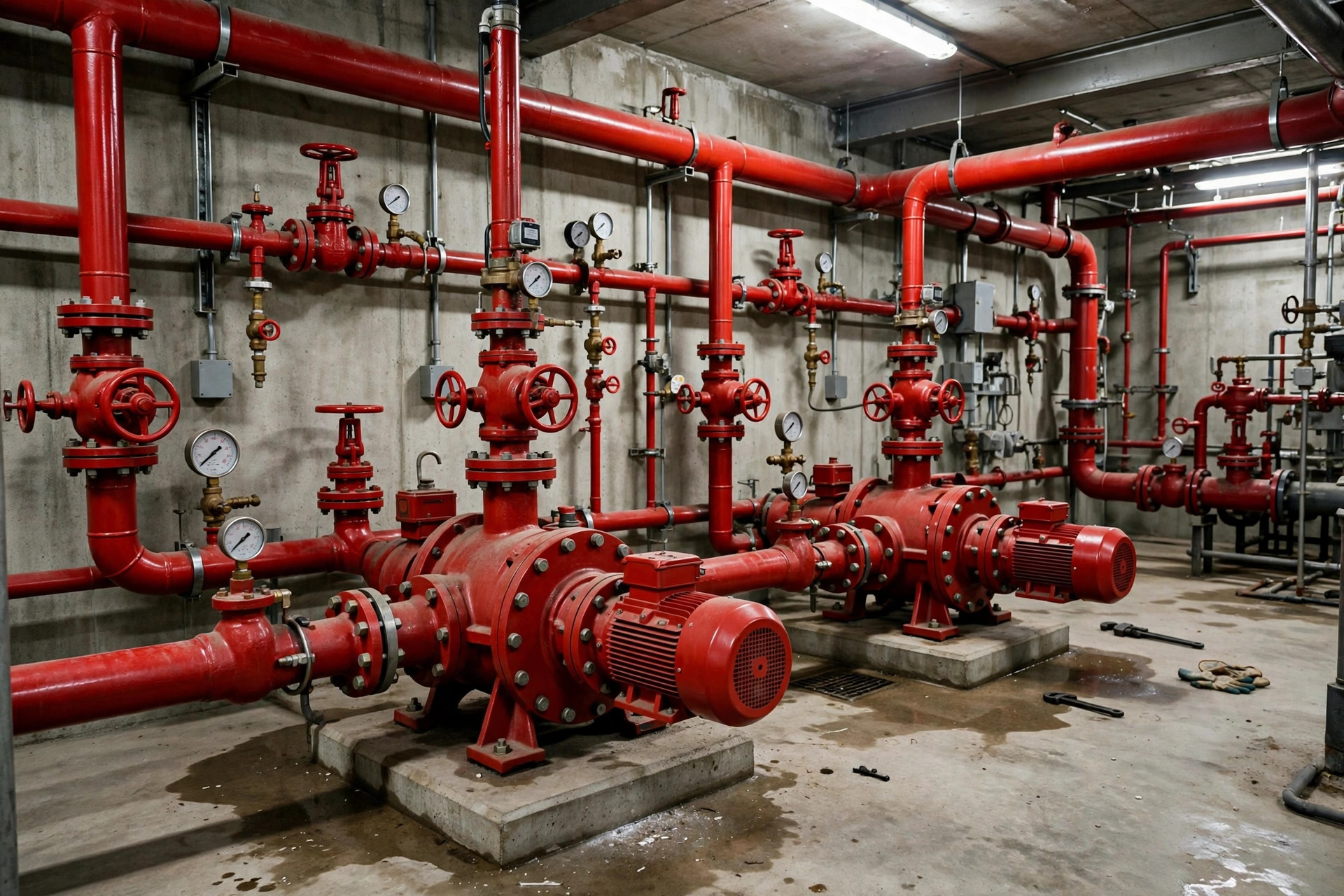
If a fire broke out in your warehouse tonight, how many minutes of water do you actually have?
Not the number on the design drawings. Not the number from the acceptance test five years ago. The real number, tonight, with your current racking, your current inventory, and your current tank.
Last winter I walked a 220,000-square-foot 3PL warehouse in Ontario, California, full of apparel and small home appliances. The fire safety manager showed me the sprinkler system with real pride: ESFR high-flow heads throughout, last year's annual flow test with a beautiful performance curve. I nodded, then asked where the water came from.
"City main, straight feed," he said. "Plenty of pressure."
"And if the city main goes down," I asked, "or the fire happens during peak demand hours?"
He went quiet. No fire water tank. No rooftop gravity tank. No diesel backup pump. All of his confidence rested on one assumption: the municipal supply will never fail.
That's what this article is about: fire water supply. Everyone spends money on the visible hardware — heads, pipes, pumps. But the water itself — is there enough, does it refill fast enough, is it clean, will it freeze — is the part most warehouses are clueless about. Twenty years in this business has taught me that warehouses love spending where the cameras can see, and gamble their lives where they can't.
Your tank was sized for a different warehouse
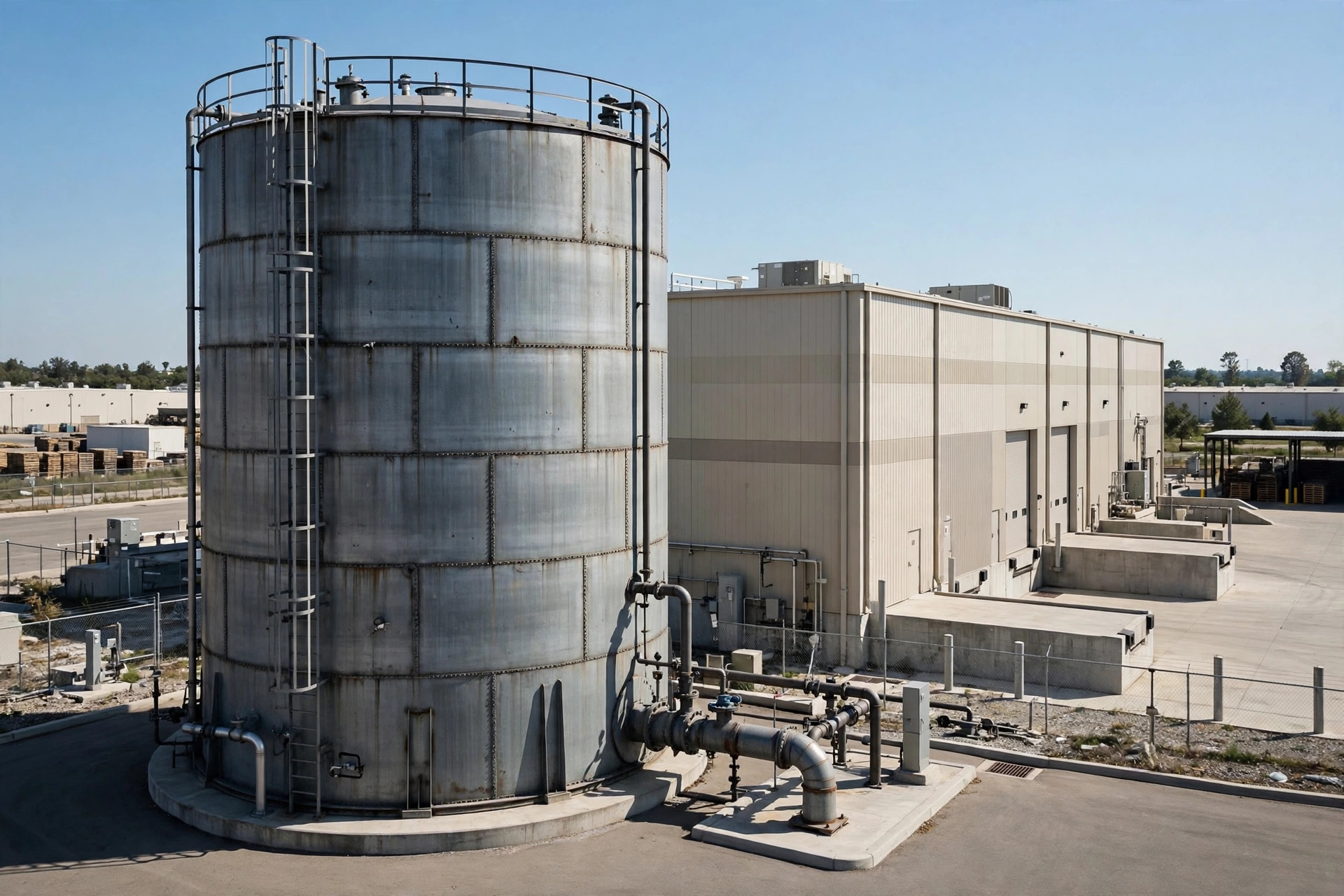
A fire water tank exists for one reason: to keep the system alive on its own when the municipal supply falters.
For how long? That number isn't a guess. During design, engineers calculate how much water the system drinks per minute at full demand — based on hazard class and sprinkler type — and multiply by the duration the code requires. The framework comes from NFPA 13 for sprinkler installation and NFPA 22 for water tanks: capacity equals flow times duration, the engineer does the math, the fire authority signs off. Every link in that chain is documented. In the real world, though, too many tanks are "close enough": a warehouse adds racking and goes from conventional storage to high-piled, the sprinklers get upgraded to ESFR heads, but the buried tank stays sized for the old system. Head demand multiplies several times over; in a real fire the tank drains in minutes and the remaining heads spray air.
A furniture warehouse in Riverside learned this the hard way in 2023 — not through a fire, but through the annual inspection. The testing contractor ran the flow test and watched the tank level drop far faster than the calculations predicted. Three years earlier, a row of high-bay racking had been added, the sprinkler retrofit was done, and nobody mentioned upsizing the tank. The fix was a second tank of the same size piped in parallel — half a year of construction and permitting, during which the warehouse had to run at reduced inventory. Had the tank been upsized during the sprinkler retrofit, it would have cost half as much.
So my verdict is blunt: any warehouse that has changed its storage method, rack height, or commodity type should dig out the original tank calculation sheet. Does the duration on that sheet still match the sprinklers you have today? If not, nothing else matters until capacity is fixed.
One more trap: a tank's effective volume is not its nameplate volume. The sediment zone at the bottom can't be pumped out, the air gap at the top doesn't count, and what you can actually use is meaningfully less than the stamped number. A tank that never gets cleaned loses effective capacity year after year. Nobody reminds you of this. Put it on your own calendar.
Refill is the part nobody owns
Suppose the tank is big enough. Next: as water leaves, who puts it back, and how fast?
The logic is simple: during a fire, the pump pulls hundreds of gallons per minute — more for high-demand systems — and the city main or the refill pump has to replace it at roughly the same rate. Otherwise the tank empties before the designed duration is reached. An undersized refill line, an undersized refill pump, a refill valve seized shut — any one of these breaks the chain, and the prettiest capacity calculation in the world is worthless.
The most telling case I saw: an 180,000-square-foot cold storage warehouse in Fontana with a generously sized tank. Then one year, during the annual flow test, the crew noticed the tank level falling noticeably faster than the design predicted. They traced it to the refill line — during original construction, someone had downsized the refill pipe by one size to save a little money. Nobody had ever noticed, because the refill pump had never run at full load. The fix — replacing the pipe to the designed size and upsizing the refill pump one step — cost under twenty thousand dollars. Twenty thousand dollars to buy the guarantee that the tank won't run dry on the day it matters.
Refill has a silent killer: the refill valve got left closed. Many tanks refill through a manual valve. It gets closed for maintenance, and nobody opens it back up. NFPA 25 explicitly requires verifying that control valves are in the open position — the code is written down, but execution is human. Put "refill valve status" on the weekly inspection sheet, with a photo for the record.
And warehouses on a straight city feed shouldn't feel exempt. Mains get shut down for repairs, pipes burst, and pressure sags at peak demand. NFPA 25 requires a main drain test at least once a year — static pressure versus residual pressure, showing whether your supply is getting better or worse. Plenty of warehouses run it and never read the report. Compare the residual pressure line to last year's; if it's trending down, call the water utility now — not on the night of the fire.
Dirty water kills sprinkler heads
The third problem may be the most invisible: water quality.
Fire water sits in a tank for years. In a place like Southern California, summer heat turns it into a breeding ground for algae, microbes, and sediment. Scale and rust eat pipe walls from the inside, shrinking the effective diameter a little at a time. NFPA 25 requires an internal pipe inspection every five years precisely to catch this. But the tank water itself gets less attention from the code, and that gap is where the trouble lives.
What does dirty water do? Most directly, it clogs sprinkler heads. The orifice is small; one flake of rust or one clump of algae can choke flow at the worst possible moment. Worse is microbiologically influenced corrosion — certain bacteria accelerate corrosion on pipe walls, rotting the pipe from the inside while the outside looks fine, sometimes until it perforates.
I worked a case on a warehouse built in 2019. At its five-year internal inspection in 2024, they cut open a branch line and found scale plus corrosion so bad that the effective diameter at the worst spot was barely more than half the original. The cause was simple: the tank fill had no filtration, makeup water went straight in, sediment had never been cleaned out in five years, and sludge at the tank bottom was nearly a foot deep. The remediation was expensive: a full system flush, tank dredging, and a new filtration setup. All avoidable — half a day a year to clean the tank and look at the water color would have stopped this years earlier.
So my verdict on water quality: stop treating it as "the water utility's problem." It's yours. The tank is yours, the pipes are yours, and when there's no water in a fire, the insurer and the fire marshal won't be calling the water utility. They'll be calling you.
Winter adds one more gate: freezing. Wet systems in unheated warehouses, exterior pipe runs, and dock areas genuinely freeze. Some people reach for antifreeze — caution here. NFPA's restrictions on antifreeze systems have tightened considerably (there were fires where antifreeze fed the flames), with explicit limits on concentration and type. Never pour anything into the system yourself; follow the code and your licensed fire contractor.
Three sentences to close: capacity has to match the sprinkler system you have today, refill has to keep up with pump demand, and water quality needs an owner. Fire water is worth nothing on an ordinary day, and worth everything in the few minutes of a fire.
One thing you can do tomorrow: open the tank manhole and shine a flashlight in. Level at the mark? Water clear or green? Then check the refill valve — open or closed — and when the refill pump last ran. Under twenty minutes, and you'll know whether your sprinkler system actually has water.