We have a client in Ontario, California — a home-appliance distributor that took 12,000 square feet in one of our partner 3PL warehouses in 2024. Six weeks after move-in, the fire inspector came through and wrote up seven deficiencies. Six of them were about the sprinkler system. The lease was signed, the inbound containers were already scheduled, and three boxes were sitting at the Port of Long Beach. The client's owner called me: "Susan, if we can't pass inspection, my goods can't come in. Demurrage is hundreds of dollars a day. So tell me — who pays for the fixes?"
And here's one I lost. 2022, Inland Empire, a 200,000-square-foot prospect. I had worked that deal for nine months. Pricing done, payment terms done. At the final technical review, the client brought in an independent fire consultant to walk the building. The consultant stopped in the southwest rack aisle, looked up at the ceiling, and said: "Top-level pallets are stacked too close to the heads. The water pattern will be blocked. This will not pass." The client asked the landlord to add in-rack sprinklers. The landlord said no. The client signed the warehouse across the industrial park. Nine months of work, killed by the position of a sprinkler head.
After walking a few clients through fire inspections, I've learned one thing: on the inspector's checklist, the sprinkler system is where the most points get docked. And the vast majority of problems aren't "there's no sprinkler system." They're "there is a sprinkler system, but the water can't reach where it needs to go."
The Five Gaps Inspectors Love to Find
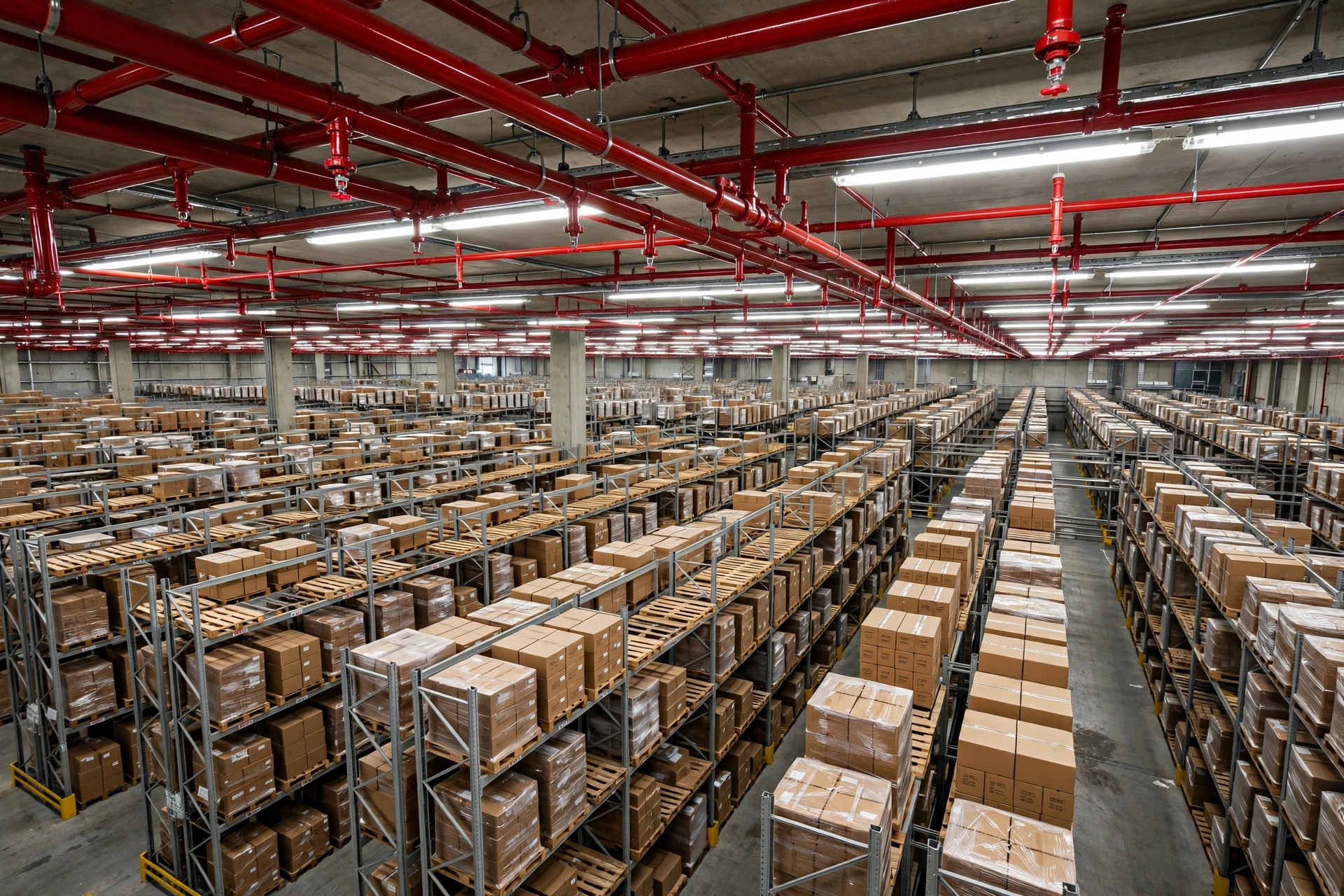
First, inventory smothering the heads. The most common way to fail. Ceiling sprinklers protect by spraying downward; once top-level rack inventory climbs too high, the discharge gets blocked. There's an industry rule of thumb — roughly 18 inches of clear space below ceiling sprinkler deflectors (confirm against your local fire department's current requirements). But in real warehouse operations, forklift drivers quietly stack one more pallet on top to save space. Inspectors don't need a tape measure. They look up and they know that aisle is doomed.
Second, the wrong sprinkler head for the building. Older industrial buildings have standard-response heads under the ceiling, but the racks have since been raised to 30-plus feet and now hold boxed consumer goods. A standard head simply cannot suppress a fire in that fuel package. The inspector sees that combination and will almost certainly require an upgrade to ESFR (early suppression, fast response) heads. That's real money and real lead time — the math comes later in this piece.
Third, structural obstructions. Big beams, ventilation ducts, cable trays, light fixtures — anything that splits the water pattern leaves a dry patch on the floor. Converted factories fail here most often, because the sprinkler layout was designed for the original empty building, and nobody ever re-verified head placement after the equipment and structures went in.
Fourth, "renovations" without new sprinklers. This is the tenant's own doing, and inspectors love digging into it: office partitions, packing canopies, enclosed QC rooms, mezzanine platforms. The builder wanted to save money, the wall went up, and the sprinklers never followed. The inspector steps into the new room, looks up at a bare ceiling, and writes the citation. The painful part: this remediation bill lands on the tenant almost 100% of the time, because you built it.

Fifth, the commodities changed but the system didn't. This one is a 3PL specialty: the aisle holds apparel boxes today, foam-packaged appliances tomorrow. The fire hazard classification jumps a full level, but the sprinkler design was approved for the original goods. The inspector asks, "What's stored in this section now?" compares it to the original fire design documents, and any mismatch is a deficiency.
The Counterintuitive Truth: Sprinklers Are the Only "Living" Fire System
Most people treat fire inspection as the fire department's business and the landlord's problem. Wrong. Smoke detectors, alarms, hydrants — once installed, they barely move. Sprinkler coverage is a living thing: add a rack level, change the stack height, put up a partition, and the protection capability changes with it. The more flexible your warehouse operation, the higher your sprinkler gap risk. That's why inspectors look up at the heads first and down at the racks second. And it's why you can't evaluate a warehouse on rent and location alone — you have to look at the ceiling before you sign.
The Remediation Checklist, Cheapest to Most Expensive
| Remediation | Who usually pays | Cost scale | Negotiation difficulty |
|---|---|---|---|
| Clear obstructions, lower top-level stacks | Tenant | Near zero, but you lose capacity | Low |
| In-rack sprinklers | Depends on lease terms | Thousands to tens of thousands per rack row | High |
| Ceiling upgrade to ESFR heads | Landlord's capital improvement | Tens to hundreds of thousands | Very high |
| New piping for partitions / mezzanines | Whoever built it | Billed by pipe footage | Medium |
Notice the second column: "depends on lease terms." That's where I do my real work.
Who Pays for Fire Remediation? Read the Lease, Not the Code
When landlords and tenants sign leases, everyone stares at the rent, the free-rent period, the escalations. The fire-compliance page gets skimmed and turned. Then the inspection fails, the freight can't come in, the remediation quote lands on the desk — and everyone discovers the lease either says nothing, or says "as-is delivery," which means: whatever fire condition this building is in, you accepted it.
After getting burned by that once, fire compliance became its own chapter in every lease negotiation checklist I hand to clients. It comes down to three things:
One, get a fire baseline inspection before signing. Both sides hire an independent fire consultant for a baseline inspection. Deficiencies that predate you — undersized heads, structural obstructions — are the landlord's fix or the landlord's money. Remediation triggered by your own operations later — partitions, commodity changes, taller racks — is on you. This draws the line between "history" and "your problem," and it gives you something to show the inspector.
Two, define delivery as "passed fire inspection," not "as-is." The lease should say explicitly: delays caused by the landlord's pre-existing fire issues that push back your move-in extend the free-rent period, with a formula for damages. Landlords hate this clause, which is exactly why it works — the moment it's on the table, the landlord starts taking his own fire baseline seriously.
Three, if the landlord won't pay for upgrades, take it out of the free rent. When the landlord says "I'm not paying for the ESFR upgrade," don't fight it head-on. Go after the free-rent period instead: ask for two or three more months, which is the landlord paying for it by another name. I've run this play several times. The CFO on the landlord's side runs the numbers and usually says yes.
Next time you're negotiating a lease, remember to ask these three questions:
- "Can I see this building's last fire inspection report?"
- "Does the lease say what happens to my free-rent period and damages if pre-existing fire issues delay my move-in?"
- "If I add partitions or change commodities, who pays for the extra sprinkler work — and is it written into the contract?"
Ask those three, and the other side knows you know the game. On inspection day, don't bet on the inspector being in a good mood. Do the math on the day you sign.
By Susan, 3PL Sales Director