
Let me put the verdict up front: the EU AI Act wasn't written for warehouses, but it landed squarely on the two tools warehouses use most — facial-recognition time clocks and algorithmic scheduling. I've spent 20 years in US warehousing, and this is the first time I've told American operators they should actually read a European law.
Here's the bottom line. The Act took effect on August 1, 2024. The banned practices — things like emotion recognition in the workplace — have been illegal since February 2025. High-risk systems tied to employment start carrying compliance obligations in August 2026. The fines are serious: up to €35 million or 7% of global annual turnover for prohibited practices, up to €15 million or 3% for most other violations — check the official EU text for the latest numbers, I'm not your lawyer. But the numbers aren't the real story. The real questions are: which risk bucket does your system fall into, and what does compliance actually cost? Two sides to this, and I'll walk through both.
The EU AI Act Sorts Warehouse AI Into Four Buckets — One Table
| Tier | Typical warehouse examples | What it means |
|---|---|---|
| Prohibited | Cameras analyzing worker emotions, "social scoring" of employees, real-time remote biometric ID in public spaces | Illegal, full stop |
| High-risk | Facial-recognition time clocks, algorithmic shift scheduling and task assignment, AI performance reviews, AI résumé screening | Usable, but you must comply: risk assessment, human oversight, logging, worker notification |
| Limited risk | Internal HR chatbot answering leave-policy questions | You must disclose it's AI |
| Minimal risk | Slotting optimization, demand forecasting, AMR path planning | Business as usual |
The key to reading this table is one word: identification versus verification. Plenty of time-clock vendors advertise "facial recognition," but there are two very different technologies hiding under that label. One-to-many identification means a camera scans a crowd and figures out who you are. One-to-one verification means you tap your badge first, and the system only checks whether the face matches that one badge. Under the EU AI Act, the first is "figuring out who this person is" — squarely high-risk. The second is "confirming this person is who they claim to be" — a much lighter compliance burden. Asking that one question during procurement can save you a fortune in legal fees later.
A Trap I Watched Happen: Face-Clocking Is a Money-Saver in the US
In 2023 I was on a project at a 3PL warehouse in Ontario — 80,000 square feet, 300-plus people. They had just installed facial-recognition time clocks, and the results were genuinely good: buddy punching basically vanished, time-clock disputes dropped from 40-plus a month to single digits, and payroll processing went from three days to one. The system cost a little over $40,000 with under $10,000 a year in maintenance. The owner thought it was money well spent.
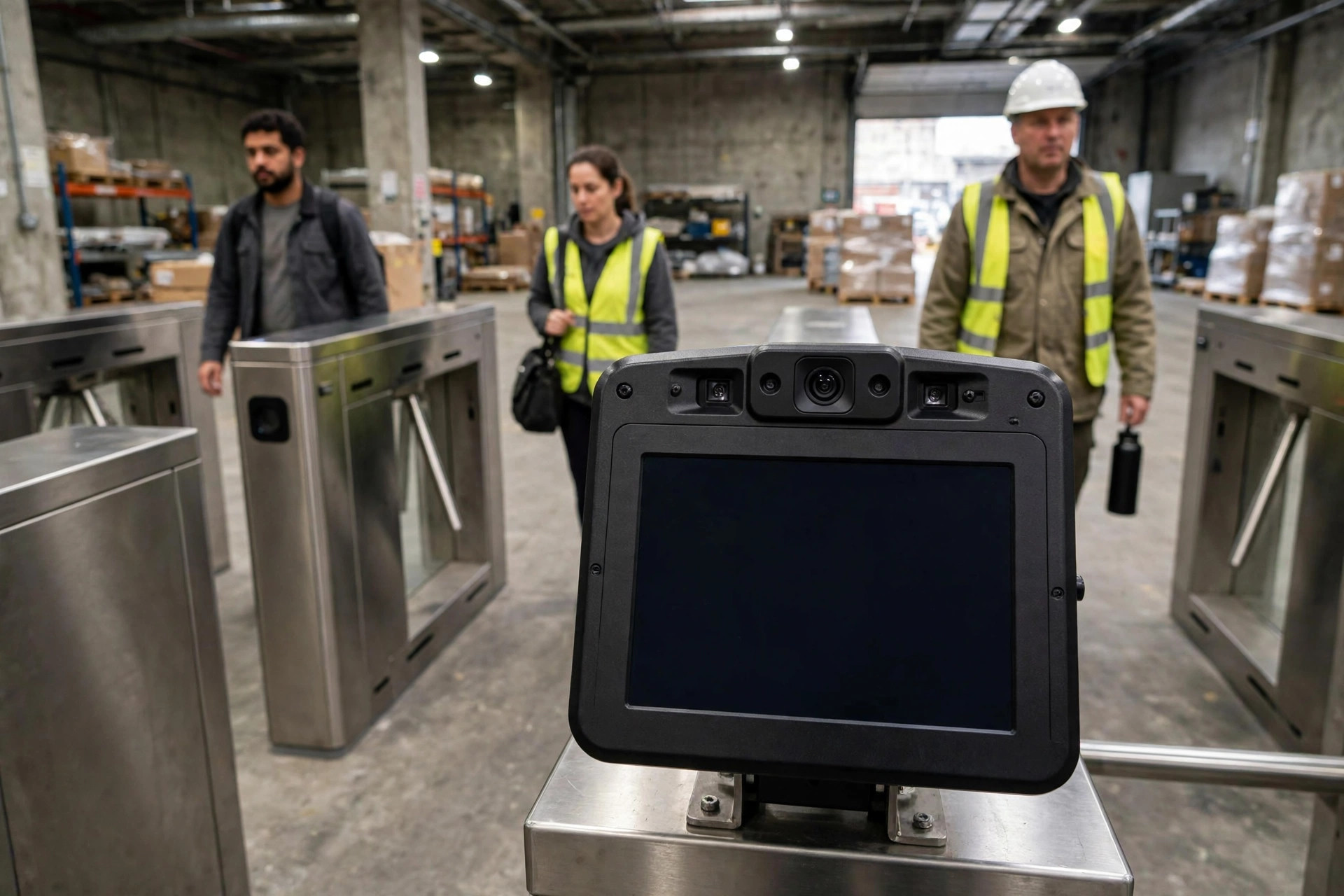
Then, at the end of 2024, the company opened a new facility in Rotterdam and wanted to copy the same system over. I told them to hold on. Their system ran in one-to-many identification mode — an employee walks past, the camera recognizes them, the clock punches in. In the US that's efficiency. Under this Act, workplace biometrics go straight into high-risk. The harder part is the human-oversight requirement: for high-risk systems, every consequential decision must be understandable, overridable, and attributable to a human. The clock misidentifies someone, overtime hours go missing — that used to be an IT ticket. Now it's a compliance matter.
Their eventual solution was telling: the Rotterdam site switched to badge-plus-face one-to-one verification. Tap the badge, and the system only confirms the face belongs to that badge holder. Functionally almost no difference — buddy punching stayed dead. But in compliance terms it moved from "identification" to "verification," and combined with written employee notice and log retention, their lawyer signed off. The Act isn't telling you not to use the technology. It's forcing you to separate "figuring out who this person is" from "confirming this person is who they claim to be." The first is surveillance. The second is a service. One word apart, totally different treatment.
Algorithmic Scheduling Meets the EU AI Act: I've Seen Too Many People Trip on "We Can't Explain It"
In 2022, an e-commerce fulfillment client in Phoenix — 20,000 orders a day at peak — rolled out an algorithmic scheduling system. It auto-built shifts and assigned tasks from historical productivity data, and the unofficial rule became "low efficiency gets night shifts." Three months in, labor productivity was up 12%, and management was thrilled. But the floor was furious — some people got night shifts three weeks running, and when they asked why, even their supervisors couldn't say. "The system decided." It ended at the union. The system got scrapped, and the investment went with it.
Under the EU AI Act, that kind of system is textbook high-risk: the Act explicitly lists "employment and workers management" in its high-risk catalog — hiring, task allocation, performance monitoring, all of it. Deployers have to run an impact assessment before go-live, guarantee a human can override the system's decisions, keep operating logs, and notify affected workers and their representatives.
Here's the counterintuitive take: I keep seeing people treat the EU AI Act as a cost. It's actually a filter. The real value of algorithmic scheduling was never "fully automated, nobody touches it" — it was turning scheduling from a supervisor's gut feeling into explainable, auditable rules. The human oversight and explainability the Act demands are exactly what these systems were missing in the US all along. If that Phoenix client had been forced to add a "why is he on nights again" explanation screen back then, it might never have reached the union. Money spent on compliance is, in a way, paying tuition for product design they should have done in the first place.
Complying With the EU AI Act Without Overpaying: Inventory, Classify, Do the Math
My approach has three steps, each with a concrete deliverable.
Step one: inventory within 30 days. List every AI in your operation that makes decisions about people — time clocks, scheduling, performance reviews, any surveillance camera with analytics. Most warehouses can't even name all the AI systems they're running. The inventory itself is lesson one.
One obligation people consistently miss: deployers must inform workers' representatives and affected employees before a high-risk system goes live — which processes use AI, what data goes in, what safeguards exist. I've heard of European warehouses where the union invoked exactly this clause: a scheduling algorithm went live without worker notice, and the union had it suspended. You can nail the technical compliance and still fail the procedural part.
Step two: classify against the table above. Shut down anything in the prohibited tier immediately. For high-risk systems, go back to your vendors and ask for conformity documentation. Here's something most people miss: the Act puts the heaviest obligations on the providers — the people who build the systems. Buy from a compliant vendor and your burden as a deployer shrinks dramatically. Writing "EU AI Act conformity documentation required" into your RFP is far cheaper than retrofitting compliance later.
Step three: do the math. Any AI output that affects an employee's schedule, pay, or evaluation needs a human who can understand it, change it, and take responsibility for it — that's the cost of "human oversight." A concrete example: a facial-recognition time-clock system with $10,000 a year in maintenance can easily add another $15,000–$20,000 a year once you layer on compliance assessments, log audits, and manual review workflows. Compliance costs 1.5 times the system itself. At that point you have to ask honestly whether the money saved on buddy punching covers it. If that cost (assessment plus logging plus oversight workflow) exceeds what the system earns you, fall back to "rules engine plus human confirmation." I've seen plenty of so-called AI schedulers where the rules-engine fallback performs within 5% at 80% lower cost. Don't pay a premium for the word "AI."
One last piece of advice: if your scheduling system can't explain itself well enough for a supervisor to defend its decisions, the EU AI Act will only be the first in line to cause you trouble — the union, the lawyers, and the departing employees are all queuing up behind it.
By Lao Mi, Supply Chain Veteran (20 yrs)