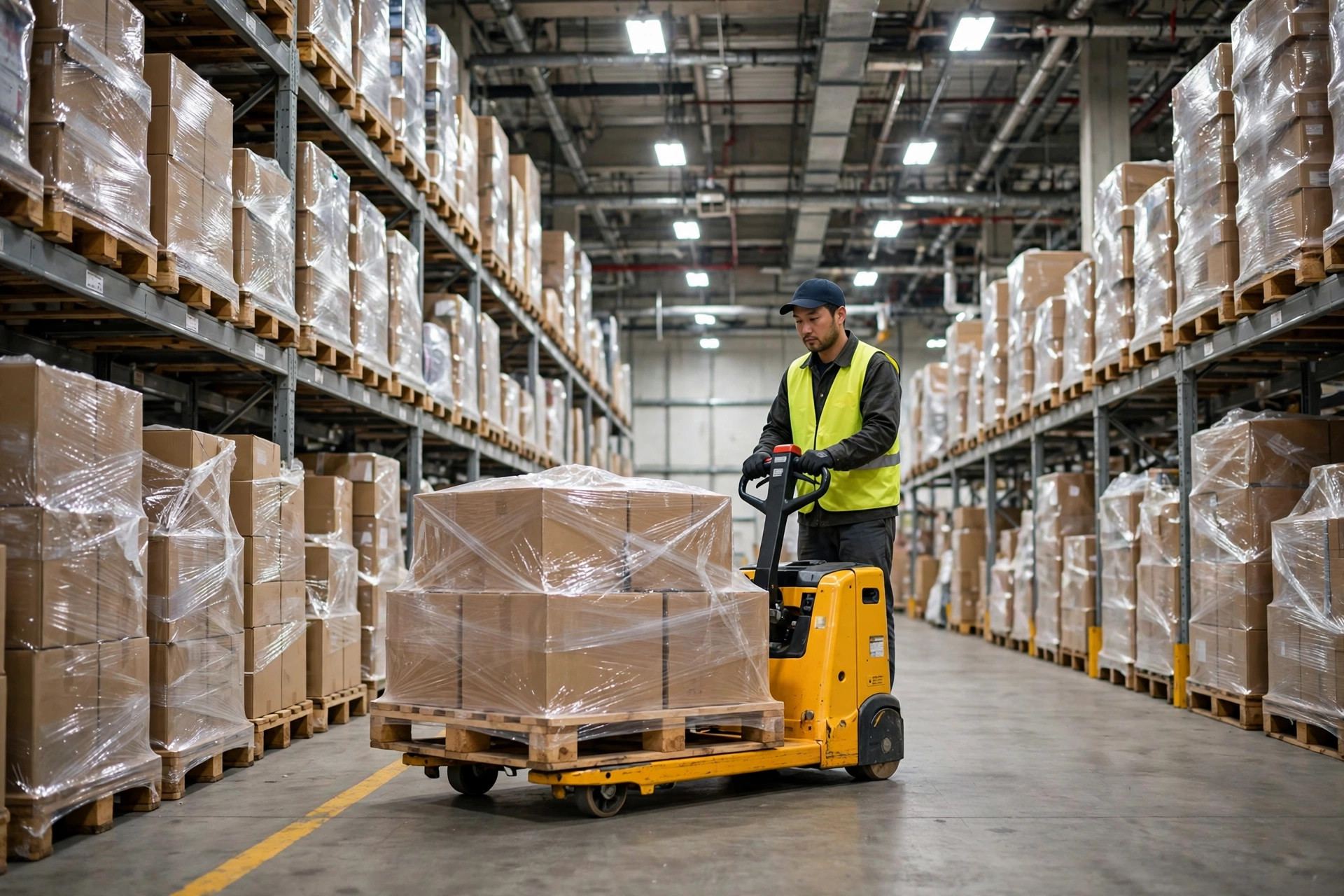
Let's start with the money. People keep asking me how much does an electric pallet jack cost, and if you Google it you'll get answers anywhere from a few hundred bucks to ten grand — which is about as helpful as no answer at all. So here it is, straight: in 2026, a mainstream lithium walkie-style electric pallet jack runs $1,500–$2,500. Go upmarket or ride-on and $4,000–$6,000 is normal. A manual hydraulic jack? $300–$800. The electric costs four to six times more up front.
But that number barely matters. What matters is this: a $2,000 electric jack in a warehouse paying $25 an hour, saving 30 minutes of labor a day, pays for itself in about 7 months. Saving only 10 minutes a day? It never pays back. This article isn't about specs. It's about the math — when electric is a money machine, and when it's a tax on wishful thinking.
Two Real Invoices, Two Different Answers
Case one: March 2024, a 3PL cross-dock in Ontario, California, moving about 80 pallets a day off inbound trailers. Two guys, each dragging a manual hydraulic jack from the dock to the staging area. Then the manager bought one lithium electric walkie for $2,200. One operator now handles the whole flow — electrics run roughly three times faster than manual, quicker travel, easier steering, about 40% more pallets per shift. The second guy got reassigned to putaway.
The math: one full headcount saved. At $25/hour, 8 hours a day, that's over $50,000 a year in labor. The incremental investment? $2,200 minus $400 for a manual — $1,800 — plus one battery replacement over five years (~$500) and the maintenance delta, call it roughly $3,000 total. $3,000 ÷ $50,000 — paid back in under a month. One of the fastest equipment paybacks I've ever seen.
Case two: November 2024, an auto-parts distributor in Ohio, 12 pallets a day. The owner heard electric was "the future" and spent $1,900. Here's the reality: unloading is a part-time chore there. The worker pulls freight for 40 minutes a day and spends the rest on picking and packing. The electric jack works 40 minutes and sits on the charger for 23 hours. Lithium batteries degrade whether you use them or not — three years later, a $500 battery swap, basically buying half a manual jack again. Meanwhile the $450 manual jack in the next bay is still going strong, year seven, two sets of wheels.
Same money. One was a goldmine, the other a write-off. The difference wasn't the machine. It was the pallet count.
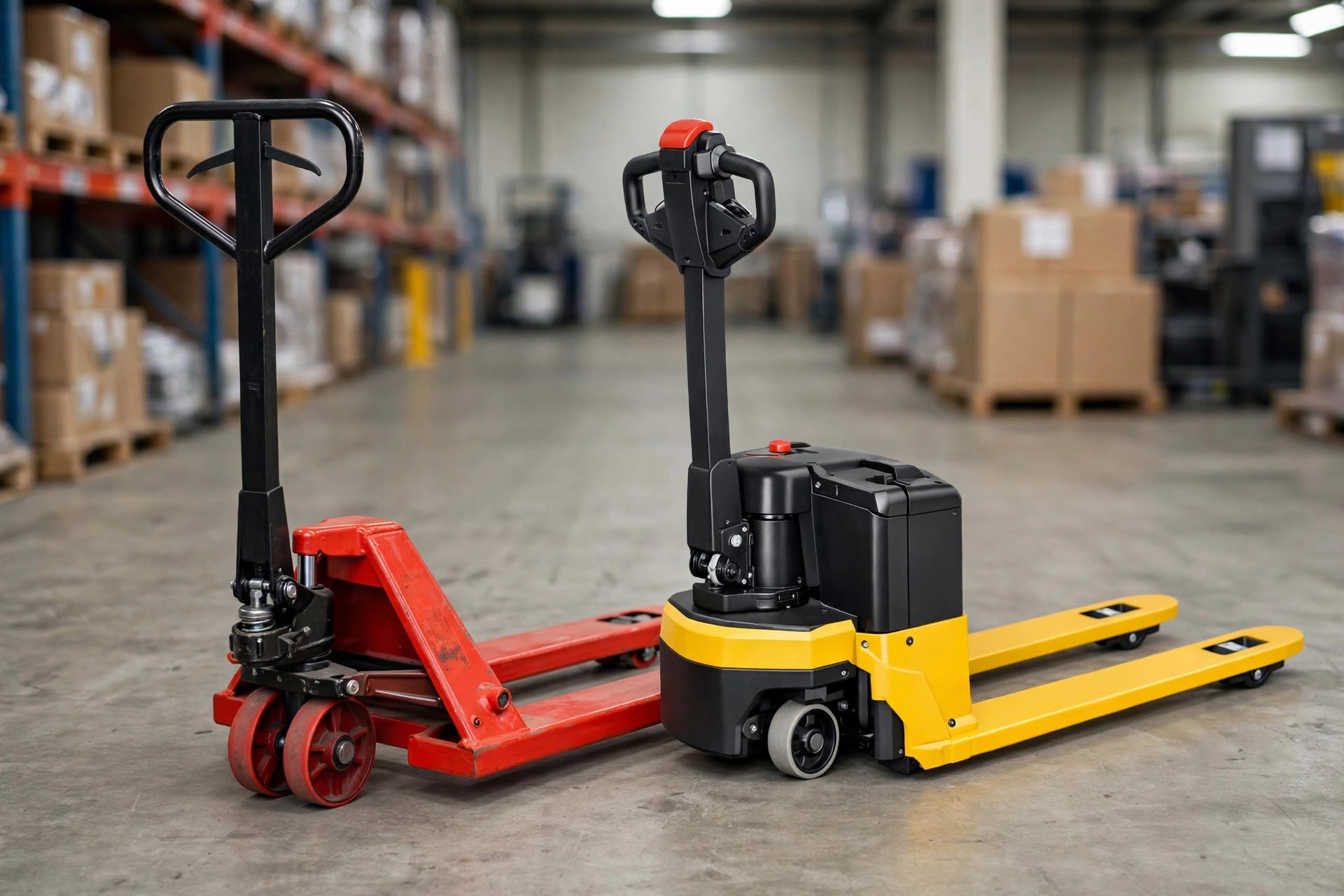
The Five-Year TCO: The Sticker Price Isn't the Real Cost
Stop staring at the price tag. Look at five-year total cost of ownership. Here's the breakdown from published dealer pricing:
| Cost item | Manual hydraulic | Electric walkie (lithium) |
|---|---|---|
| Purchase | $300–$800 | $1,500–$2,500 |
| Battery replacement (5 yrs) | None | ~$500 (every 3–5 years) |
| Annual maintenance | ~$200 (lube, wheels, seals) | ~$100 (fewer moving parts) |
| Charging electricity | None | Negligible |
| 5-yr equipment-side TCO | ~$1,400 | ~$5,000 |
The equipment-side gap is about $3,600 — pocket change next to the labor math. Pulling a pallet 100 meters takes a manual operator roughly 4 minutes; the electric does it in under 1.5. That's 2.5 minutes saved per pallet. At 60 pallets a day, that's 2.5 hours — $62.50 a day, $16,000 a year over 260 working days. The labor-efficiency gap is the whole deal. The equipment price gap is a rounding error. Anyone asking how much does an electric pallet jack cost usually stops at the sticker — and misses the $500 battery swap and the idle-time depreciation hiding in year three.
So where does electric really hurt? Two places: the battery — lithium packs need replacement every 3–5 years at ~$500, no way around it — and idle depreciation. An electric jack sitting unused depreciates just as fast and its battery ages anyway. Which means the payback math has one precondition: enough daily volume to keep it fed.
The Counterintuitive Part: Small Warehouses Should Skip It
Here's the judgment most people get wrong: under about 20 pallets a day, electric is a waste of money.
Why? Not because it's a bad machine — because the time you save doesn't convert into dollars. Twelve pallets a day at 2.5 minutes saved each is 30 minutes a day. But your worker is full-time. Saving half an hour doesn't take half an hour off the paycheck. You can't deduct it from wages unless you eliminate a position or kill overtime. Paper efficiency that never hits payroll is phantom savings.
But flip the ledger and there's a second story that can overturn this whole conclusion: injuries. Manual pallet jacks are a leading source of lower-back strains and crushed feet in receiving areas, and one back-injury claim can cost several times what an electric jack costs. I worked with a food distributor in 2023 — two operators strained their backs dragging heavy pallets two years running. The owner did the injury math and electrified the whole dock. Not for speed. For workers' comp and turnover. Warehouse labor is hard to hire as it is; after the switch, attrition dropped visibly.
So the real trade-off: small warehouses shouldn't cost-justify electric on labor efficiency — they should justify it on injury risk and retention. If your dock crew turns over every year and backs keep going out, the electric money is well spent. If your crew is stable and volume is light, it's money down the drain.
The Payback Line: When the Price Makes Sense
Most buyers who Google how much does an electric pallet jack cost really want this formula, not the price list. First, the real labor dollars saved per day:
Daily pallets × minutes saved per pallet (~2.5) ÷ 60 × hourly wage = daily savings
One critical rule: those "daily savings" only count if they land on payroll — one fewer hire, overtime eliminated, or the worker producing value elsewhere. Phantom savings don't count.
Payback months = incremental electric investment (~$3,000–$4,000) ÷ monthly real savings
Plug in typical scenarios at $25/hour labor:
| Daily pallets | Time saved/day | Annual labor saved | Payback |
|---|---|---|---|
| 15 | 37 min | ~$4,000 | Over 18 months (not worth it) |
| 30 | 75 min | ~$8,000 | 5–8 months |
| 60 | 2.5 hours | ~$16,000 | 3–4 months |
| 80+ | 3.3 hours | ~$21,000 | 1–2 months |
The rough line: 20 pallets a day is the watershed. Under 20, keep the manual jack running and spend the money elsewhere. At 20–40, it depends on whether your staffing lets you convert saved time into saved payroll — if yes, buy. Above 40, it's a no-brainer; every day you wait is money poured into labor. That 20-pallet line also lines up with dealer guidance of 12–18 month payback — it's the same math from the other direction.
The Bottom Line: What an Electric Pallet Jack Really Costs You
Three things to take away:
First, an electric pallet jack isn't an equipment purchase — it's a claim on labor time. The payback line isn't on the price tag; it's in your daily pallet count.
Second: under 20 pallets a day, keep the manual hydraulic jack. At 20–40, look hard at whether saved time can become saved payroll. Above 40, electrify without hesitation.
Third: small warehouses, stop costing electric on efficiency. Cost it on injuries and turnover — those hidden bills are often an order of magnitude bigger than the equipment gap.
So next time someone asks you how much does an electric pallet jack cost, don't answer with a price. Ask them one question first: how many pallets do you move a day?
By Lao Zhou, Logistics Cost Analyst