Egypt cotton export warehouse storage is a business where one set of numbers deserves a look before anything else. According to figures published by the Egyptian Cotton Association in July 2026, Egypt planted 195,623 feddan of cotton in the 2025/2026 season, about 82,161 hectares, against 312,844 feddan the previous season. A one-season drop of more than a third in planted area is a change worth asking questions about in any bulk commodity. Tighter supply means buyers get pickier about quality, not more forgiving, and that shifts the source of Egypt's cotton premium: increasingly it has to be protected in the warehouse rather than spread across a few more acres in the field.
The premium rests on fibre length. Most of what Egypt grows is extra-long staple, with fibres of roughly 35 millimetres or more, spinning into finer, stronger and smoother yarn than ordinary cotton. The varieties all carry the Giza name plus a number. Giza 45 is widely regarded as the finest and is grown only in small quantities, Giza 87, Giza 92 and Giza 96 are the extra-long staple workhorses, and Giza 86 and Giza 94 are long staple varieties grown in larger volumes. Which varieties are planted shifts from season to season, so any variety list should be read as a snapshot of one season, not a permanent fact. The crop grows mainly in the Nile Delta, sown in spring and picked from late summer into autumn, and much of it is still picked by hand, which keeps the long fibres unbroken and clean, and is part of why it costs more than machine-harvested cotton.
Why Egypt Cotton Export Warehouse Storage Starts in the Field
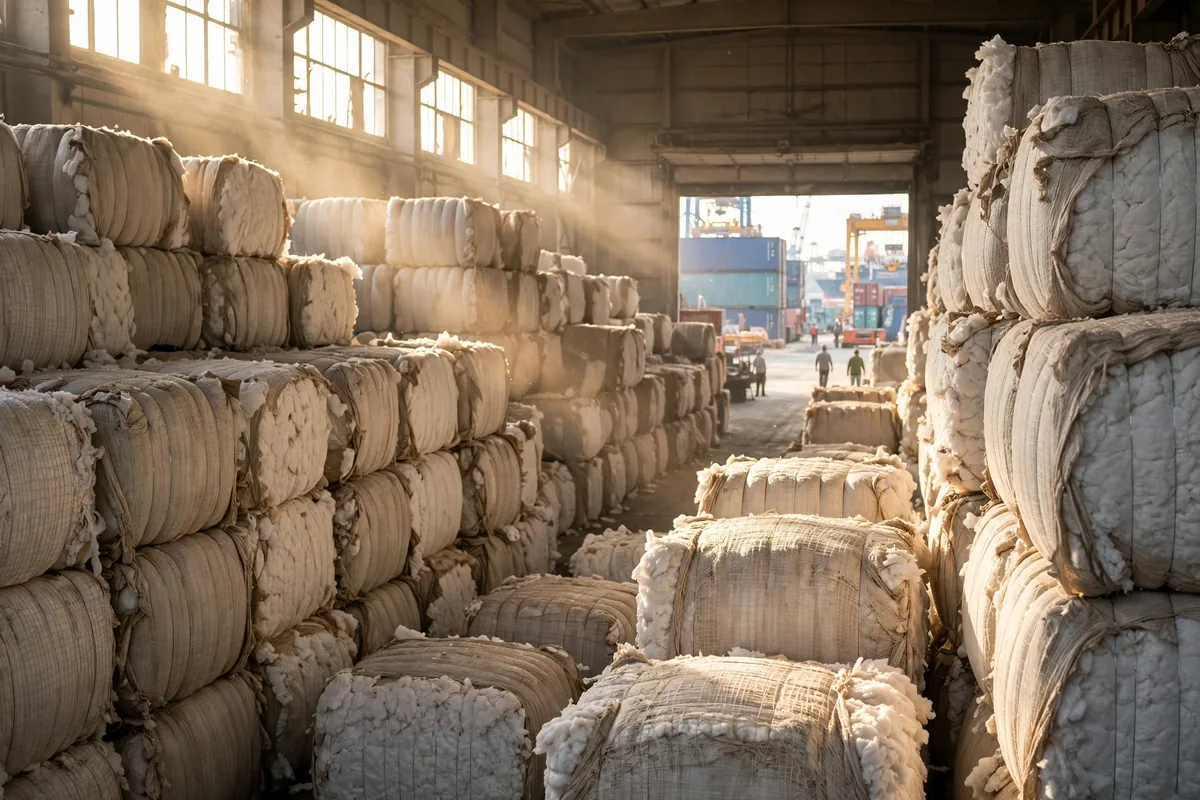
The storage bill for a lot of cotton does not start on the day it enters the warehouse. It starts on the day it is picked. Seed cotton arriving at the gin has to be separated by variety and by lot before anything else happens, because once Giza 92 and Giza 86 share the same stack, the grading that follows is compromised and the test certificate cannot be written cleanly. After ginning, bales go into storage, and the warehouse has to answer three questions: keep it dry, keep it clean, and keep lots apart. That means indoor storage, bales stacked off the floor, ventilation, and separate zones for different varieties and grades, with labels matched one to one against test certificates. All of it sounds like common sense, and the opposite of common sense is what the bill measures: every corner cut in the warehouse shows up on the grading certificate.
Time is a cost in itself. A study published by Alexandria University in 2004 followed six years of indoor-stored Giza 70 bales and found that fibre quality declined as the storage period lengthened, with length, strength and fineness all clearly weaker by the fifth year, while the first three storage periods, zero, one and two years, showed little or no change. The implication is not complicated: bales sitting in a warehouse are not frozen in time, they are sliding slowly downhill, gently for the first two years and more steeply after that. Storage is not a free safe. The longer cotton waits, the heavier the quality bill.
Variety structure rewrites the warehouse layout as well. Extra-long staple is grown in small volumes at high unit prices, so it needs its own zone, its own stacks and its own ledger, not a shared inbound and outbound lane with high-volume long staple. Long staple turns over fast and belongs near the loading dock, where restacking is kept to a minimum. Every restack is another chance for lots to mix and bales to break, invisible on the books and visible on the certificate.
The Grading Bill: Who Decides What a Bale Is Worth
The grade of Egyptian cotton is not decided by the seller. It is decided by the Cotton Arbitration and Testing General Organization, known as CATGO, at its testing centre in Somoha, Alexandria. Every export lot is classed and certified, with HVI instrument testing and certificates covering grade, fibre data and moisture, alongside the certificate of origin and the packing and weight documents. Buyers pay against the certificate, and prices are quoted FOB Alexandria, so whatever grade the certificate carries is what the cotton is worth, and any slip in the warehouse ends up priced in as a downgrade.
What a downgrade costs can be worked through with a hypothetical example. The following is a hypothetical calculation: a 50-tonne lot downgraded one grade because of damp or mixed lots in storage, selling for 120 dollars less per tonne, loses 6,000 dollars on the lot, and the same downgrade on a 200-tonne lot loses 24,000 dollars. The numbers are assumed, but the logic is real. This is the part of Egypt cotton export warehouse storage that most newcomers underestimate: the warehouse does not set the price, the certificate does. The harsh part of the grading bill is that it is calculated from the certificate, not from your costs. Whatever a warehouse saves by skimping on moisture protection is trivial next to the price gap a downgrade opens up.
There is a counterintuitive point here: cotton does not get more valuable the longer you store it. Some agricultural goods improve with age, and cotton is not one of them. Its quality curve points in one direction only, downward, so holding stock is a bet on rising prices paid for with falling quality and tied-up capital. With planted area down sharply in 2025/2026, supply is tight and there is room to imagine higher prices, but no price imagination is bigger than the downgrade clause on a grading certificate. Sell early and you lock the price while giving up the upside. Sell late and you gamble on the price while carrying quality loss and financing cost at the same time. There is no standard answer, but the framework for deciding is fixed: the expected price gain has to exceed quality loss plus financing cost, or holding is not justified.
From Warehouse to Alexandria Port
Alexandria is the traditional outlet for Egyptian cotton, a port that grew rich on cotton warehouses, brokers and a cotton exchange, and export contracts are still registered with the Alexandria Cotton Exporters' Association, ALCOTEXA. Before loading, lots are usually retested to confirm that grade and moisture still match the certificate, and only then do they go into the container. Common practice in the container leg is an inner lining against damp and keeping things dry, because the logic is the same as in the warehouse: moisture is cotton's first enemy, and holding the line on land means nothing if it is lost at sea.
The choice between port warehousing and inland warehousing deserves its own calculation. Stock held at the port sits close to the ship and moves fast, but port warehouse rent and handling usually cost more than inland storage. Stock held inland costs less to store but needs an extra short-haul leg, an extra handling, and an extra exposure to damp and breakage. Neither side is right by default. The answer depends on sailing frequency and cargo value: frequent sailings and high-value lots justify the port premium, while sparse sailings and large volumes make inland storage plus one short haul the cheaper route. Check the latest port and carrier terms before fixing the plan.
Taken together, Egypt cotton export warehouse storage comes down to only three lines: from field to gin, do not mix lots; in the warehouse, keep it dry and do not hold it too long; before shipment, make sure the certificate and the goods agree. None of the three is difficult, and the difficulty is getting all three right at the same time. As planted area shrinks, the story of Egyptian cotton is shifting from a story about scale to a story about quality, and the main character of a quality story is the warehouse. Whether the next few years turn that chain from protecting quality into competing for supply, and whether warehousing moves from cost centre to bargaining chip, is a question the next season's numbers will have to answer.
By Dr. Chen, Supply Chain Researcher