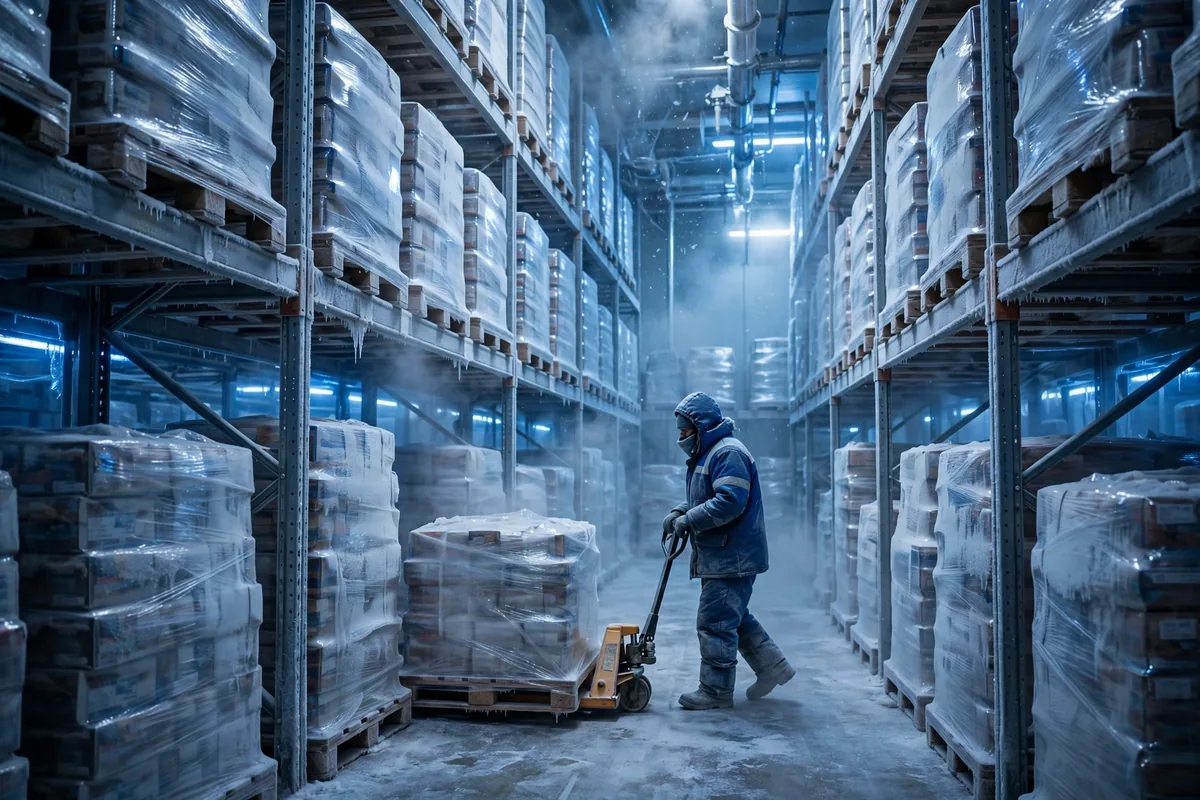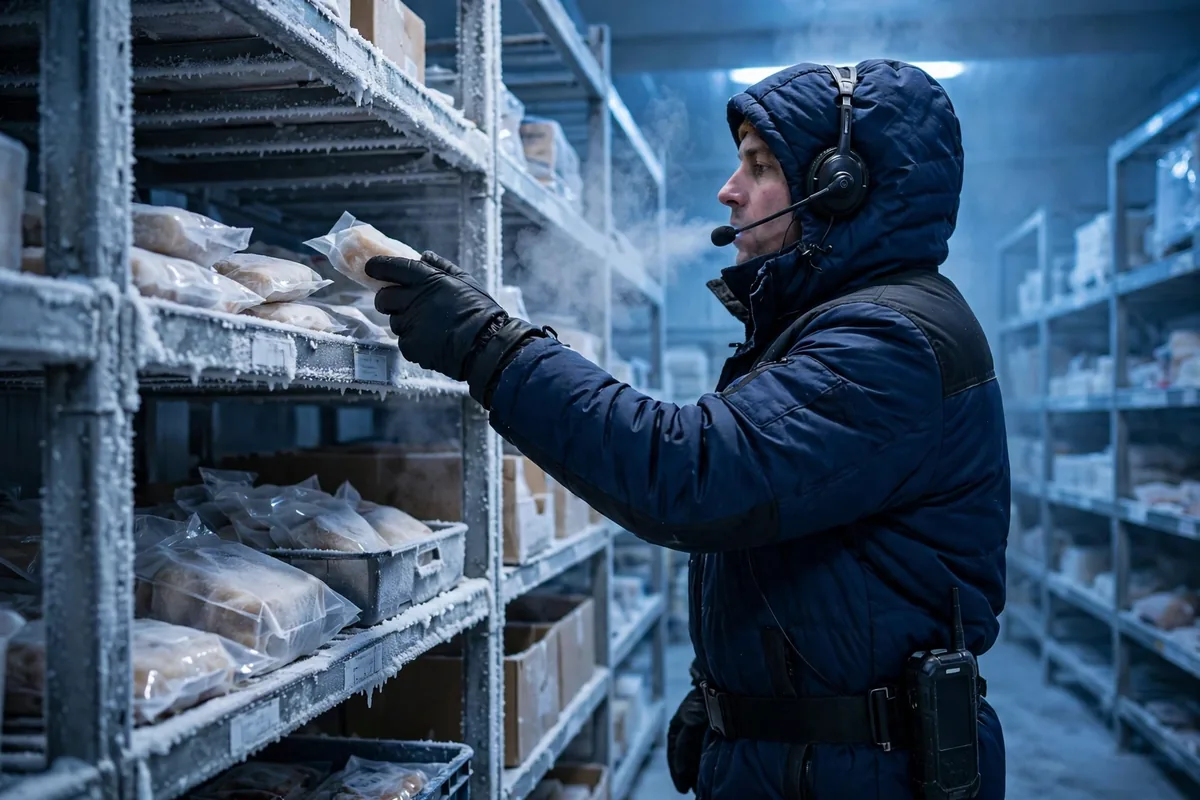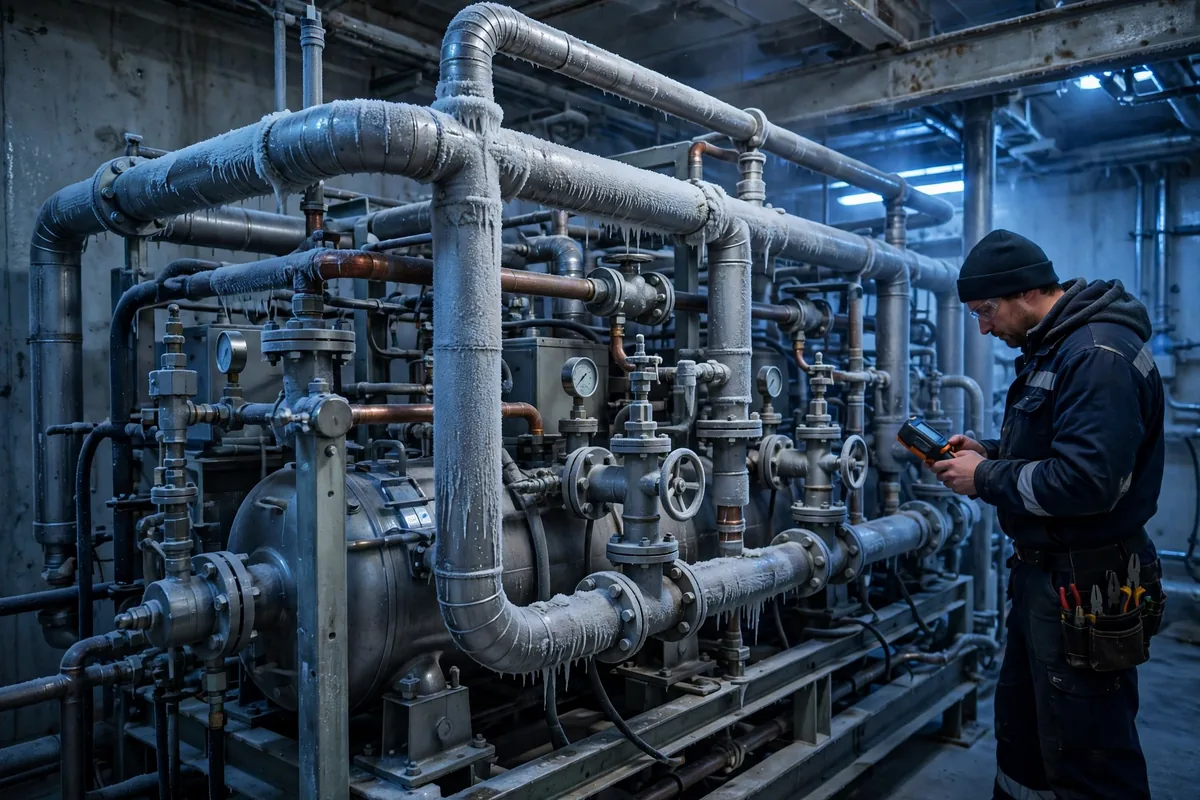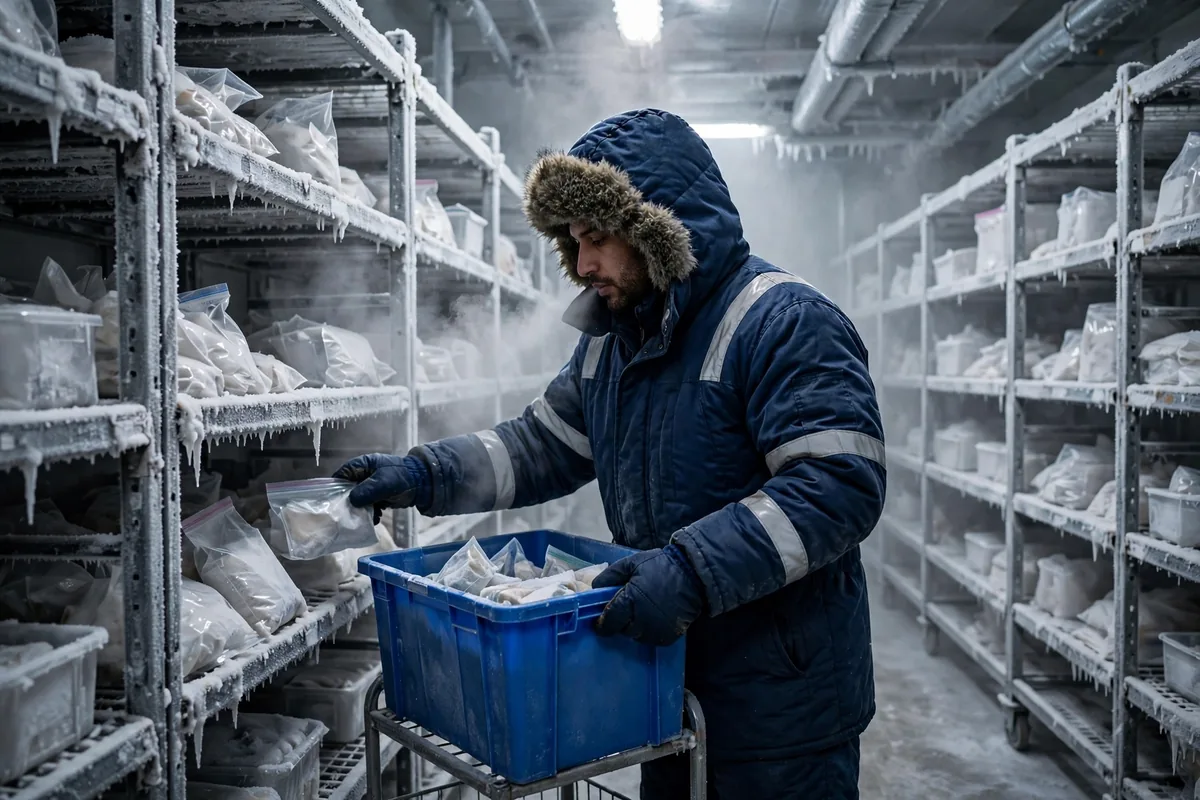
In 2024, Ecuador exported about 6.2 million tonnes of bananas, worth roughly 3.5 billion dollars, and the Ecuador banana export cold chain warehouse stands behind every box of that trade. According to World Bank WITS data, the volume converts to 6,198,210,000 kilograms, or about 346.16 million 40-pound boxes, up about 1.42 percent year on year. Ecuador is the world's largest banana exporter, accounting for roughly 25 to 30 percent of global banana exports, and every box in that quarter-plus share has to answer the same question — what keeps a banana from turning black between the plantation and the reefer. The answer is not found at sea. It is found on land, in every hour of warehouse time between harvest and loading at the port of Guayaquil.
The scale of the Ecuador banana export cold chain warehouse question
Spread the figure of 346.16 million boxes out. Every box passes through pre-cooling, packing, staging, and container loading, and a temperature failure at any point in that chain does not stay confined to one box. The difficulty with bananas is that damage shows up late. The peel can still look green in the producing region while black spots develop slowly during the voyage, and by the time the buyer opens the container, nobody can say with confidence whether pre-cooling was insufficient at origin or the reefer drifted mid-journey.
There is a unit mismatch to state before any cost discussion. The 2024 export figure of about 346.16 million boxes is counted in 40-pound boxes, while the 2026 export reference price of about 7.50 dollars per box refers to a 43-pound box. Different box sizes mean the two numbers cannot simply be multiplied together. A worked example, clearly labelled as hypothetical, gives a better sense of scale. At the 2026 reference price of about 7.50 dollars per box, 1,000 boxes of 43-pound boxes would be worth about 7,500 dollars, and a container load sits around that order of magnitude. The example is not precise pricing; it shows where the real risk lies. The risk was never one or two damaged boxes. It is an entire container, or an entire lot, losing temperature control at the same point in the chain. Pre-cooling done halfway shortens the shelf life of the whole lot at once.
Bananas stay green through stability, not cold
The common misunderstanding about the banana cold chain is that colder is safer. Applied to bananas, that judgement is exactly backwards. Bananas are a tropical fruit, and they suffer from cold almost as much as from heat. Push the temperature too low and chilling injury sets in, and the peel blackens faster rather than slower. The industry practice of holding reefer transport at about 13 to 14 degrees Celsius is the balance point between preservation and chilling injury: warmer and ripening accelerates, colder and chilling injury arrives. Once that is understood, the objective of the warehouse changes. It is not to drive the temperature as low as possible. It is to hold it near 13 to 14 degrees Celsius, and to hold it steady.
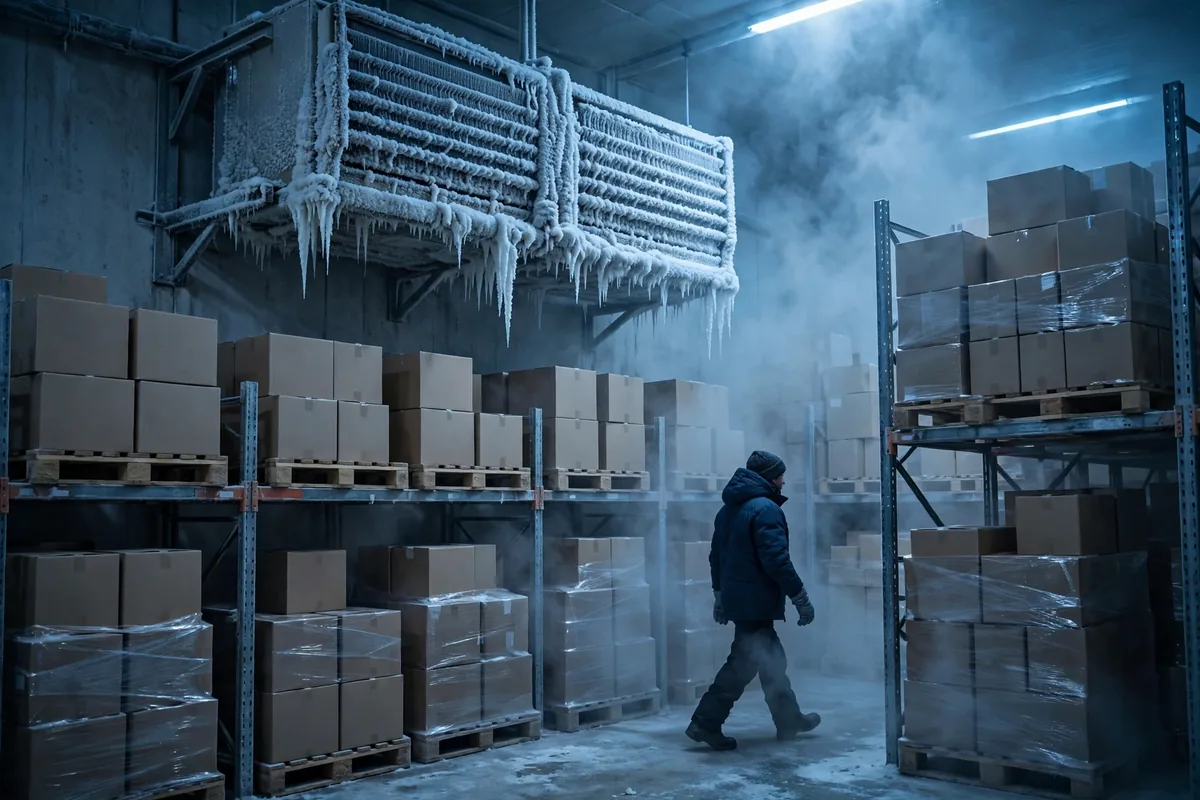
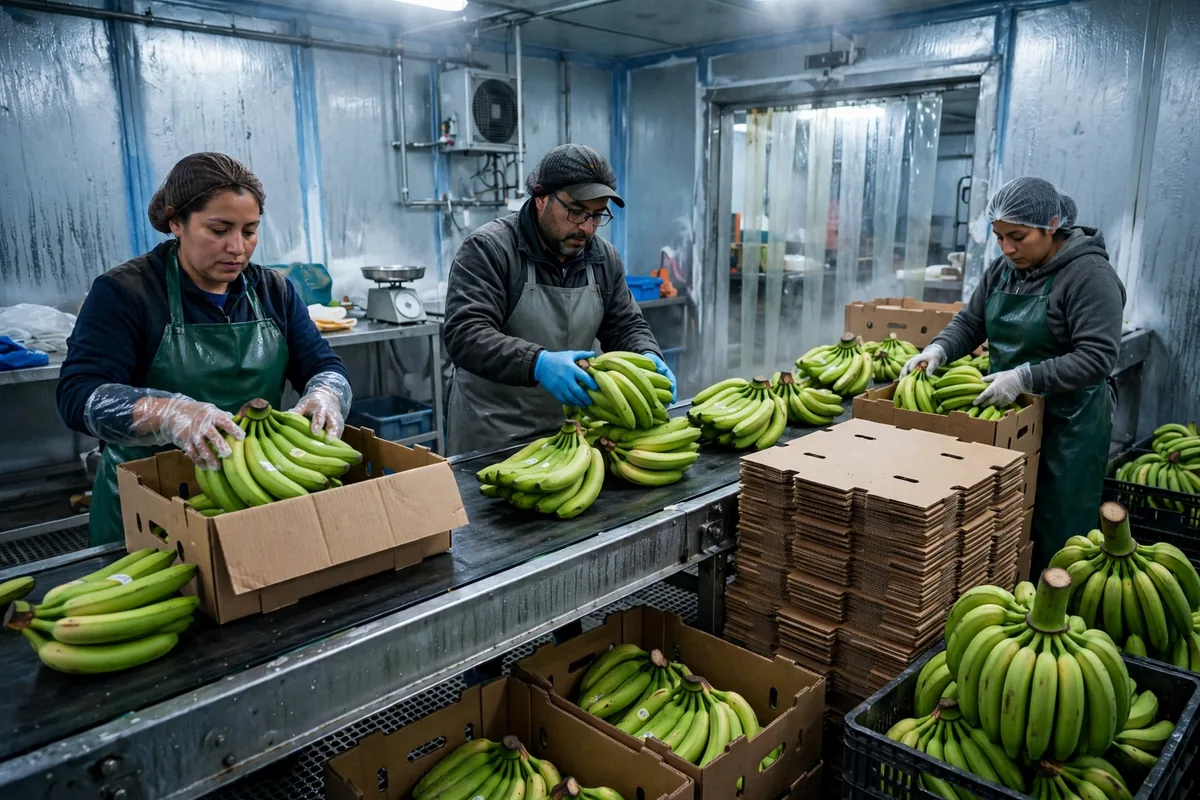
Stability is difficult because fluctuation damages fruit more than the temperature level itself. A banana harvested in the field carries field heat, and if it is packed and moved straight into a cold room, the heat at the centre of the pallet has nowhere to go: the outer cartons cool while the core stays warm. The standard industry response is post-harvest pre-cooling, followed by forced-air cooling that pushes cold air through the gaps between cartons so the whole lot cools quickly and evenly. Done thoroughly, holding 13 to 14 degrees Celsius inside the reefer later becomes easy. Skimp on it and the whole burden falls on the transport leg, and a reefer container is designed to maintain temperature, not to pull a warm load back down.
Ethylene control follows the same logic from a different direction. Bananas release ethylene themselves, and ethylene in turn ripens the bananas around it, so cartons ripen each other faster than any single fruit would ripen alone. Managing ethylene is therefore less a matter of technology than of time management: the speed of pre-cooling, the rhythm of ventilation, the timing of container loading. Each step is a race against the fruit's own ripening clock. Win the race and the bananas are still shippable green at destination. Lose it and the black spots develop at sea, leaving the buyer to discount the lot on arrival.
The Ecuador banana export cold chain warehouse trade-off: time for temperature, or temperature for time
Taken apart, every stage poses the same trade-off: spend more time getting the temperature right, or save time and get the cargo into the reefer. The framework below carries no specific price quotations — prices should be checked against the latest official data — and it only maps how each stage trades off against the others.
| Stage | Standard industry practice | Cost of skipping it | Where the trade-off sits |
|---|---|---|---|
| Post-harvest pre-cooling | Cool down as soon as possible after harvest | Field heat shortens the whole lot's shelf life | Eases everything downstream, but occupies space and time |
| Forced-air cooling | Push cold air through the gaps between cartons | Warm core, cold surface, uneven temperature across the load | Balance between airflow intensity and loading speed |
| Reefer transport | Hold about 13 to 14 degrees Celsius | Too warm speeds ripening; too cold blackens the peel | Holding the range beats chasing a lower temperature |
| Ethylene management | Ventilation and loading sequence control | Cartons ripen each other and the whole lot matures early | Time management beats remedial action |
| Port loading handover | Keep the cold chain unbroken into the port of Guayaquil | A final-leg break wastes everything upstream | Certainty at handover beats single-stage efficiency |
The last row deserves the most attention. Guayaquil is Ecuador's main banana export port, and nearly all cargo passes through it on the way from land transport to ocean shipping. The cold chain is most likely to break exactly at such a handover. A load held perfectly in the cold store can lose its margin while waiting on the quay, and every investment made upstream is discounted at once. A warehouse manager's attention should therefore tilt toward handover points rather than being spread evenly across every stage.
Read the 2024 data once more for the trend. Exports of about 346.16 million boxes, growing about 1.42 percent, is not a fast growth rate. It describes an industry at a high base and a slow rate of expansion. In such a phase, competition usually shifts from volume to loss rate: selling one percent more is hard, but losing one percent less has the same effect on the bottom line. The room for improvement sits inside that arithmetic. Pre-cool a little more thoroughly, ventilate a little more evenly, hand over a little more reliably, and each improvement lands directly on cargo value.
One further judgement needs its basis and its timeline stated. At the 2026 reference price of about 7.50 dollars per box, the value of a single box of bananas is not high, which means the margin for error in cold chain investment is narrow. Heavy spending on any one stage is hard to recover per box. The direction for optimisation is therefore not to pile on equipment, but to place limited investment where the probability of temperature loss is highest: the thoroughness of pre-cooling, the uniformity of the temperature field, and the reliability of the handover. That ordering holds at the 2026 point in time; its lifespan depends on where the reference price and export volume move next.
The road from plantation to reefer is, in the end, a negotiation with time. The data tells us how large the trade is, industry practice tells us where the temperature should sit, and the warehouse floor has to answer one question every day: at which stage is this lot's cold chain most likely to break. There is no standard answer. Different producing areas, different port connections, different sailing schedules all give different answers. And that is exactly why improving this cold chain warehouse will never be a one-off project, but a round of on-site review after another.
By Dr. Chen, Supply Chain Researcher