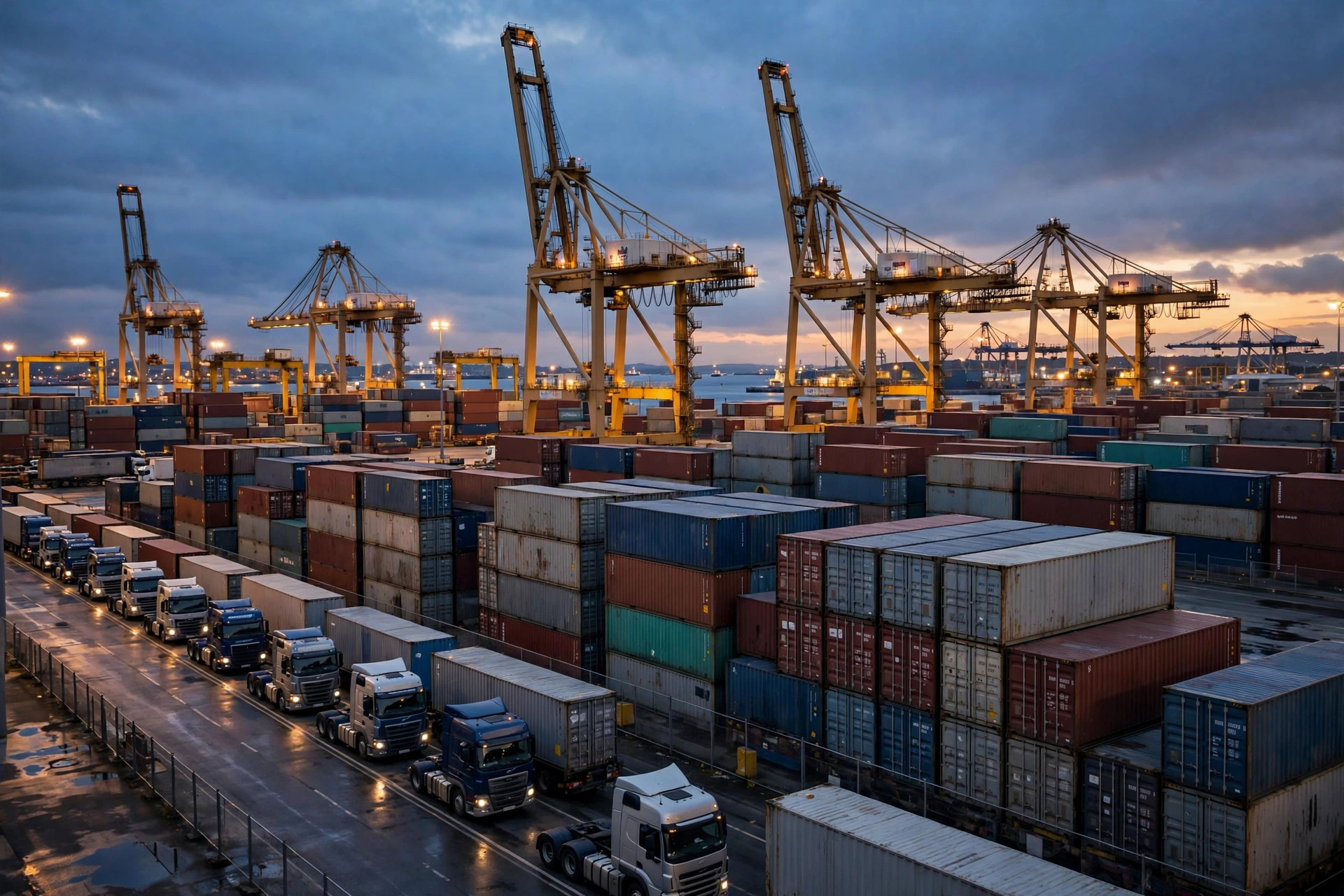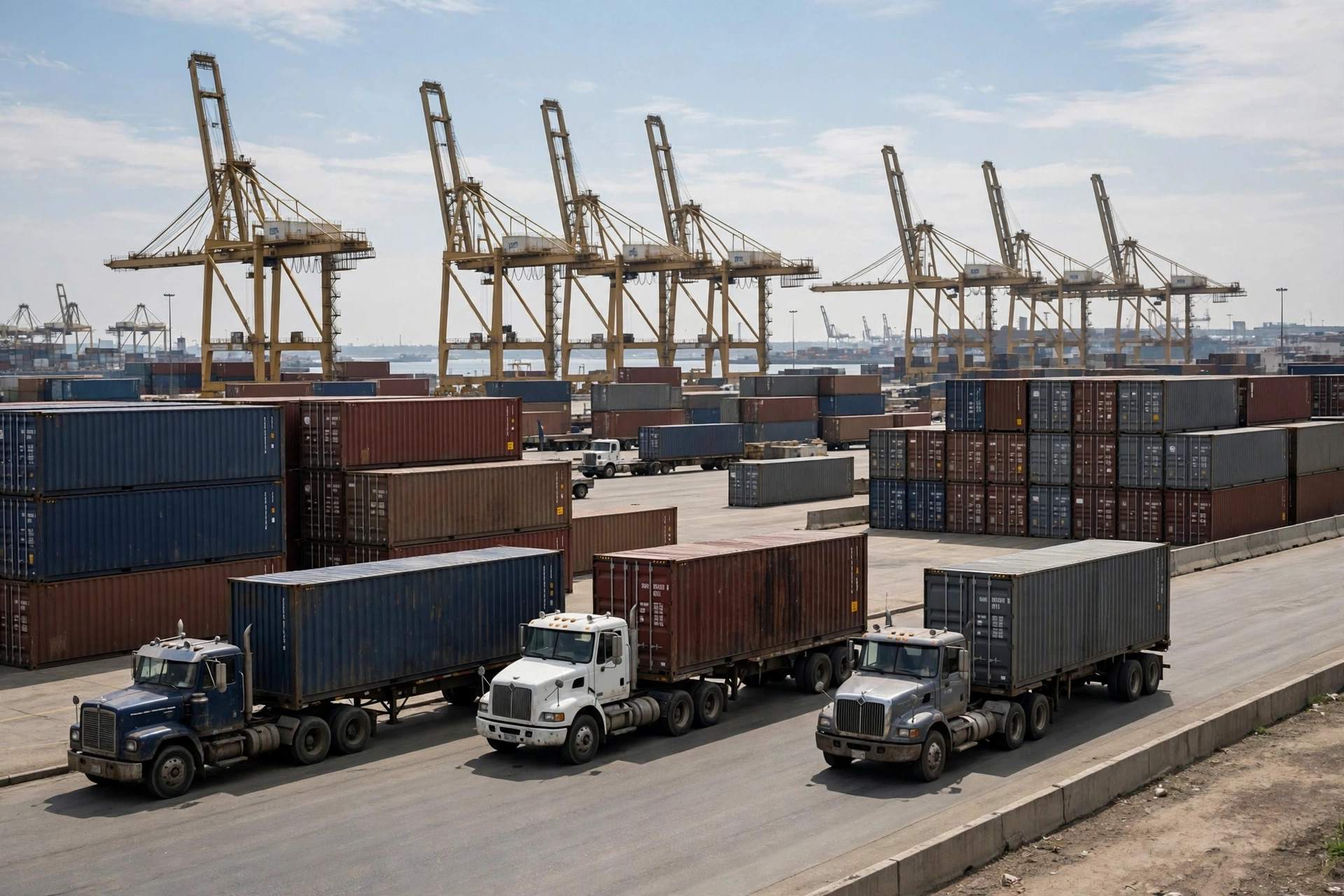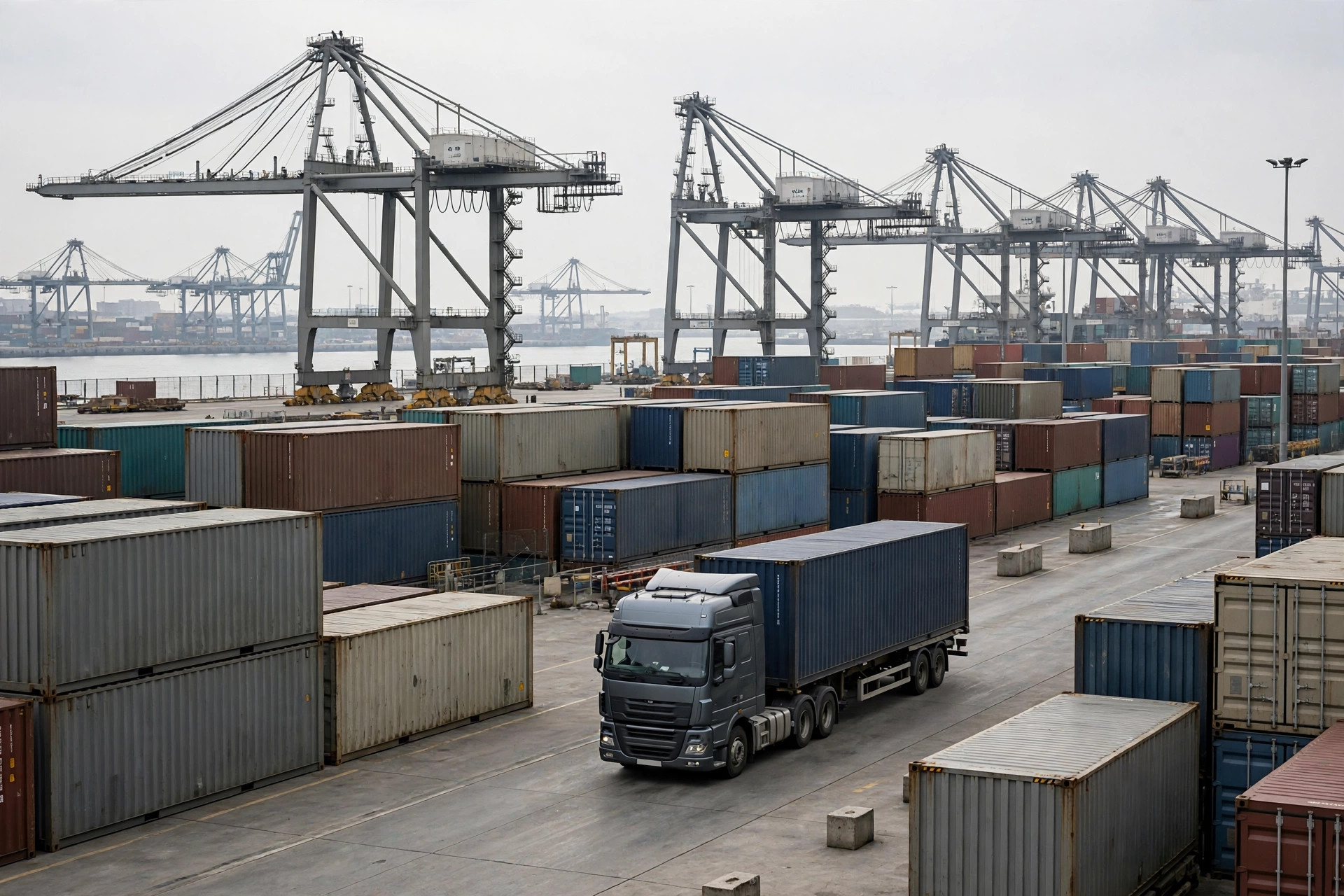
At 3:30 in the morning I was sitting in line outside the Port of Los Angeles/Long Beach gates, twenty-some trucks ahead of me, brake lights strung out like a red river. The driver in the next lane rolled down his window, handed me a cigarette, and asked the question every driver eventually asks: how do drayage drivers get paid — per load or by the hour? We did the math together — he was on per-load pay, I was on hourly at the time — and for the same night's work, our take-home was miles apart. He just shook his head. "So you're basically working this night shift for free?"
That question — how do drayage drivers get paid, per load vs hourly — gets typed into Google every single day, mostly by drivers comparing job offers and by shippers trying to figure out what a fair rate looks like. After fifteen years behind the wheel, I can tell you there's no single answer. At most US ports, the majority of drayage drivers are paid per trip — what we call "per turn." A US Department of Transportation survey of port drivers found the same thing: a driver's whole day is organized around hitting a target number of turns. But hourly pay exists too, and so does a mix of both. Let me walk through each model the way drivers actually experience it.
Per-Load Pay: How Drayage Drivers Get Paid by the Trip
Per-load is simple: you get paid a flat amount for each completed turn — port to customer, customer back, that's one. The more turns you run, the more you make.
Last fall I picked up a 40-footer at the Port of Oakland. The gate system was acting up that day. I arrived at 4 AM and didn't get my box until 10. By the time I delivered to the customer's warehouse and got back, it was 2 PM. One turn. The entire day. On per-load pay, that's one payment — and the six hours I spent in line paid exactly zero.
That's the catch nobody puts in the job ad: on per-load, you don't get paid for waiting. When the port is flowing and you knock out four or five turns, the money is good. When the gates jam up, a chassis is short, or your box gets flagged for inspection, you might manage one or two turns and your effective hourly rate collapses. You can't control the line. After all these years, here's how I put it: on per-load, you're not really earning wages — you're gambling on not getting stuck in line.
Hourly and Hybrid: The Other Ways Drayage Drivers Get Paid
Some companies pay by the hour. A couple of years back I drove short-haul for one of them, and the deal looked like this — I saw these numbers on a job posting in one market, so take them as a reference point only; they vary a lot by region and by year: base pay around $28–30 an hour, $42–45 after overtime kicks in, plus about $25 for every completed turn, plus detention pay of roughly $25–28 an hour once you've been held up more than two hours with paperwork to prove it.
That's the hybrid model: an hourly floor so the day is never a total loss, a per-turn kicker for hustle, and a detention rule so waiting isn't free labor. You always know roughly where you'll land. But my buddies who stayed on it told me the honest truth: on hourly, the fire goes out. If you get paid the same whether you run three turns or five, why kill yourself for the fifth? Hourly is stable, but it has no engine.
Here's the counterintuitive part — the thing most shippers get backwards. Shippers love per-load because it looks cheaper and it looks like it keeps drivers moving. But on a day when the port is gridlocked, a per-load driver is the last person who wants to wait on your container. Every hour he burns at your gate is a turn he doesn't run, and a turn he doesn't run is money he doesn't make. He'd rather deadhead to a short nearby job and bank the turn. You think per-load saves you money; in reality, per-load trucks are the first to disappear exactly when you need them most. That's the trade-off nobody talks about: per-load shifts all the waiting risk onto the driver, so the driver votes with his wheels and cherry-picks the jobs with no lines.
Running the Numbers: Same Day, Three Pay Models
Let's put all three side by side on the same day: eight hours, four turns, three of those hours spent in the port line. I'll use the hybrid numbers from that job posting ($28–30/hr base, $25 per turn, detention at $25–28/hr after two hours — reference only):
| Pure per-load | Pure hourly ($30/hr) | Hybrid | |
|---|---|---|---|
| Pay basis | Flat rate per turn × 4 | 8 × $30 = $240 | $240 base + 4 × $25 = $100 in turn bonuses |
| The 3-hour wait | Unpaid — $0 | Paid — $90 | Covered by the detention rule |
| Day's total | Depends entirely on the per-turn rate | $240 | ~$340 plus detention |
| Bad day (2 turns only) | Income gets cut in half | Still $240 | $240 + $50 = $290 |
The math tells the story: pure per-load swings the hardest — a congested day cuts your pay in half. Pure hourly never moves, but neither does the driver's motivation. Hybrid sits in the middle, and a bad day doesn't wipe you out. That's why more and more carriers are landing on hybrid: the base keeps drivers from quitting, the bonus keeps them hustling, and the detention rule ends the arguments before they start.

What does this mean in practice? It means the question "how do drayage drivers get paid, per load vs hourly" has no single answer — it depends on whose risk you're looking at. For the driver, per-load is a bet on the port running smooth. For the shipper, per-load looks cheap until the one week a year when the port melts down — and that week is exactly when your freight is most urgent. The hybrid model is the industry's compromise: it admits that waiting is part of the job and prices it instead of pretending it doesn't exist.
What This Means for Shippers and Warehouses
First, stop shopping on the rate alone and ask who pays for the wait. When you negotiate with a carrier, get detention in writing: after how many hours it starts, the hourly rate, and what proof counts (gate receipts, GPS timestamps — anything documented). Without that clause, your freight is the first thing a driver drops on a congested day.
Second, your system has to handle all four pay models: per-load, hourly, hybrid, and detention rules. A TMS or drayage management system should tie driver pay directly to dispatch records and gate in/out times so payroll calculates itself. Reconciling it all by hand at month's end is how you end up in week-long arguments over a single invoice. If your software only knows one pay model, it's already behind the industry.
Third, in peak season and port-meltdown weeks, the hybrid model with a guaranteed floor is what keeps drivers on your loads. Drivers don't quit over low pay as often as you'd think — they quit over time they can't control. Three unpaid hours in line, and next month he's driving for somebody else.
There's an old saying among drivers: you get what you pay for — and with drivers, that means every hour of waiting deserves its dollar. Get the pay right, and the wheels keep turning.
By Shifu Zhao, Trucking Veteran (15 yrs)