Does a small warehouse need a WCS? Every few months someone asks me exactly that: "We only have two conveyor lines and a handful of AMRs. The integrator says we need a warehouse control system. Do we?"
My short answer: if your operation is small enough to ask that question, the answer is almost certainly no. A WCS is a specialized piece of software, and most small warehouses simply don't generate enough machine-to-machine decisions to justify one. This article explains what a WCS actually controls, gives you a decision table with hard boundary lines, and shows you what happens when you buy one you don't need.
What a WCS actually controls
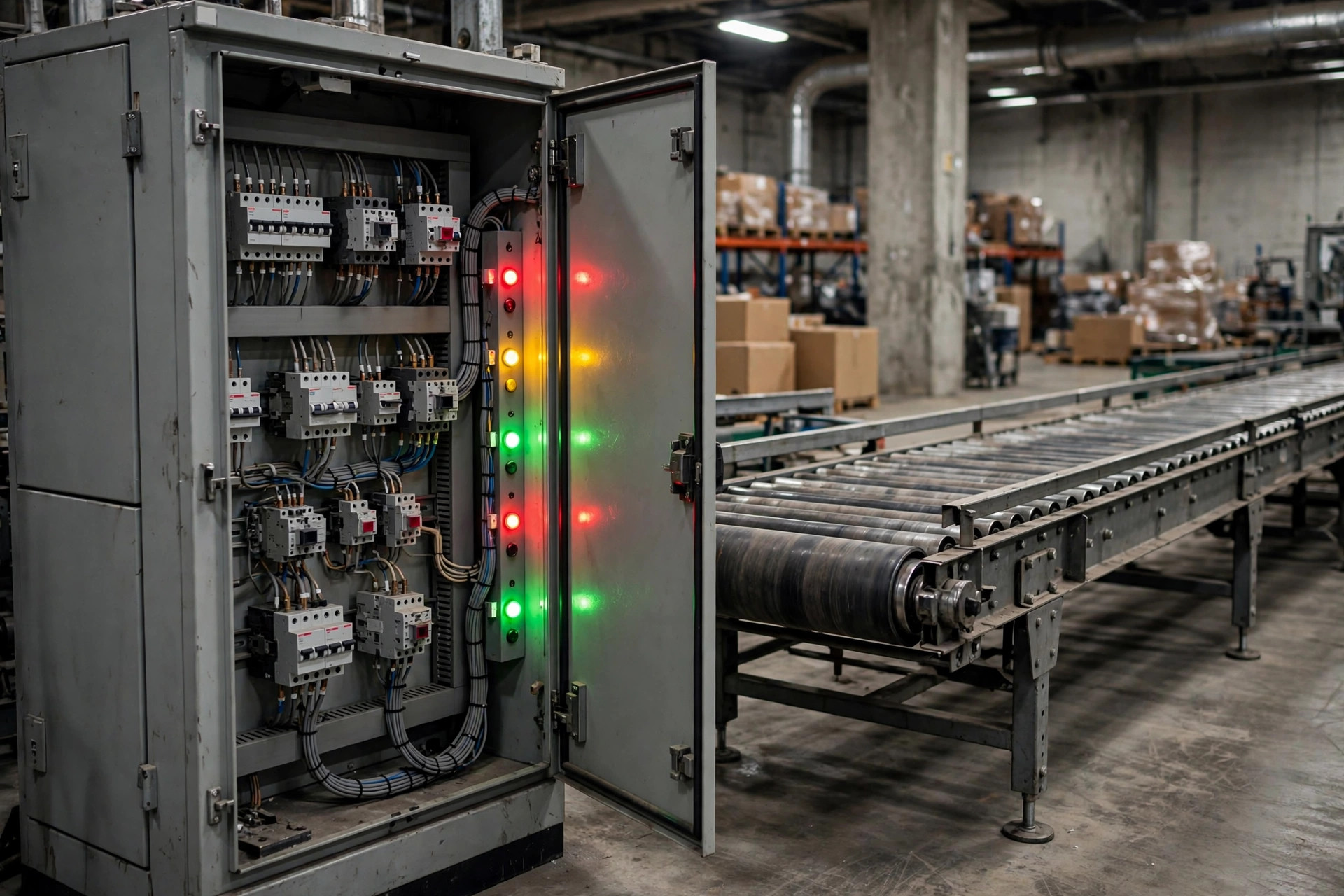
Let's clear up the confusion first, because vendors love blurring it. WMS is the brain: it owns inventory, orders, and task assignment. PLC is the muscle: it drives a single conveyor, a lift, or one robot. The WCS sits in between. You can think of it as the air-traffic controller of your warehouse floor.
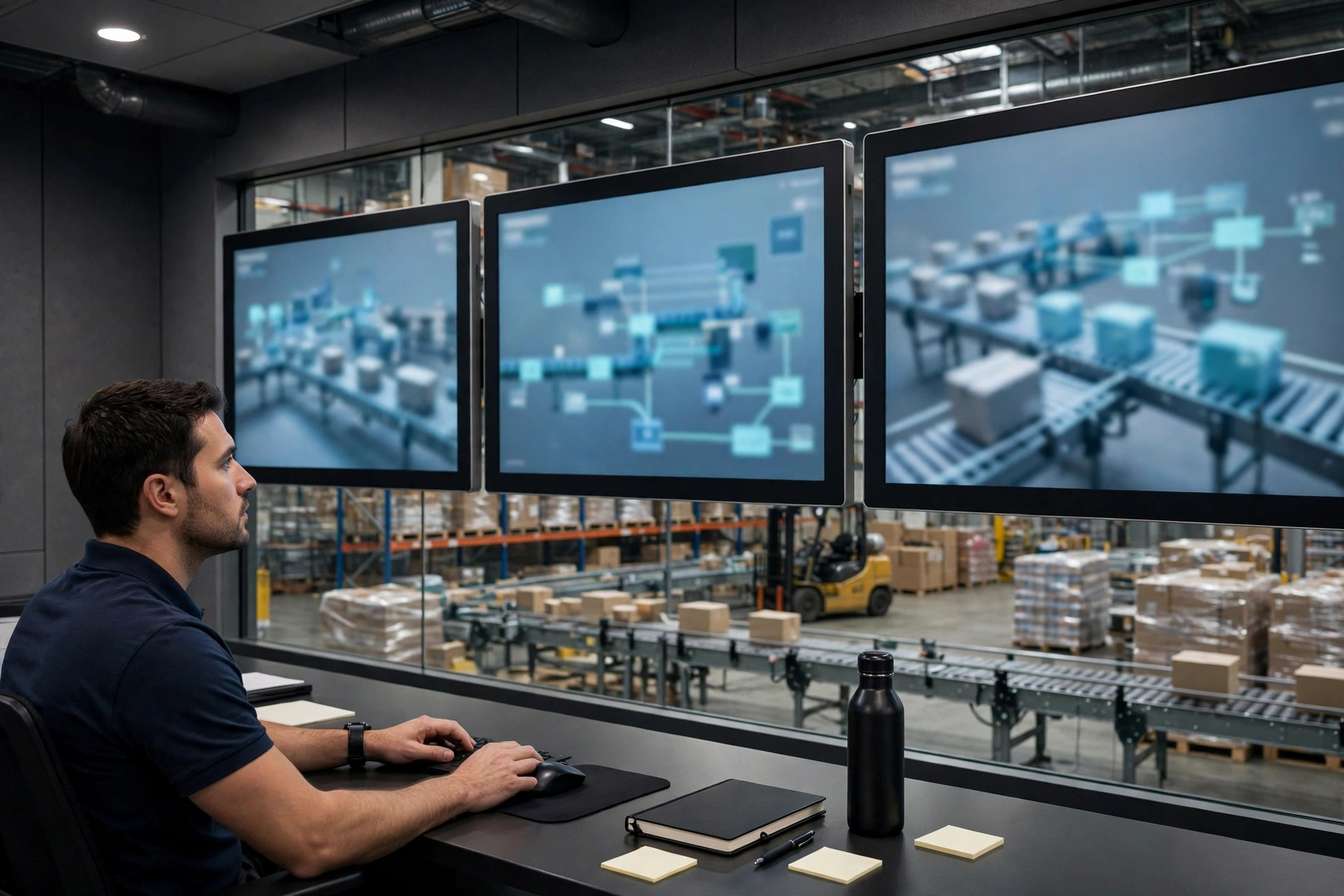
It does four jobs: it queues the tasks coming down from the WMS, dispatches them to the right piece of equipment, arbitrates conflicts — two AMRs want the same aisle, a sorter lane is backing up — and pulls every device status onto one screen. The classic analogy: if your warehouse is an orchestra, the WMS wrote the score, the PLCs are the musicians, and the WCS is the conductor waving the baton. Without a conductor, five musicians can still jam. With fifty, you get chaos.
One distinction worth making, since salespeople won't: WCS versus WES. A WCS controls equipment in real time; a WES (warehouse execution system) adds wave planning and labor balancing on top. For a small warehouse the difference barely matters, because you probably need neither. The moment a vendor starts upselling you from WCS to WES, ask him to show you the conflict data first.
That's the whole philosophy of this article. A WCS earns its keep only when the number of machines — and the number of decisions between them — crosses a threshold. Below that threshold, direct PLC interlocks plus a WMS with a decent device interface do the job for a fraction of the cost.
Does your small warehouse need a WCS? The decision table
Here's the table I draw for clients on a whiteboard. Check which column you land in on at least three of the four rows:
| Dimension | Skip the WCS | Gray zone | You need a WCS |
|---|---|---|---|
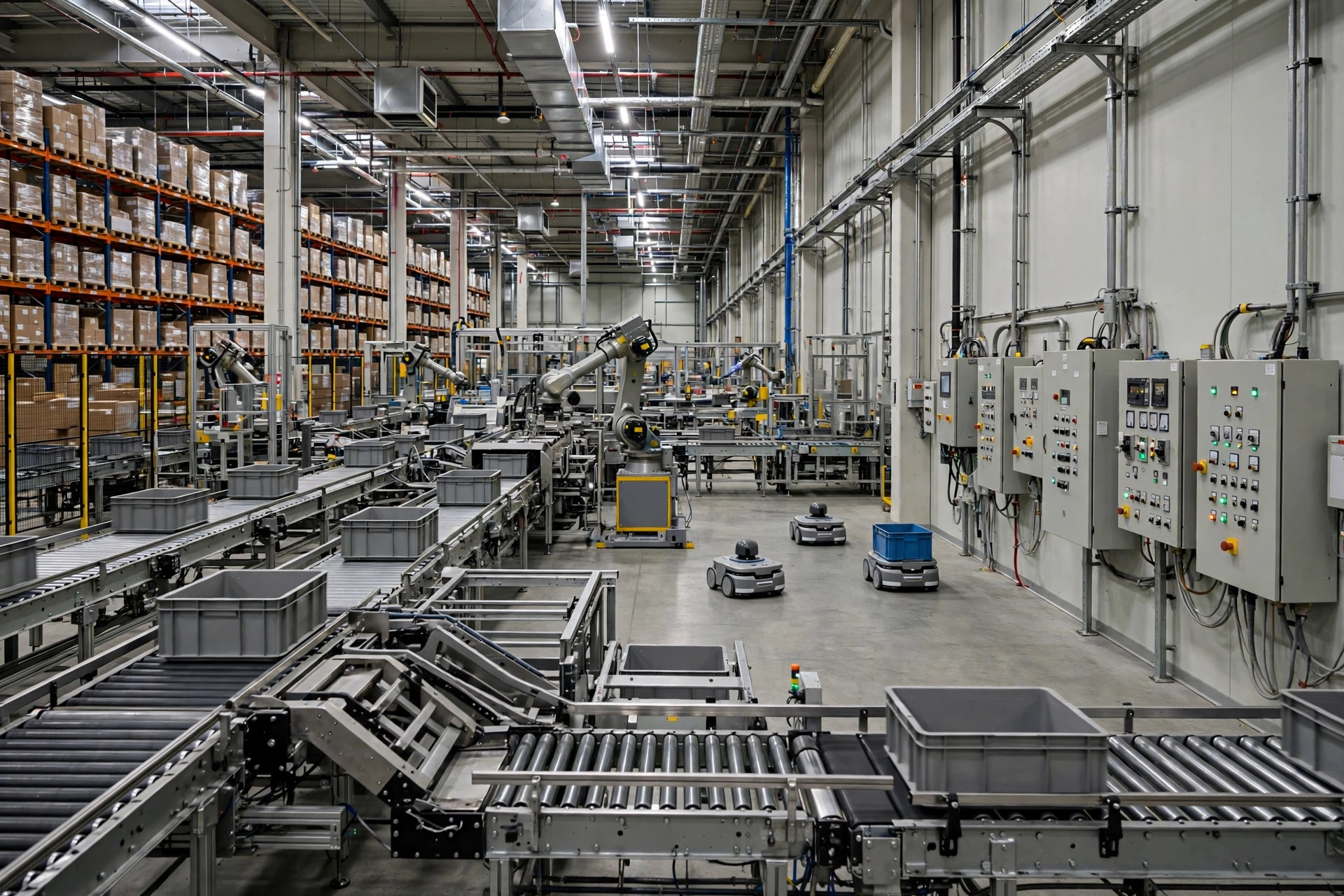
| Automation mix | Manual + forklifts, or one standalone conveyor | Conveyor lines + lifts, shuttle layers, simple sortation | Cross-belt sorter + AMR fleet + AS/RS + multi-layer shuttles running together |
| Daily order volume | Under about 5,000 orders | 5,000–20,000 | Over about 20,000 |
| SKU count | Under about 5,000 | 5,000–30,000 | Over about 30,000, or high-velocity turnover |
| Conflict handling | A jam gets fixed by a person walking over | Occasional rerouting, still human-manageable | Constant machine-to-machine arbitration that no human can keep up with |
The logic is simple: a WCS is worth buying when equipment conflicts happen faster than people can resolve them. Two conveyor lines feeding two pack stations don't conflict — they just run. A 20-unit AMR fleet sharing three narrow aisles with a cross-belt sorter conflicts every few seconds. That's the line.
Two worked examples. A 40,000-square-foot apparel DC doing 8,000 orders a day on conveyors plus two lifts: high volume, but the equipment barely talks to itself — gray zone leaning "skip." A 25,000-square-foot 3PL doing only 6,000 orders a day but running a small sorter with 12 AMRs: lower volume, but the machines fight each other constantly — that's a WCS candidate. Volume alone never decides. Equipment interaction density does.
The gray zone is where integrators make their money. If you're in it, don't treat "does small warehouse need WCS" as a yes-or-no question. Ask for a pilot instead: run the PLC-interlock version through one peak season, count the conflicts, then decide with data.
When a WCS becomes an expensive dashboard
In 2023 I visited an e-commerce warehouse near Ontario, California — about 35,000 square feet, 2,500 to 3,500 orders a day, two belt conveyors running straight into the pack stations. The integrator had sold them a WCS for a low six-figure sum, three years of support bundled in. I told the owner straight: for this setup, hardwired PLC interlocks plus task download from the WMS would have cost a fraction of that. He signed anyway.
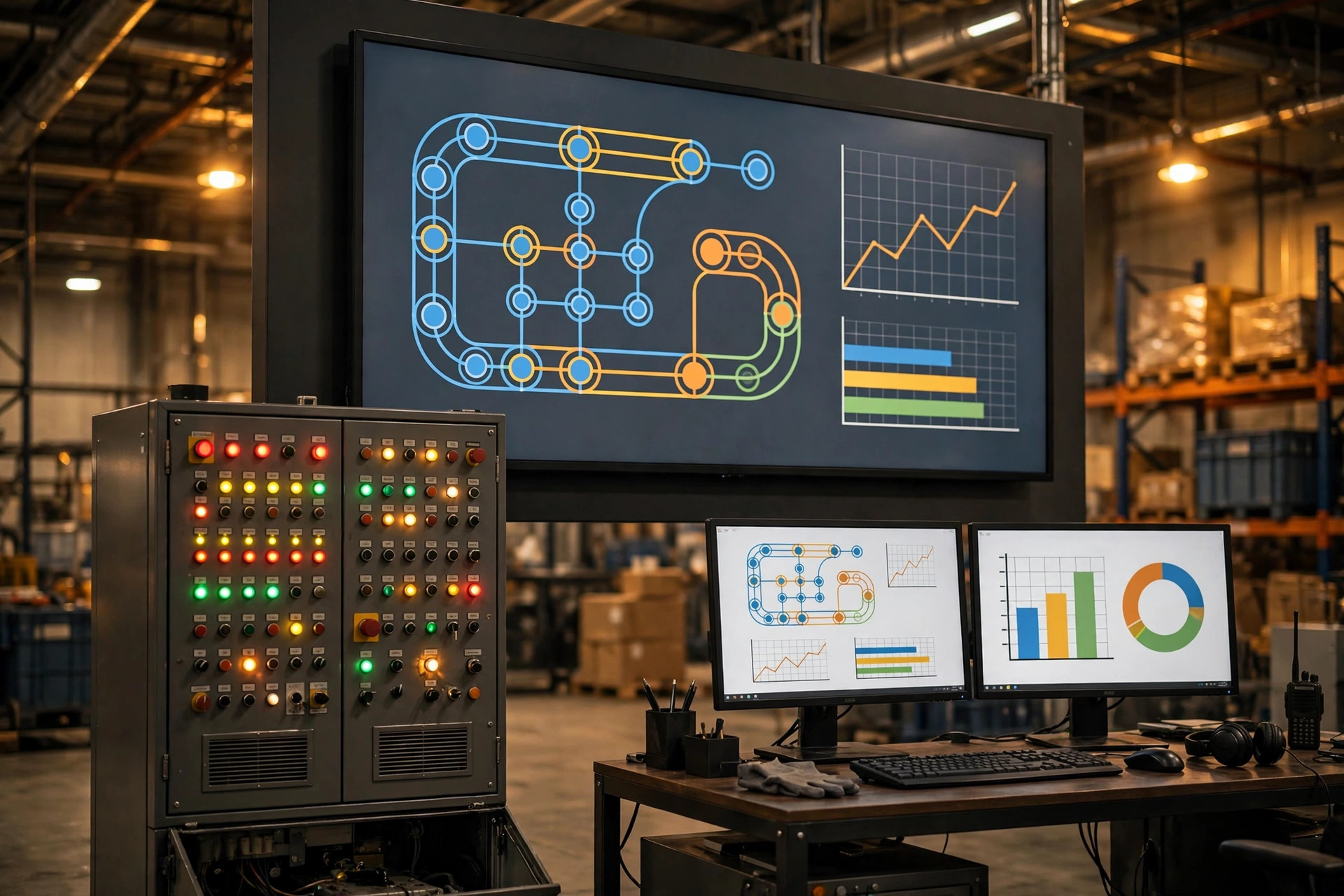
Two years later I stopped by. The WCS dashboard was glowing on a big screen — and nobody touched 90% of its functions. It had become a very expensive status monitor. The only "decisions" the system ever made were things a relay could have handled. And the support contract was about to expire, which meant paying again or letting the software rot.
The counter-example: a 3PL in New Jersey I worked with in 2024, pushing around 12,000 orders a day with a cross-belt sorter and a 20-unit AMR fleet. Before the WCS, AMRs queued at aisle intersections while people shouted over radios, and every peak season ended in a traffic jam at the sorter's induction. After commissioning, task queuing and traffic control went automatic, and the pileups stopped. Same software, opposite outcome. The difference was never the product — it was whether the operation had enough complexity to feed it.
Here's the unpopular opinion: buying a WCS for two conveyor lines is just donating money to your integrator. The equipment doesn't need conducting. You're paying for an orchestra conductor to lead a two-person band.

The part nobody quotes: maintenance
A WCS is not a one-time purchase. It's software plus integration, and integration rots. PLC firmware gets updated and the WCS driver breaks. The integrator's project team disbands and nobody left knows how the custom routing logic works. Vendors love quoting 99.5% uptime; what they don't mention is that the missing 0.5% always lands in peak season, and that the MTBF number on the brochure assumed a trained technician on site.
Run the staffing math. A WCS needs someone who can read its logs, tweak routing rules, and argue with the vendor's support line at 2 a.m. during peak. A big DC has that person on payroll. A 30-person warehouse doesn't — the "WCS admin" becomes the operations manager's side job, which means it becomes nobody's job. So the system slowly degrades into exactly that glowing dashboard nobody touches, one unpatched driver at a time.
So, is it worth the money? Watch this one number
Here's my closing rule, the one I give every small-warehouse owner: count how many machine-to-machine decisions your floor needs per day — a conflict arbitrated, a reroute chosen, a task reprioritized. If it's under fifty, you don't need a WCS. PLC interlocks and a competent WMS interface will carry you.
How do you count? Shadow your floor for one normal week and one peak week. Every time two machines would have needed a system to decide between them — and a human had to step in instead — make a tally mark. Under fifty a day: skip it. In the hundreds and climbing: run the pilot I mentioned and measure.
The money is worth it only when the machines are making decisions faster than your people can. Below that line, a WCS is the most expensive wall decoration your warehouse will ever buy.
By Da Liu, Automation Engineer