We had a client who opened his first conversation about dodoma tanzania warehouse logistics with one sentence: "Susan, we already have a warehouse in Dar es Salaam — do we really need another point in Dodoma?" I told him not to ask me for a quote yet. First we work out who his cargo is sold to and where it ends up, then we talk about warehouses. Dodoma is Tanzania's official capital, sitting in the middle of the country, and government institutions have been steadily relocating there, so the city's administrative weight keeps growing. But an administrative capital is not the same thing as a logistics hub. Where your cargo enters, where your customers sit, and where the projects land — that is what decides where a warehouse belongs. Plenty of clients hear the word "capital" and feel they must plant a flag, then discover the volume cannot carry the fixed cost of a site. That is the embarrassing outcome, not the other way around.
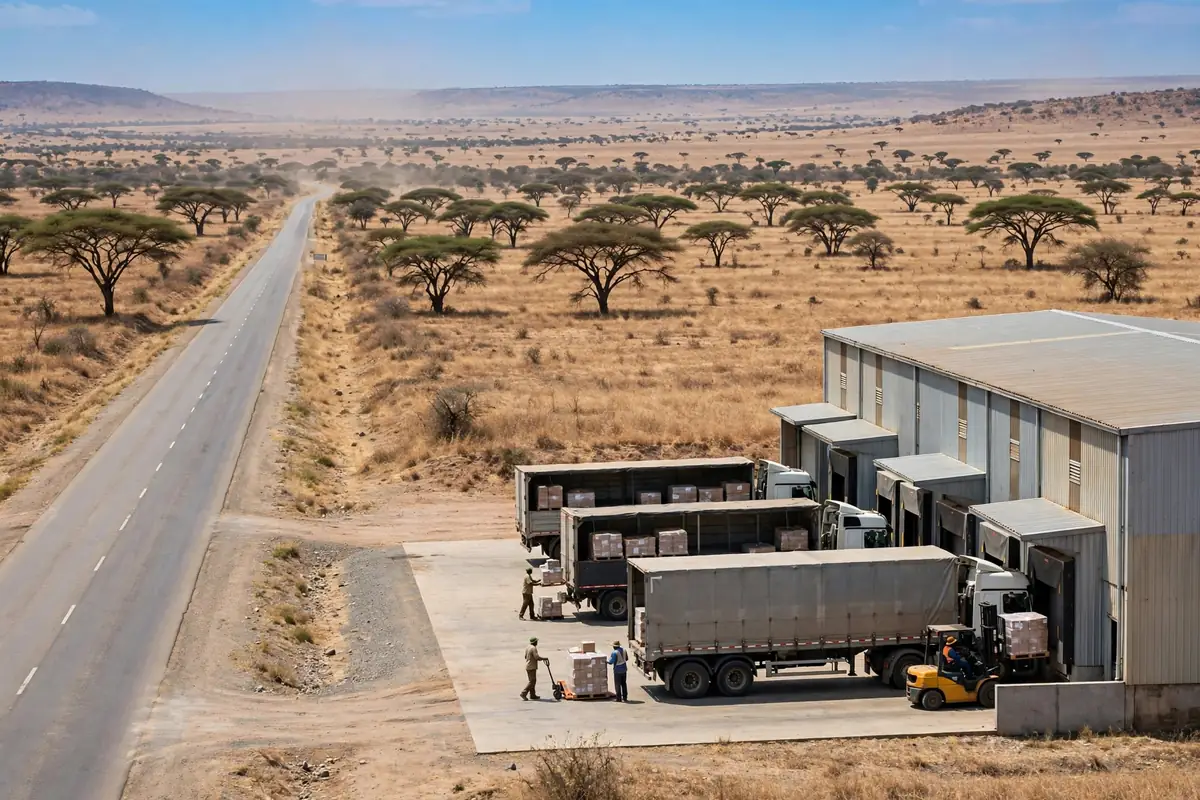
This client ran two streams: project cargo for construction work, and wholesale consumer goods. Almost everything entered through the port of Dar es Salaam, Tanzania's main seaport gateway. From the port, cargo moves inland along the central corridor toward Dodoma, by road or by rail. The route looks simple on a map. The devil is in the inland leg, which is where cost and lead time swing the most: clearance pace, how smoothly containers are pulled from the port, and how well inland carriers organize their capacity. Any one of those slows down and everything behind it slows down. We pulled his shipment history and found that roughly sixty to seventy percent of his volume was ultimately delivered around Dar es Salaam and the coast, and under thirty percent went to Dodoma and the central region. The conclusion was uncomfortable: at that volume, he did not need a standalone Dodoma warehouse at all. A main warehouse at the port plus one reliable inland linehaul was enough. Only later, when two project customers appeared in the central region and the mix changed, did we reopen the Dodoma math.
Dodoma Tanzania Warehouse Logistics: Do You Actually Need a Distribution Point?
Here is an insider habit from the 3PL side: when we quote, the thing we fear most is the client asking the wrong question. Ask "how much is a warehouse in Dodoma" and you get a rent number plus a handling rate — clean, clear, and completely misleading, because that is not the full bill. The real comparison belongs in a table. I have clients fill it in with illustrative numbers first — a worked example, not a quote — and swap in real bids when the conversation gets serious:
| Option (illustrative example) | Fixed cost | Linehaul dependence | Delivery experience | Right stage |
|---|---|---|---|---|
| Dar es Salaam warehouse only | Low, one team | High, every order rides the long road | Central customers wait longer | Central share of volume is low |
| Dar main hub plus Dodoma distribution warehouse | High, two sites to staff | Low, linehaul consolidated in full trucks | Faster, steadier central delivery | Central volume is stable and sustained |
| Dar hub plus a light forward point in Dodoma | Medium, fast movers only | Medium, replenishment rhythm must be planned | Fast on common lines, slow on the tail | Volume is still climbing |
Once the table is filled in, the decision rule is one sentence: can the Dodoma-bound volume continuously carry the fixed cost of a site? If yes, open it. If no, do not open it for appearances. And here is the counterintuitive part I always say out loud: sometimes a capital-city warehouse is not about saving money at all. It is about winning government and project business. Those customers care about delivery certainty and local responsiveness far more than about a small rate difference, and having a visible warehouse and team on the ground changes your weight at the negotiating table. Flip it around: if your cargo is price-sensitive wholesale freight and your buyers only care about cheap, a Dodoma site is pure cost, and every month you open it early is a month you bleed.
Project cargo in Dodoma also behaves nothing like consumer goods. It moves project by project: a batch follows a construction site, arrival timing follows the project schedule, the mix is messy, pieces are heavy, and some of it needs light sorting and kitting in the warehouse before staged delivery to site. What that cargo demands from a warehouse is not turnover speed. It is three things: floor space that can take oversized and long pieces, records clean enough to show exactly which batch belongs to which project, and outbound deliveries that can be released in stages matched to the construction rhythm. Government-linked cargo adds one more layer: the document chain has to be complete and the in-out records have to survive a later audit. No shortcuts. We had a project-cargo client who learned this the hard way — goods were stored without separating them by project, the totals on paper balanced, but when staged deliveries started, the batches did not. Days went into re-counting and reconciling while the site waited. Since then, project cargo gets filed and zoned by project the moment it crosses the dock. Anyone who wants to save time by stacking it mixed gets stopped by me first.
Dodoma Tanzania Warehouse Logistics and the Empty Backhaul Problem
You cannot talk about an inland warehouse without talking about the problem that makes every carrier groan: the empty backhaul. Cargo flows from the port inland easily enough. But once a truck unloads in Dodoma, where does it find a return load? Cargo moving from the central region back toward the coast is less stable in both mix and volume than the inbound flow. If trucks regularly run back empty, that cost lands in your rate eventually. There are no exceptions. Plenty of shippers negotiate by staring at the one-way price and feel they won something. The carrier has already priced the empty-return risk in, and the harder you squeeze, the more he protects other customers' freight when capacity gets tight. Not pleasant to hear, but true.
The fixes exist; they just take effort to organize. First, keep your outbound rhythm regular and consolidate into full truckloads, so the fleet can plan rotations and hunt return loads in advance. Second, if you or your partners have any cargo in the central region moving toward the port, even small volumes, share that information with your carrier proactively. Helping him fill part of the backhaul changes your rate and your priority over time. Third, run the rail-road combination through the numbers: the central corridor offers a rail option, so bulk cargo that is not urgent can ride rail while small urgent batches go by road. How you split it depends on your volume mix and lead-time requirements. There is no standard answer, only a fit or a misfit.
So, back to the opening question: should you open in Dodoma? My advice is three steps. Step one, run the central-region business off the Dar es Salaam hub with a stable linehaul, and get real data on volume and customer mix. Step two, as volume climbs, add a light forward point holding only fast movers and project-critical stock, and prove local delivery and team management there. Step three, once central volume and customers are genuinely standing on their own, upgrade it into a full distribution warehouse. Every step is backed by data, and when your board asks, you have answers. Opening the big warehouse in one leap looks impressive, but the fixed cost burns every month, and if the volume is not there, you cannot cut it gracefully. In the end, dodoma tanzania warehouse logistics is a game won not by the fastest mover, but by whoever does the math clearest and paces the steps steadiest.
Next time you negotiate a contract, remember to ask these three questions. One: what share of my volume is central-region, what is its growth based on, and is it enough to carry a distribution point — show me the data behind your answer. Two: how is the inland backhaul organized, how is empty-running cost allocated inside your quote, and can that be written down? Three: for project and government cargo, how exactly do you zone, file, and audit the records — and can that be written into the service standard? Ask those three, and you will know immediately whether you are talking to someone who understands inland warehousing or someone who only knows how to quote rent.
By Susan, 3PL Sales Director