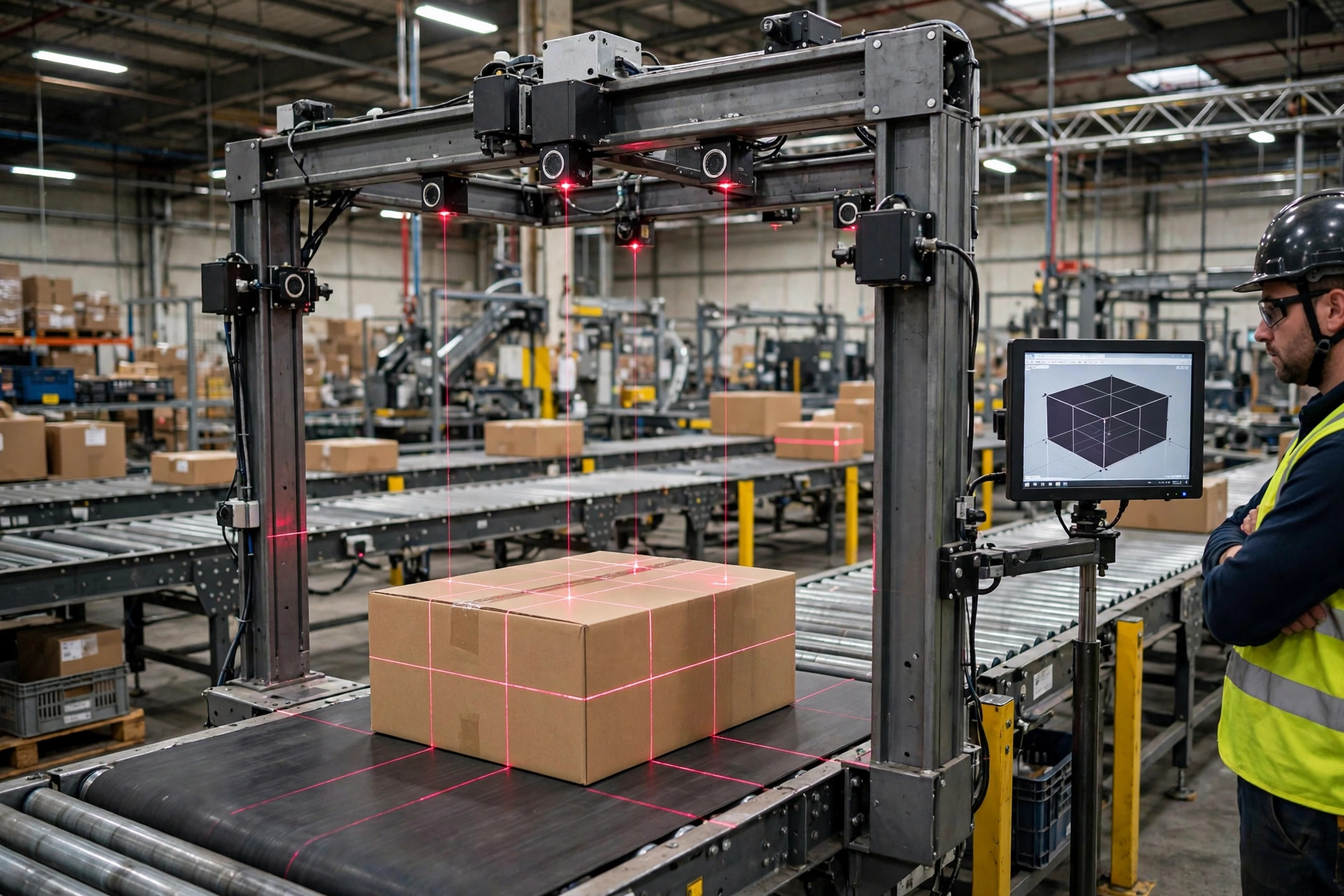
Bottom line up front: if you run a small-parcel export warehouse without dimensioning equipment, at least 5% of your monthly freight bill is money you can't account for — overcharges you'll never win back, because you have no evidence.
"Bulky" freight is the industry's open secret: light but space-hungry. Carriers aren't stupid — they bill whichever is greater, actual weight or dimensional weight. The formulas are public and nearly universal: domestic couriers in China typically use length × width × height ÷ 6000 (centimeters); international air freight mostly uses ÷ 5000; the big US carriers use L × W × H ÷ 139 (inches). A 60×40×40 cm box weighing 3 kg dim-weights to 16 kg. You pay for 16 kg. That's why bulky freight hurts.
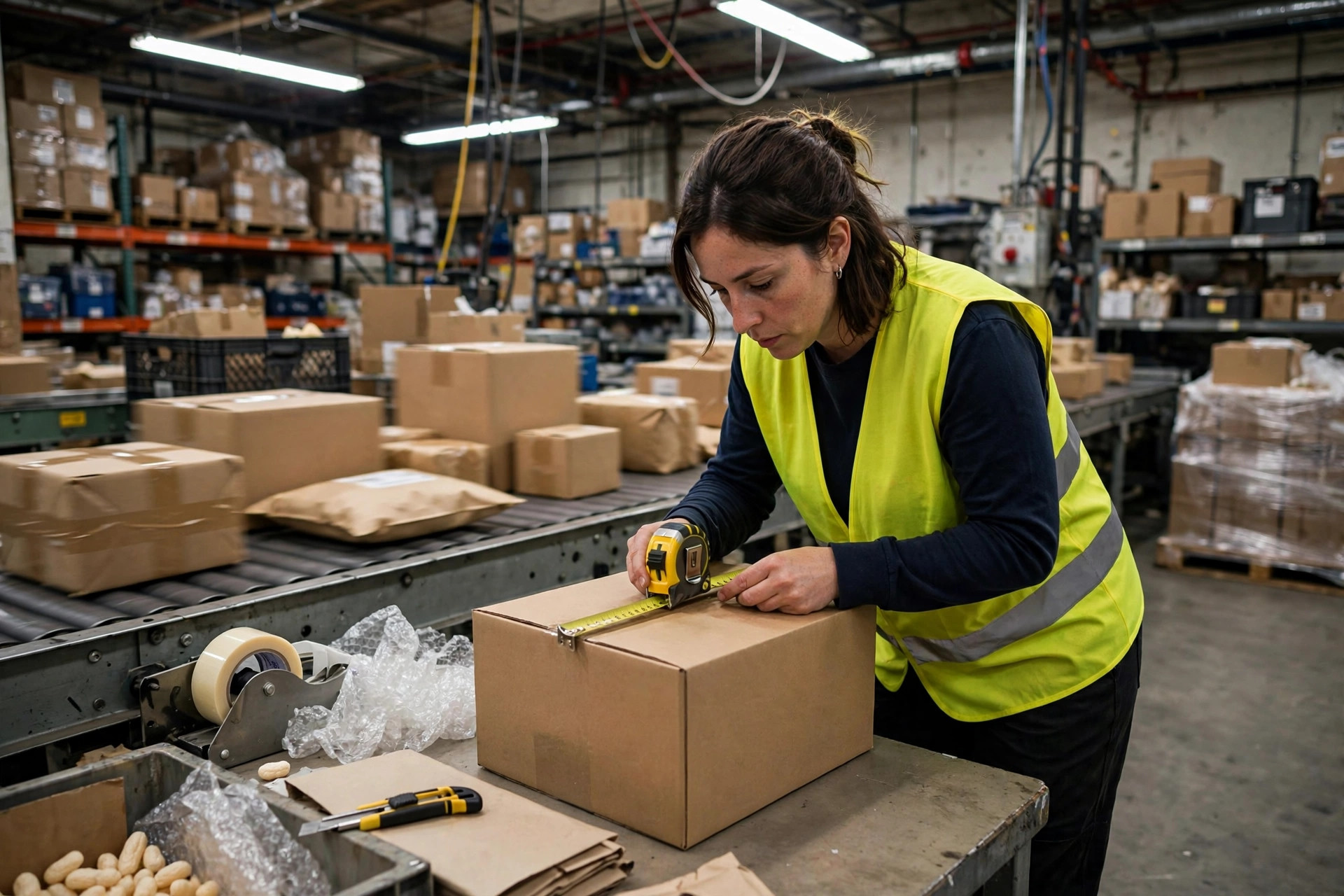
The fight is always about the measuring. Your warehouse measures with a tape; the carrier's depot measures too; the numbers disagree and the freight differs. At peak season, a few thousand parcels a day, the measuring guy is eyeballing by afternoon and two or three centimeters of error is routine. Then the monthly statement arrives showing dimensional weight 8% above your records, and you have nothing to argue with — the carrier has per-parcel dimensioning data in its system, and you have a spreadsheet.
A cross-border parcel 3PL in Shenzhen told me in 2024 they'd been fighting their carrier agent for half a year. Manual measurement at outbound, agent settling on its own dimensioning data, the gap stuck at 6–8% for months. They finally bought a static dimensioning station. Three months of reconciliations later, the gap was under 1%. The freight saved paid for the machine within a year. Note the word: saved, not earned. But for a 3PL running on paper-thin margins, saved is net profit.
Static or in-line? Let your volume decide
Two categories of equipment. Pick wrong and it's worse than buying nothing.
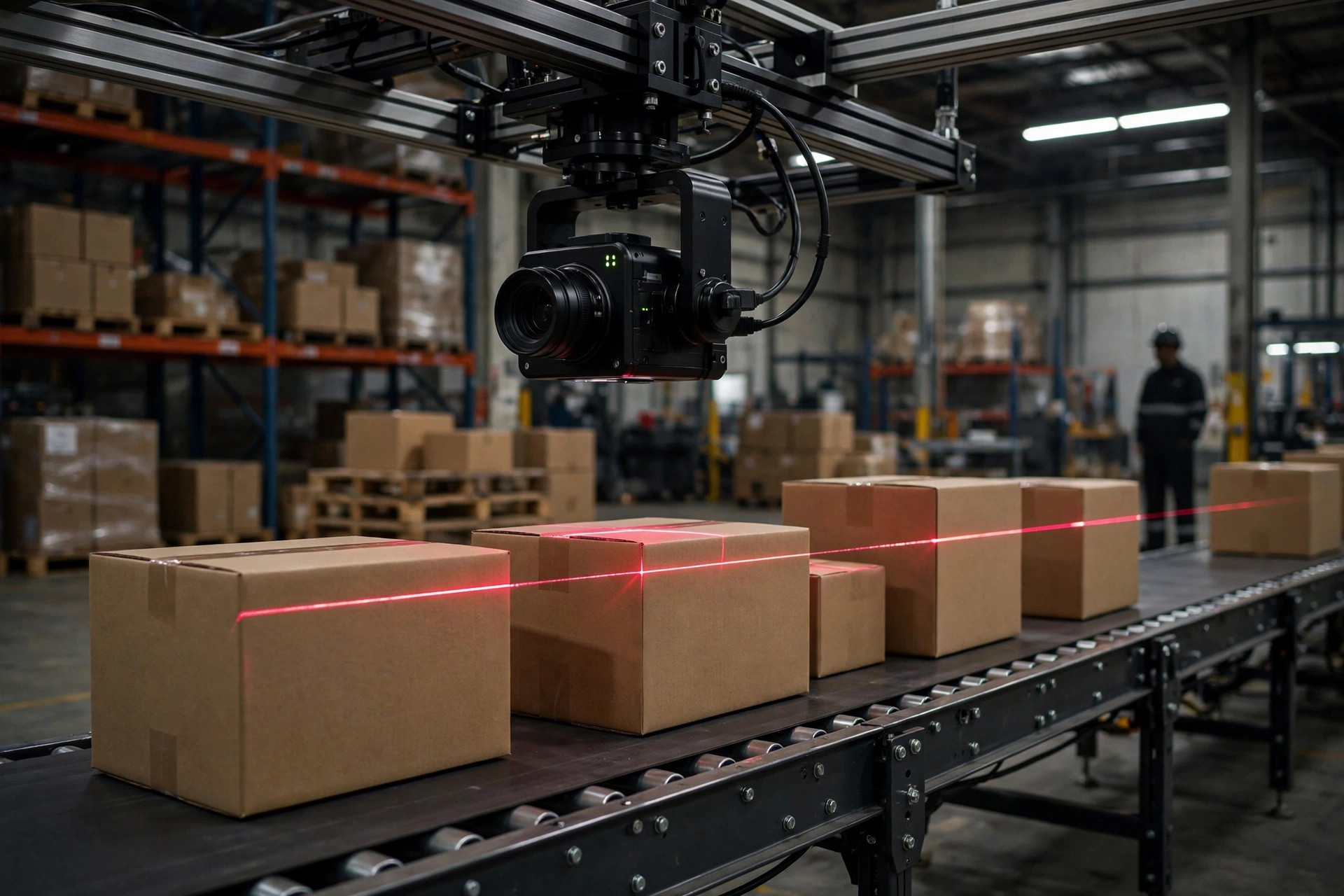
Static dimensioning: set the parcel on the station, lasers or cameras scan it, dimensions and weight in one shot. One operator, a couple thousand parcels a day, no problem. Cheap, small footprint, and handles odd shapes (the operator tilts the item for a better scan). The downside is queuing at peak — the station becomes the outbound bottleneck. Under about 3,000 parcels a day, static is plenty. Don't let a salesperson talk you into in-line.
In-line dimensioning: mounted over the conveyor, parcels get measured, weighed, and barcode-scanned in one pass. This is the toy for carrier hubs and mega-warehouses doing tens of thousands a day, rated by the hour. Fast, no labor — but expensive, unfriendly to irregular and oversized items, and when it faults, the whole line stops. Below that volume it's an expensive sculpture.
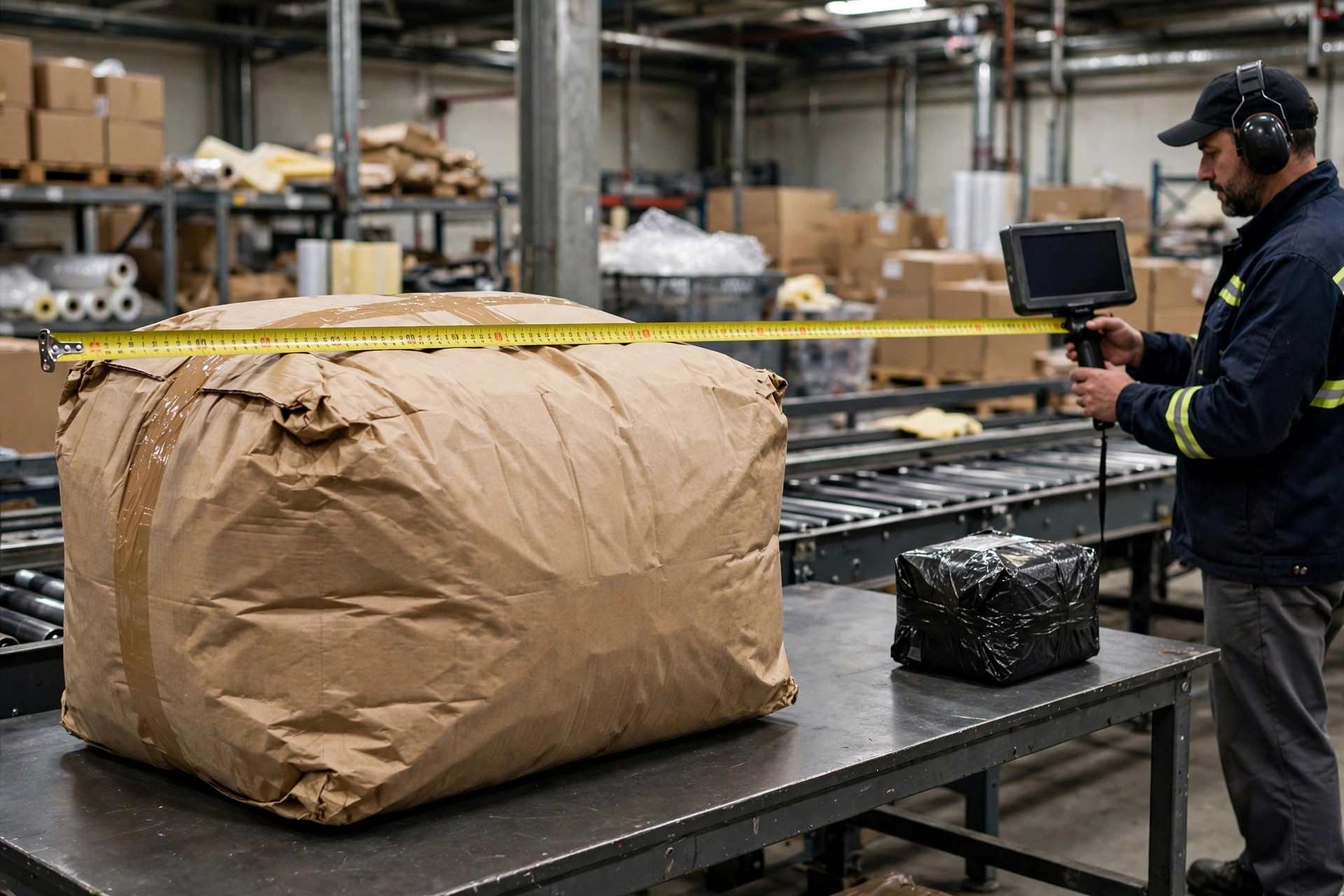
There's a middle path: semi-automatic. Conveyor feeds a dimensioning station, operator squares the parcel, machine scans. Faster than pure static, cheaper than full in-line — good for warehouses whose volume is climbing. Don't buy for today's volume or for a fantasy; buy for next year's plan with about 30% headroom. Oversized is waste, undersized is a bottleneck.
Three specs salespeople will mislead you on
First, accuracy. "±2 mm accuracy" sounds great until you ask: full-range accuracy, or accuracy in the range you actually use? Some machines are precise on small boxes and drift badly past 80 cm — and bulky freight is exactly the big boxes. Make them measure your largest box on site. Data talks.
Second, maximum range. Three numbers: max dimension, max weight, minimum measurable size. Oversized freight can't go on the station and goes back to manual measuring, which torpedoes your coverage. Pull your last three months' ten largest parcels, check them one by one against the spec. Under 95% coverage, walk away from that model.
Third, software integration. The machine is just a scale; the value is whether the data flows into your systems. Dimensioning data should write itself into the WMS outbound order and feed the billing system so every parcel reconciles. Some vendors charge separately for integration or only offer Excel export. Think hard about that — you're buying this machine to kill spreadsheets, not to feed them.
A word on irregular items: laser dimensioning measures the bounding box, so odd shapes get overstated. That's physics, not a quality defect. If irregulars are a big share of your mix — home décor sellers, I'm looking at you — negotiate the irregular-item billing terms into the carrier contract. The machine makes your measurement accurate; it can't negotiate for you.
Calibration is not optional
Dimensioners are measuring instruments and they drift. Conveyor vibration, dusty laser heads, tired load cells — the numbers creep. My rule: calibrate monthly with a reference box of known dimensions, log the deviation, and call the vendor when it exceeds tolerance. Keep the calibration records. In a billing dispute with the carrier, "my equipment was calibrated last month, within tolerance — what about yours?" is a powerful sentence at the negotiating table.
Small detail: where you put the station matters. Not in the middle of the packing bench with people bumping into it all day. Give it its own little cell, level floor, no clutter around it. These machines are fussy; a rough environment hits accuracy first.
Do the math before you buy
Don't take the salesperson's ROI. Do your own. Take three months of carrier statements, compare "billed dimensional weight" against "your recorded dimensional weight" parcel by parcel. The gap ratio times monthly freight is your monthly bleed. Annualize it, compare against the quote. Payback beyond 18 months? Hold off, and first tighten manual measurement: one standard method (outer carton or maximum protrusion — decide and document), double-person spot checks, keep records. Process discipline alone can halve the gap. Re-run this math quarterly — as volume grows, the answer may flip.
My verdict: over ~2,000 parcels a day, with bulky freight, in a standing billing fight with the carrier — a static dimensioning station is a necessity, not an option. It's not just about saving freight; it's about negotiating leverage. With data in hand, reconciliation becomes a conversation. Smaller warehouses: standardize manual measurement first and spend the money where it counts.
Tight on budget? Rent. Some vendors offer monthly leases, or pick up a used unit. Rent for three months, bring the reconciliation gap down, get the process smooth, measure the real return, then decide. The machine is the means; the reconciliation data is the end. Don't invert them.
Tonight's homework: pull last month's carrier statement, sample 50 parcels at random, and line up the carrier's dimensions against your warehouse's records. If the gap tops 5%, dimensioning equipment belongs on your agenda.