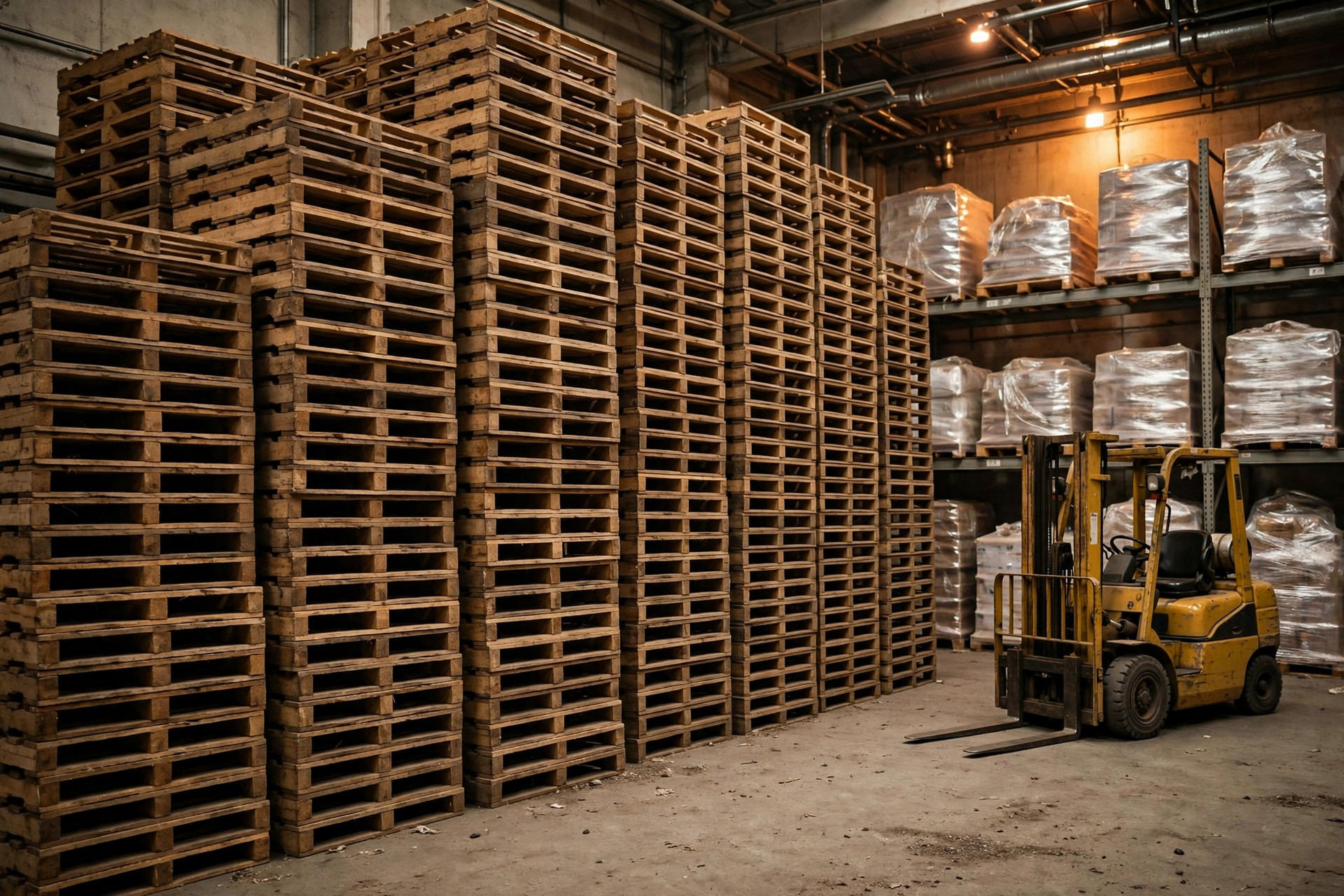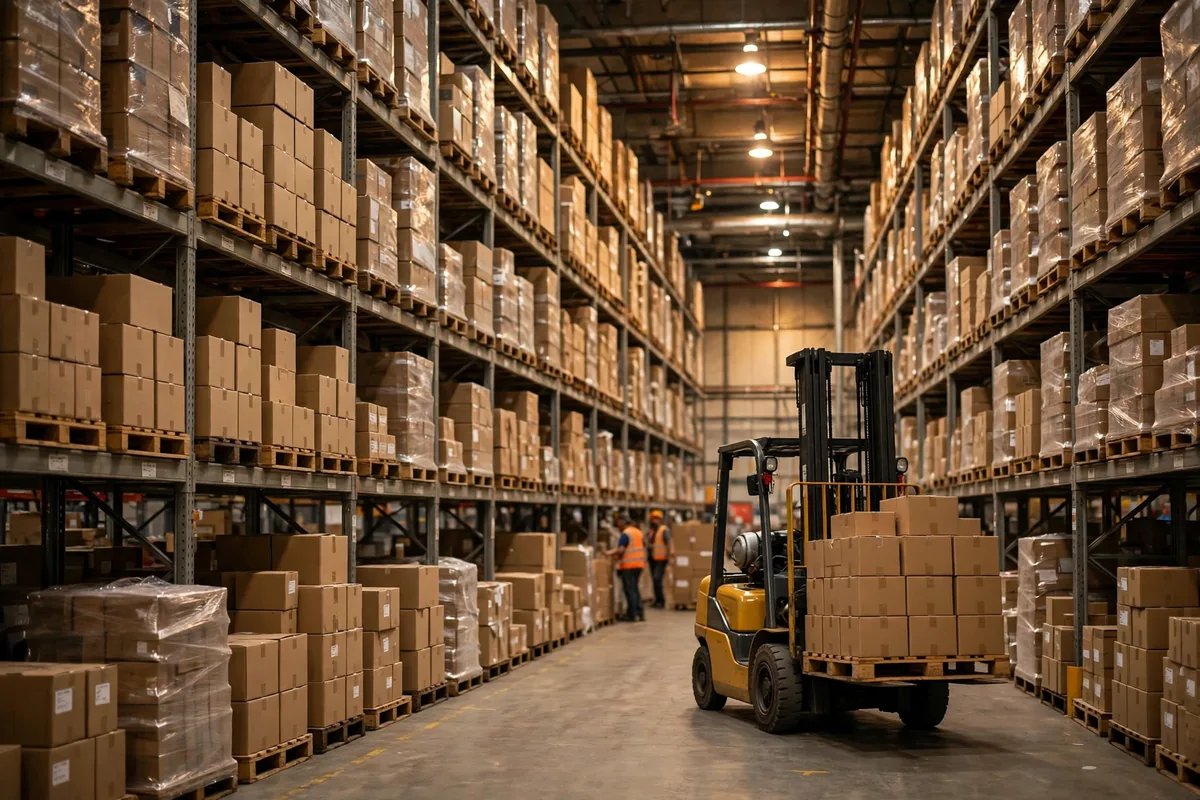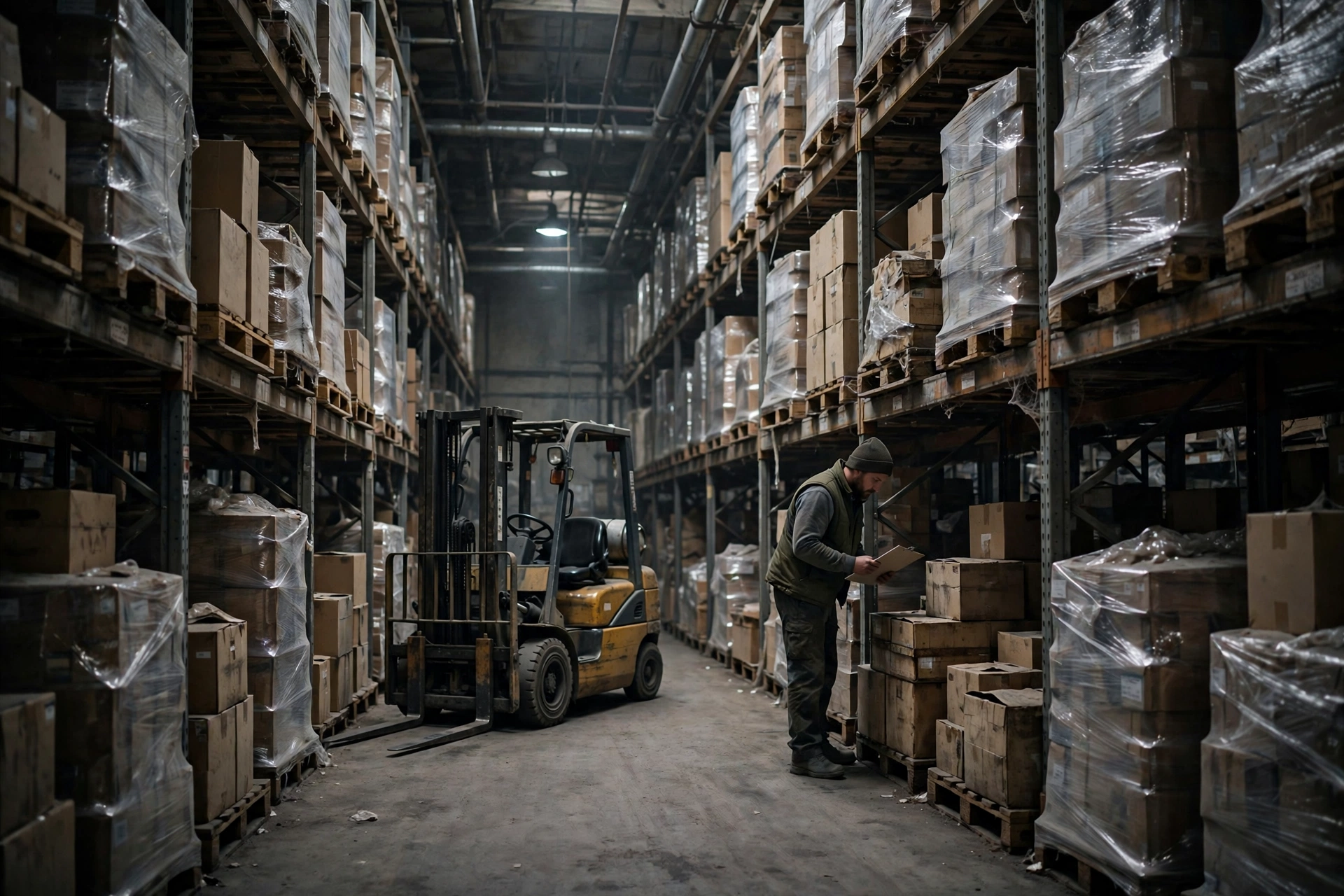
In March 2025 I was at a 3PL auto-parts warehouse in Ontario doing an equipment walk-through. Eighty thousand square feet, the pick face running fine, the top racks frozen solid. One batch of brake pads, received at the end of 2023, had not moved in 14 months — 240 pallet positions, untouched. The manager told me the stock was still worth $180,000 on paper, and the positions it occupied each month would have covered half a small warehouse on their own.
That is what dead stock warehouse slow moving inventory actually looks like: not goods nobody wants, but cash bolted to a rack. Think of it as a machine that depreciates, takes up floor space, and draws power — except a machine can at least be switched on.
How Dead Stock Forms: Start With the Mechanism
People blame purchasing the moment dead stock comes up — they ordered too much. In my experience purchasing carries only a small share of it. Dead stock forms more like a conveyor line: every station upstream adds a little extra, and by the end the whole thing jams.
The first jam is the forecast. Sales reports a number, purchasing adds a margin for fear of a stockout, and the supplier's minimum order quantity rounds it up another notch. Three layers of padding, and inbound volume ends up far above real demand. You can think of a demand forecast the way you think of a nameplate rating on a motor: it looks clean on the label, but the moment operating conditions change, the whole line has to adjust. Once stock is in the warehouse, the cost of that adjustment lands on warehousing.
The second jam is safety stock. It only ever goes up — the most common fault I see. A product stocked out once during peak, so safety stock goes from 200 units to 500. Peak passes, nobody turns it back down. Two years later those 500 units are dead stock themselves. Safety stock should be reviewed on a schedule, the same way equipment gets a maintenance interval. In most warehouses that interval is: never.
The third jam is new products. In September 2024, a home-storage seller in Los Angeles stocked up for a big promotion with 9,000 units of a new storage box. Four months later only 2,700 had sold; 6,300 sat on the rack. Nobody asked at launch: if this does not sell, who owns it on day 90? Mixing launch logic for a new SKU with replenishment logic for an old one is the most reliable source of dead stock I know.
These three jams share one trait: when the goods come in, everyone has a reason; when they stop moving, nobody owns the problem. Dead stock never appears in a day. It is three departments each adding "a little extra" until the rack is full of it.
The Disposal Line for Slow-Moving Inventory: Do the Math First
Before you dispose of anything, do the math — clearing stock without it is the same mistake as ordering it without it.
Take those brake pads again. Value on paper: $180,000. Pallet positions: 240. By that warehouse's own costing, one position ran $28 a month — rent, labor, system costs, all in, their number, not mine. Two hundred forty times 28 is $6,720 a month; over 14 months, $94,080. No invoice, no purchase order. It just burned, quietly.
The clearance math ran like this: sell at 40 percent off, recover $108,000, take a $72,000 loss in one go. It sounds painful. Hold it another year and the holding cost is another $80,640, while brake pads only get less sellable with time. Clear it and lose $72,000 once, getting $108,000 cash back. Hold it and burn more than $80,000 a year while recovering nothing. The manager needed about a minute once he saw the two numbers side by side.
No disposal method is right in itself; each one has a line. Mine has three checks, in order: how long it has sat, how much value it still holds, and how many pallet positions it eats.
| Method | Fits what kind of stock | What you recover | How fast | The line |
|---|---|---|---|---|
| Discount clearance | Still sellable, just slow | 50–70% of value | Weeks | Start at 180 days idle, not 365 |
| Bundling | Slow alone, moves with a seller | 60–80% of value | 1–3 months | Needs a fast mover to carry it; a lone SKU will not bundle |
| Return to supplier | Supplier accepts, stock not expired | 70–90% of value | 1–2 months | Negotiate returns before ordering; after the fact it rarely works |
| Strip for parts | Generic parts with reusable components | Depends on the parts | Weeks | If the labor to strip costs more than the parts, do not strip |
| Scrap or donate | Expired, damaged, unwanted | Near zero, but frees the position | Immediate | Scrap when value is below three months of holding cost |
Here is the counterintuitive part: clearance is not the loss — discount clearance is the smallest loss available. People refuse 40 percent off hoping for 20 percent off later, while waiting costs $6,720 a month and the goods get cheaper the longer you wait. The most expensive part of dead stock is not the value of the goods; that value is already sunk. It is the pallet position, live cash bleeding every month.
There is a second trade-off most people get backwards: dense storage makes dead stock harder to see. Automated high-bay storage hides goods deeper, so nobody notices the dead freight, and rack utilization looks great while half the building is dead stock. The denser the storage, the more frequent the age review has to be — otherwise you are paying premium money to build a luxury home for dead stock.
The Los Angeles seller bundled instead. The 6,300 slow boxes went into combo packs with a fast-moving product, and 4,200 moved in three months; the remaining 2,100 went to discount clearance. Bundling recovered roughly 20 percent more than straight discounting, but only because a fast mover was willing to carry it. A lone SKU with no partner should go straight to discount. Do not force it.
Stopping It From Coming Back: The Maintenance Traps
Clearing one batch of dead stock warehouse slow moving inventory is half the job. The other half is keeping it from growing back, and that is where the maintenance traps sit.
The first trap is the aging report nobody reads. The WMS already has the data — 90, 180, 365 days, one query gives you the whole picture. Yet too many warehouses open it only at the quarterly stocktake. Age review should be a monthly routine — 90 days idle goes on the watch list, 180 days idle gets a disposal decision, 365 days idle goes straight to clearance. Without that rhythm, dead stock grows back exactly the same way.
The second trap is a KPI set that only watches stockouts. If that is the only thing measured, the rational move for purchasing and operations is to overstock. The cost never shows up on the stockout report; it shows up in pallet positions. Add one line to the scorecard: dead stock value as a share of total inventory value. The moment that number is measured, ordering gets more careful on its own.
The third trap is buying a software module to fix it. I have heard "let's get a dead-stock management module" more than once, and I will say it plainly: a module only makes the numbers look tidier. It cannot fix forecasts made by gut feel, and it cannot fix safety stock that only goes up. Without a human review rhythm, the list it produces just sits there unread. Build the manual review rhythm first; software only makes a working rhythm run faster.
One more trap: new products launch with no exit plan. When a new SKU goes in, write down the exit at the same time — if sell-through misses the target by day 90, who disposes of it, and through which channel? A new product without an exit plan is like a machine without a maintenance manual.
Those brake pads cleared in six weeks, and the 240 pallet positions went to fast-moving stock for two new customers. The manager told me later that the day the clearance finished was the day he realized the empty top racks were not just space — they were $6,720 a month in cash flow, back.
Whether the money was worth it comes down to one number: for every $100 of dead stock you hold, how much does it burn each month? On the brake pads, $6,720 divided by $180,000 is $3.70 per $100, per month. Above $3, any clearance option beats holding. Work out that number for your own warehouse, and you will know whether to move or keep waiting.
By Da Liu, Automation Engineer