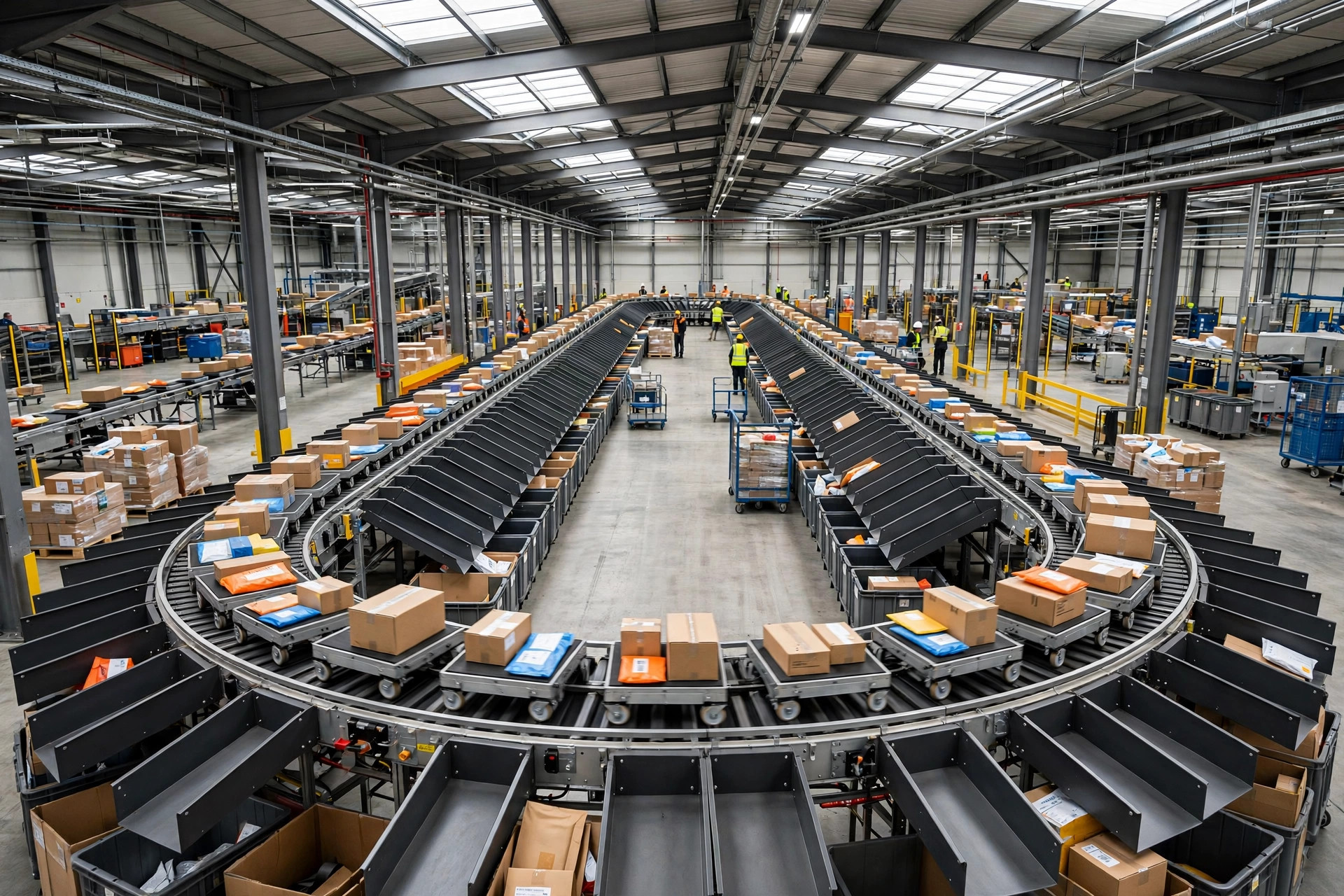
Let me be honest up front: our warehouse is 3,000 square meters. On a normal day we push three to four thousand orders; during peak season, seven or eight thousand. Last year I toured an e-commerce mega-warehouse before the big sale. They had a crossbelt sorter with hundreds of chutes ringing the loop, parcels diving in like they had eyes. I stood behind the railing drooling. Then I asked the sales rep for a quote, heard the number, and decided on the spot: crossbelt sorters and I are never going to happen.
There is no way our little warehouse can burn that kind of money.
But that tour wasn't wasted. One afternoon watching their sort line taught me something: the soul of that beast isn't the loop — it's how they allocate chutes and how they tune mis-sorts. The loop is built out of money. The tuning brain is free. And that part, I could steal without spending a dime.
The mega-warehouse has a "chute guy." Every morning he does three things.
They had a role I've nicknamed the chute guy (never caught his real title — he runs chute allocation). I chatted with him for a while. Every morning, without fail, he does three things: review yesterday's mis-sort report, check today's inbound forecast, and redraw the chute allocation sheet.
Before a big sale, hot sellers get their own dedicated chute; on normal days, three slow-moving lanes share one chute and make do. The allocation sheet isn't drawn once for the year — it changes daily.
I asked a dumb question: more chutes is better, right? He laughed. Every extra chute is extra rent and one more thing to watch. An idle chute is pure cost; an overflowing chute is pure mis-sorts. You should see how many long-idle chutes we ripped out last year.
That line stuck with me. More chutes isn't always better — my first counter-intuitive takeaway from the big warehouse. A chute is like a rack in our little warehouse: if it sits empty, it's losing money.
The core logic of chute allocation, translated for small warehouses
I chewed on it for days after I got home, and translated their system into our language. Three rules:
One, prime lanes get the golden chutes. The chutes closest to the induction point, with the smoothest slides, go to your highest-volume flows. One less step per parcel for the sorter adds up to thousands of steps a day. Same reason supermarkets put bestsellers next to the checkout.
Two, hot sellers get their own chute; slow movers carpool. During a sale, a hot item must have a dedicated chute or it'll flood everyone else's. On quiet days, slow lanes share a chute until it's full. Chute allocation follows the freight, not the blueprint.
Three, tune it constantly — don't draw it once. When the volume mix shifts, the chute sheet shifts with it. Every Monday morning we now spend ten minutes reviewing last week's lane data, swapping chute labels on the spot. Paper printouts. Costs about two cents a sheet.
Can't buy the machine? Rent the chutes.
Understanding the theory is one thing; making it work is another. Last peak season we were pushing seven or eight thousand orders a day, and our manual sort couldn't keep up — three or four mis-sorts per hundred parcels, all tossed into the wrong bins, and customer service drowned in wrong-shipment complaints.
Buy equipment? No money. Hire people? Try hiring anyone during peak season.
So I came up with a wild idea: rent chutes. There's a sortation hub nearby whose 8 PM to 10 PM window is their dead time. I negotiated: every evening we'd book four chutes, our parcels pre-sorted by the first two digits of the zip code, and their line would run them through. A few hundred bucks a night — cheaper than two extra sorters, and no meals or dorms to provide.
The results were ridiculous. After the rough sort, our crew only had to do the fine split, and our mis-sort rate dropped from three or four per hundred to one in several hundred. Complaints got cut in half. For two months straight, I wanted to bow to that hub's owner every night.
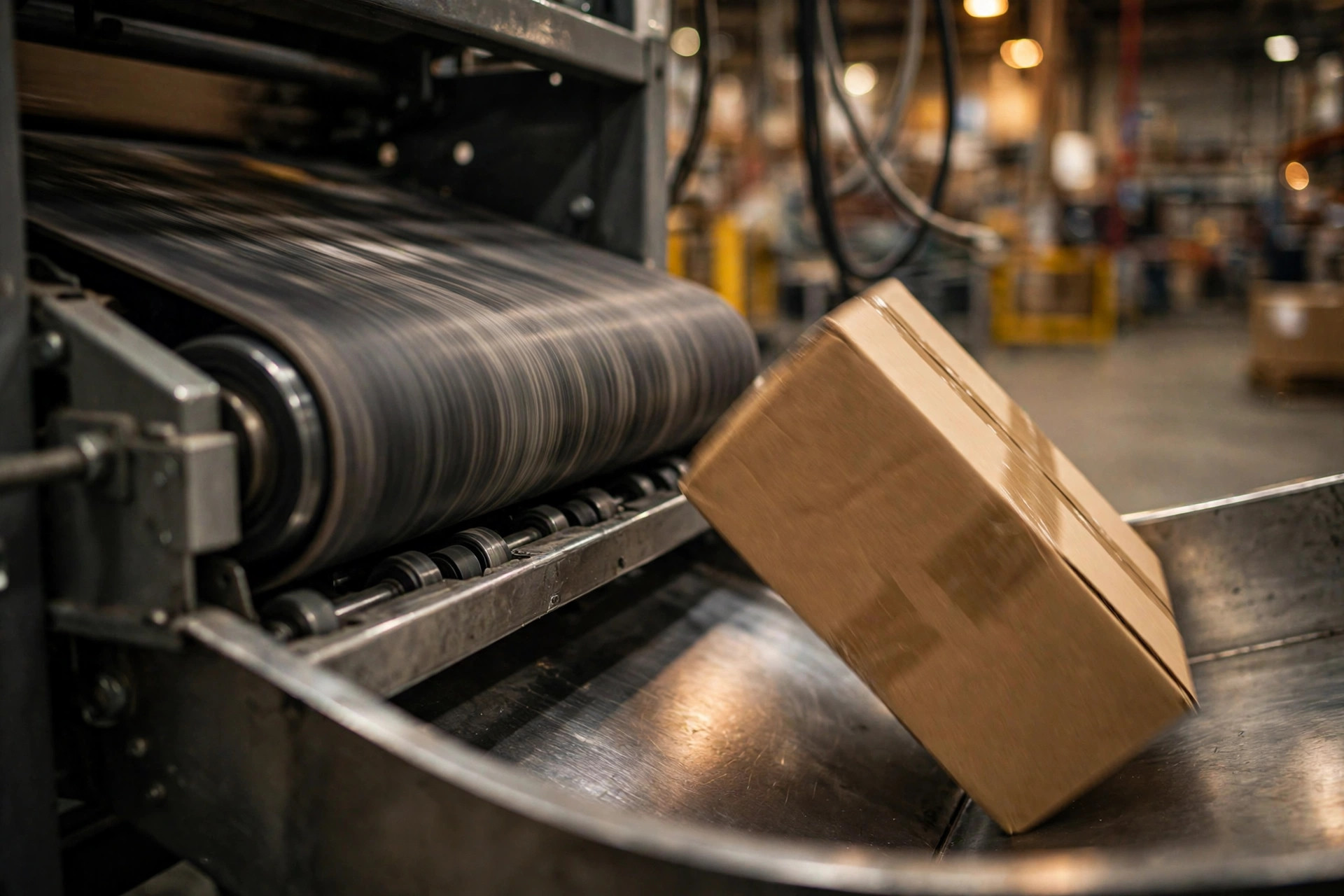
The dirt-cheap version: a row of cardboard boxes is our "crossbelt"
Rented chutes solved peak season. For normal days, we rely on something even more primitive.
We have a sort wall in our warehouse — which is really just a row of big cardboard boxes, each with a printed sheet taped to it showing the lane. The guy upstream scans with a barcode gun, the system shouts "bin seven!", and he tosses it in. Laugh all you want — this human crossbelt pushed our everyday mis-sort rate down too.
Eventually it clicked for me: sorting is allocation logic plus execution discipline. The machine just executes faster. The allocation sheet is our brain, the boxes are our chutes, the scanner is our reader. What the big warehouse does with millions in equipment, we do at seventy, eighty percent with a few thousand bucks of gear.
Let's do the math: where the three tiers break even
Fellow small-warehouse owners always ask: at what volume does sortation equipment make sense? Here's my break-even table, built from our own bruises. These are orders of magnitude, don't take them as gospel:
| Setup | Investment | Fits daily volume | Mis-sort level |
|---|---|---|---|
| Manual sort wall (racks plus boxes plus scanner) | A few thousand bucks | Under 1,000 orders | A few percent, held down by discipline |
| Slides plus scan zones / renting chute time | Tens of thousands, or pay-per-use | 1,000–5,000 orders | A few per thousand |
| Crossbelt sorter | Millions to start | Tens of thousands of orders, sustained and growing | A few per ten thousand |
See the pattern? Below ten thousand orders a day, a crossbelt is a dragon-slaying sword for a dragon you'll never meet. You spend a fortune solving a problem you don't have yet, and adopt a new ancestor to worship — maintenance alone could fund half a team.
We're parked comfortably in tier two. The day we hold steady above ten thousand orders, I'll be the first to sign the purchase order. Until then: rented chutes plus a cardboard sort wall. Chef's kiss.
Mis-sort tuning: three moves small warehouses can copy
Back to mis-sorts. The chute guy told me something that surprised me: most mis-sorts don't start at the sort — they start upstream. Three moves, all free, all copyable:
Move one: labels straight and face-up. A crooked, wrinkled label the reader can't scan makes perfect downstream sorting worthless. New rule in our warehouse: whoever applies labels self-checks ten orders every two hours. A crooked label buys bubble tea for the whole team. Nothing straightens labels like the threat of bubble-tea duty.
Move two: clear a full chute immediately. One overflowing chute misplaces everything behind it — all that perfect sorting, wasted. It's the thing the chute guy watches closest all day. Our dirt-cheap version: every chute (box) has a warning line drawn on it. Hit the line, haul it away. No piling above the rim, ever.
Move three: scan one order at a time — don't batch. Some folks batch-scan a pile to save time, and one mistake cascades through the whole pile. Switch to one-scan-one-order and errors surface instantly. We fought about this one until the data settled it: cascade errors went to zero.
Three suggestions for fellow small warehouses
First, tour a big warehouse. Go in with questions: how do they allocate chutes, what happens when one overflows, what does their mis-sort report look like. The equipment isn't the valuable part — their management playbook is. Swallow your pride and ask; most of them are happy to show you around.
Second, rent before you buy; go dirt-cheap before you go fancy. Rent chutes for peak season, run the cardboard version on normal days, and get your allocation logic working first. Once your brain (the allocation sheet plus discipline) is mature, then decide whether you need the body (the equipment).
Third, don't let equipment salespeople run your math. When a rep tells you it will only get more expensive later, ask three questions: what's my daily volume, what's my mis-sort rate, what's my labor cost? Lay out those three numbers and you'll know the answer yourself.
Small warehouses have their own way of surviving. We can't afford a crossbelt sorter — but we copied its tuning brain without spending a cent. Honestly it feels like a steal: the big guys paid millions in tuition; we graduated after one afternoon of touring.
By Xiao Ma, Small Warehouse Owner