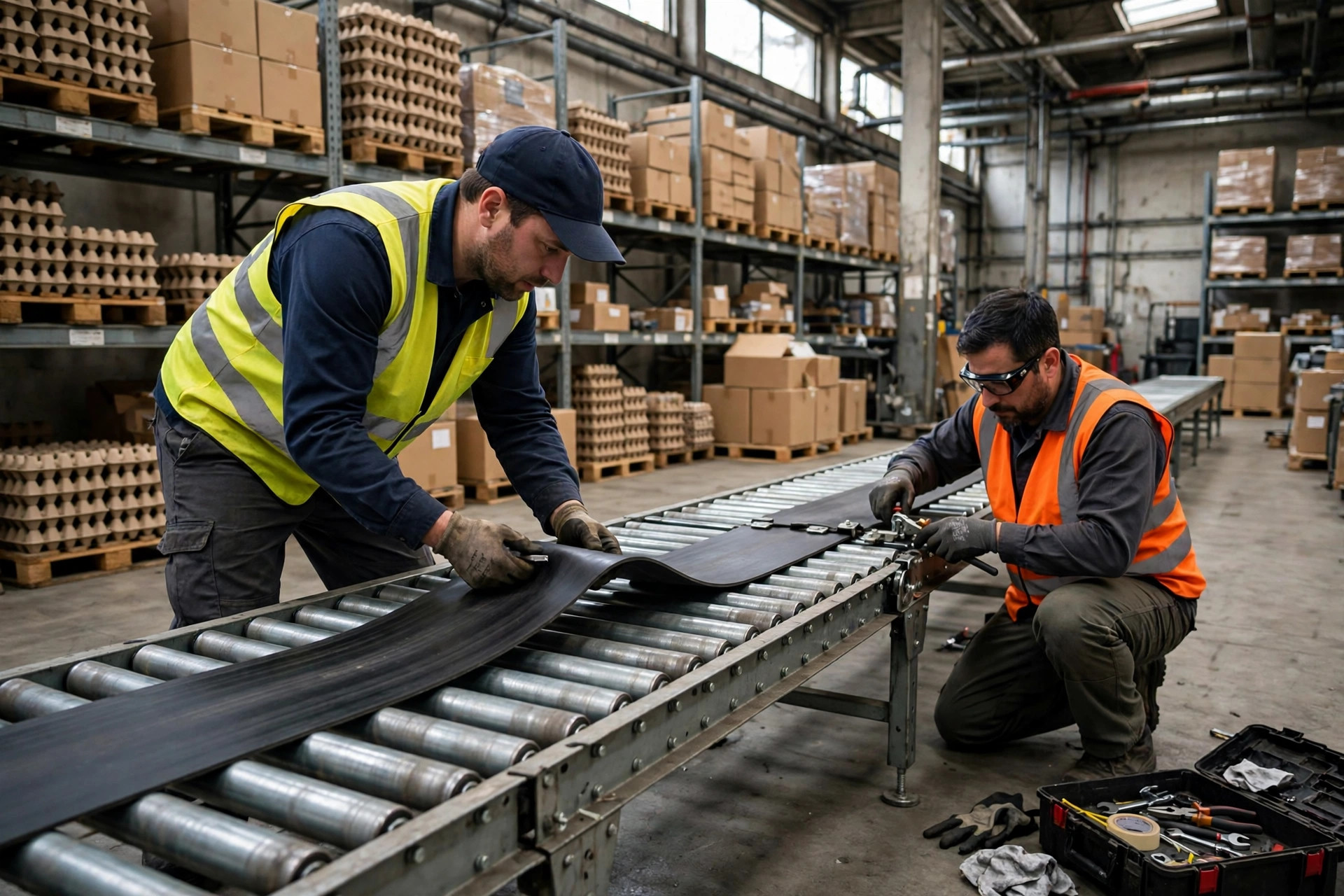
I learned to take conveyor belt splicing seriously at about two in the morning, on a sortation line that had just stopped for no obvious reason. A tote lurched on a roller, an operator walked over, and there it was: the joint had lifted like a page torn loose from a book. The belt had not snapped. The joint had given up first, and the line sat idle for more than forty minutes while the maintenance crew was called in. By restart, the backlog had already pushed the morning departure back by half an hour.
That is the pattern I kept seeing when I led technical work for an integrator. On a purchase order, a belt is a width, a length, and a material, and the joint is treated as a free extra. A crew cuts it on site, runs the belt for two loops, and calls it done. Then peak season arrives, and the joint starts talking back: peeling, cracking, drifting, and in the worst case tearing open at a roller. Every minute saved during installation gets repaid later as downtime.
Conveyor Belt Splicing Fails Rarely at the Splice Itself
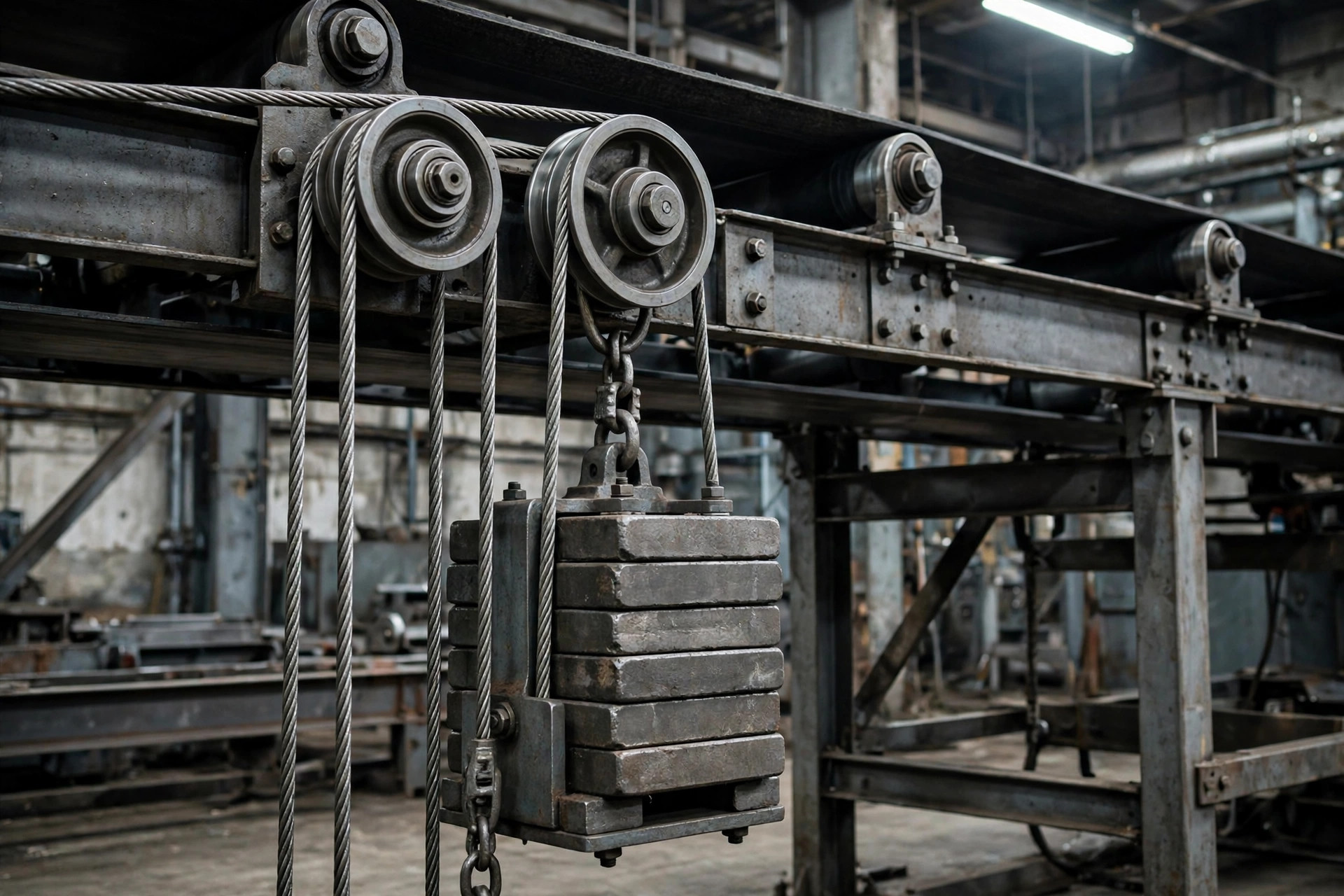
In the winter of 2023, a third-party warehouse in Kunshan, Jiangsu, asked me to look at a main line that kept stopping once or twice a month because of its joint. The crew had already tried mechanical fasteners and then a cold bond, and neither held. I did not start with the joint. I started with the rollers. The tail pulley was small, so the joint was forced through a tight bend every revolution. Bend a business card back and forth enough times and it always breaks at the crease. A belt joint behaves the same way.
We measured three things: pulley diameter, belt thickness, and the bend radius the joint experienced at that pulley. The problem was not the method. It was the layout. The joint was sitting in a high-frequency bending zone, and no method survives that placement for long. We moved the joint to a longer straight section and fitted a larger-diameter pulley. Same belt and crew, and the line then ran for three months with only one stop, caused by a jammed foreign object. Many so-called joint failures are really layout failures, and the joint is just the part that takes the blame.
In the summer of 2024, an electronics warehouse in Dongguan taught me the other half of the lesson. Its line carried small plastic totes with uneven feet, and every tote thumped the joint as it passed. The joint itself was vulcanized, and its strength was not in question. But it was slightly thicker than the belt, so each tote foot caught it thousands of times a day, the edge frayed, and the cycle fed itself. My judgment was blunt: strong enough does not mean suitable. In that operation, thickness and flatness mattered more than raw strength. We switched to a thin mechanical fastener with chamfered edges, the totes ran smoothly, and the joint outlasted the stronger one it replaced.
Vulcanized, Mechanical, and Cold-Bonded: Three Different Bills for Conveyor Belt Splicing
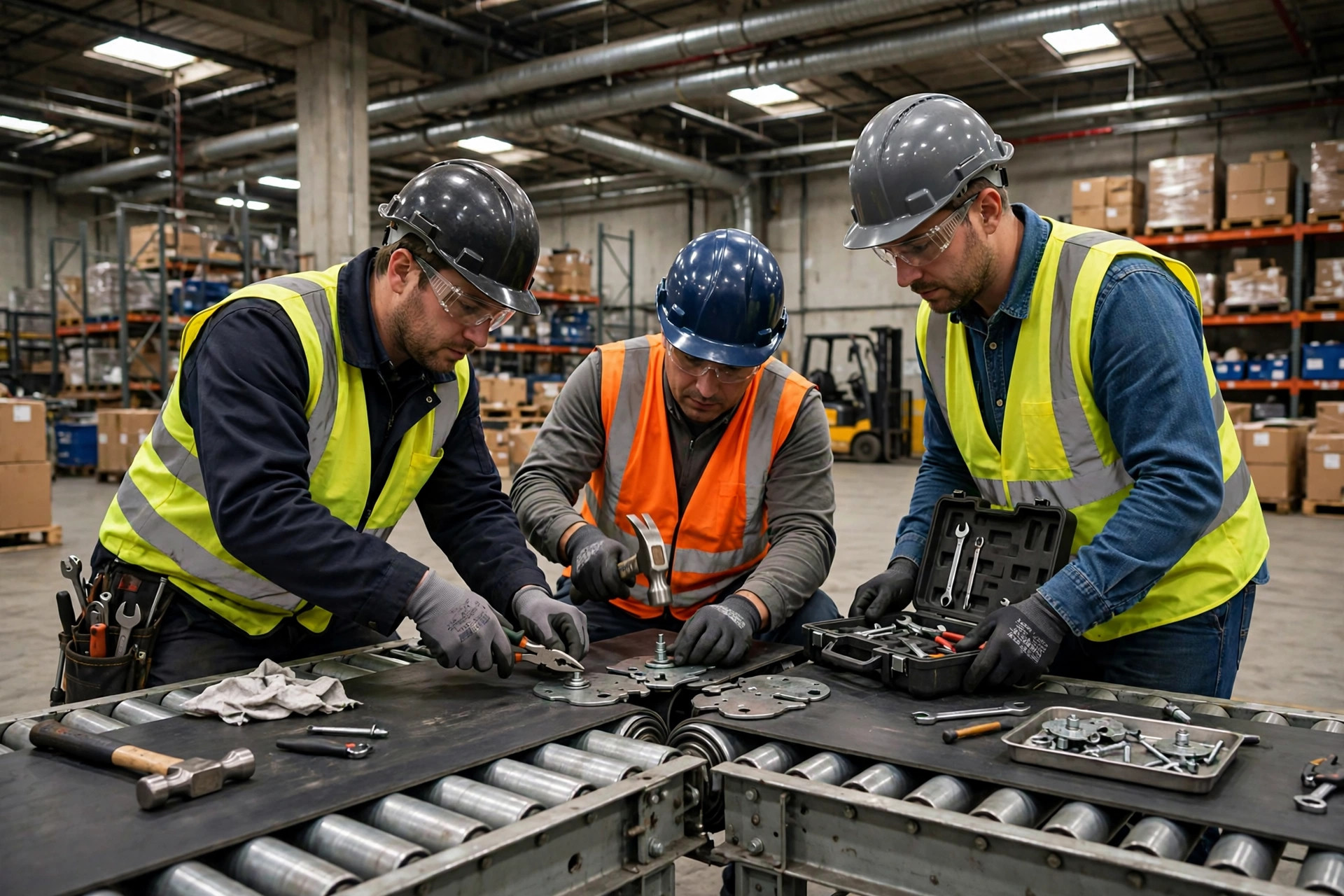
The three methods are not three grades of good, better, and best. They are three different deals. Vulcanizing grinds both ends into steps, lays in fresh rubber, and uses heat and pressure to turn them back into one continuous piece. A mechanical fastener staples the ends together with metal clips, like a belt buckle for the belt itself. It is fastest to install and easiest to replace. Cold bonding glues the ends at room temperature with a special adhesive. It needs no heating press, sits between the other two on performance, and demands the most care from the person doing the work.
When I price conveyor belt splicing, I do not compare methods on installation time alone. I compare them up to the next planned shutdown. I ask every site three questions before I recommend anything. First, what is the belt made of, and can it take heat at all? Second, how long is the shutdown window: half a day, or barely an hour? Third, will the joint pass repeatedly over a small pulley, or get knocked by tote feet and pallet feet? Once those three answers are clear, the dividing line almost draws itself.
| Method | Best fit | Shutdown window | Strength and flatness | Biggest trap |
|---|---|---|---|---|
| Vulcanized | Main lines, long runs, heavy loads, joints you do not plan to touch | Longest, needs heating, pressing, and cooling | Closest to original strength, flattest surface | Rushing it leaves bubbles and weak bonds |
| Mechanical | Fast recovery, frequent inspection, temporary joints | Shortest, often back running within the hour | Strong enough, but the surface has a bump | Fasteners wear, snag tote feet, and fatigue over small pulleys |
| Cold-bonded | No vulcanizing press, no hot work allowed, heat-sensitive belts | In between, needs curing time | Between the other two, highly dependent on technique | Wrong temperature or humidity, or a poorly pressed glue layer, means it never really bonded |
The classic mismatch is using vulcanizing to fix an emergency. I have seen a night crew rush a joint with a makeshift heater, trap air bubbles in the rubber, and watch it split the next day as soon as volume rose. The reverse mistake is just as common: running a heavy main line on mechanical fasteners, letting the clips wear thin unnoticed, and having them let go during a shift change. You would not patch a tire with a bandage, and you would not send a whole truck to a rebuild shop for a flat.
Here is the counterintuitive part about conveyor belt splicing. The most expensive method is not always the cheapest over time, and the cheapest is not always the most expensive. A vulcanized joint costs the most to install, but if a line only shuts down twice a year, doing it once and properly can be the least disruptive choice. A mechanical fastener costs the least per job, but if the joint bends tens of thousands of times a day, inspection and replacement frequency quickly flips the total. The honest calculation counts shutdowns, recovery time, and inspection labor across the full life of the joint. An installation quote alone will never tell you that truth.
Three Moments That Decide Whether Conveyor Belt Splicing Holds
The first moment is the end of the installation itself. With vulcanizing, check that heating was even and cooling was complete; starting the belt while it is still hot invites bubbles. With cold bonding, check that grinding was thorough and the glue layer was pressed firmly; looking stuck on the surface does not mean it is bonded underneath. With mechanical fasteners, check that every clip is fully set and the edges are chamfered; a burr left behind is a future snag. My acceptance test is to run my hand along both sides of the joint, then run the empty belt for three loops and listen for a repeated thump.
The second moment is the first week after the line returns to full volume. A new joint rarely fails instantly. It drifts. If the belt tracks slightly off, one side gets pulled tighter than the other. The loose side peels first, the tight side fatigues first, and the joint dies unevenly. For that first week, I ask the shift team to look at both edges at handover and keep a photo on file. Symmetrical wear means even load. If one side is shiny and the other is frayed, tension or pulley alignment is off. Fix the line first. Do not blame the joint for a tracking problem.
The third moment is a change of season or product. Temperature changes alter how much the belt stretches, so tension has to be adjusted with it. A change from light cartons to heavy ones, or from flat bottoms to footed totes, changes how the joint is loaded entirely. Too many warehouses adjust tension at the change of season but never recheck the joint, and it then fails within a month under the new conditions. My rule is simple: every product change and seasonal adjustment must include a joint check on the maintenance sheet, with a photo and a thickness check. If that line is not on the sheet, the maintenance is not finished.
So before you choose a method for conveyor belt splicing, look at the line itself: is the pulley diameter large enough, does the joint sit in a high-bending zone, will tote or pallet feet strike it, and how long is the shutdown window really? Answer those four questions honestly, and only one method will still make sense. Whether the money was well spent comes down to a single number: can this joint survive until the next planned shutdown without dragging you back on a midnight call?
By Da Liu, Automation Engineer