Here's the verdict up front: the math on the Colombia banana export warehouse cold chain isn't about reefer rental. It's about what a broken link costs you. Hold 13.5°C, pre-cool before stuffing, keep the vents open — do all three and the fruit lands in Europe still green. Skip one and you're opening a black container.
I've seen too many people treat cold chain as a switch you flip. Plug the reefer in, see 13.5°C on the display, assume the cargo is safe. To be blunt, that display shows the air temperature, not the pulp temperature. I've opened containers where the air read 13.5°C and the pulp sat at 17°C.
This cuts both ways. Bananas are fussy at both ends: too warm and they ripen on their own, too cold and they're damaged for good. They're picked green and hard, starch not yet turned to sugar, and the cold chain's job is to keep them asleep across the ocean, then wake them up at destination. The temperature window is barely a degree and a half wide.
The scale of the Colombia banana export warehouse cold chain
Colombia is the world's third-largest banana exporter: about 2.15 million tonnes in 2024, breaking $1 billion in export value for the first time — roughly 90,000 reefer containers a year. The market is concentrated — the EU takes close to 70%, the US around 15%, the UK around 15% — so most fruit spends two weeks or more at sea, and any small crack in the cold chain gets magnified on the water.
Production splits two ways: Urabá, in Antioquia, about 32,465 hectares and roughly 60% of output; the Caribbean region — Magdalena and La Guajira — about 40%. A standard box weighs 20 kilos and holds around 100 bananas. At that scale the warehouse game isn't muscle, it's process — thousands of boxes a day, and any skipped step comes back double at arrival.
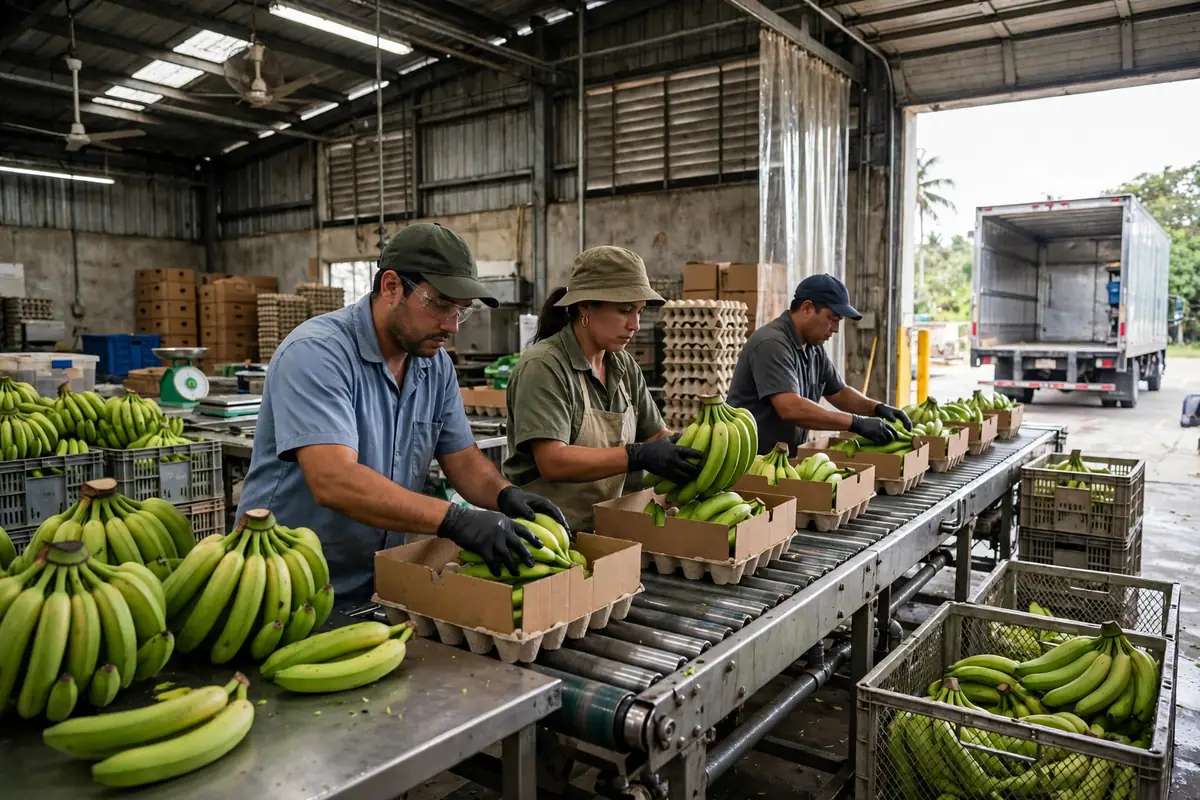
Harvest is where the bill starts. Export bananas are cut at 75 to 80% maturity, still green and hard, then de-handed, washed, treated, and packed. None of this can drag — the run from plantation to packing plant is under a tropical sun and pulp temperature climbs fast. The first job at the plant is probing pulp temperature, not counting boxes.
The mistake I made in Urabá: a reefer can't cool warm fruit
I still remember a load out of Urabá a few years back. Morning harvest, into the plant by noon, stuffed that afternoon — it looked smooth. The problem was pre-cooling: the cold room was backed up, the fruit only got a couple of hours of cold air, and pulp was still around 17°C when the crew stuffed it. The reefer was set at 13.5°C and the log looked fine.
Here's the thing: a reefer is an insulated box, not a blast freezer. It holds temperature; it doesn't pull it down. That fruit went in warm, and the unit ran three days straight dragging the pulp down, while the fruit generated its own heat and pumped out ethylene — ripening itself inside the box. At Rotterdam the cartons by the door were still green and the middle ones had turned yellow and soft. The buyer paid a downgraded price: more than 30% of the container's value gone.
I've gone over that one three times and the conclusion never changes: before the fruit goes in the box, the pulp has to be at 13.5°C. Miss that and everything after is damage control. A forced-air pre-cooling room pushes cold air through the cartons until the pulp is down to carrying temperature — a few extra hours and a bit of electricity, and the whole container is safe. Pre-cooling is the best money in the whole Colombia banana export warehouse cold chain.
A reefer is not a fridge — it's a thermos
On reefer settings, I only trust one set of numbers: 13.5 to 14°C, relative humidity 85 to 95%, ventilation 15 to 25 cubic metres per hour. These aren't guesses — they're the consensus across cold-chain guidance. Below 13°C, bananas take chilling injury: the peel turns dull grey or black while the flesh stays hard, and no ripening fixes it. Above 14°C, respiration speeds up, ethylene builds, and the fruit ripens in the box.
Ventilation is the one people forget. Bananas are alive. They breathe, they give off ethylene and CO2. Vents shut, ethylene accumulates, and the whole container ripens together. Run the fresh-air exchange at 15 to 25 cubic metres per hour and that gas gets flushed out. I've watched people close the vents to save cold air — saving that electricity against losing a container doesn't work.
Leave air channels — cold air comes up through the T-floor, rises through the load, and returns to the unit. Stack the cartons tight and the cold air only skims the surface; the middle is a dead zone. Room for airflow matters more than two extra rows. Before stuffing, check the pre-trip inspection: sound unit, calibrated probes. A bad empty box is worse than a bad full one — you only find out at destination.
The enemy isn't heat, it's fluctuation. Two steady weeks at 13.5°C and the fruit is fine; bouncing between 13°C and 16°C wears it out. The port handover is where fluctuation sneaks in — the box leaves the cold store and sits in the sun waiting for vessel or truck, and half an hour of direct sun can push pulp temperature up. My rule: no box gets stuffed until the container is there, and once stuffed, it moves.
Urabá and the Caribbean run on two different roads The two regions ship differently, and the warehouse play has to follow. Urabá ships through Turbo, close to the plantations, short road leg. The Caribbean region ships through Santa Marta and Cartagena — bigger deep-water ports, more large vessels, but a longer road leg and one more reefer-truck handover.
A longer road leg means one more chance to break the chain. My practice: the reefer truck runs at 13.5°C too, and pulp gets probed before loading — if it's not at temperature, the load waits. Don't force it. When the sailing is tight, the easiest mistake is "load it and sort it out later" — loading the problem onto the ship to explode in Europe. A sailing can change. Chilling injury can't be undone. Rainy season makes Urabá's harvest come in bursts, so size pre-cooling for the peak, not the average.
Ripening at destination: the last mile of the cold chain The chain doesn't end at the port. Ripening happens at 14 to 18°C, with ethylene for about 24 hours, waking the whole lot to the same stage. Below 12°C, bananas barely respond to ethylene; above 20°C, the pulp softens too fast — yellow, but with a short shelf life.
Watch fruit temperature in the ripening room, not air temperature — fruit out of a 13.5°C container needs to warm up gradually. Before ripening, sample the load for grey patches or chilling injury. Chilled fruit won't ripen properly: peel goes grey-black, never turns yellow, supermarkets reject it. That inspection is the last chance to cut losses.
The Colombia banana export warehouse cold chain bill
Take one 40-foot reefer — hypothetical example, for illustration only: about 1,000 boxes, 20 tonnes of fruit. Done right, pre-cooling costs well under a dollar per box. Done wrong, a 30% downgrade on arrival is 30% of the container's value.
| Step | Cost of doing it right | Cost of skipping it |
|---|---|---|
| Forced-air pre-cooling to 13.5°C pulp | Under $1 per box, roughly | Warm pulp in the box, self-ripening in transit |
| Ventilation 15–25 CBM/hr | A little electricity | Ethylene builds up, whole container ripens together |
| No baking on the quay | Some extra scheduling care | Half an hour in the sun lifts pulp temperature |
| Pre-ripening inspection | Half a day of labour | Chilled fruit enters the ripening room and never recovers |
The counterintuitive part is this: in banana cold chain, the most dangerous move isn't running too warm — it's running too cold. Plenty of people think colder is safer and set the box to 10°C. Wrong. Below 13°C the fruit takes chilling injury, the peel blackens, and it can't be fixed. 13.5°C looks not-cold-enough, and it's exactly the safe line. I'd rather run steady at 14°C than gamble at 12°C.
The Colombia banana export warehouse cold chain comes down to three things: cool the fruit right after harvest, get the pulp to temperature before stuffing, and hold 13.5°C steady at sea. None of it is high-tech. Skip any one of them and arrival day collects the debt with interest. Next time you're loading, probe the pulp before you sign — try it once and you'll know what that habit is worth.
By Lao Mi, Supply Chain Veteran (20 yrs)