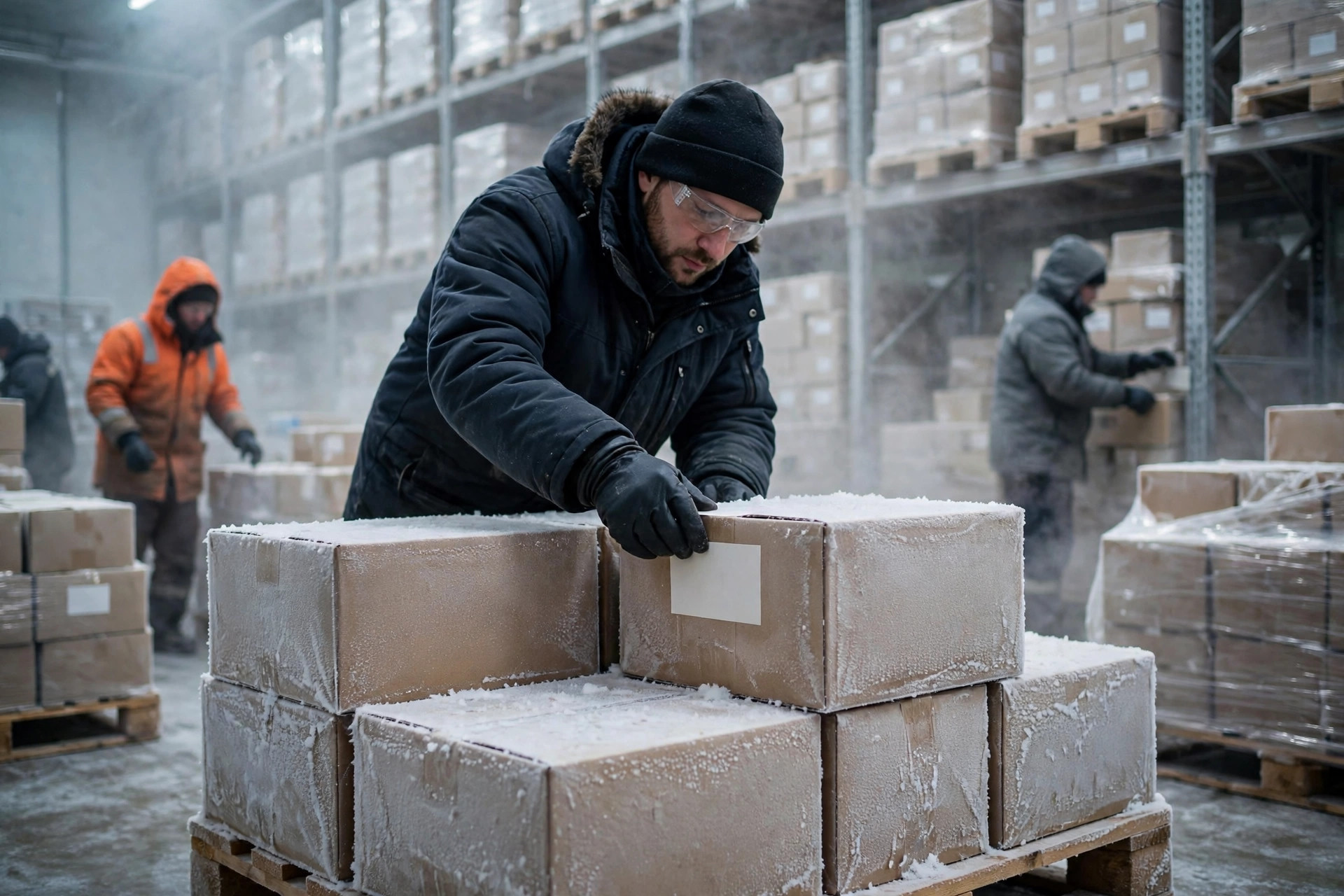
Bottom line up front: when a label falls off inside a freezer warehouse, the problem is almost never just "bad glue." Cold storage warehouse label durability is a chain: material, adhesive, surface, timing, and temperature all have to be right. Get any one of them wrong, and the label will quietly curl, lift, and drop off during some night shift — and on count day, you will be staring at a pallet of anonymous goods.
I have seen this pitfall three times, and all three ended the same way: people standing in front of a pallet, unable to find it in the system.
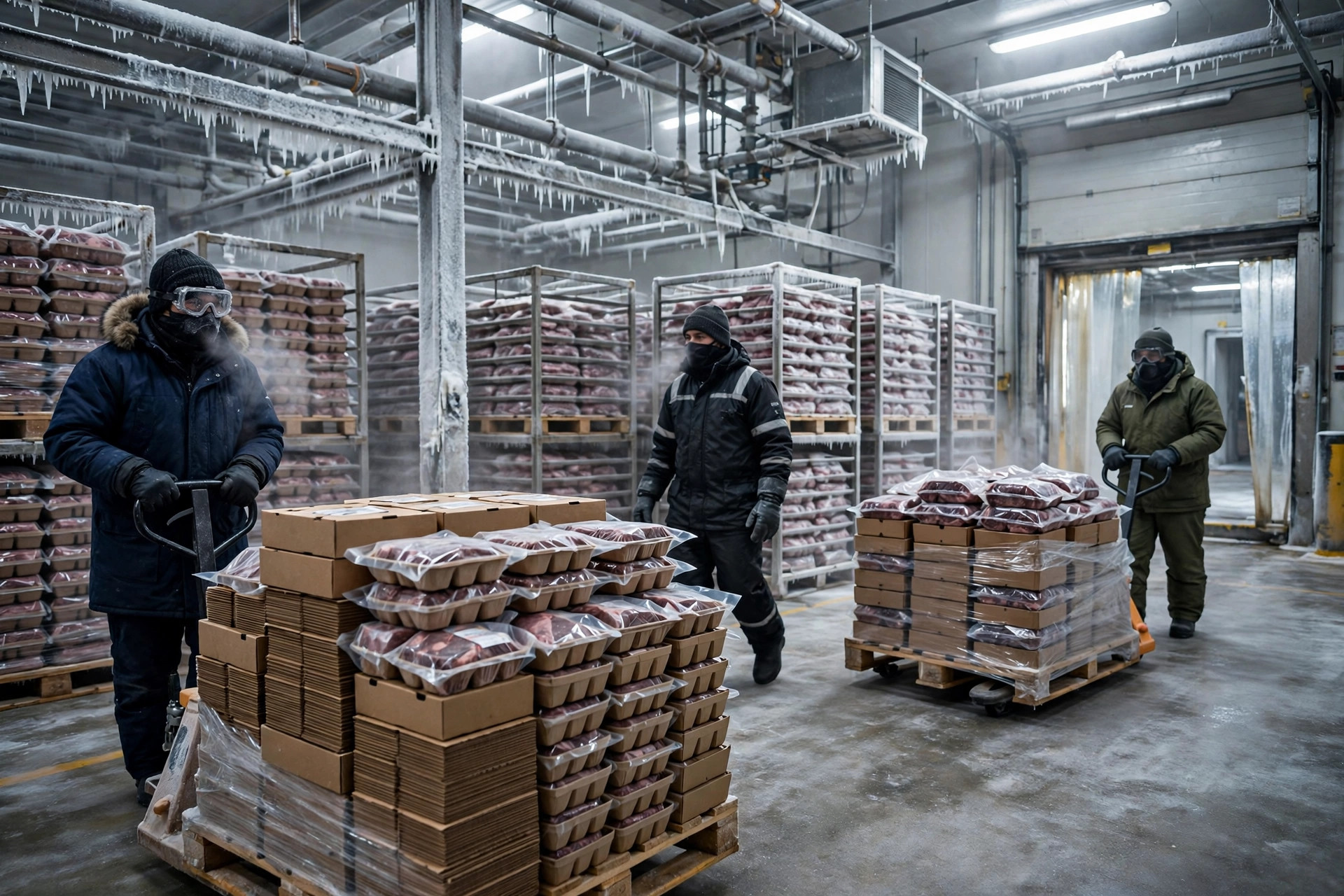
The first was an imported seafood cold store running at minus 22 degrees Celsius. A customer complained that a batch of shrimp could not be located. On site, the pallet label had rolled into a little tube, and every scan came back an error. The cause was embarrassingly basic: standard room-temperature coated paper labels with ordinary adhesive. The paper absorbed moisture, the adhesive hardened in the cold and lost its grip, and one forklift jolt was enough to shake the label off. The second was a dairy warehouse. The label itself was fine; the timing was wrong. Labels were applied on the ambient dock, then the cartons went into the freezer and frost formed on the surface. The label was effectively stuck to a layer of frost, and when the frost melted, the label came with it. The third was the most unfair: material, adhesive, and timing were all correct, but the label went onto stretch wrap. The film is smooth and carries static, so the label drifted within three days and scans started returning the neighboring pallet's code.
So the first step in freezer label durability is to separate the job by surface. Pallet labels, rack labels, and tote labels are three different jobs, not one.
Freezer Label Durability Starts With the Surface, Not the Label Brand
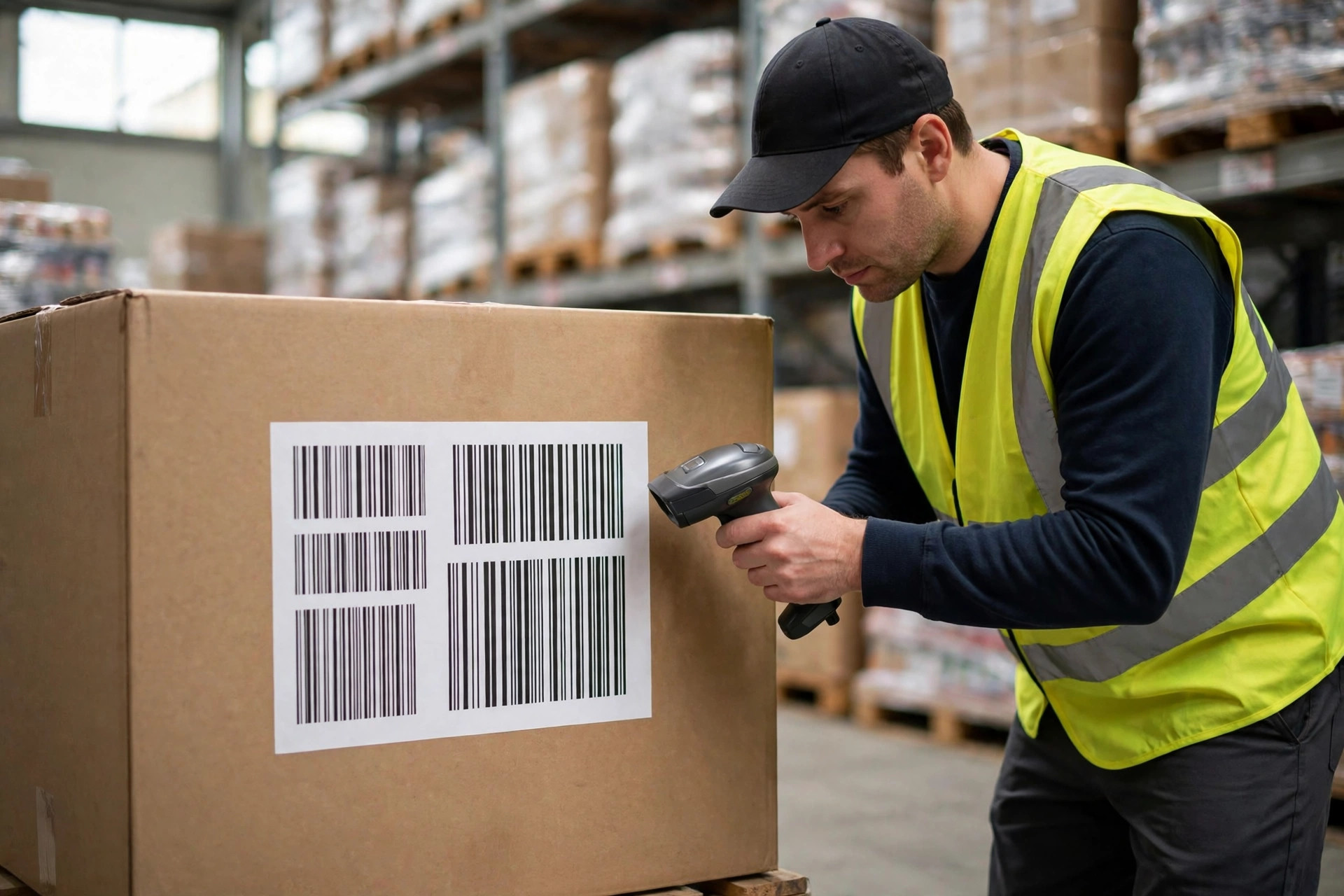
Carton faces are the most common and the easiest to get wrong. Corrugated cartons are rough, absorb moisture, and grow frost in sub-zero rooms. The rule is simple: use PP synthetic paper or polyester film, never coated paper. For adhesive, choose a low-temperature rubber-based adhesive; acrylic adhesives harden fast in the cold and lose tack. Treat the exact low-temperature limit as a vendor-tested figure, and ask the supplier for test data rather than trusting a brochure. Before applying, the carton surface must be dry and frost-free. If frost has already formed, wipe it dry first, or move the labeling step to before the goods enter the freezer.
Rack labels and tote labels are a different job. Rack beams are metal, and metal condenses water in the cold, so labels need a polyester face with a high-tack base adhesive, applied after wiping the condensation off with a dry cloth. Totes are usually plastic with low surface energy, where ordinary adhesives simply do not hold. Either use an adhesive made for plastic surfaces, or stop fighting the glue altogether and switch to a slot-in card holder. For pallet labels, my recommendation is a tag holder: the label sits in a slot on the side of the pallet, physically fixed, independent of adhesive. In a freezer, that is the most stable option of all.
Here is the decision table I use with clients:
| Surface | Recommended material | Adhesive direction | Early warning sign |
|---|---|---|---|
| Corrugated carton | PP synthetic paper, polyester film | Low-temperature rubber-based | Corners lifting, air pockets under frost |
| Metal rack beam | Polyester film | High-tack base adhesive | Bubbles where condensation sits, whole label sliding off |
| Plastic tote | Polyester film or slot-in holder | High-tack adhesive or physical fixing | Label drift, scans returning the wrong pallet |
| Stretch wrap | Do not label directly | Label the carton itself or use a tag holder | Label migration, cross-pallet scans |
Labeling Timing in the Freezer: Before Entry or Inside the Room
This is the question teams argue about most, and my answer is blunt: if you can label before the goods enter the freezer, do not label after.
Labeling before entry means the surface is dry and at room temperature, so the adhesive wets out and cures properly. The flow is: apply the pallet label at receiving inspection, bind label and pallet in the WMS in one step, and move the whole pallet into the freezer with the label untouched afterward. Under that sequence, label failure rates are at their lowest.
There are two cases where you must label inside the freezer: bulk goods that are only palletized after entering the cold room, and labels damaged during cold-room work that need replacing. For in-room labeling, the rules have to be absolute: wipe the surface dry and frost-free with a dry cloth; press the label firmly with your palm for at least five seconds so adhesive and surface make full contact; scan and verify immediately. A replacement label that is not scanned on the spot is a time bomb. I have seen a warehouse re-label without verifying, only to discover at count time that the replacement carried the wrong batch number. They had planted the error themselves.
One more detail: the label printer itself hates the cold. Thermal printers in sub-zero rooms print slower, produce fainter text, and both ribbons and label stock turn brittle. Keep printers on the dock or in a buffer zone, not inside the freezer. If printing inside the cold room is unavoidable, use an industrial low-temperature-rated model, and confirm the rating with vendor test data.
What to Do After a Label Falls Off: The Count Recovery Flow
A fallen label is not a disaster. The disaster is having no recovery flow and letting staff identify goods from memory. Write this four-step flow into your SOP and follow it every time.
Step one, isolate. Move the unlabeled pallet out of the picking area, hang a "pending verification" tag, and forbid shipping it on anyone's say-so. Step two, trace. Check WMS receiving records, location history, and neighboring pallet data to narrow the candidates down to two or three batches. Step three, verify. Open cartons and sample-check against batch characteristics, with two people cross-confirming before a new label goes on. Step four, review. Record the cause in one of four buckets — material, adhesive, timing, or surface — so the next purchase order and the next training session are based on evidence, not guesswork.
Here is the counterintuitive part: label budgets should not be cut, but the saving is not in the unit price of the label. A freezer-rated label costs a few cents more than a standard one. One night of hunting for a lost pallet, or one mis-shipment compensation payment, buys tens of thousands of labels. The real cost to cut is the cost of finding goods after labels fail. Anyone who treats label durability as a consumables line item will eventually pay for those few cents during a count night.
The repeat offenders, one more time: coated paper in a freezer; acrylic adhesive asked to survive sub-zero temperatures; labeling directly onto frost; labeling onto stretch wrap; re-labeling without a verification scan; and running a printer inside the cold room. Hit any one of these six, and freezer label durability is gone before you start.
Finally, a go-live night checklist. Tick every box before the cold room opens: carton labels are PP or polyester; the adhesive is low-temperature rated with vendor test data for its limit; labeling happens before freezer entry; in-room re-labeling follows wipe, press, and scan; and the isolation and verification flow for unlabeled pallets is written into the SOP. Pass all five, and your cold storage warehouse label durability is built to hold.
One last thing that gets overlooked: the binding between the label and the WMS record. A fallen label can be reprinted, but if someone takes a shortcut and copies a neighboring pallet's code, or mistypes one digit of a batch number by hand, that is worse than no label at all. The system looks perfectly normal while the physical goods are already crossed. Re-labeling must go through the system flow: scan the pallet number, pull up the original order, let the system regenerate the label, and scan a second time to confirm. Hand-typing batch numbers is not allowed. Labels are the goods' identity cards. An identity card can be reissued, but it must never be borrowed from someone else.
By Lin Xiao, WMS Implementation Consultant