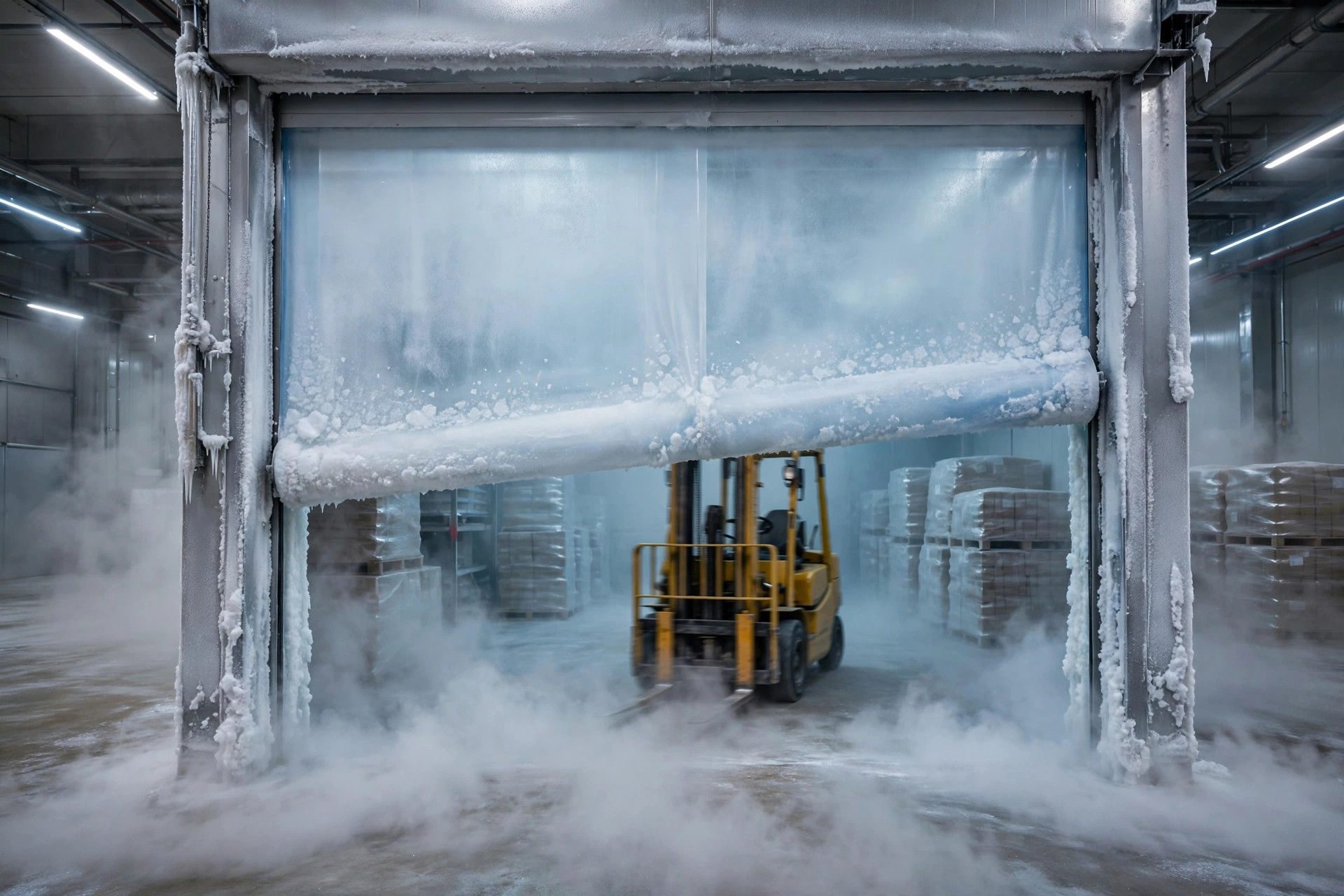
Cold storage humidity control rarely fails where people first look. When frost builds up faster than the defrost schedule can clear it, the usual response is to blame the defroster: a weak heater, a short cycle, a misplaced sensor. Figures published by the Air Movement and Control Association (AMCA) point somewhere else: for a standard 5-by-8-foot doorway, with the dock outside at 80°F (27°C) and 60 percent relative humidity, convective exchange carries roughly 114 pounds — about 52 kilograms — of water into the room every hour. That water does not vanish: it becomes frost, ice, or leaves through dehumidification and defrosting. Frost starts with the water in the air; the defroster only deals with the consequences.
Cold Storage Humidity Control Starts at the Door
The doorway is the first route in, and by a wide margin the largest. AMCA's analysis puts a number on the split: 90 to 95 percent of moisture transfer across an open doorway comes from bulk convective air exchange, not from vapor slowly diffusing along a concentration gradient. Cold air inside is dense and heavy, so it spills out along the floor the moment the door opens, while warm, moist dock air is pulled in through the upper half of the opening. An open door works like a conveyor belt in both directions, and the busiest door is usually the largest single source of moisture in the building.
The second route is what people and product carry in. Freshly harvested produce is still respiring and transpiring when it arrives, bringing field heat and moisture with it. Cartons and pallets left on the dock absorb damp and carry it inside, and workers, forklift tires, and wash water add small amounts that never stop.
The third route is the building envelope. Aging panel joints, worn door gaskets, holes where pipes pass through walls, and a pressure equalization valve frozen shut all let the room pull moist air in through gaps. A freezer creates negative pressure as its air contracts during cooling, and a failed equalization valve lets that vacuum find the weakest seam — rack inspectors report freezer floors heaving and racking icing over from exactly this kind of leakage.
The fourth route is the one most easily missed: the refrigeration system dries the room itself. An evaporator coil runs far colder than the room it serves, so air passing over its fins sheds moisture as condensation or frost. A design case makes the point: a room held at 4°C and served by a coil at -8°C works with a 12 K temperature difference, which can drag relative humidity down to 70 to 75 percent against the 90 to 95 percent the crop needs. The room holds temperature while quietly losing humidity.
What Uncontrolled Humidity Costs
The cost splits in two directions: in a freezer, it is frost. Frost insulates: it chokes airflow across the fins, degrades heat transfer, forces the compressor to work harder, and pushes the defrost schedule ever tighter — and every defrost means a shutdown, a heat-up, and a swing in room temperature. Ice on floors and racking adds a second bill: sliding forklifts, falls, and inspections blocked by ice over the structure.
In a fresh produce room, it is weight: low humidity makes produce lose water, wilt, and weigh less at dispatch. Data cited by the University of Maine Cooperative Extension puts losses from improper storage and handling at 10 to 40 percent of the total harvest. Shrink from low humidity differs from mold in one respect: mold is a probability, while weight loss from dry air is a certainty, settled on the scale at dispatch.
Targets differ by temperature and by product:
| Scenario | Room temperature | Relative humidity target | Cost of missing it |
|---|---|---|---|
| Leafy greens | 0–2°C | 95–98% | Wilting, shorter shelf life |
| Apples and most fresh fruit | 0–4°C | 90–95% | Weight loss from drying |
| Citrus | 4–8°C | 85–90% | Mold if too damp, drying if too dry |
| Dry onions, garlic | 0–4°C | 65–70% | Mold and sprouting if too damp |
| Frozen storage | -18°C and below | No relative humidity target; control dew point and infiltration | Any moisture in becomes frost and ice |
Note the last row: air at freezer temperatures holds very little water vapor, so relative humidity is a weak guide down there — what matters is dew point and how much moisture gets in. Applying a fresh produce target to a freezer, or the reverse, confuses two different problems.
AMCA's doorway figures show the scale: at 52 kilograms of water per hour, a door whose total open time adds up to one hour a day admits 52 kilograms a day, more than 1.5 tonnes in a month. That water has only three destinations: frost, ice, or removal by dehumidification and defrosting. The point is the order of magnitude, not false precision. Once the scale is visible, the choice between adding a dehumidifier and managing the door answers itself.
Humidity Control Is Four Jobs, Not One Machine
The first job is airtightness and the door. High-speed doors, air curtains, and double-door airlocks all do the same thing: shorten the time the doorway stands open and break the convective exchange. Gaskets, door heater tapes, and equalization valves deserve maintenance priority close to the refrigeration plant itself. Door openings should be treated as a managed metric — cycles per day, duration, and which door is worst — and once those numbers are recorded, the biggest source of moisture identifies itself.
The second job is choosing the right dehumidification technology, because the wrong choice performs worse than none. Refrigerant dehumidification cools air below its dew point so water condenses out, and it works well above 15°C; below that threshold the coil ices over and capacity falls away. Desiccant dehumidification adsorbs water vapor onto a slowly rotating silica gel wheel and does not depend on condensation, so it keeps working from -20°C to 50°C — the standard choice for freezers and low-temperature rooms — at the cost of the energy needed to regenerate the wheel with heated air. Select on room temperature and target dew point, not the nominal capacity on the nameplate, usually rated at 20°C and 60 percent relative humidity — conditions a cold room never sees.
The third job is airflow. The smaller the temperature difference across the evaporator, the higher the room humidity stays — the key to keeping moisture in a fresh produce room, since a coil running close to room temperature condenses little water out of the air. Push the coil temperature too low and the room holds temperature while its humidity is stripped away. Air velocity and discharge direction matter too: cold air blowing directly onto product dries it locally, so air distribution should be designed against the humidity target, not temperature uniformity alone.
The fourth job is where the sensors go. A sensor at the doorway or the evaporator return does not measure the air the product actually sits in. Points are needed in the product zone, at the door, and near the evaporator, with temperature and humidity read together — dew point, rather than relative humidity, explains what is happening. Monitoring pays in attribution: on the days frost grew fastest, was the door open more often, or did a wet load arrive?
Defrosting and Humidity Control Are Two Different Jobs
Defrosting is remedial; humidity control is preventive. The more often a room needs defrosting, the more likely it is that humidity control has already failed somewhere upstream: a high defrost count is not evidence of a strong defrost system but often the signature of uncontrolled infiltration, and stretching the interval and calling it a result hides the problem just as effectively. When the two jobs are confused, spending lands on the most expensive end of the chain — defrosting costs shutdowns, heat, and temperature swings, while much of humidity control costs little more than keeping a door closed.
There is a counterintuitive judgment worth stating plainly. In a fresh produce room, humidity that is too low costs more than humidity that is too high. High humidity risks mold, which is probabilistic. Low humidity guarantees weight loss, settled on the scale every day at dispatch. Many rooms run their humidity target low because dry air looks clean and safe, while the loss is spread across every kilogram shipped. The arithmetic, done monthly rather than by feel, points the other way.
The industry is moving toward treating humidity as a controlled variable on par with temperature: doorway infiltration monitoring, dew point control, dehumidifiers interlocked with the refrigeration plant, and zoned sensor coverage. Sensors have become cheap enough that data gets there first, and the rooms that measure first ask a different question: how much water entered today, through which routes, and in what proportions.
That is what cold storage humidity control comes down to in practice: three questions — how much water enters each day, where it comes from, and where it ends up. A cold store that can answer all three gives its defroster the chance to sit idle. As for your own room — when was the last time someone stood at the door and counted how many times it opened in a day?
By Dr. Chen, Supply Chain Researcher