Let me start with a number.
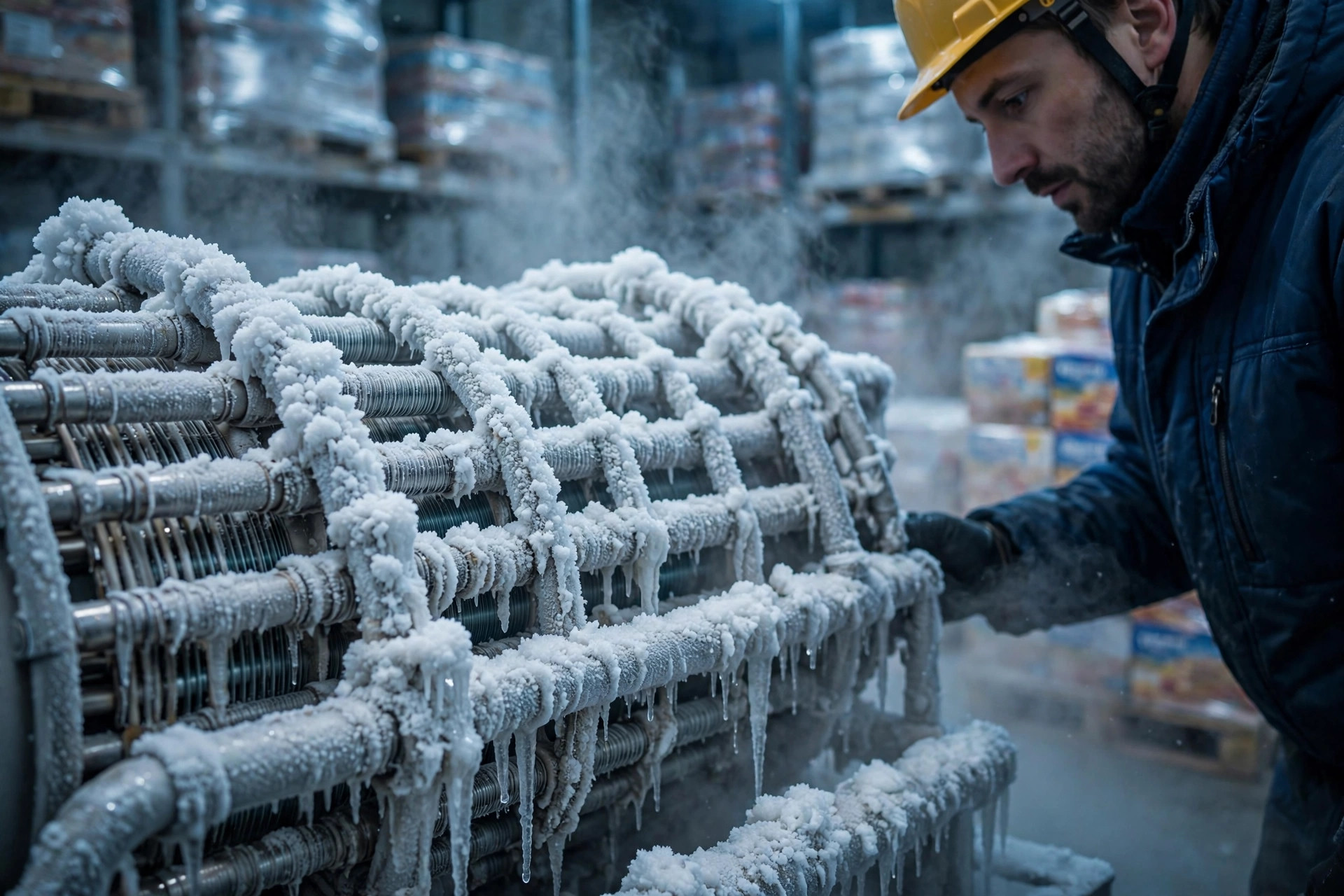
A 24,000-square-foot freezer warehouse running at -18°C was spending over $340,000 a year on refrigeration electricity. Three years earlier it was under $270,000. Same equipment. Same throughput. Electricity rates hadn't moved that much. So where did the extra money go? Two words: frost buildup.
Frost on an evaporator coil is insulation you never ordered. Ice conducts heat poorly and chokes airflow, so the compressor runs longer and harder to do the same job. And frost doesn't go away on its own — it only gets thicker until you pay to melt it. Here's the nasty part of the math: melting it costs electricity too. Skip defrost, and frost steals your power. Run defrost, and defrost itself burns your power. Either way you pay. The only question is which side of the bill you let grow.
First, the total: what frost steals in a year
In the fall of 2023 I walked a third-party cold storage facility outside Chicago — 24,000 square feet, mostly -18°C freezer space, forty to fifty trailer moves a day across the dock. The owner showed me the power bills: $340,000 a year for refrigeration, up nearly 30% in three years.
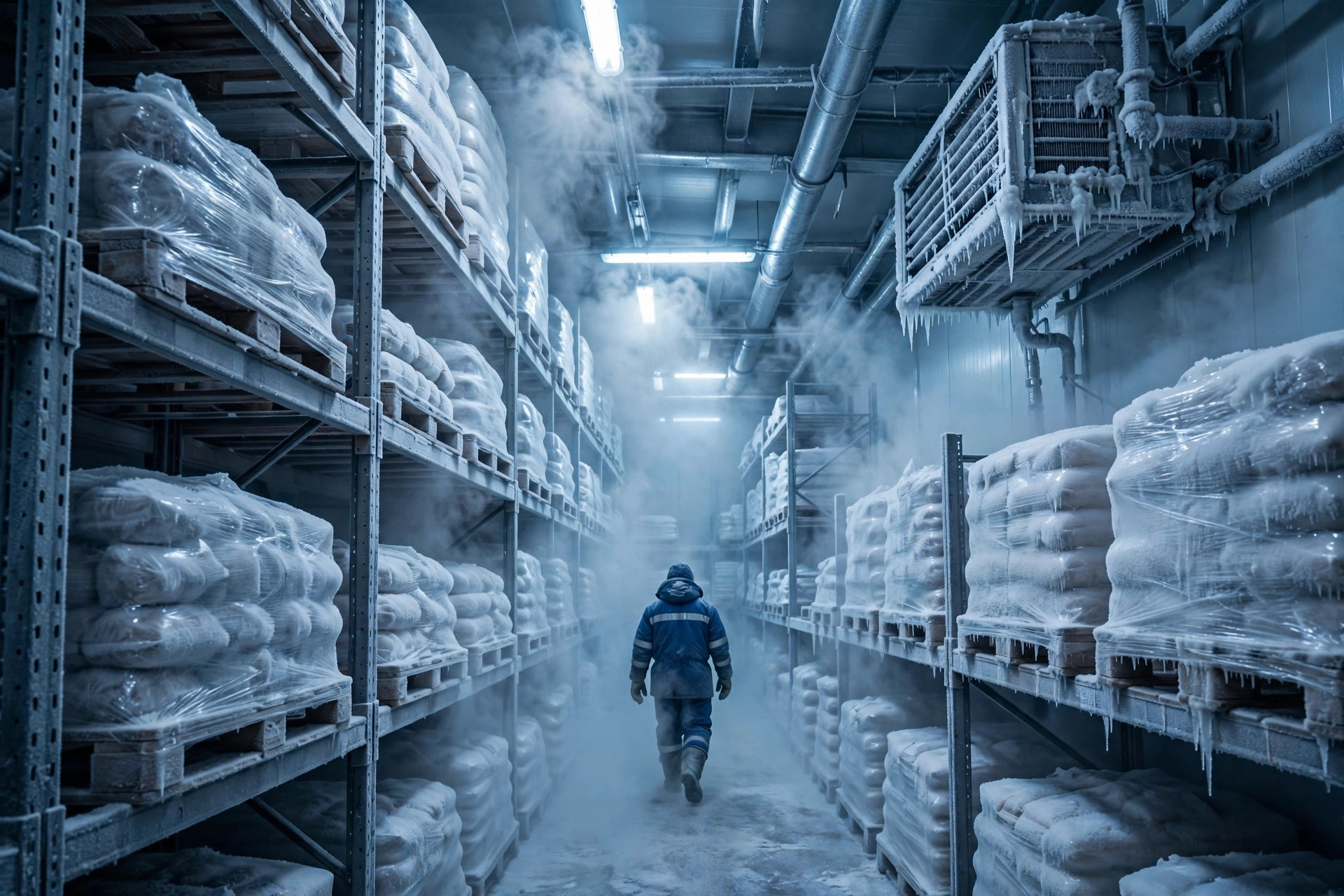
Three months of data and one walk through the freezer told the story. The evaporator coils were caked in frost. Every time a dock door opened, warm humid air poured in and condensed straight onto the coldest surface in the building — the coils. Suction pressure running low, discharge temperature running high: the classic signature of a system being strangled by frost. Nothing was broken. It was just choking.
They were running factory-default timed defrost — electric heaters, four cycles a day, whether the coils needed it or not. We changed two things. First, demand defrost: differential-pressure and temperature sensors, so the heaters only fire when frost is actually there. Second, high-speed roll-up doors on the dock to cut door-open time. Total retrofit cost: under $20,000.
The result: refrigeration electricity dropped by more than ten percent over the next twelve months. On a $340,000 base, that's more than $30,000 a year back in the owner's pocket. Payback in under two quarters. His words: "I used to pay tuition. Now the frost pays it for me."
A defrost cycle really costs you three times
Most people count only the heater electricity when they cost out defrost. That's one-third of the bill. Every defrost cycle actually charges you three ways:
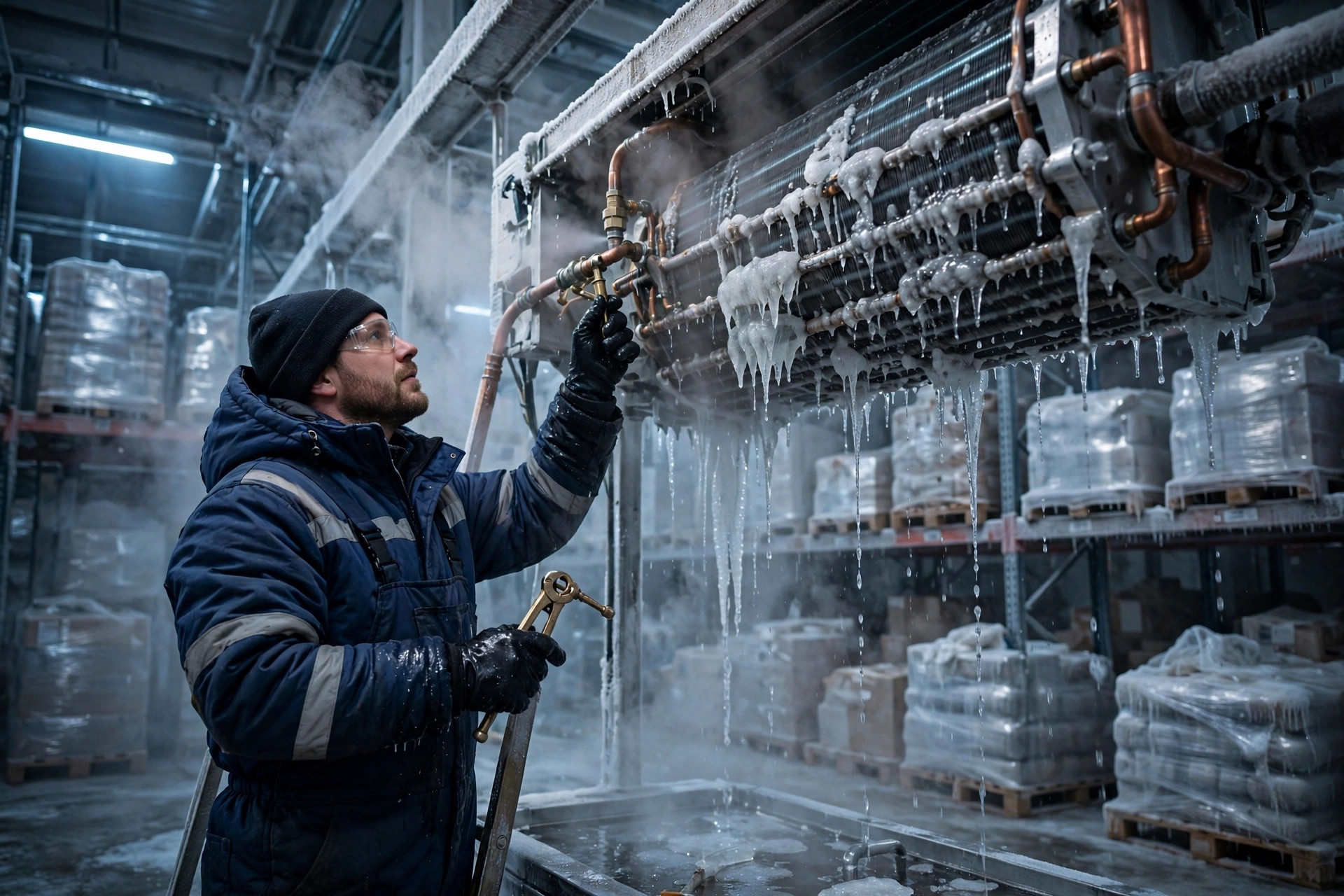
First, the heat itself. Electric defrost is the brute-force option: tens of kilowatts of heater elements blasting the coil for fifteen, twenty minutes, the meter spinning the whole time. Hot-gas defrost is far gentler — it routes hot discharge gas from the compressor through the coil — and uses a fraction of the energy. But the system has to support it, and the retrofit isn't free.
Second, the refrigeration "repayment." Every joule of heat you dump into the freezer during defrost has to be pumped back out by the compressor afterward. Heat in, heat out — you pay for the round trip. Almost nobody models this, but it's real: the longer and hotter the defrost, the bigger this second tax.
Third, product risk from temperature swings. During defrost the evaporator is offline and box temperature drifts upward. Product sitting near the coil takes the hit first, and frozen food tolerates temperature cycling far less well than most operators assume.
Defrost more or defrost less? It's a breakeven problem
Here's the comparison most operators never put on paper:
| Defrosting too often | Defrosting too rarely | |
|---|---|---|
| Heater electricity | High — four or five full-power cycles a day | Low |
| "Repayment" cooling load | High — all that heat has to be pumped back out | Low |
| Energy stolen by frost | Low — coils stay clean | High — compressors run loaded for long stretches |
| Product risk | Medium — frequent temperature cycling | High — in the extreme, blocked airflow and a lost box |
And here's the counterintuitive part: more defrost is not better. I've walked plenty of warehouses running four timed cycles a day where more than half the cycles were dry runs — barely any frost on the coil, heaters blasting anyway, all that heat dumped into the freezer for the compressor to haul back out. That's paying for the privilege of punishing yourself.
The optimal frequency is a calculated number, not a gut feeling. The math is simple: total up the full cost of one defrost cycle (heater energy + repayment cooling + allocated labor), estimate how much extra compressor energy each increment of frost thickness costs you, and find where the two curves cross. Can't build the full model? Fine — install a differential-pressure sensor across the coil and defrost when air resistance climbs. That's demand defrost in its simplest form: a few thousand dollars of hardware, and most mid-size facilities earn it back within a year.
The frost comes through the door: your best defrost investment isn't a defroster
Second case. Early 2024, a Houston seafood importer asked me to look at their numbers. Their defrost system was fine — timed electric defrost, three cycles a day, like clockwork. But the power bill wouldn't come down, and the coils kept frosting up fast.
Half an hour in the freezer told me why: the dock doors stood open, forklifts running in and out, no air curtain at the entrance. Houston's hot humid air was pouring into a -18°C box, and every bit of that moisture plated itself onto the coils as frost. You can have the best defrost system in the world and still lose if you're manufacturing frost around the clock.
The math on the fix: one high-speed roll-up door plus an air curtain, a little over $10,000 installed. Average door-open time dropped from four or five minutes per move to barely over a minute. Within three months the coils were visibly frosting slower, defrost dropped from three cycles a day to two, and the monthly refrigeration bill fell by several thousand dollars.
That's the point I most want to land: a freezer's most effective "defrost equipment" is its door. Frost doesn't originate at the evaporator — it originates in infiltration, the humid air leaking in. Upgrading from electric to hot-gas defrost might save you less in a year than simply managing your doors better, and the door retrofit costs a fraction of a refrigeration overhaul.
One more thing before you go — a formula you can use tomorrow. Don't buy equipment yet. Run three numbers on a sheet of paper:
- Pull twelve months of power bills and circle the annual refrigeration total. Call it E.
- Go look at your coils. Frost thicker than about 3 mm, or suction pressure running noticeably low, means frost is already stealing from you. As a rule of thumb, a badly frosted system commonly runs 10-20% above its clean-coil energy use.
- Do the rough math: E × 10% is what you're feeding the frost every year. If that number clears $20,000, your defrost strategy deserves attention. If it clears $50,000, hot-gas retrofit and door upgrades both belong on the schedule.
One cold-eyed closing note: there is no standard answer to defrost, only your warehouse's answer. A facility with constant door traffic and one where the doors stay shut have nothing in common on this question. But one rule holds everywhere — run the numbers first, then reach for the wrench. Gut feelings lie. Power bills don't.
By Lao Zhou, Logistics Cost Analyst