China ceramics export warehouse work is rarely decided at the kiln. It is decided in the packing room, on the pallet, and in the photographs taken before a crate is sealed. Ceramics concentrate their value in shape, glaze, and condition, so one knock or one damp carton can downgrade a whole shipment in the buyer's eyes, even when most pieces survive intact.
Why China Ceramics Export Warehouse Work Fails at Packing First
Consider a familiar scene. A small Jingdezhen kiln produces a handsome set of blue-and-white tableware, but the export warehouse treats it like ordinary household goods: large and small pieces share a carton, only a thin layer of paper separates them, and a forklift lifts the pallet from the edge. At the destination port, the buyer finds chips on three bowl rims, and the inspection verdict shifts from accepted to discounted. The lesson is not mysterious. Breakage in ceramics export warehouse handling is usually cumulative: handling frequency, poor fixation inside the carton, and stacking pressure add up together.
Moisture causes a quieter kind of loss. In the rainy season, a batch stored near the warehouse door for a few days can look fine from the outside while the inner lining has softened, leaving paper fibres stuck to the glaze. The buyer photographs the result, and the seller has little to answer with. Warehouse managers often ask whether there is enough space, but they ask less often whether the goods are too close to the door, whether the floor sweats, or whether cartons sit directly on concrete. The first test of a ceramics export warehouse is therefore simple: treat the goods as fragile and moisture-sensitive precision items, not as generic heavy freight.
Breakage, Moisture and Wooden Crates in China Ceramics Export Warehouse Work
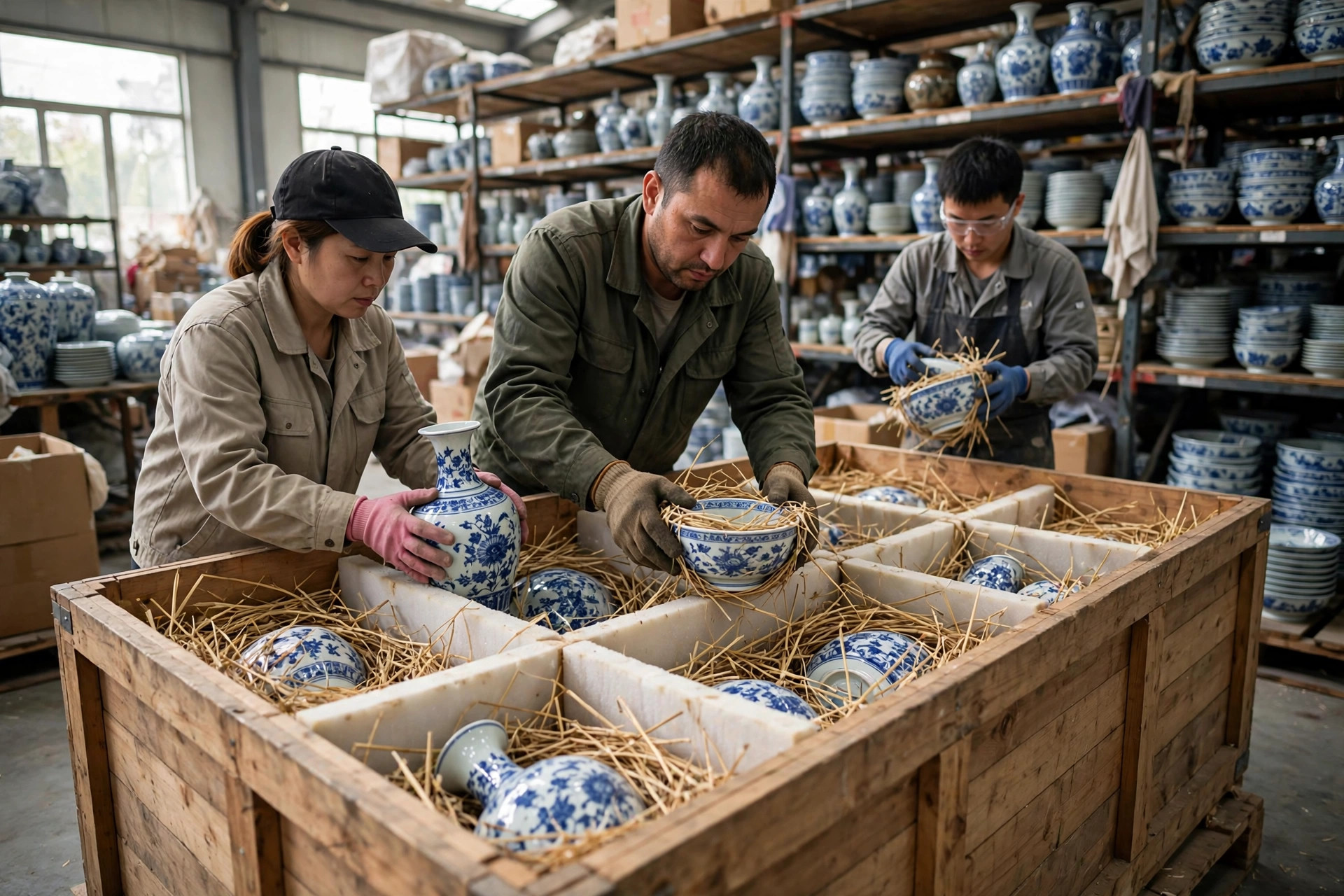
Useful practice can be reduced to three packing steps. First, protect each piece individually, with extra padding on rims, handles, lids, and knobs, and no hard contact between pieces. Second, fix the contents inside the carton: fill every void so nothing moves, and shake the closed carton by hand. If anything shifts, it is not ready. Third, control the outer carton and stacking: heavy cartons below, light cartons above, a clear stacking limit, and pallets loaded squarely and strapped, with no carton hanging half off the edge.
Moisture control belongs in the same routine. Cartons should sit off the floor and away from walls, high-value ceramics should not occupy door or window bays, and cartons arriving in wet weather should be inspected before they are put away. Wooden crates for export add another step that cannot be skipped: destination ports apply their own quarantine rules to wood packaging, and treatment and marking must follow the latest requirements of the destination. Always check the official current policy for the destination port rather than copying what worked last time, because a method accepted on one route may not be accepted on the next.
A worked example makes the economics plain. Suppose a container of ceramics is valued at one million yuan for illustration, and upgraded packing adds twenty thousand yuan per container, about two percent of value. If weak packing leads to a ten percent downgrade on the whole container, the loss is one hundred thousand yuan. Twenty thousand against one hundred thousand is not a sophisticated model; any warehouse manager can do that arithmetic. The counterintuitive point is that sellers who refuse a small packing cost often end up paying a much larger claim or discount. What looked like saving was only deferred spending.
Packing standards must also survive staff turnover. Many warehouses do have a standard, but it lives only in a senior worker's head, and new hires improvise from day one. A practical fix is a packing board for each carton type: a diagram showing how many pieces go in each layer, what fills the gaps, and which photographs must be taken before sealing. A second person then checks the sealed carton by shaking it, weighing it, and matching the carton number. A carton that moves, feels suspiciously light, or carries the wrong number is reopened. That check costs minutes and stops most packing errors before they leave the building.
Stacking and handling deserve their own rules too. Ceramic cartons should not be rushed onto a high fork, pallets should be lifted slowly on uneven floors, and each carton should show its upright direction and maximum stacking layers, so handlers do not have to guess. The temporary staging area by the door is the most dangerous place in the building: every extra day there adds risk of knocks and damp. Goods that can go inside should not spend the night by the entrance.
Claims: Warehouse Records Are the Evidence
At claim time, daily records matter more than explanations. When a buyer reports breakage, the seller should be able to produce a chain of evidence immediately: a photograph of each piece before packing, a photograph inside the carton, a photograph of the sealed carton, a photograph of the pallet, and a picking list matching piece counts and carton numbers. The more complete that chain, the stronger the seller's negotiating position. A warehouse with only a general dispatch note, facing ten buyer photographs of damage, has almost no room to argue.
There is also a trade-off that is easy to miss: stronger packing means heavier and bulkier cartons, which raises freight and storage costs. The answer is not to pad everything indiscriminately, but to grade protection by product: high-value, irregular, and large pieces get full protection, ordinary small pieces use standard inserts, and bulk lines use fixed standard carton types. Grading is not cutting corners; it concentrates protection where damage is most likely.
One more practical detail matters in negotiation. Buyer photographs prove arrival condition, not responsibility. If warehouse records show packing time, operator, carton number, and sealing photographs, the discussion can move from blame to specifics: was fixation weak at packing, did transit cause impact, or was the destination unpacking at fault? The finer the responsibility split, the fairer the settlement, and the less likely a single dispute is to break a long-term relationship. Evidence is not only about winning one claim; it is about making both sides trust the same standard next time. Looking ahead, the direction is clear: buyers will demand more unpacking evidence, not less, and warehouses that do not make photographs, numbering, and packing standards a daily habit will find every claim turning into a defensive explanation. So the question for any warehouse is worth asking now: for the next container leaving for export, is your evidence chain ready?
By Dr. Chen, Supply Chain Researcher