Here's a confession: we never bothered to match carton size to our products — and last year, void fill alone cost us almost ten grand. Matching carton size to your products sounded like a big-company luxury to me, until my accountant slapped the bill on my desk and I realized that cutting void fill cost might be the easiest money a small warehouse ever picks up.
We can't afford to burn money like that. The big guys have packaging engineers and auto-boxing machines. What do we have? We have Jay, our packer, and his "one big box fits all" packing philosophy.
Start with the bill: what void fill really costs
Back in November 2025, I spotted something wrong while reconciling the books: kraft paper plus bubble wrap had eaten more than $900 in a single month. We ship 4,000 to 6,000 orders a month, so that worked out to about $0.18 per order — just for stuffing material.
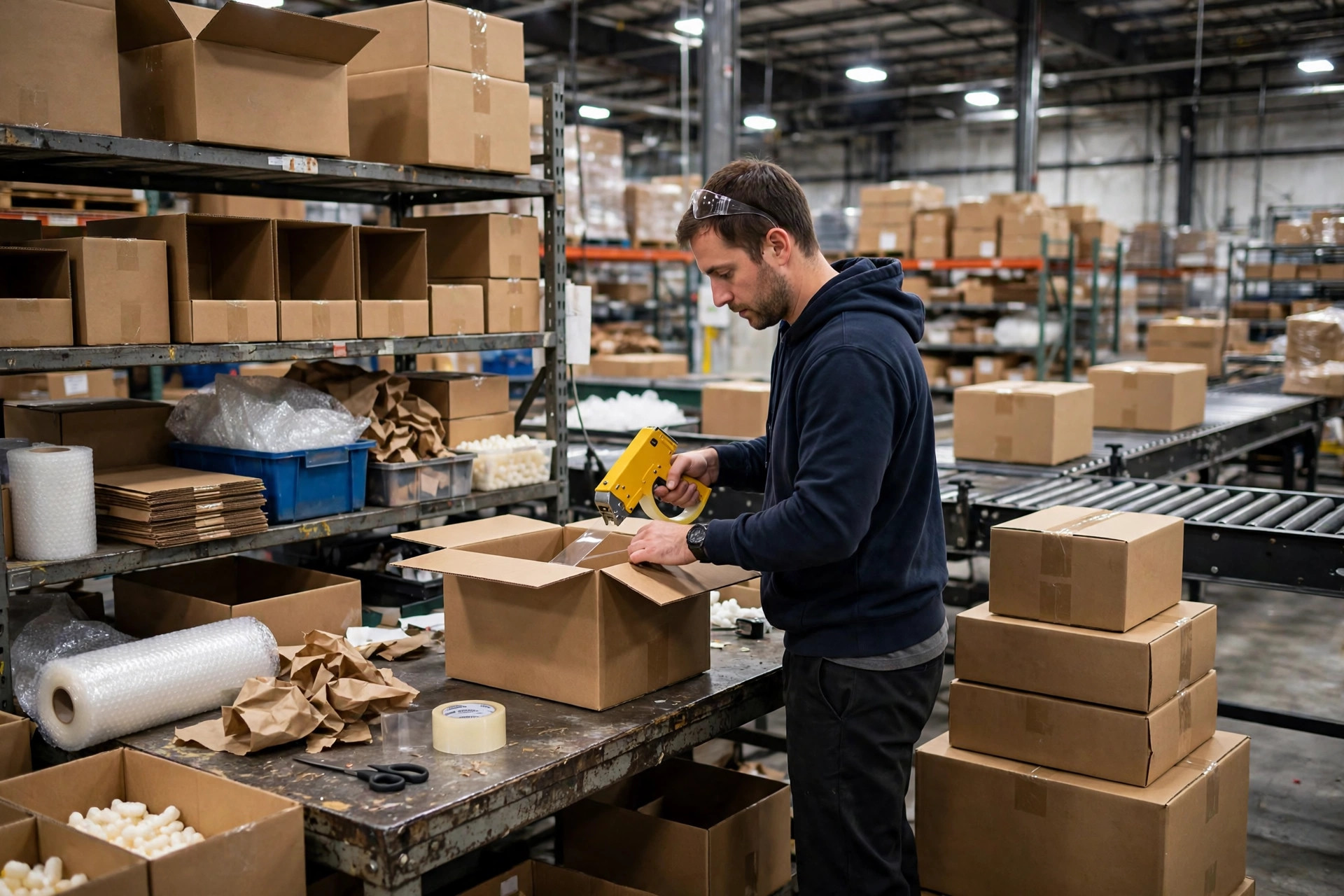
I camped out at the packing station for two days and found the culprit. Jay kept three box sizes on the shelf, mostly mediums and larges, and grabbed whatever was closest. A coffee mug goes into a big box, then whoosh, two giant handfuls of paper — he wasn't stuffing paper, he was stuffing my money. Over those two days I counted: more than half the orders had enough empty space inside to fit a second copy of the product.
The shipping bill hurt even more. Carriers bill by dimensional weight, so an oversized box jumps you into a pricier bracket. Roughly a quarter of our orders were paying extra shipping for no reason other than the box being too big. That kind of waste keeps you up at night.
The dirt-cheap fix: an SKU-box matching table
The enterprise solution is software and algorithms. Our solution was a spreadsheet, a tape measure, and one weekend of overtime.
Step one: pull your top 80 SKUs by shipment volume over the last 3 months. Don't measure everything — we had 400+ SKUs and I'd still be measuring today. The top 80 covered more than 85% of our order volume. Small-warehouse survival wisdom: chase the big fish.
Step two: measure each SKU's three dimensions, weigh it, and log it in the sheet. Add two more columns: fragility tier (three levels — basically unbreakable / hates compression / shatters if you look at it wrong), and "frequently ships with" (some SKUs always get ordered together — note that down).
Step three: play matchmaker. Every SKU gets an assigned box. One rule: keep the empty space inside under 5 cm, just enough for a handful of paper to hold things steady. No performance art.
Print the table, tape it to the wall right in front of the packing station. Jay glances at it, picks the right box in 3 seconds. I titled the header "Stop grabbing random boxes, read the chart." He called it a personal attack on his packing philosophy.
The first two weeks, Jay's wrong-box rate was around 5% — pure muscle memory. I didn't yell. I just pulled the mis-boxed orders before clock-out each day and made him look at how much paper he'd used. By week three the error rate was under 1%. People don't feel numbers, but they feel money they wasted with their own hands.

Do the math: before and after carton-size matching
Three months in, I ran the comparison. These are our own warehouse's measured numbers — your mileage will vary, don't copy them blindly:
| Item | Before | After | Change |
|---|---|---|---|
| Void fill cost per order | approx. $0.18 | approx. $0.07 | down 60% |
| Monthly void fill spend | $900+ | approx. $350 | $550+ saved/month |
| Extra shipping from oversized boxes | about 1/4 of orders | basically gone | approx. $500/month saved |
| Carton purchase price | $0.60–$1.20 each (what we paid then; check your supplier's latest quote) | more sizes, same unit price | flat |
Let me unpack the shipping line: about 1,250 orders a month used to jump a dimensional-weight bracket purely because the box was one size too big, costing an extra $0.30–$0.50 per order (ballpark — your carrier's invoice rules). Right-sizing the box wiped that out.
Combined, we're saving around $12,000 a year. The spreadsheet cost zero dollars. Jay's grudge is priceless.
Bonus surprise: after the coffee mug SKU moved to a smaller box, damage claims dropped from 7–8 a month to 1–2. Less room to rattle around means a safer ride. Didn't see that one coming — buy one, get one free.
The counterintuitive part: fewer box sizes is NOT better
Here's a take that gets me funny looks: fewer carton sizes is not always better.
Conventional wisdom says fewer SKUs of boxes = easier management — 3 sizes, simple stocking, cheaper bulk pricing, no thinking required from the packer. But we measured it: with 3 sizes, the "big box, small product" waste on void fill and shipping dwarfed whatever we saved on simplicity.
So is more always better? I tried that too — at my most ambitious we ran 12 sizes. It backfired. The packing station couldn't hold 12 box sizes, Jay's wrong-box rate shot up, stocking ate floor space, and splitting purchase volume across 12 sizes actually pushed unit prices up. Half the void-fill savings got eaten by rework.
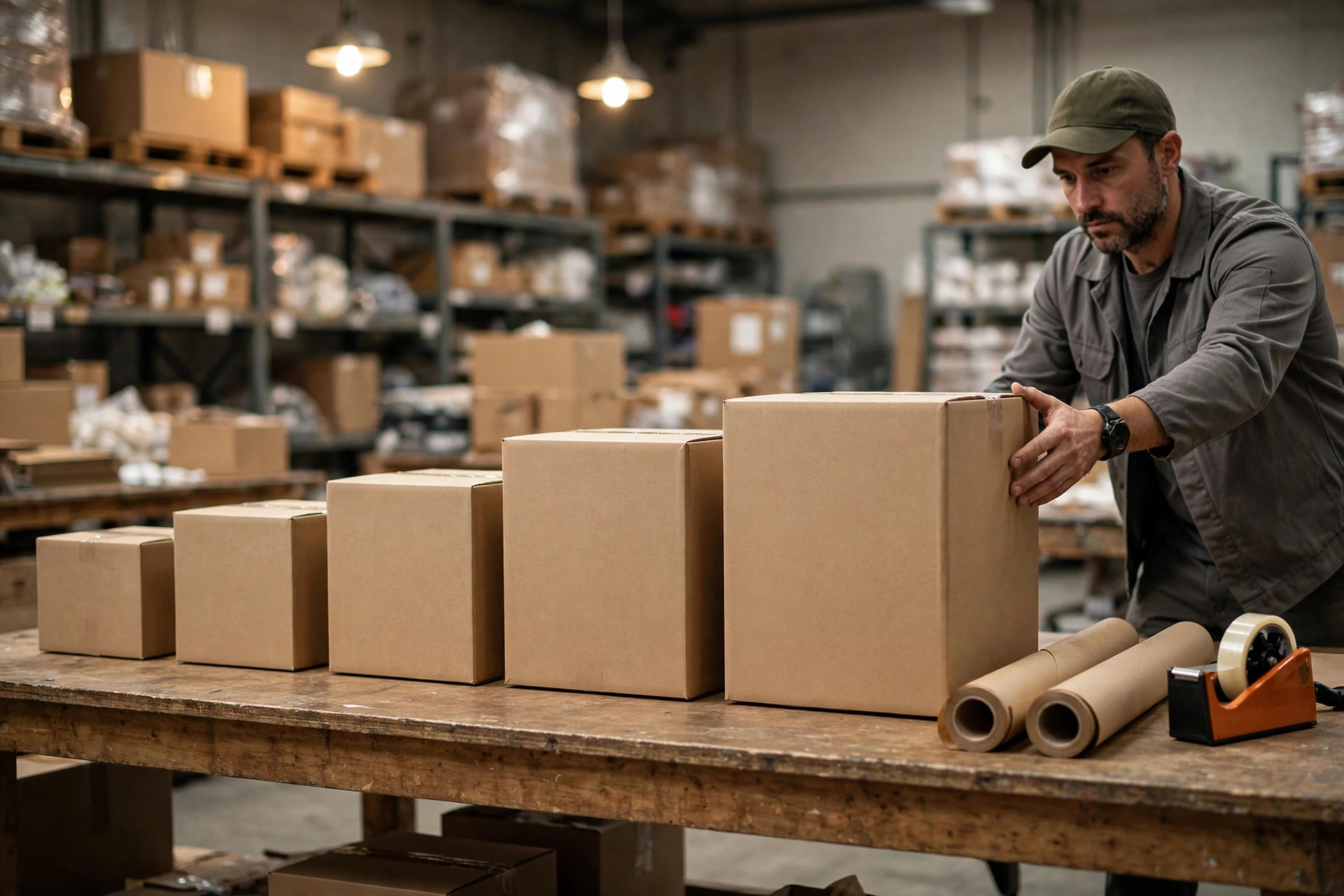
Our sweet spot landed at 8. My rule of thumb: a small warehouse's box count should stop at "the packer can grab the right one with his eyes closed." For us that's 8; for you it might be 6 or 10, depending on your SKU mix and station size. Don't copy the number, copy the method: add sizes from the bottom up, and stop when the error rate starts climbing.
The 3-step copy-paste version for small warehouses
For fellow small-warehouse owners, the minimalist playbook:
First, pull your top-shipped SKUs, measure and weigh them, build the table. Cover 80% of order volume first, skip the long tail. Second, assign boxes on the "5 cm of empty space" rule, print it big, and tape it exactly where the packer looks. Third, review the wrong-box rate and void-fill spend monthly — be cautious about adding sizes, and even more cautious about cutting them.
One more street-smart trick: box suppliers clear out odd sizes twice a year (we once grabbed a batch at $0.40 each). If the dimensions fit your mix, add them as bonus box types — one more row in the matching table. Saving money is never embarrassing.
The enterprise carton-optimization systems quote five figures and up. We can't burn that kind of money. But one spreadsheet, one weekend, and one reluctantly reformed packer got us 80% of the result. Small warehouses have their own way to survive.
By Xiao Ma, Small Warehouse Owner