Start with a cargo warehouse slot booking bill. Last November I reconciled a monthly invoice for a 3PL client in the Inland Empire, and one line stopped me: "slot booking fees," a little over $4,800. The client's first reaction was the obvious one — we already pay for storage, so why are we paying again just to book a time to show up? I broke the invoice down for him: 214 arrivals inside free windows, zero charge; 37 arrivals in rush slots at $85 each; 9 no-shows at a $150 fine each; plus a peak-season surcharge. That is $4,800 in one month, more than $50,000 over a year. This article is about that bill — what cargo warehouse slot booking actually charges for. (All dollar figures below are a hypothetical worked example to demonstrate the math; actual rates follow each warehouse's latest published policy.)
Free Windows: The Cheapest Line on a Slot Booking Invoice — and the Most Misread
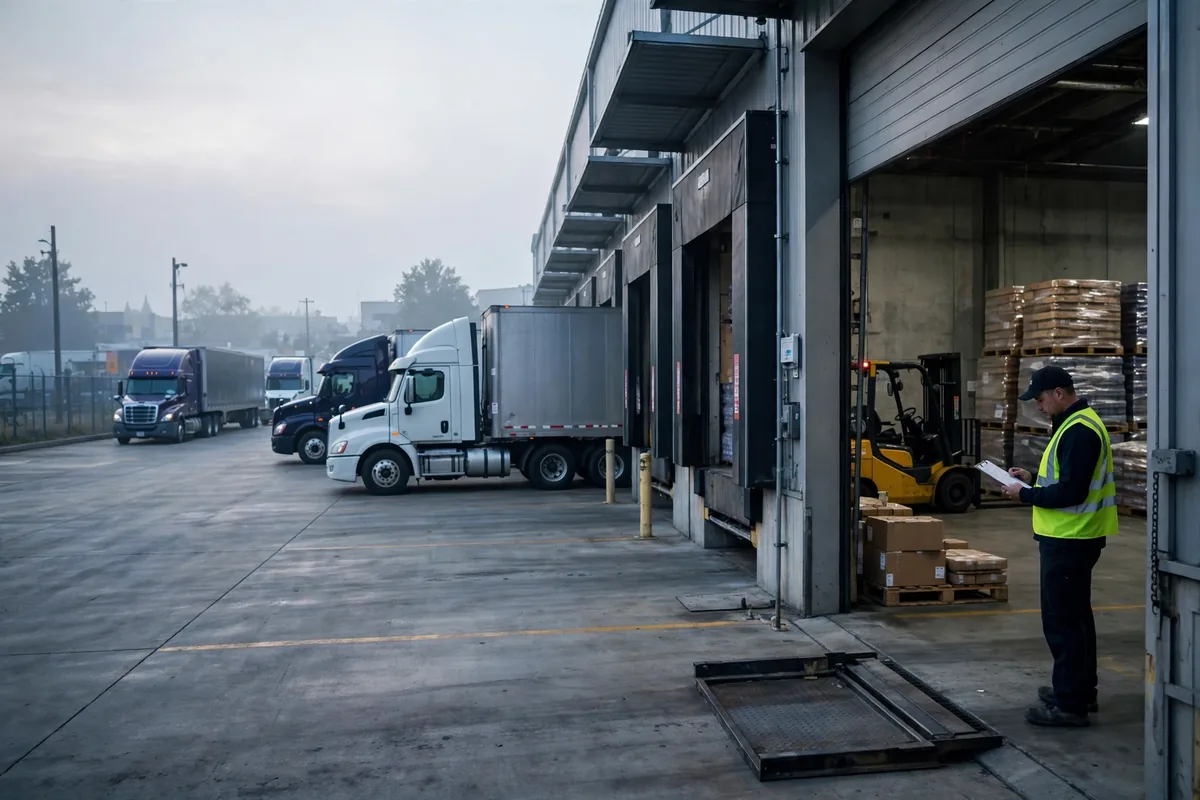
Here is the counterintuitive part: a free window is not a favor from the warehouse. It is a pricing tool the warehouse uses to flatten its own peaks. Dock capacity is fixed — 12 doors, two hours per truck, roughly sixty to seventy trucks a day at best. Everybody wants 9 to 11 in the morning, and the dock cannot hold them all, so the warehouse uses price to push traffic to the edges: free before 10 a.m. and after 3 p.m., paid at midday peak. What is free is never the time. It is your ability to schedule around it.
I ran a one-month experiment with that 3PL client: move 40% of arrivals out of the midday peak and into free windows. The cost was real — drivers had to arrive earlier, the receiving shift moved half an hour forward, the whole roster was rewritten. Rush slots fell from 37 to 11 in a month, saving more than $2,200 on that line alone. But the honest math is this: money saved on rush fees, minus the extra scheduling and waiting cost, is what you actually saved. People who only count the first half always discover they saved nothing at all.
Rush Slots and No-Show Fines in Cargo Warehouse Slot Booking
The fee structure for cargo warehouse slot booking is really just four items:
| Fee | Trigger | Hypothetical rate | One month's bill |
|---|---|---|---|
| Free window | Arrival in an off-peak slot | $0 | 214 trucks, $0 |
| Rush slot | Peak hours or same-day booking | $85 per truck | 37 trucks, $3,145 |
| No-show fine | Booked a slot, never arrived, never cancelled | $150 per truck | 9 trucks, $1,350 |
| Peak-season surcharge | Peak-season slot scarcity | Per latest published policy | Billed separately |
The second case comes from a home-goods e-commerce client. One week before peak season they changed their inbound plan three times: two booked slots missed, one outright no-show. The fines themselves were only a few hundred dollars. The real loss came after — the missed freight arrived two days late, missed the promotional stocking window, and they had to hire a truck for a shuttle run. A $150 no-show fine is never just $150. It is the fine plus the chain reaction. My read: the fine is not a punishment. It is the warehouse putting a price on an empty door. A missed slot means a door sits idle for two hours while labor and equipment keep burning. The warehouse would rather collect your fine than leave a door empty.
One distinction matters here. Warehouse slot booking and port terminal appointments are two different billing systems with different logic. The terminal side revolves around vessel schedules and yard turns — the approach is laid out in this complete guide to drayage terminal appointment booking. The logic rhymes, but do not copy a terminal's free-window rules onto a warehouse dock.
There is one more fee people miss: the rescheduling fee. That is the part of cargo warehouse slot booking nobody budgets for. Many warehouses allow free changes up to 24 hours before the slot, then charge for changes inside that window — typically around half the rush rate, per the latest published policy. The amount is small, but it treats a specific disease: an inbound plan that changes every day. Change it today, change it again tomorrow, and a month of rescheduling fees adds up to several hundred dollars. My fix is to centralize the authority to rebook: only the planning desk can change a slot, not every salesperson calling the warehouse directly. Once that authority is pulled back, the number of changes drops immediately.
Three Levers That Cut Your Cargo Warehouse Slot Booking Bill
First, put free windows in the roster, not in a memo. Nobody reads memos; everybody has to follow the roster. Fix two inbound batches a week into free windows, hold that pattern for three months, then look at how far rush arrivals fell. Let the numbers do the talking.
Second, if your no-show rate passes 5%, fix your own planning before blaming the warehouse for charging. Eight times out of ten, a no-show means your inbound plan changed and nobody told the warehouse. My rule: when the plan changes, rebook or cancel within two hours. Cancelling is free; only the no-show costs money. Writing that into the internal process saves more than negotiating the fine down ever will.
Third, lock peak-season slots early instead of buying rush slots on the day. A rush slot is a spot price; an early booking is a forward price. Lock 70% of your slots four weeks before peak and keep 30% flexible. That ratio is one I have actually run the numbers on: lock more and you waste slots, lock fewer and you pay rush rates. The break-even sits near 70%, drifting with how stable your inbound plan is.
One last point: put slot fees on the customer quote. Many 3PLs quote storage plus handling and absorb slot fees themselves. Absorbing $4,800 a month means more than $50,000 a year quietly missing from the profit line. The right way is a separate line item: arrivals inside free windows cost nothing, rush slots and no-shows are billed as incurred. The customer can see it clearly, and you stop paying for your customer's chaotic planning.
Here is the calculable conclusion. Monthly slot cost is roughly (rush trucks × rush rate) + (no-shows × fine) + peak-season surcharge. Divide that by your monthly storage fee. If it is over 3%, do not start by negotiating price — start by fixing the roster. A fixed roster can push that number under 1%. The money you save will not come from negotiation. It will come from the schedule.
By Lao Zhou, Logistics Cost Analyst