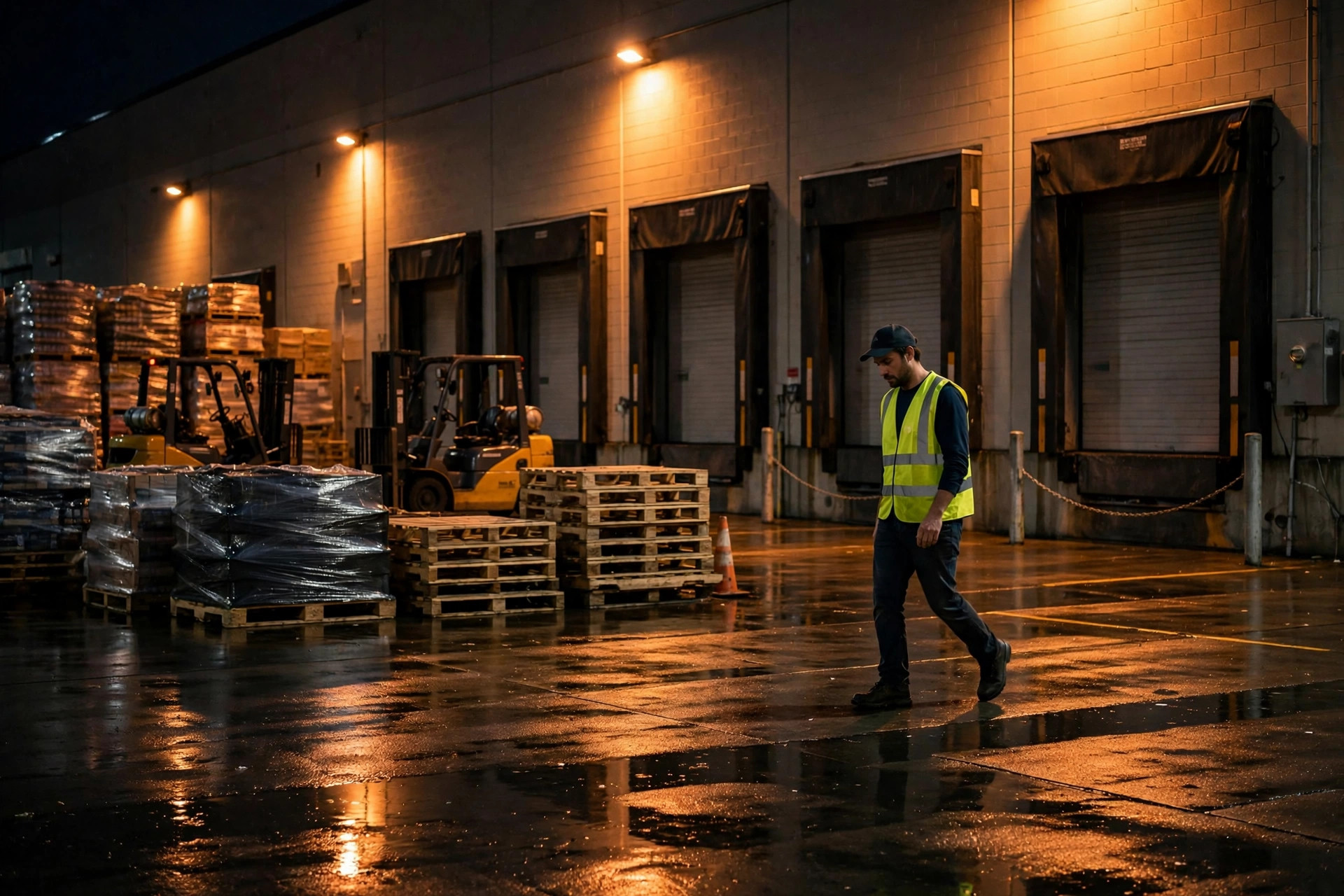
Last fall I got a call from a friend who runs a 3PL in Fontana, and he sounded defeated. "Lao Mi, Cal/OSHA came knocking." My first question was what happened — someone hurt? A forklift tipped over? Nothing like that, he said. Normal operations, normal day, and then two people in vests showed up at the door on an anonymous complaint and asked to take a walk through the building. They walked, they took notes, and three weeks later a letter arrived: several citations and a corrective-action deadline. His summary of the experience: "Federal OSHA never bothered us in all these years. California gave us the lesson instead."
That story is unremarkable in California, which is exactly the problem. Most states run on the federal OSHA program. California runs its own — Cal/OSHA — and its standards are stricter in a lot of places, with inspectors who actually show up. For warehouse operators, the killer isn't the volume of rules. It's the extra ones: requirements you'd never meet in a lifetime of running a DC in Texas or Arizona, but that hit you in year one in the Inland Empire. Here are the three that hurt the most, plus a self-audit checklist you can run tomorrow.
The written plan: your word doesn't count
Title 8, California Code of Regulations, section 3203 says every California employer, regardless of size, must maintain a written Injury and Illness Prevention Program — an IIPP — and name a specific person responsible for it. Two words do all the heavy lifting: written, and named.
Operators relocating from other states trip on this constantly. In their Arizona or Texas buildings, safety ran on the supervisor's morning huddle and verbal reminders, and nothing bad ever happened. That doesn't fly in California. A Cal/OSHA inspector's first request is almost always the same: "Show me your IIPP." Tell them "we cover it verbally" and they'll nod politely — and write you up for having no written program.
A passing IIPP doesn't need to be a thesis, but it must contain a few non-negotiables: who owns it (a name, not "the operations manager"), how hazards get identified (inspection cadence, who walks the floor), how findings get corrected (timelines, records), how incidents get investigated, and how new and transferred employees get trained. And the document has to match the floor. The most expensive failure I ever saw was a warehouse with a beautiful IIPP binder — until the inspector asked a random picker who trained him on day one, and the kid couldn't answer. Paper and reality didn't match. Citation.
My take: the IIPP is the foundation everything else in California sits on. Treat it as inspection theater and it will perform exactly like theater. Treat it as a management tool and it absorbs half the pain of what comes next.

Heat — indoors and out, both are regulated
The outdoor heat rule (8 CCR 3395) has been around for years: water, shade, rest breaks, training, emergency procedures. Anyone in logistics knows that drill. What catches warehouse owners off guard is that as of July 23, 2024, the indoor heat illness prevention standard (8 CCR 3396) is also in effect, with the trigger at 82°F indoors — and warehouses and distribution centers are explicitly among the covered workplaces.
What does 82°F mean in practice? On a summer afternoon in the Inland Empire, a big flat-floor warehouse with no AC and a few exhaust fans sails past that number by 2 or 3 p.m. The rule asks for specific things: temperature measurement, water access, cool-down rest areas, acclimatization procedures, training, emergency response — and a written heat illness prevention plan. At 87°F the requirements step up another level, with more engineering and administrative controls. The details get tuned year to year, so check the current Cal/OSHA guidance before you write your plan.
There is a real trade-off to think through. Full-building air conditioning is the cleanest fix, but for a 100,000+ square foot box, the retrofit and the electric bill are serious money. Most operators I know run a combination play instead: spot cooling in the work zones (industrial fans and misting at pack stations and charging areas), shift adjustments to dodge the hottest hours, more frequent breaks. My verdict: stop debating whether to comply — the rule is already live. The only live question is how to comply cheapest. The fine for having no plan, plus the forced remediation, would have bought you a lot of big fans.
(We published a separate piece on building an indoor 82°F playbook — the step-by-step version. This article stays at the why and the what; go read that one for the how.)
The workplace violence plan — yes, warehouses too
This is the one that surprises warehouse owners most. Effective July 1, 2024, SB 553 (California Labor Code section 6401.9) requires nearly all California employers to maintain a written Workplace Violence Prevention Plan, train employees on it, and keep a violent incident log. The typical first reaction: "Isn't that for retail stores and hospitals? What does it have to do with my warehouse?" Plenty.
Warehouses have real exposure: night-shift receiving, driver-versus-dock confrontations, a terminated employee coming back, parking-lot robberies. Cal/OSHA's logic is straightforward: if your site is accessible to the public and your people can encounter outsiders, you have violence risk, and you need a plan. The exemptions are narrow — for instance, sites with fewer than 10 employees that aren't open to the public — and most warehouses don't qualify.
A WVPP has to spell out: violence hazard identification, assessed site by site (no corporate template stamped across every building — Cal/OSHA explicitly warns against top-down, one-size-fits-all plans); a reporting procedure (who an employee tells, and how, when something looks wrong); incident investigation and recordkeeping (keep the log at least five years, and employees can request a copy); and training (at hire, then annually). Inspectors are probing this one hard because it's a 2024 rule and the agency is still in its enforcement honeymoon.
Practical advice: the WVPP can live inside your existing IIPP or stand alone, but do not download a generic template, fill in your company name, and call it done. If three buildings share one identical plan, the inspector will notice in about thirty seconds.
What getting caught costs, and a checklist
Back to my friend in Fontana. His final math: the citations added up to five figures in penalties (amounts depend on the violations and their severity — check Cal/OSHA's current schedules), remediation ate two-plus weeks, and a follow-up inspection hung over everything. The money stung, but the real cost was two weeks of his entire management team doing compliance triage instead of peak-season prep.
So here is the self-audit I'd run on any California warehouse before an inspector does it for you. For each item, you need paper evidence, not confidence:
- Is the written IIPP on file, with a named owner and a recent update date?
- Grab three floor employees at random. Can they describe their onboarding safety training?
- Is there a written indoor heat plan? Do the 82°F temperature logs, cool-down areas, and water stations match what's on the floor?
- Is there a WVPP written for this building's specific risks — not a corporate copy-paste? Can you produce last year's training records?
- Is the violent incident log set up? (Set it up even if nothing has ever happened. An empty log beats no log.)
- While you're at it, sweep the federal-OSHA items too: extinguishers, rack protection, forklift inspections.
In California, compliance cost is operating cost. It doesn't go away by ignoring it. My view hasn't changed in twenty years: money spent on fines and forced fixes is always more expensive than money spent up front. Cal/OSHA is your second landlord in this state — read the lease before move-in, not after the eviction notice.