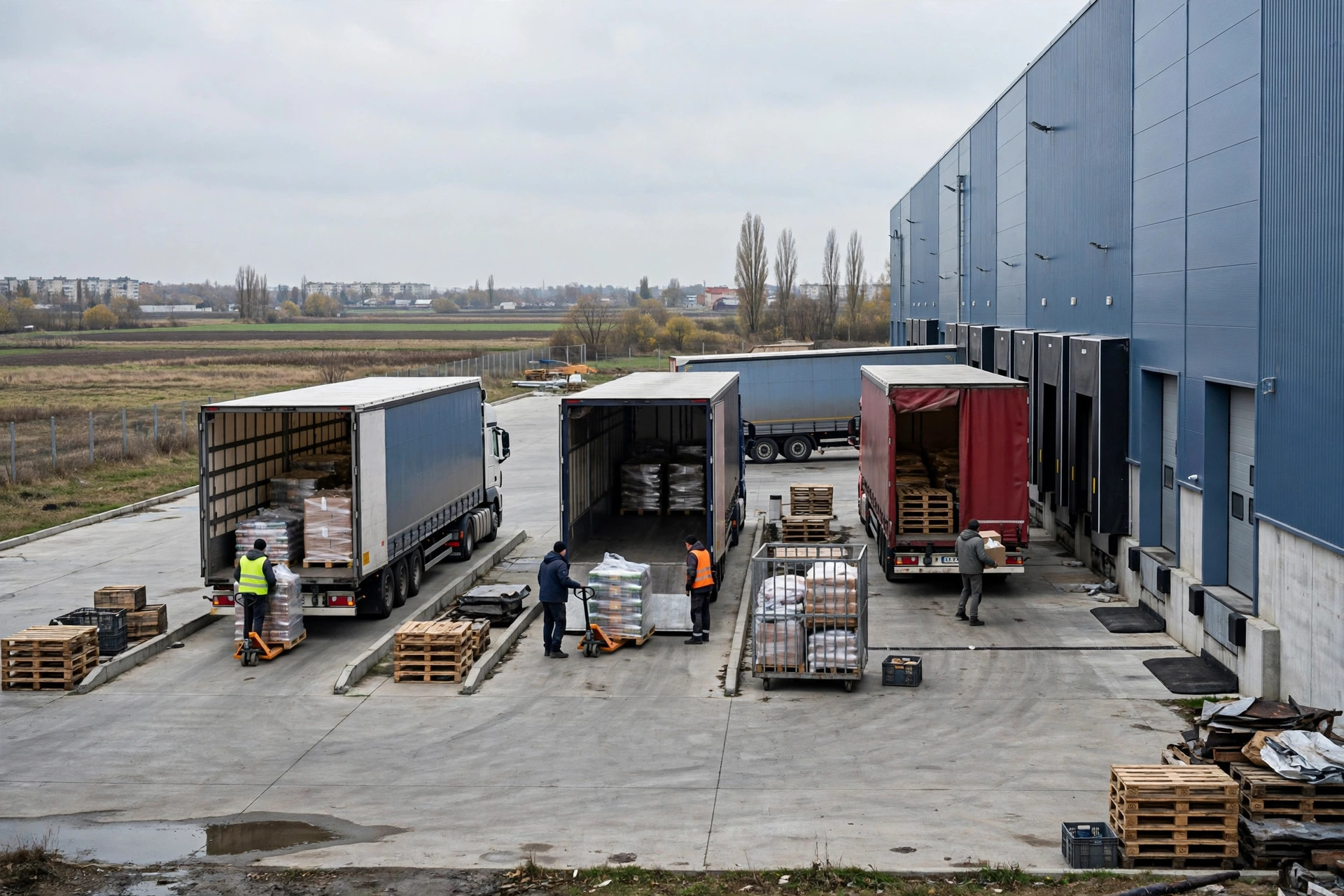
It was six in the morning, and the Bucharest warehouse market was already awake. The night shift in our suburban warehouse had just handed over, and the first trucks were already lining up at the docks. Brothers, let me be straight with you: the first thing I checked was not the freight. It was the road. When traffic on the ring road starts to build, that decides whether our first outbound wave leaves on time.
Our warehouse sits to the west, near the corridor toward Pitesti. Anyone who has worked that side knows the upside. Shipments heading west and toward Central Europe move well. Linehaul trucks are easy to book. Drivers know the route. The downside is just as real. Hiring is hard. The warehouse looks cheap on rent, but workers face a long daily commute, and when peak season brings overtime, people start to leave. In our busiest two weeks last peak season, we were four people short on nights. The day shift covered for three days straight. The error rate climbed, and you could see it happening. That was when the lesson landed for me. In this business, rent is only the first line of the budget. Staffing and outbound timing are the lines after it.
Bucharest Warehouse Market: On the Western Corridor, People Come Before Roads
So what did we try? We changed the roster first. Fixed two-shift working became staggered starts. The early shift now gets on the road before the ring road clogs up. The night shift keeps one floating role, purely to cover sickness and late arrivals. Then we arranged fixed shuttle routes from nearby towns, so workers stopped changing buses twice to reach us. Late arrivals dropped fast. Neither change cost much money. Both worked better than another round of pay rises. That is how we run the warehouse now. Rosters follow traffic. Hiring follows commuting. A good location still fails if the people cannot get there reliably.
Here is another scene every warehouse manager in this city will recognize. During an e-commerce promotion week, order volume doubled. The constraint was not floor space. It was outbound windows. Our site is close to a ring-road entry, which feels fine on a normal day. On promotion day, every truck wanted to leave the city in the same window. The dock schedule could be perfect and still lose to traffic. We learned to split waves a week ahead. Long-distance loads get built the night before. Local loads go first in the morning. Everything that can be staggered, gets staggered. In a site-selection budget, traffic deserves its own line. On the Bucharest ring road, morning and evening peaks are not exceptions. They are the routine.
Bucharest Warehouse Market Location: Comparing Three Directions
When owners ask me whether to choose the west, the south, or the east, I do not give a direct answer. I give them the comparison table we use internally, and I ask them to fit their own freight into it:
| Direction | Best for | Advantage | Watch out for | | Western corridor | Central Europe and westbound domestic distribution | Smooth linehaul, experienced drivers | Staffing and commuting pressure | | Southern suburbs | Local delivery and Bulgaria-bound freight | Closer to the city, easier hiring | Outbound congestion still bites at peak | | Eastern side, toward Constanta port | Imports and sea-freight handover | Close to port freight | An extra inland leg for onward distribution |
Inside that table sits a contrarian judgment. The direction with the cheapest rent is often not the cheapest operation. We worked with a client who moved south for a lower rent, then watched drivers run a longer suburban leg every day. Fuel and driver hours added up. Within three months, the saving on rent was gone, plus two late-delivery penalties on top. Turn it around. The western site cost more per square metre, but linehaul trucks could run out and back in a day. Drivers did not need overnight stays. The saving on accommodation and empty return legs balanced the rent. So do not judge a site by rent per square metre alone. Judge it by the full cost of each order, from inbound receipt to final delivery.
One more practice we fixed in our warehouse, and it connects directly to Eastern Europe distribution. Freight for Bulgaria and beyond no longer waits until a truck is full. We set a daily cut-off time per route. One fixed departure leaves every afternoon, carrying the urgent orders for that day, whether the truck is full or not. The rest consolidates into the next day. Load factor looks less impressive on a report. On-time arrival improves. Complaints fall. Re-shipments and customer-service costs fall with them. Brothers, a beautiful load factor does not equal profit. On-time delivery does.
One detail I want to flag, because it is easy to postpone: the system. In our early days we ran on manual sheets and phone calls. One wrong line in peak season meant reopening a whole truck and rechecking it by hand. Once we added basic scanning and wave control, the change was immediate. Picking errors fell. Night-shift handover stopped relying on word of mouth. New starters got up to speed faster. The system does not need to be expensive. It needs scan records for putaway, picking, and dispatch, so any problem can be traced to a person, an order, and a time. A warehouse without that traceability runs peak season on luck, and that is a lesson every buyer in the Bucharest warehouse market should hear before signing a lease.
Winter is another test. Mornings start late, icy roads push driver departures back, and worker commutes slip. Before winter we now shift the early shift half an hour later, check dock lighting and anti-slip surfaces in advance, and bring forward the cut-off time for long-distance loads by half a day. Small steps, all of them. But when winter arrives, the warehouse stays busy instead of turning chaotic. Half of warehouse management is freight. The other half is weather, roads, and people, planned half a step early.
A final reminder for fellow managers. In Bucharest, warehouses are not hard to find. What is hard is getting location, staffing, and traffic right at the same time. Before signing, go and stand outside the site during a morning peak. Watch how trucks move, how workers arrive, and how the docks are sequenced. That one visit teaches more than reading a floor plan three times. Once the location is set, let rosters and waves follow the traffic. Then the warehouse can actually run.
Let me be straight with you. Choose the site well, and peak season is just busy. Choose it badly, and peak season is chaos. That one-word difference comes down to whether staffing costs and road costs were counted on the same day the site was chosen.
By Chen Feng, Warehouse Operations Manager