Two falls ago I sat in a project kickoff meeting at a 3PL outside Ontario, California, walking the CFO through an automation business case. He stopped me halfway through the deck. "Labor savings, throughput gains — those I can sign off on. But this page about fewer picking errors and fewer injuries? Soft stuff doesn't go in my approval packet." Fair enough, I told him. It doesn't have to. But you should know what you're leaving on the table.
Twenty years on American warehouse floors has taught me this: soft benefits in automation ROI are either deleted entirely or inflated until the CFO stops believing any of your numbers. There is a middle path — turn them into hard dollars, conservatively, and let the payback math speak for itself.
The true cost of one mispick
Mispicks are the most undervalued soft benefit because the cost never shows up on a single line. It's scattered across freight bills, customer service hours, and returns processing, and nobody aggregates it. I use this formula to pull it together:
Cost per mispick = reship freight + return pickup freight + customer service labor + returns inspection and restocking + review-driven repeat-purchase loss
Every line below is a range from our project experience — replace with your own actuals when you run your numbers:
| Cost item | Per order (experience-based) |
|---|---|
| Reship freight | $8–12 |
| Return pickup / reverse logistics | $6–10 |
| Customer service (about 20 minutes) | $7–9 |
| Returns QC and restocking | $4–6 |
| Total per mispick (excl. review loss) | $25–37 |
I deliberately leave review loss out of the total. Nobody can tell you exactly what one bad review costs, and pretending otherwise is how soft benefits get their bad reputation.
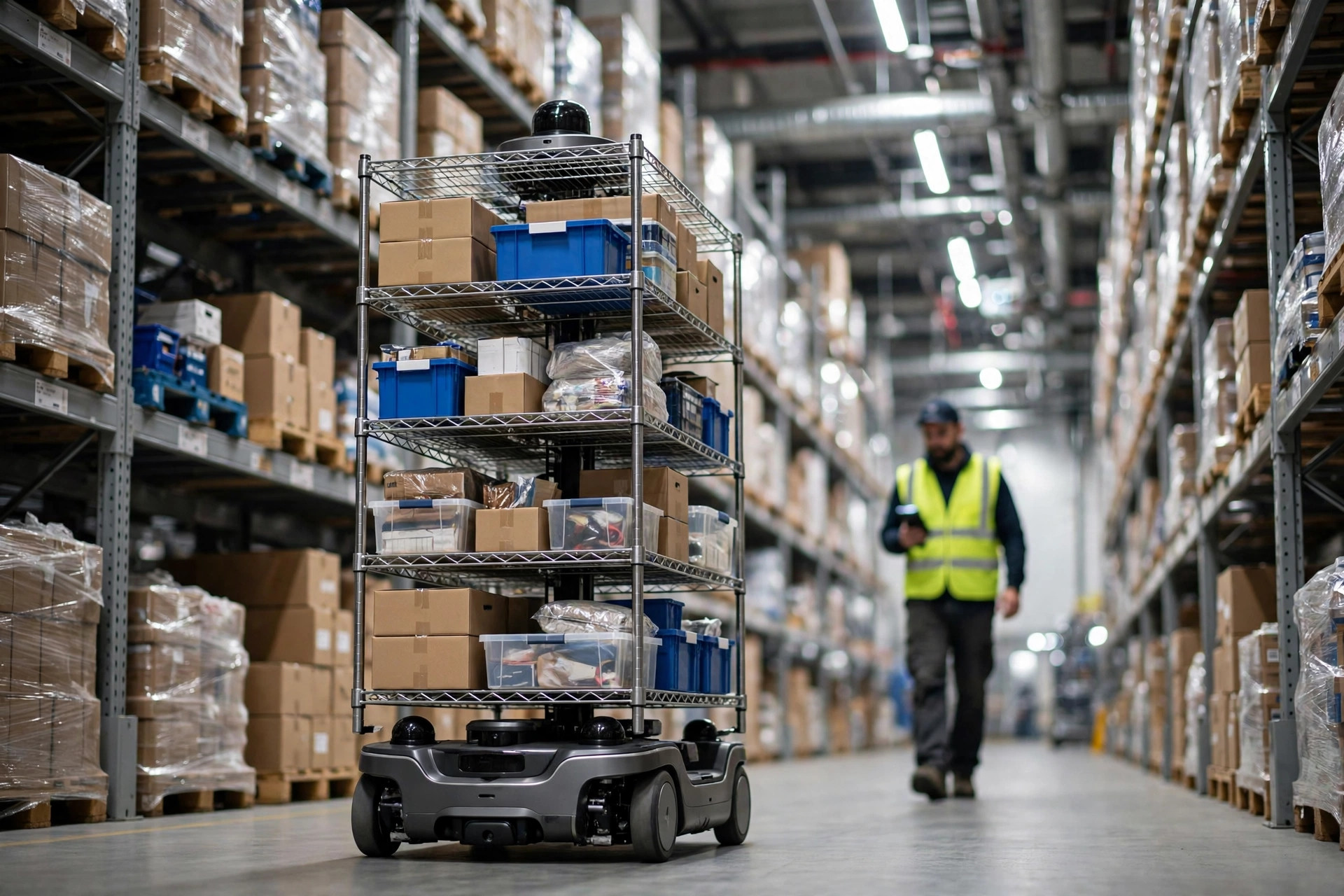
Run it with real scale: earlier this year a 60,000-square-foot e-commerce fulfillment center in Mira Loma shipped about 40,000 orders a month. Before goods-to-person AMRs went live, their pick error rate sat at 0.35%. Six months after go-live, it held steady at 0.08%. That's 108 fewer mispicks a month. At $30 a mispick, roughly $3,240 a month — $38,880 a year. The owner told me he'd never totaled mispick cost before; "customer service just always seemed busy." Turns out mispicks were quietly funding nearly a full headcount.
Injuries cost more than the medical bill
Then there's safety. Warehousing and manual material handling carry persistently high injury rates in the U.S., and OSHA has specific recordkeeping requirements for recordable incidents — check OSHA's current published guidance for exact definitions, as I'm not going to quote policy numbers from memory here. What matters for the business case: the real cost of one recordable injury goes far beyond the medical invoice.
From our project experience, a single recordable injury requiring medical treatment typically runs several thousand to low five figures in direct costs (medical plus indemnity). The indirect costs are the bigger story — line downtime, incident investigation, corrective actions, overtime for replacement labor, and the nastiest line item of all: workers' comp experience modification. U.S. workers' compensation is experience-rated, so a bad year multiplies your premiums for years afterward. One serious injury can live on your premium bill long after the worker has recovered.
Automation cuts injuries where they actually happen. Goods-to-person takes people out of the daily grind of walking double-digit miles and repeatedly bending under load, and musculoskeletal injuries in picking drop accordingly. To quantify: take your recordable incident count and total workers' comp spend over the last three years, annualize them, and apply a conservative reduction assumption to the picking-related share (say 30–50% reduction, and use the low end). That dollar figure belongs in your middle-case model — not the conservative one, because injuries are lumpy and any CFO will rightly point out that next year might have been quiet anyway.
Turnover is the silent budget killer
The third soft benefit is turnover. Frontline warehouse turnover in the U.S. runs chronically high, and every peak season HR team knows the pain of hiring against the clock. Fully loaded, replacing one hourly warehouse worker — job posting, interviews, background checks, onboarding, and the ramp-up until a new hire matches veteran productivity — costs roughly $3,000–5,000 per person in our project experience.
Why does automation reduce turnover? It eliminates the worst parts of the job. A goods-to-person pick station is stationary, paced, often in a separately climate-controlled zone — a completely different proposition from pushing a cart across a million-square-foot box. I've watched picking go from "the hardest role to fill" to "the role people request transfers into" after automation went live, more than once.
The math: take trailing-twelve-month separations in your picking and material-handling roles, multiply by $3,000–5,000 per replacement, and apply a conservative reduction assumption (20–30% lower turnover, low end). One common mistake to avoid — don't credit automation with facility-wide turnover improvement. It only touches the roles it covers. Count picking and handling, not receiving or QA, or you'll get dismantled in the first review meeting.
Three versions of the truth: conservative, middle, optimistic
Now assemble it. Take a mid-size project: $1.2 million in automation capex, $400,000 a year in hard benefits (labor plus throughput). Static payback: three years. Layer in the soft side — $39,000 a year in mispick savings (conservative case, direct costs at the low end of the range), $20,000–30,000 in injury-related savings (middle case), $40,000–60,000 in turnover savings (middle case). Here's how I tier them:
- Conservative: mispick direct costs only, priced at the low end of each range. No review loss, no injury savings, no turnover savings. This is the version for the board and the CFO — every number defensible under questioning.
- Middle: conservative plus injury-related savings plus turnover savings, with reduction assumptions at the low end. This is the version you actually decide on, and the one I align with clients internally.
- Optimistic: middle plus review-driven repurchase loss plus the high end of insurance savings. Sensitivity reference only — never in the approval packet. An inflated ROI damages trust more than a thin one. Get caught exaggerating once, and every number you bring afterward gets discounted.
On the middle case, annual benefit moves from $400,000 to roughly $480,000–500,000, and payback compresses from three years to just over two. That's the real role of soft benefits: they rarely make or break a project on their own, but they routinely decide whether it clears committee comfortably or barely — and how much negotiating room you have on budget.
One last trap, and it's the biggest: attribution. Error rates fell — was that the automation, or the WMS upgrade and slotting project you ran the same quarter? Warehouses love stacking improvements and then crediting all of them to the most expensive project. My rule: lock the baseline at project kickoff. Record twelve months of pre-go-live data for the three metrics — error rate, recordable incidents, turnover in covered roles — and write them into the project document. Post-launch comparisons only move those three needles; everything else gets its own accounting. No baseline, no credible math.
Your homework for tomorrow: pull your last twelve months of mispick counts — your WMS probably has reason codes, or your CS lead knows the number — and run the first calculation with the table above, using your own freight rates and service labor. You may find the soft-benefits page becomes the most persuasive page in your entire ROI deck — as long as you can explain, line by line, where every number came from.