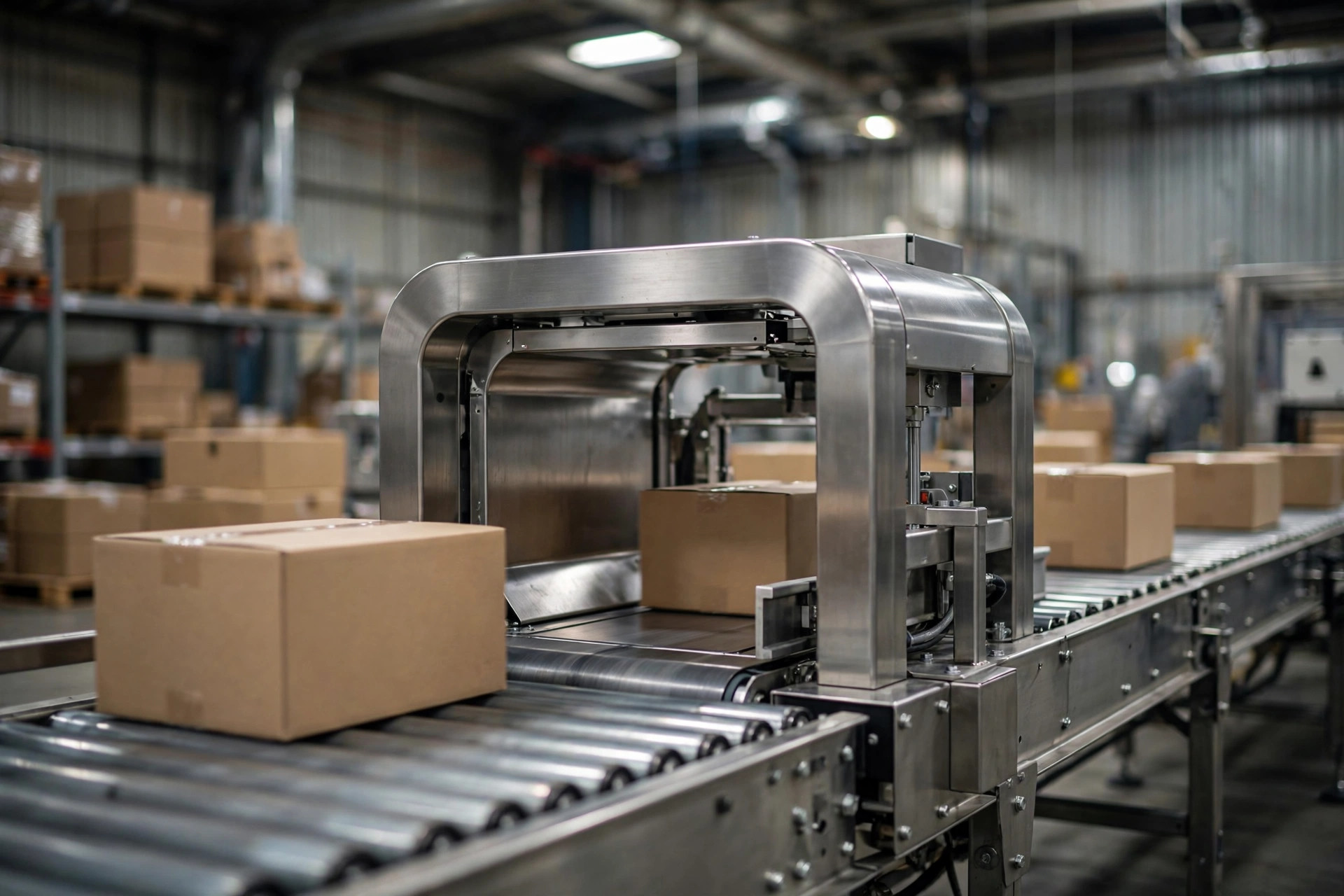
In December 2023 I was walking a beauty subscription-box warehouse and watched their pack line: 40 cartons a minute on the belt, four people at the QA table, one static scale each. Every box got weighed by hand — right weight passed, light ones got opened and checked. The entire last line of defense was four scales and four pairs of eyes. I spot-checked 200 boxes over half an hour: five were short. A 2.5% miss rate — one shorted box out of every 40 shipping out the door. Each short shipment cost 6 to 8 dollars to fix: ten minutes of customer service, reship freight, repack. At 8,000 orders a day, reships alone were burning close to twenty grand a month.
That is the problem a dynamic checkweigher with an automatic reject station solves: machine eyes replacing the human ones at the end of the line.
How it actually weighs things
Think of dynamic weighing like photographing a speeding car. The faster the car, the shorter the shutter time, the noisier the image. Same with a checkweigher: cartons fly through at dozens per minute, and the sensor has tens of milliseconds to capture the weight. Fewer samples, bigger error.
Most serious machines use electromagnetic force restoration sensors. Picture a balance scale — the carton on one side, and instead of calibration weights on the other, an electromagnet adjusting its pull in real time to keep the beam level. The current it draws is the weight reading. Fast response, high accuracy, the mainstream choice for dynamic weighing. The cheap alternative is strain-gauge load cells: fine standing still, drifty at speed.
Accuracy and throughput are locked in a permanent trade-off. The typical numbers I see in the field look like this:
| Belt throughput | Typical dynamic accuracy | Fits |
|---|---|---|
| 20–30 pcs/min | ±1–2 g | Small cosmetics, 3C accessories |
| 40–60 pcs/min | ±2–5 g | Standard e-commerce parcels |
| 80–120 pcs/min | ±10 g and up | Heavy/bulky rough screening |
There is an international standard, OIML R51, that governs accuracy classes for automatic catchweighing instruments. When buying, ask for the R51 class certificate — do not take the sales rep's "high precision" at face value. Calibration uses E2-class test weights, the same grade labs use, and you run them weekly.
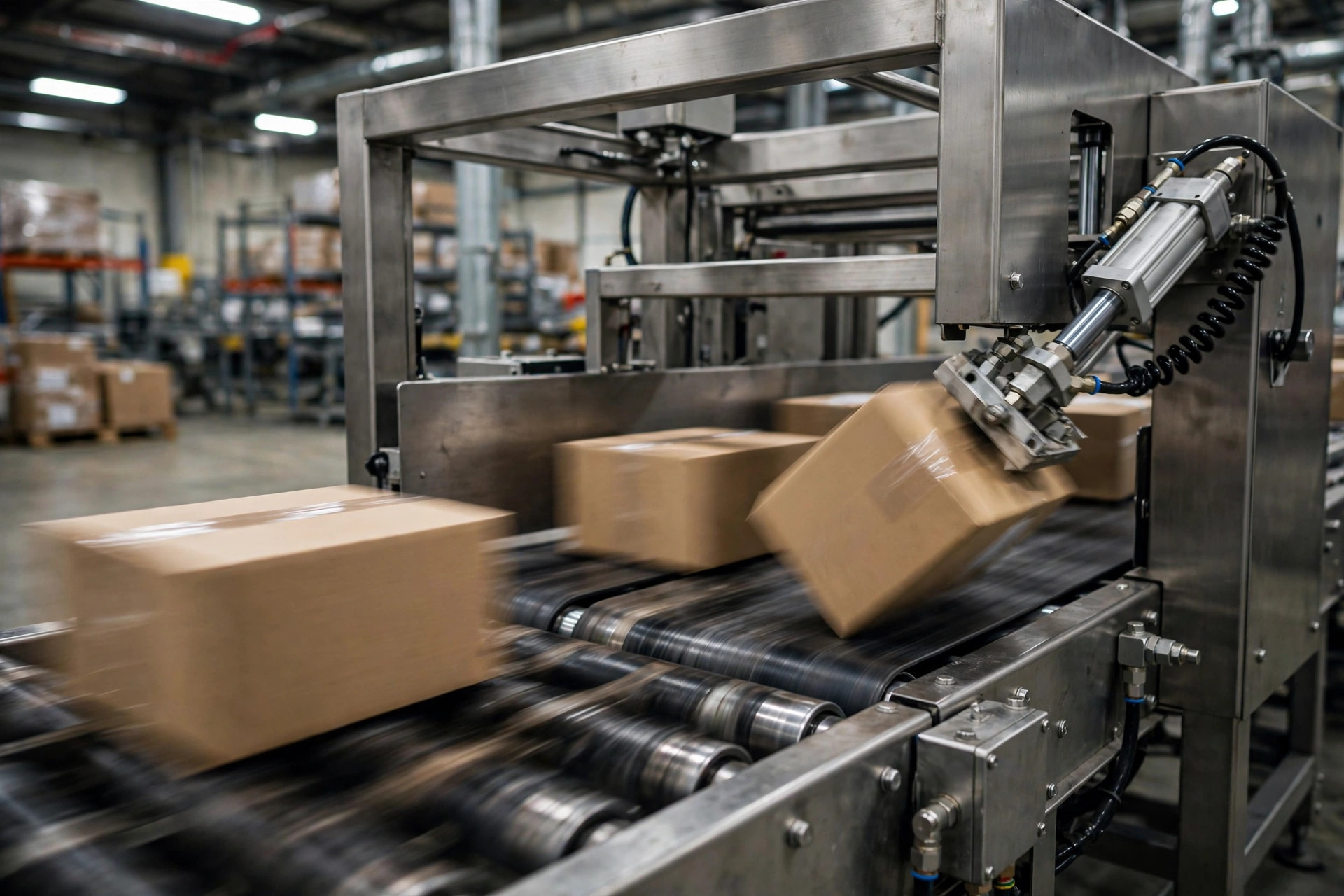
The real math: false rejects vs. misses
The spec that actually kills projects is not accuracy — it is the false reject rate. A ±2 g accuracy sounds great until the machine kicks 3% of good cartons off the line and your QA table drowns.
Early 2024, a pet-food e-commerce warehouse in Dallas installed a checkweigher and ripped it back out three months later. I went to look and the cause was obvious: they sold 500 ml liquid supplement bottles. Every belt accel and decel sloshed the liquid, and the weight reading swung 8–10 g. With tolerance set at ±3 g, the false reject rate hit 5%, the QA table buried itself, and humans ended up faster than the machine. Checkweighers fear three things: vibration, airflow, and shifting centers of gravity. Liquids, powders, and anything loose inside the box are its natural enemies.
So before selecting, run two numbers:
- Cost of one false reject: kicked cartons need manual reweigh, confirmation, re-induction — 30 to 60 seconds of skilled labor each, roughly $0.30–0.50 all in.
- Cost of one missed short: customer service, reship freight, repack, review risk — $5 to $12 is typical, higher for high-repeat categories like subscription boxes.
The decision formula is one line: false-reject rate × false-reject cost < current miss rate × miss cost, and the machine pays for itself. Run the beauty warehouse through it: 2.5% miss rate × $7 = $0.175 of miss cost per order. The machine cuts misses to 0.3% with a 1.5% false reject rate × $0.40 = $0.006 per order. At 8,000 orders a day that is over $1,300 saved daily — a $150k–250k machine pays back in well under a year. That math works.
Who should buy one — and who should walk away
Three thresholds; meet two before you talk to vendors:
- 3,000+ orders a day. Below that the machine sits idle most of the shift and the amortization never gets thin.
- Average order value above $25, or a short-shipment complaint rate above 0.5%. Low value and few complaints means the miss cost was never high enough to justify the machine.
- Stable product weights: standard box sizes, fixed SKU combinations. If you change packaging daily or build custom gift boxes, someone will be re-teaching tolerances every shift until they give up and bypass the reject.
Now for the pseudo-demand, and I will not be polite about it: some warehouses doing 800 orders a day want a checkweigher, and I tell them to fix their picking first. A checkweigher catches short picks, not wrong picks — the wrong SKU at the right weight sails through. If your wrong-pick rate is the problem, the problem is in picking and QA process, not at the end of the pack line. Buying equipment before fixing process is putting a lid on a leaking bucket. The same water leaks out.
One more trap: overweight rejection. Using the weigher to catch over-packs is valid logic, but set the over-tolerance twice as wide as the under-tolerance — box material variance and two extra wraps of tape live in the 3–5 g band. Set it tight and your false rejects take off.
Maintenance: where the bodies are buried
Installation is the easy part. Checkweighers are the most temperamental machines in the automation family, and whether you hit 99% uptime comes down to care:
- Weekly calibration: run the E2 weights, five minutes. An uncalibrated scale drifting 2–3 g silently kills a ±3 g tolerance line.
- Belt tracking: a wandering belt drifts the dynamic zero. Glance at belt position at every shift start — matters more than anything.
- Dusty photoeyes: carton triggering depends on the photoeye, and dust shifts trigger timing by 10 ms, misaligning the weighing window. Blow it out weekly with compressed air.
- Unstable reject air pressure: with pneumatic rejects, compressor swings mean light cartons do not clear and heavy ones fly. Give the reject valve its own regulator.
- Floor vibration: no forklift traffic next to the weighing section. If unavoidable, pour an isolated foundation for the weigh section with damping from the main line. I once saw a warehouse with the scale beside the main aisle — every forklift pass swung the reading 5 g, and it took two months to find the cause.
So is the money worth it? It comes down to one number: your current short-shipment complaint rate × your average reship cost. If that beats the monthly machine amortization plus false-reject rework cost, buy it. If the math does not close, do not. A checkweigher is not magic — it is an online gatekeeper with a scale inside. Run the numbers before you buy, and maintain it properly after.
By Da Liu, Automation Engineer