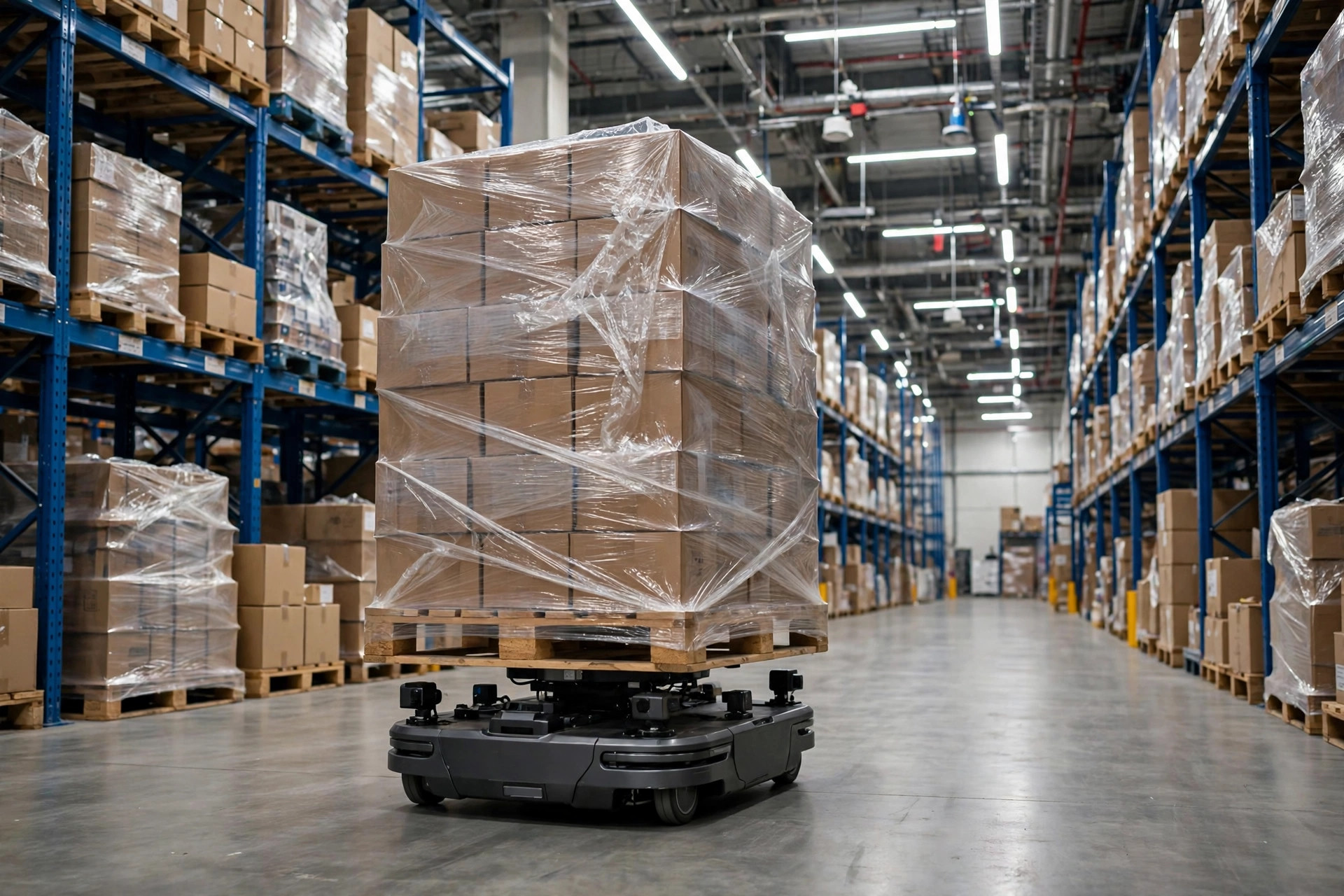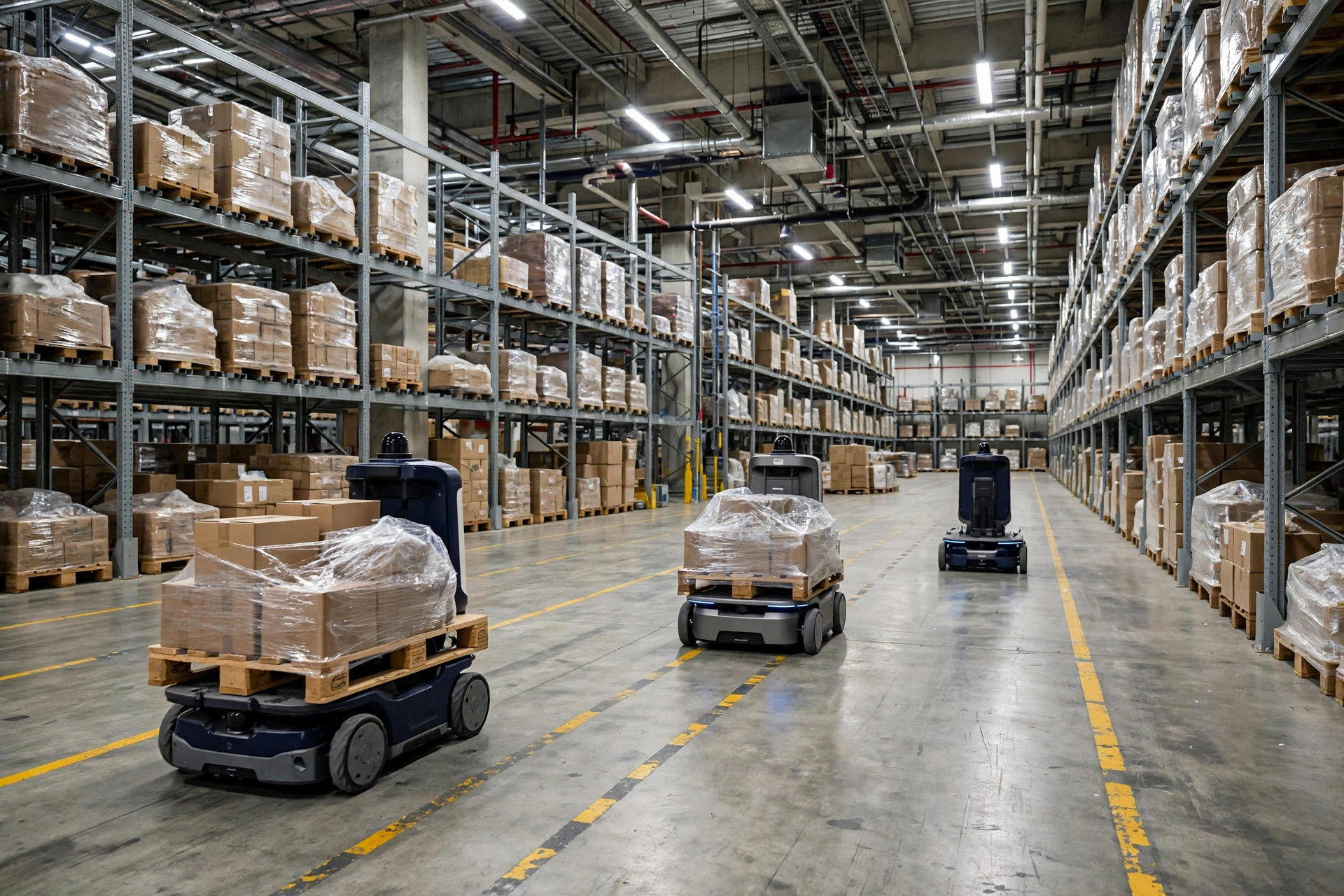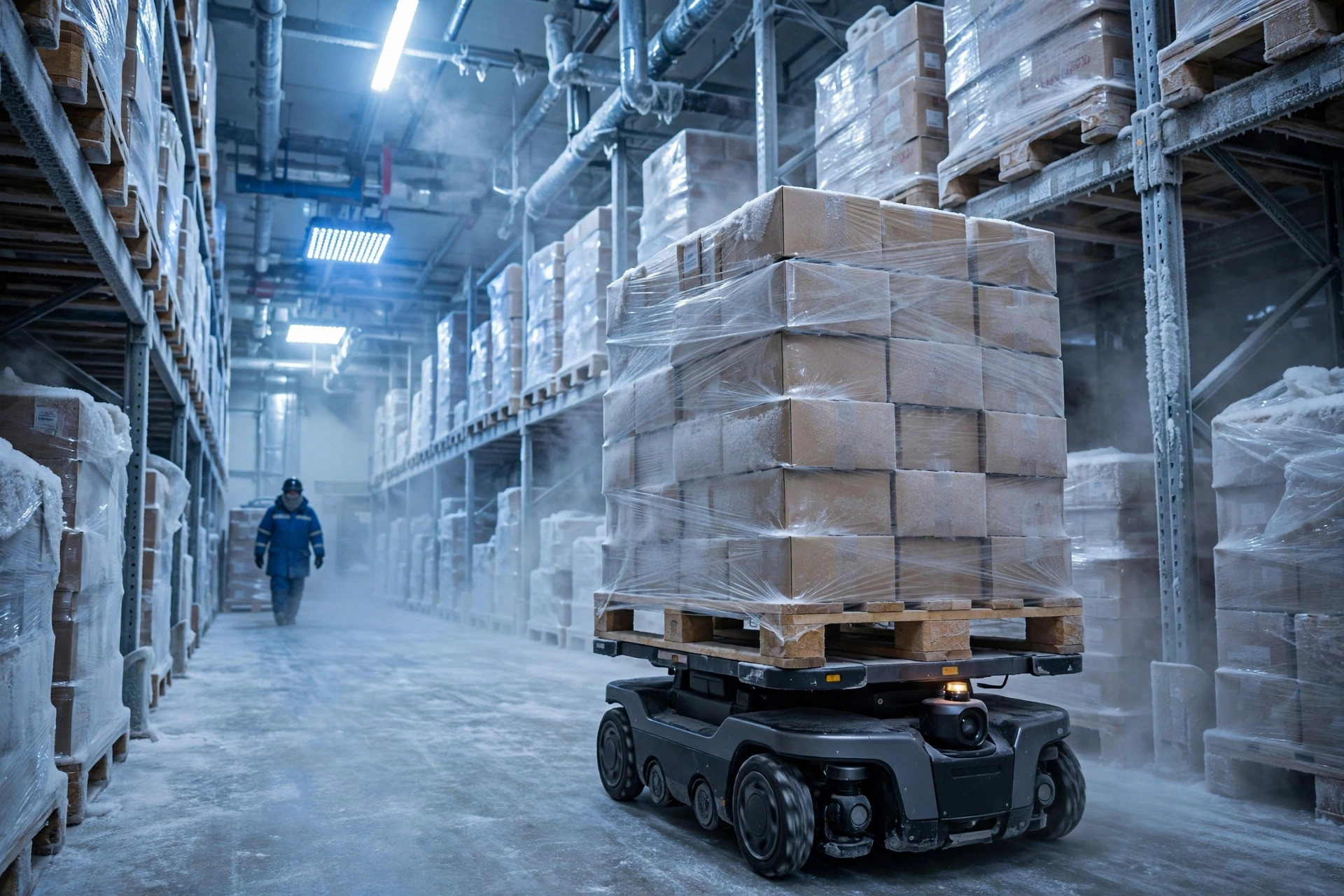
This past spring I was at a 3PL freezer warehouse outside San Bernardino for a site assessment. Roughly 150,000 square feet, held at -18°C year-round. The owner had a fleet of lift-type AMRs running beautifully in his ambient distribution center, so he figured he'd just copy-paste the setup into the freezer — buy two more bots, stick the chargers by the freezer door, done. Three months later I went back. The site manager's exact words: "These things move slower in the freezer than a guy with a hand pallet jack."
I walked the building, and the problem wasn't the robots. Nobody had told him that an AMR that thrives in an ambient warehouse enters a different planet the moment it rolls into a freezer. Batteries, navigation, floors — three traps, one at a time.
The battery quits first
Lithium batteries hate the cold. That's physics, not brand quality. As temperature drops, internal resistance climbs and both usable capacity and discharge capability fall off. The same bot that finishes a shift in an ambient DC with charge to spare will visibly lose range in a -18°C freezer — "low battery, returning to charger" alarms start popping up far more often.
Charging is the nastier problem. Charging a lithium cell below 0°C causes irreversible internal damage, so any decent battery management system throttles current or refuses to charge outright. The opportunity-charging playbook from ambient warehouses — grab ten minutes of charge between runs — simply doesn't work in a freezer. The bot rolls back to the charger and charges at a snail's pace while the queue behind it grows.
My approach, pick one: put the charging area in the ambient buffer room outside the freezer door — bots discharge inside, charge outside. Or spec battery packs with built-in heating. Or just buy more batteries and rotate them — my rule of thumb is 1.5x what you'd need at ambient temperature; the extra half is the tax you pay the cold. The worst option is moving your ambient charging setup into the freezer unchanged. I've seen a site do that. Bots queued at the door all day waiting for a charge, utilization cut in half — they'd bought automation and ended up employing a charging-station attendant.
For what it's worth, machines genuinely designed for freezers do exist. A few years back, a vendor that started in food-processing machinery released a freezer-rated fork AGV specced to run from -10°F to 110°F (about -23°C to 43°C) with a 2,500-lb capacity. It was engineered for the freezer from the ground up, not an ambient bot with a "cold-resistant" sticker slapped on. When you're evaluating vendors, the ones who can tell the difference are the ones worth talking to.
Its eyes fog over
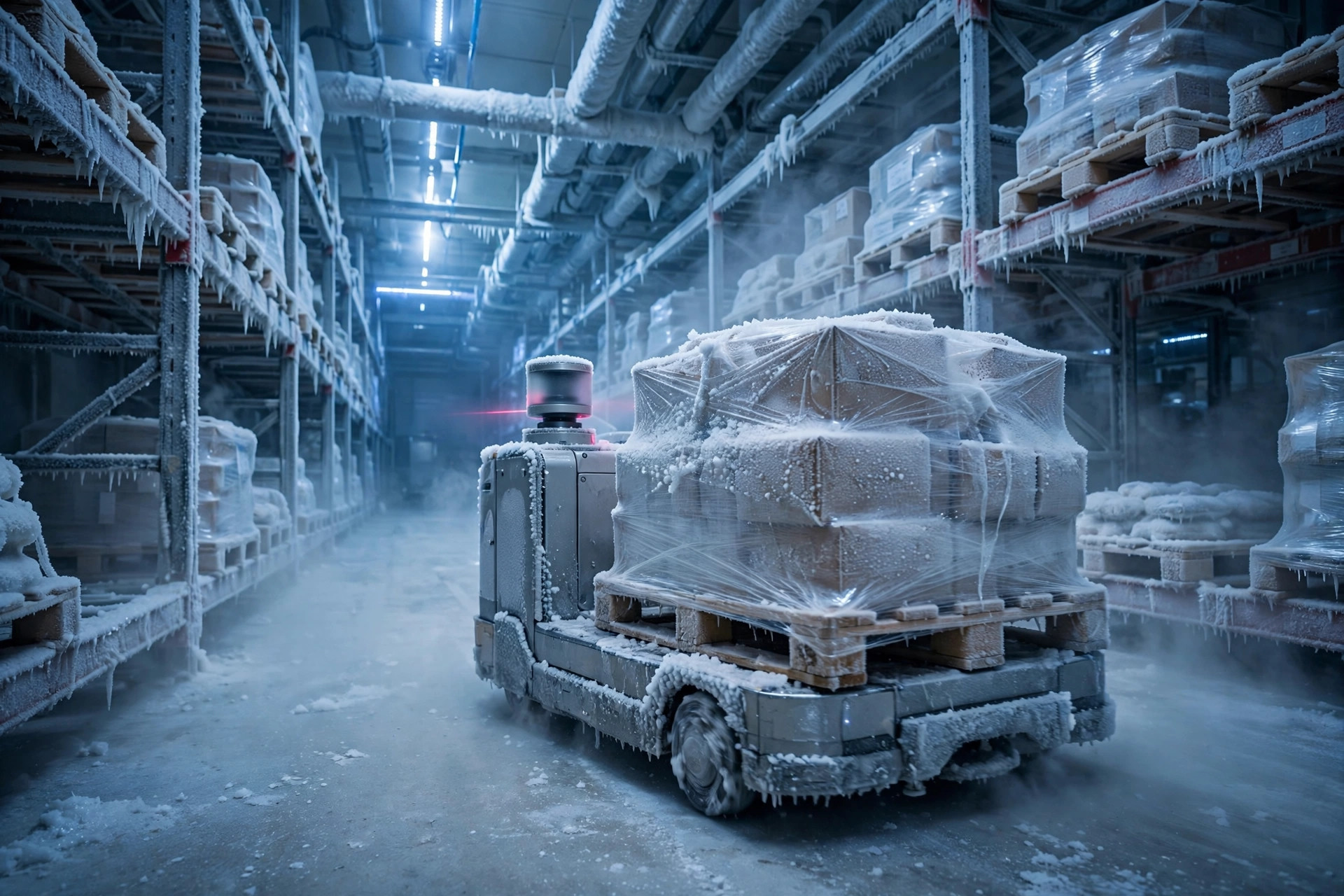
A laser navigation sensor's worst enemy isn't the cold — it's temperature swings. A bot rolling from a -18°C freezer out to an ambient dock crosses dozens of degrees in seconds, and condensation films over the sensor window instantly. Coming back in, that moisture freezes into frost. Once the lidar is fogged, localization starts drifting: slow crawling at best, emergency stops and alarms at worst. The freezer door is the AMR's haunted crossroads.
Then there's the sneakier killer: condensation. When equipment fails in a freezer, nine times out of ten it's a water problem, not a cold problem. Moisture creeps into connectors and circuit boards, and given time it means corrosion and shorts. I've seen an e-stop button rust itself solid in six months because condensation seeped in — the bot was fine; the button died first.
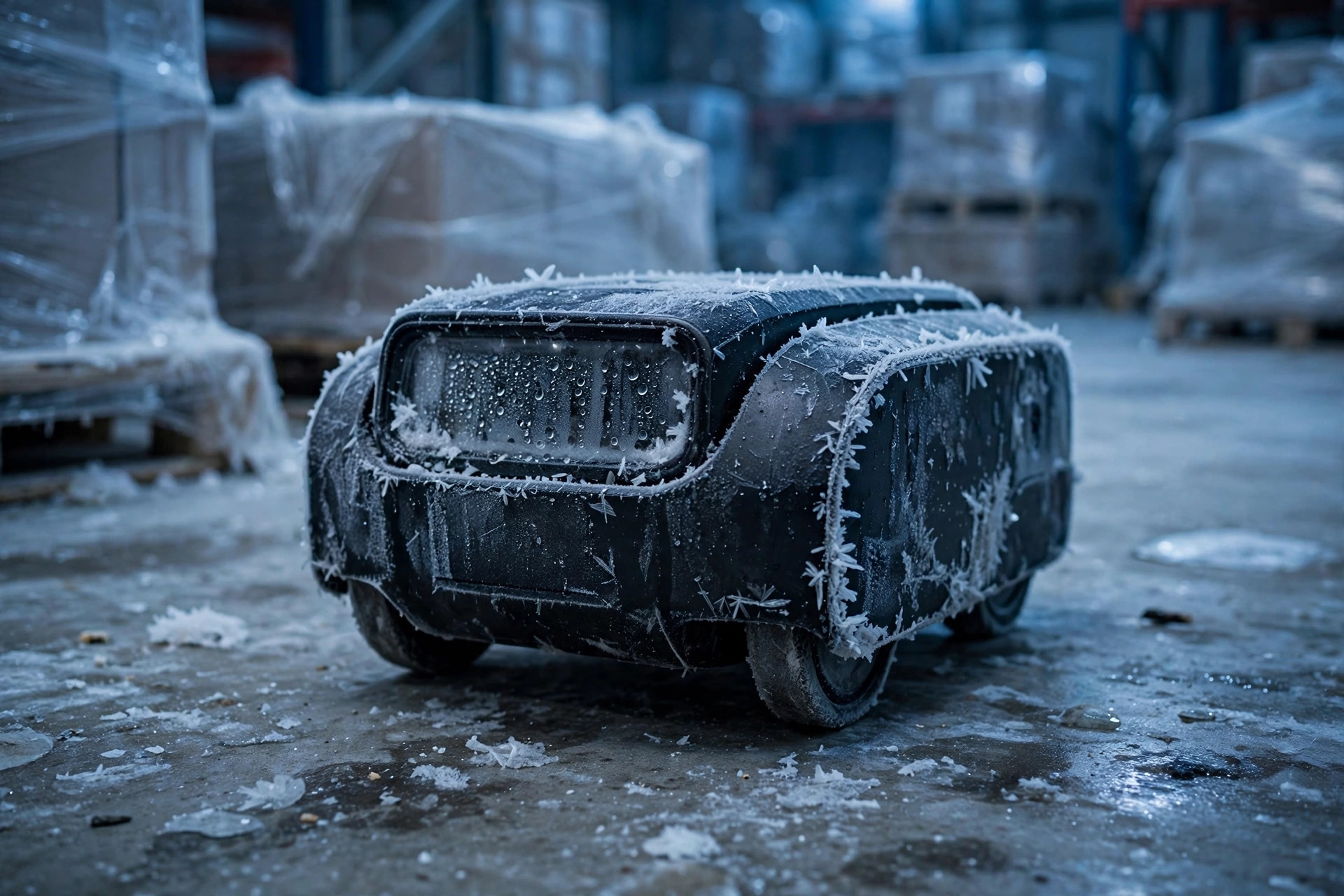
Three countermeasures, and you need all three. At selection time, ask whether the sensors have heated defogging and whether the electronics bay is treated against condensation. There are cold-chain AMRs on the market with climate-controlled electronics bays rated down to -25°C — that's what a freezer-native design looks like. Put an air curtain on the freezer door to cut the warm-cold air exchange; it's the classic cheap fix that punches above its weight. And don't worship laser navigation — magnetic tape and QR codes are just as vulnerable on an icy floor. Ice heaves tape up and buries QR codes under frost. On a frozen floor, every navigation method takes a hit.
The floor fights the wheels
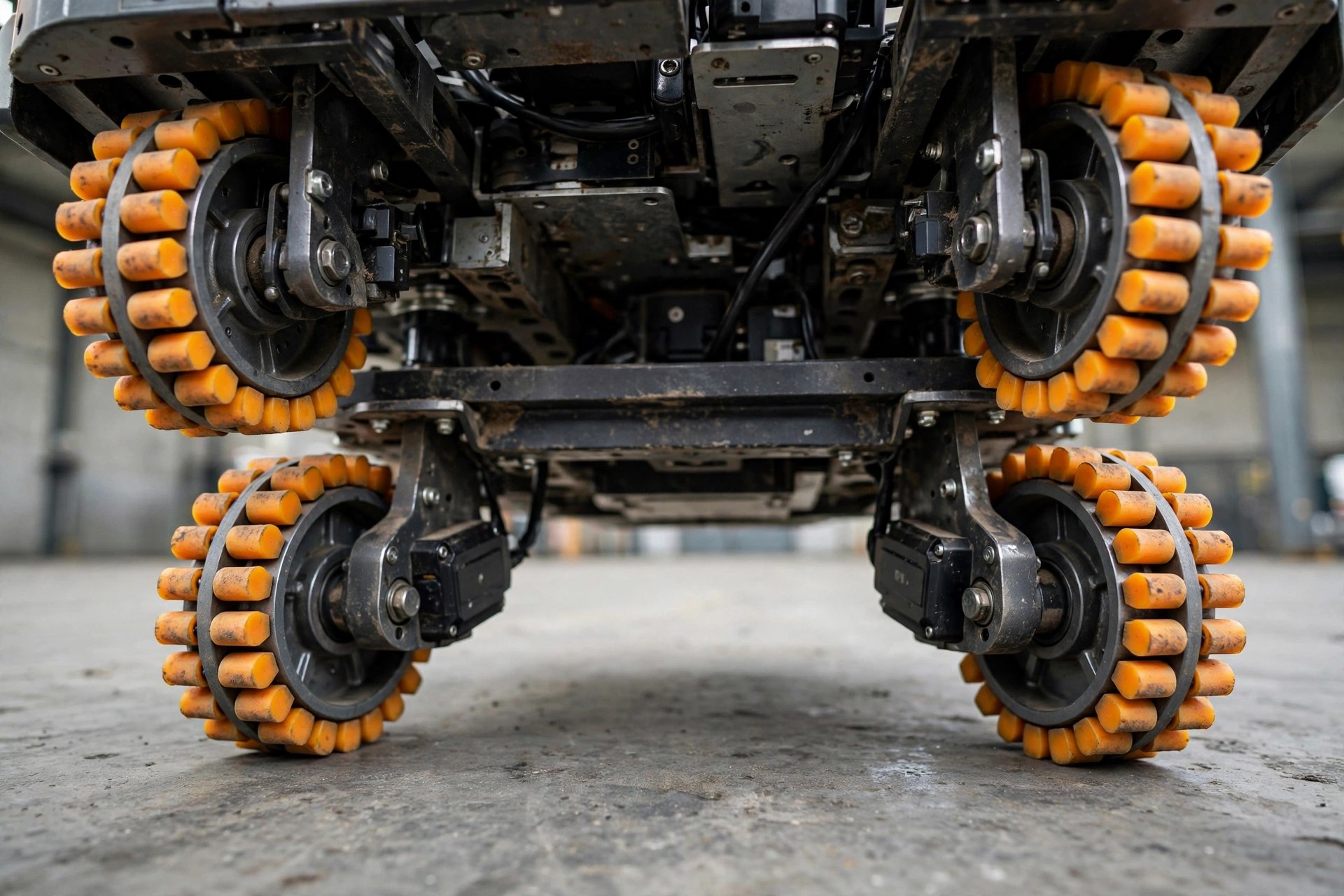
Two things kill you on a freezer floor: ice, and wheels that go hard. Standard polyurethane wheels stiffen noticeably at -15 to -20°C, grip drops, stopping distances grow. And that little sideways slip during a pallet lift racks the pallet crooked, and everything stacked above it pays the price.
Don't cheap out on floor treatment: dehumidify the doorway zone, scrape ice on a schedule, and use epoxy with anti-slip aggregate instead of plain concrete — once it ices over, plain concrete is a skating rink. For wheels, ask the vendor outright for a cold-rated compound or a deeper-tread anti-slip wheel. Running ambient wheels in a freezer is like wearing flip-flops onto an ice rink.
Mixed traffic is the freezer's special headache. Workers inside are bundled in heavy insulated suits with goggles — narrow field of vision, slow reactions — and an AMR's little blue beacon is nearly invisible in the vapor. My advice: physically segregate every mixed-traffic zone, and tune the beacon brightness and buzzer volume for freezer conditions instead of leaving factory defaults. When something goes wrong, it's usually not the bot's fault — it's that nobody saw the bot.
Before you deploy, get clear on these
- Is it 0°C chilled or -25°C frozen? How much does it swing day to night?
- How many times a day does each bot cross the freezer door? More crossings, more condensation risk.
- What's the floor made of? Any history of icing? Any slope at the doorway?
- Can charging live in the ambient room outside? If not, forget opportunity charging.
- Where do people and bots mix — and can you separate them?
Five questions to put to your vendor
- What's the battery pack's rated minimum operating temperature — and does it self-heat? (Don't ask "does it work in freezers." Too vague.)
- Below 0°C, how does the BMS protect the cells during charging? Will it lock out?
- Do the laser sensors have heated defogging? How is the electronics bay protected against condensation?
- What are the wheels made of? How much does hardness change in the cold? Show me a freezer reference at comparable temperatures.
- Give me a customer running the same temperatures with the same door-crossing frequency — I want to see it in person. (This one separates the vendors who've actually done freezers from the ones who've only done brochures.)
If you've already got bots running in a freezer, do one thing tomorrow morning: take a bot that just came out of the cold, park it on the dock, and watch it for ten minutes. Fog on the sensor window? Water beading along the chassis seams? If yes, condensation is already eating your fleet — put an air curtain on that freezer door before you spend another dollar on upgrades. In freezer automation, the cheapest fix is usually the right one.