Here's something nobody tells you before you buy an AMR: the day you sign the purchase order is the cheapest day of the whole journey. The real invoice starts arriving the first time you plug the thing in.
Last fall, a buddy of mine who runs a 3PL warehouse about my size — roughly 3,000 square meters — signed a lease on four AMRs for in-house transport. The sales rep's spreadsheet was a work of art: unit price, labor replaced, payback in months. Six months later my buddy calls me up: "Dude, I figured it out. This isn't buying a robot. This is buying batteries, and they threw in a robot for free."
The batteries were degrading way faster than the brochure promised. Hot workshop, two shifts a day, and the runtime just kept shrinking. The "five to six years of battery life" from the sales pitch evaporated in real-world conditions. Then he got the quote for a replacement battery pack and went quiet. One round of battery replacements across his little fleet would cost enough to lease several more robots. I listened to that story and thought: good thing I didn't pull the trigger. This charging math has to be worked out before you buy, not after.
The robot is cheap. Feeding it is not.
I later took an integrator friend out for drinks and pried the whole thing apart. He gave me one line I've never forgotten: "In this business, the AMR is the phone, and the battery is the phone bill. You buy the phone once. The bill comes every month."
Crude, but accurate. I re-ran the numbers for a warehouse our size, and the truth sales reps never volunteer is this: over an AMR's full life, the purchase price might be only a bit over half the total cost. The rest is electricity, battery replacements, and all the charging-related hassle. Big companies with deep pockets just swap in fresh batteries and move on. A small warehouse like ours can't afford to burn money like that. For us, charging strategy isn't a technical decision — it's a survival decision.
So here's the counterintuitive verdict up front: the most expensive part of an AMR isn't the robot, it's the next several years of electricity and batteries. When you pick a charging strategy, you're not choosing "how to charge" — you're choosing what you'll be paying for down the road: labor, battery lifespan, or peace of mind. Three roads, no perfect answer, only the answer that fits a small warehouse.
Three charging options, small-warehouse math
There are three mainstream approaches: manual battery swapping, fast (opportunity) charging, and wireless charging. Here's how they stack up from a small operator's perspective:
| Manual swapping | Fast charging | Wireless charging | |
|---|---|---|---|
| Upfront cost | Low — just buy spare batteries | Medium — chargers plus electrical work | High — floor modules are pricey |
| Battery lifespan | Friendly — slow charges, batteries rest | Harsh — constant fast charging kills them faster | Middling — heat buildup is a concern |
| Labor needed | High — someone has to swap | Low — robots dock themselves | Minimal — just park on top |
| Fit for small warehouses | High — flexible, no site constraints | Medium — needs planned charge points | Low — payback takes forever |
One at a time. Manual battery swapping sounds like the stone age, but it's the small-warehouse sweetheart: keep a few spare packs, swap in a fresh one when the robot runs low, and the fleet barely stops. The downsides are real — you need a person doing the swapping, plus safe storage and charging space, and hauling battery packs around risks bumps and drops. But slow charging means maximum battery life, and the upfront cost is the lowest of the three. My buddy's warehouse ended up here. He did the math: a part-time helper handling swaps costs less per month than one prematurely dead battery pack. Not even close.
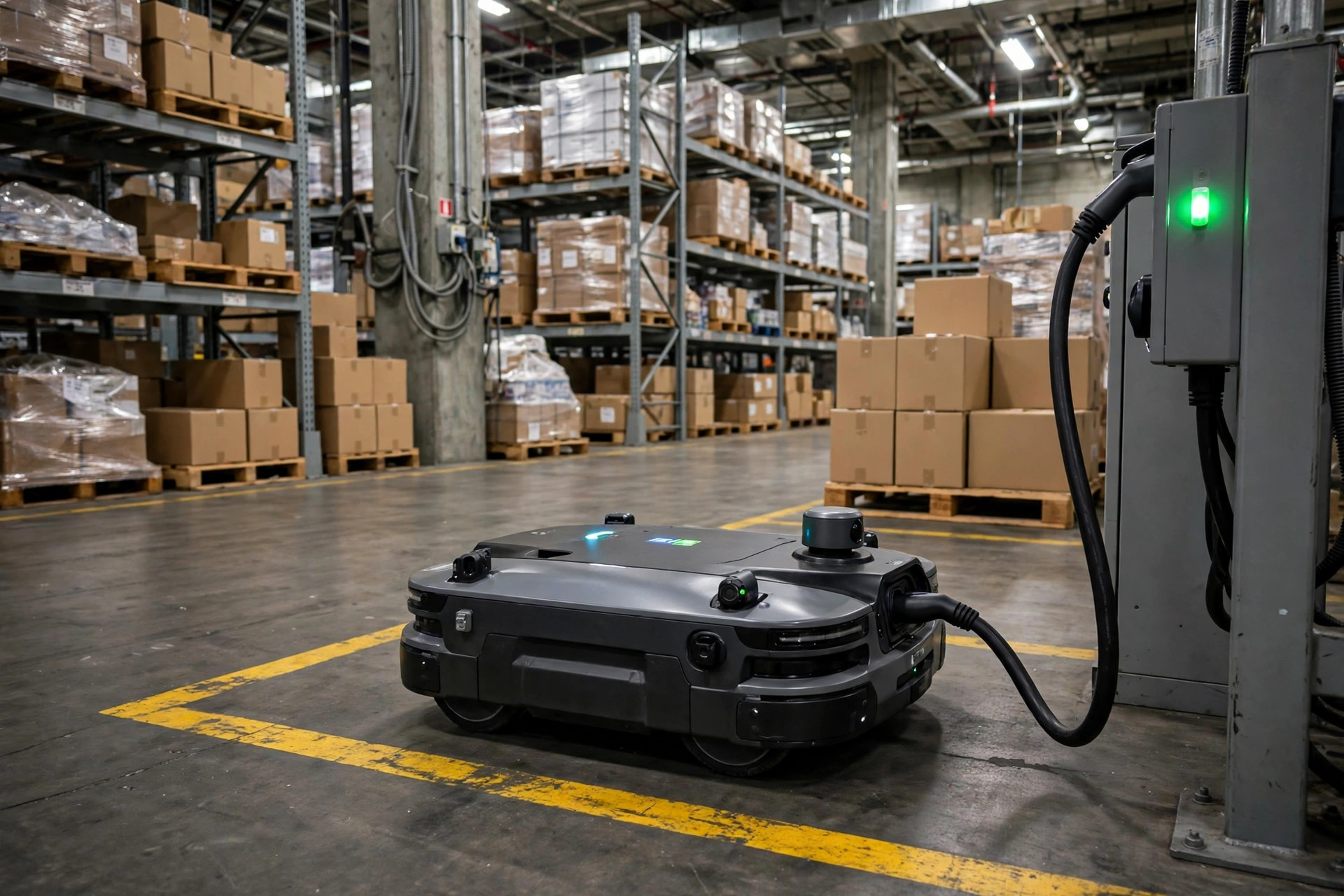
Fast charging is what the big vendors push hardest: the robot ducks back to a dock between tasks, grabs a quick top-up in fifteen or twenty minutes, and supposedly runs around the clock. Sounds dreamy, but the price is paid in battery lifespan — constant fast charging in a hot environment is the fastest way to age a lithium pack. When a rep says "supports fast charging," translate it as "you'll buy batteries more often." Big fleets with bulk battery pricing don't care. We do. With a handful of robots, one early battery funeral hurts.
Wireless charging is the sci-fi option: bury a transmitter in the floor, the robot parks over it, no docking, no people. Also sci-fi is the price. The modules are expensive, installation means cutting into the floor, and since most of us rent our buildings, the landlord's face when you mention "cutting the floor" tells you everything. Small warehouses can skip this one without a second thought.
Our conclusion is simple: manual swapping first, fast charging as a supplement, wireless as a spectator sport. The big-company fantasy of a fully unattended fleet is nice to hear about. Copying it will bankrupt you.
The scrappy tricks that actually work
Strategy picked. Now comes the small-warehouse specialty: the scrappy money-saving playbook. These are the tricks operators trade over drinks. Take them, no charge.
First, charge off-peak. Electricity isn't free. Many regions price industrial power by time of use, and overnight rates can be dramatically cheaper. Unlike the big players running 24/7, we can shift the bulk of charging to the night: swap batteries through the day, then slow-charge everything overnight. The annual savings are real money — enough to notice. Rates vary by utility, so call your local power company before you plan the schedule.
Second, don't trash retired batteries — cascade them. A pack that's too tired to haul a loaded AMR can still run LED lighting, emergency lamps, or small equipment without breaking a sweat. My buddy's warehouse now lights its corridors with emergency lighting wired to retired battery packs — his electrician knocked it out in a weekend. Nothing high-tech about it. Just don't DIY the electrical work; get a licensed electrician and follow local safety rules for battery storage.
Third, put the chargers next to the electrical room. This one I learned the embarrassing way during my own evaluation. I picked a charging zone right by the work area — shortest travel distance, very clever. The electrician took one look and shook his head: dozens of meters from the panel, conduit runs, cable trays, a capacity upgrade. The wiring bill was approaching half the cost of a robot. Final plan: chargers hugging the electrical room wall. The robots walk a few extra steps. They don't mind. Remember: chargers should be close to power, not close to work. The extra steps are free.
A few parting notes for fellow small operators: before you sign anything, have an electrician look at your panel capacity — discovering you're short on power after the robots arrive is a special kind of pain. When negotiating, get the replacement battery pack price and the warranty language on battery degradation in writing; don't just stare at the robot price. And if your fleet is small, don't chase full autonomy. Manual swapping plus overnight slow charging is the lowest total-cost way to run at our scale.
Big companies have their playbook. Small warehouses have ours. Get the charging right and the AMR is a helper; get it wrong and it's a money pit.
By Xiao Ma, Small Warehouse Owner