
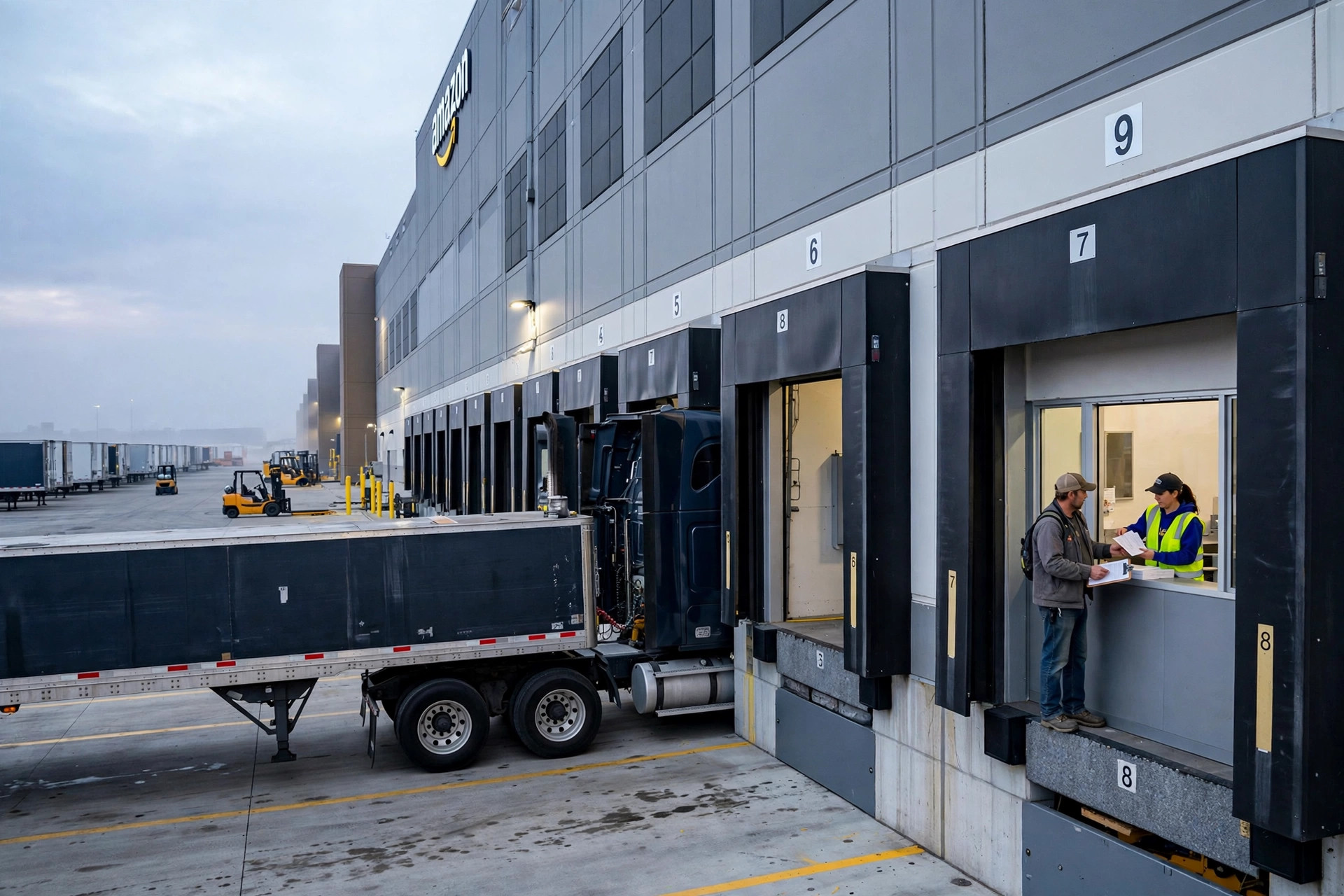
Let me tell you something. Last fall, outside Phoenix, I delivered two loads to the same Amazon warehouse in a single day — a VC load in the morning, an SC load in the afternoon. Same building, same receiving windows, and the difference in how those two loads were treated nearly gave me whiplash. Fifteen years behind the wheel, and I can tell you this: VC vs SC isn't just two account types on a screen. Out there at the dock door, they are two completely different worlds. If you're thinking about selling on Amazon, learn these 5 differences first. It'll save you real money.
The Morning Load: 40 Minutes Late, Parked Until Sunrise
The shipper was Chen, a small appliance manufacturer from Dongguan who had been an Amazon VC vendor for three years. VC — Vendor Central — means Amazon is your customer. They send you a purchase order, you build it and ship it, and once the freight crosses their dock, how it sells and at what price is no longer your business.
Chen's PO spelled out everything: carton count, models, delivery date. Then I-10 jammed up and I rolled in 40 minutes past my appointment window. The receiving clerk glanced at the paperwork and shook his head: "Window's gone. Rebook." I pleaded. He pointed at the process posted on the wall — VC freight lives and dies by the PO. Miss the window, mismatch the paperwork, and they simply don't take it. I sat in the staging lot until the next morning before I got a new window and finally got unloaded.
Chen later told me the appointment wasn't even what scared him. It was the payment terms. Amazon's vendor terms commonly run 60 to 90 days — check Amazon's official site for the current policy, because it changes. Ship the goods, see the money three months later. A small factory's cash flow can't survive that. His words: "The orders look big, but the bank account is always empty."
The Afternoon Load: 30 Mislabeled Cartons, Two Weeks of Regret
SC — Seller Central — is the opposite: you're the boss. You create the shipping plan, you label, you send the freight into the FBA warehouse yourself. The shipper, Wang, tried to save a few bucks by outsourcing his labeling. Out of 200 cartons, more than 30 had labels in the wrong spot, and a few cartons had mixed SKUs.
Receiving scanned the first pallet and the system threw errors — the shipment couldn't be checked in. The whole load got pulled to the problem area, and Amazon charged a processing fee. Wang never told me the exact number, but he winced about it for two weeks straight. His lesson, in his own words: "Turns out labeling is the one thing you never cheap out on."
See the pattern? With VC, Amazon calls the shots. With SC, you call the shots — but that doesn't mean you can cut corners at the dock door.
What This Really Means: Customer vs. Supplier Gets Different Treatment
VC and SC both sound like "doing business on Amazon," but they're fundamentally different businesses: in VC, Amazon is your customer; in SC, you are Amazon's customer. Of course the warehouse treats them differently. Here are the 5 differences that matter, learned the hard way from the driver's seat.

VC vs SC: The 5 Differences, Side by Side
| Difference | VC (Vendor) | SC (Seller) |
|---|---|---|
| Who orders | Amazon sends you a PO. You build and ship to the PO — what ships and how much is Amazon's call | You create your own shipping plan — what ships, when it ships, that's your call |
| Delivery appointments | Tied to the PO, windows enforced strictly; late arrival or paperwork mismatch can mean refusal and rebooking | Booked against your shipping plan, relatively flexible — but bad labels or bad cartonization still get you turned away |
| Receiving standards | Checked line by line against the PO; shortages, wrong packaging, bad labels can hold up the entire shipment | Checked against your shipping plan; mislabeled or mixed cartons can't be received and may trigger extra processing fees |
| Payment terms | Long terms are the norm (check Amazon's official site for current policy) — slow cash conversion, heavy cash-flow pressure | Paid on Amazon's settlement cycle after goods sell (check the official site) — faster cash, but you carry inventory and ad costs yourself |
| Returns | Amazon handles returns; the vendor absorbs chargebacks or accepts returned goods per the agreement | Returns are on you; FBA returns generate storage and processing fees |
One caution: Amazon's policies change fast. Everything above comes from my years on the road — always verify the current numbers and rules on Amazon's official site before you commit.
The Contrarian Take: VC Looks Easy, But It Can Starve a Small Factory
A lot of people think VC is the good life: no listings to manage, no ad spend, no arguing with buyers — just ship and forget. I'm telling you, that's the biggest trap of all. The essence of VC is that you hand over both your pricing power and your cash flow.
Run the numbers with me: a $100,000 shipment on 90-day terms is a three-month interest-free loan to Amazon. At an 8% annual cost of capital, those three months cost you $2,000 in financing alone. Then add Amazon's price pressure and promotional demands, and your margin is paper-thin. Small factories don't die in VC from lack of orders — they die when the payment terms snap their cash flow. The more they sell, the emptier the account gets, until they can't even buy raw materials for the next run.
SC? It looks like more work — sourcing, listings, ads, customer service, all on you. But the money stays in your hands. You know exactly what you sold and what you made. So here's my judgment call: if your cash reserves are thin, stay away from VC; if you've got operating chops, SC lets you sleep at night. Easy and profitable are not the same thing.
Straight Talk for Shippers and Warehouses
First, before going VC, do the payment-terms math. Ask yourself one question: if this shipment's money doesn't come back for three months, can I survive? If not, don't force it. Big orders are vanity; unbroken cash flow is sanity.
Second, if you're on SC, treat labeling and cartonization like your life depends on it. Wang's 30 mislabeled cartons "saved" him a labeling fee that didn't cover a fraction of the processing charge. Small things like labels and carton marks — get it wrong once and you'll remember it forever.
Third, align appointment details with your driver and carrier before the truck rolls. Send the driver the VC purchase order number or the SC shipping plan ID in advance. Don't make the driver call around from the guard shack — that's your appointment window burning, and every extra night in the staging lot shows up on somebody's invoice.
Fourth, Amazon's policies change faster than desert weather. Everything I've told you comes from 15 years of hauling freight. Check the official site for the current rules before every shipment — never run on last year's playbook.
There's an old saying where I come from: "The easy-looking road isn't always easy; the hard-looking road isn't always unprofitable." VC or SC — neither is better, only better for you. No shoe fits every foot.
By Shifu Zhao, Trucking Veteran (15 yrs)


