It was 2 a.m. when the WeChat message came in: "Xiao Ma, SOS — Amazon's hazmat review just flagged my 4,000 LED night lights as dangerous goods. ASIN locked. And all of it is sitting in YOUR warehouse."
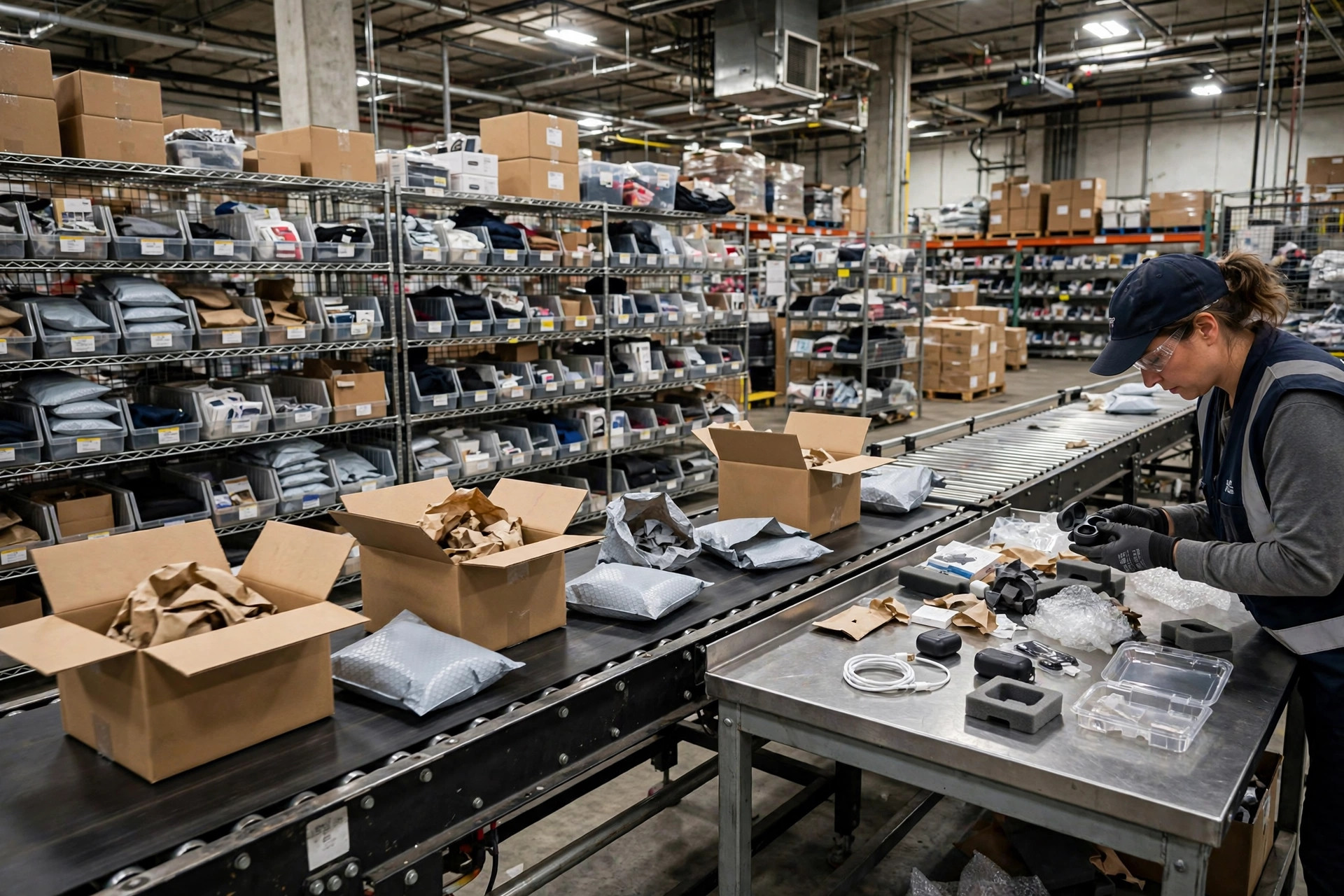
I was mid cycle count, flashlight in hand. Twelve pallets of night lights, stacked neat as soldiers — all his. Goods in my warehouse with the rent meter running; his storefront dark right before Black Friday traffic. Two grown men staring at each other over WeChat.
Where I stand: I run a small warehouse — not a seller, definitely not a compliance expert. But I've helped sellers unstick more shipments from Amazon hazmat reviews than I can count. SDS, exemption sheet, appeal letter: I can recite the trio in my sleep. Big companies have compliance teams; we small warehouses can't afford to burn money like that, so we figured out the scrappy way. Here's the whole playbook.
What the hazmat review actually checks: understand why it misfires
Amazon's hazmat review is, at its core, a machine pre-screen triggered by keywords and categories. Words like lithium, battery, magnet, spray, oil, or alcohol in your title, bullets, or ingredient list — or a category like beauty, cleaning, auto parts, or battery-powered toys — and you're tossed into the "suspected dangerous goods" pile. ASIN locked first, questions later.
Note the order: locked first, prove yourself innocent later. First-timers lose their minds: "My night light is a plastic shell with an LED — what's dangerous about that?" Doesn't matter. The machine doesn't do explanations.
Our seller's problem? His bullets said "powered by built-in lithium battery." The product ran on two AAA batteries — not lithium at all. But the machine saw "lithium" and that was that. The infuriating part: misfires are common, but the burden of proof is 100% on you.
Get this, and the trio makes sense: you're not "proving your product is safe," you're ticking boxes on a reviewer's checklist.
Getting your ASIN approved, piece one: the SDS — the free one is the good one
Piece one is the SDS (Safety Data Sheet), and my most-asked question: "Where do I get one? A provider quoted me hundreds of dollars — worth it?"
Here's my scrappy ranking:
First choice: ask the factory — free and the most legit route. Here's the email script: "Amazon US hazmat review requires an English SDS. Please provide the full 16-section GHS version for model XXX." A proper factory usually has one ready — ours sent a stamped PDF the next day. Zero dollars.
Second choice: work your way up the supply chain. Plenty of sellers buy from traders and never talk to the factory — ask your supplier, layer by layer, and someone will have it.
Third choice: only if nobody has one, pay a compliance provider — get a real quote, don't get ripped off. One hard rule: an SDS is a legal document that must truthfully reflect your product. Never buy a cheap "rename the template" job. Reviewers can tell, and getting caught is far worse than a locked ASIN.
Before uploading, read the three sections reviewers actually check — where sellers most often blow it:
Section 2, Hazard Identification: is it classified as flammable, corrosive, or oxidizing? "Not classified as hazardous" means you've won half the battle.
Section 9, Physical and Chemical Properties: check the flash point — for anything liquid or paste, this number decides flammability.
Section 14, Transport Information: UN number and transport classification. "Not regulated as dangerous goods" is basically a hall pass.
Our night light's SDS said "not classified as hazardous" in Section 2 and "not regulated" in Section 14. Three lines of text — the entire appeal rested on them.
Piece two: the exemption sheet — the part nobody explains properly
If the SDS is the ID card, the exemption sheet is the certificate of innocence — built specifically for misfires. Almost nobody explains this part properly, so let me break it open.
When do you need one? When the system misfires but the SDS alone can't clear you. Classic case: magnetic products — phone mounts, charging cables. The SDS is clean, but Amazon worries about magnetism affecting air transport and locks you anyway. The exemption sheet declares exactly what's inside: batteries or not, magnetic strength, any other hazardous content.
Who issues it? Three routes:
One, the factory or brand's compliance/quality department — the most recognized source. Four must-haves, miss one and it bounces: company letterhead; product name, model, and matching ASIN; one explicit declaration for your actual situation (e.g., "this product contains no lithium batteries"); signature, stamp, date.
Two, a third-party testing lab — for when the factory won't cooperate. Get cost and turnaround in writing.
Three, the scrappy route: draft it yourself and get the factory to sign and stamp it — we've done this for sellers. Templates aren't hard to find. The ugly truth up front: everything in it must be true and the stamp must be real. Faking a legal declaration is a hundred times worse than a locked ASIN.
Our night lights' exemption sheet came from the factory's quality department: letterhead, signature, stamp, one page. That's the format reviewers want.
Piece three: the appeal letter — don't write an essay
Last step: the appeal letter. Sellers blow it here not because the materials are wrong, but because the letter reads like a college essay — three pages of feelings that a reviewer closes after three lines.
One principle: let the reviewer find what they need to check off within 30 seconds. Here's the frame:
Paragraph one: ASIN XXXX was locked in a dangerous-goods review; requesting reclassification; materials attached.
Paragraph two: quote the Section 2, 9, and 14 verdicts verbatim. Don't explain — paste. Reviewers want the original text.
Paragraph three: one sentence on what the exemption sheet proves.
Paragraph four: please reclassify this ASIN as non-dangerous goods and release it — case ID attached.
Keep it under one page — polite but not groveling. Name attachments properly: ASIN_SDS.pdf, ASIN_ExemptionSheet.pdf. A reviewer reads hundreds of these daily; a messy filename sends yours to the back of the queue.
The math: DIY the scrappy way vs. paying someone
| DIY (the scrappy way) | Hiring a provider | |
|---|---|---|
| SDS | Free from the factory | Per actual quote |
| Exemption sheet | Free from the factory | Per actual quote |
| Appeal letter | Half a day of your time | Included in the service |
| Total time | Roughly 1–2 weeks once materials are ready (including the review queue) | About the same — nobody skips the queue |
| Best for | Sellers not racing a big sale, with a cooperative factory | Sellers racing a promotion, or with an unreachable factory |
See it? You're really just buying your own time back — the queue days are Amazon's internal line, and nobody jumps it. Verdict: no big sale coming, DIY it; locked two weeks before Black Friday, pay for speed.
Our night-light seller got locked in early November, DIY'd the whole kit, and the ASIN cleared after 9 business days in the queue — our actual experience that time; yours will vary with Seller Central's current policy. He later told me a provider would have cost him two months of warehouse rent. Our rent isn't cheap — kidding, our rates are very reasonable, inquiries welcome.
A counterintuitive take: sometimes your own listing got you flagged
Second case. This March, an aromatherapy oils seller came to me, shipment flagged as flammable. His listing title: "100% pure essential oil." Bullets: "highly concentrated." Buddy, who else would they flag? His SDS Section 9 flash point data actually passed — his own copywriting triggered the machine.
Here's the counterintuitive bit: when a review nails you, often the product is fine — your copy was just too aggressive. The trade-off: punchier words convert better, but they also trip the screener. My advice: get approved first, optimize copy later. A live ASIN beats everything.
A checklist for fellow sellers and small warehouses
- Before listing, self-screen for trigger words — lithium, battery, magnet, spray, oil, alcohol. If any appear, get the SDS ready first.
- Request the English SDS from the factory early — don't wait until you're locked.
- After a lock, supply exactly what Seller Central asks for — nothing more. Wrong documents waste more time than none.
- Exemption sheet, four must-haves: letterhead, product plus ASIN, explicit declaration, signature with stamp and date.
- Appeal letter: one page, 30-second rule, clean attachment names.
- During the queue, live your life — nagging doesn't help. Past the stated timeframe, one polite follow-up is fair.
One honest closing note: over the years, our little warehouse has fished enough seller inventory out of dangerous-goods reviews to fill two shipping containers. Big companies have compliance departments and trial-and-error budgets; we have neither. So we ground every step into a scrappy method. Not glamorous. It works.
Small warehouses have their own way of surviving.
By Xiao Ma, Small Warehouse Owner