
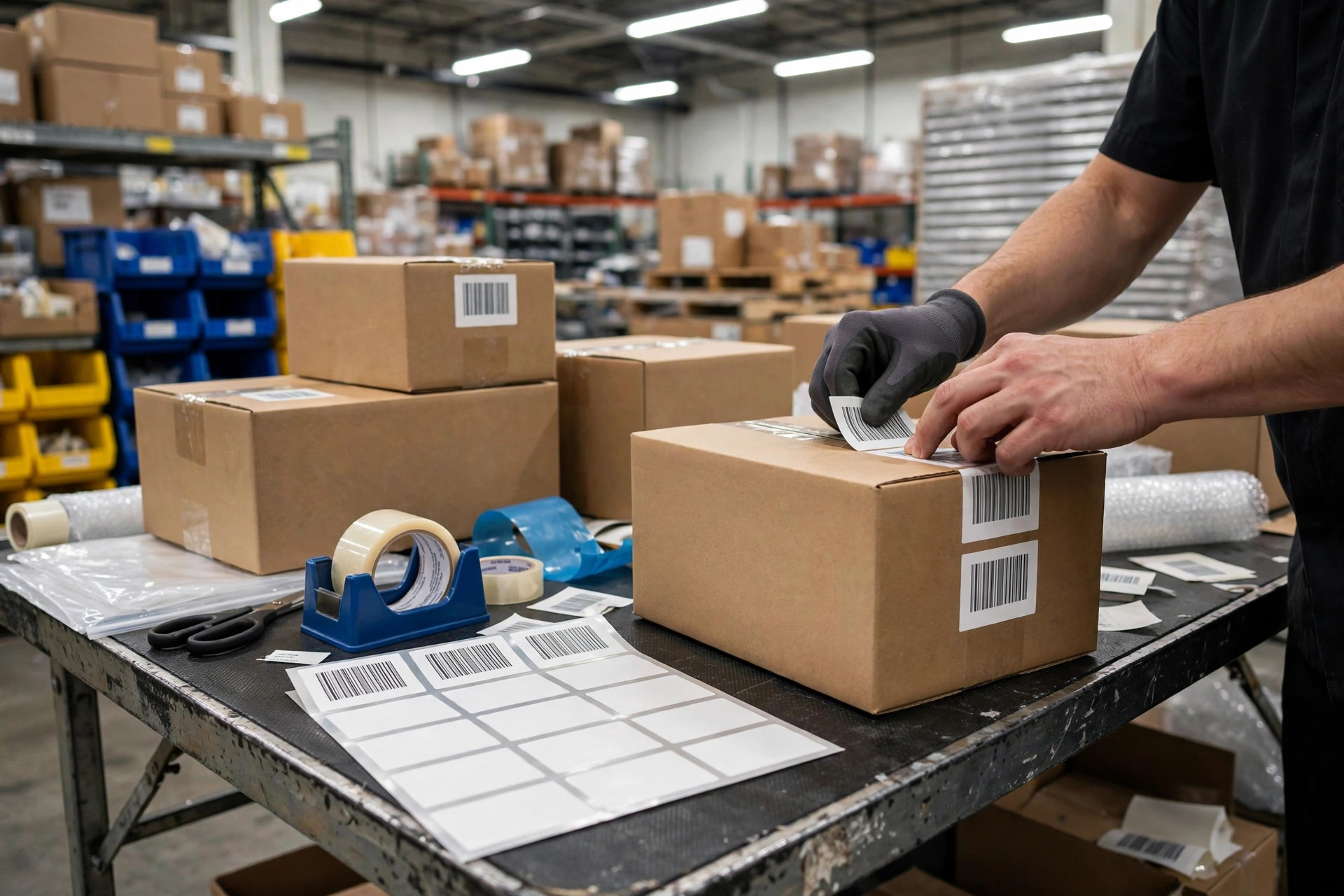
I don't run a big 3PL. I run a 3,000-square-meter small warehouse with a dozen people, and early this year two Amazon announcements nearly gave me a heart attack. The Amazon FNSKU label requirements 2026 landed, our seller group chats exploded, and every reseller who used to ride on commingled inventory and Amazon's own labeling service learned the same thing at once: labels are your problem now, and the shared pool is closed.
We went from one labeling station to four, and our thermal printers haven't stopped since January. Amazon quit doing the work, and small warehouses like mine picked it up. We can't afford the big-corporation playbook — no compliance department, no overseas prep network. What we have is a few printers, a few fast hands, and a head full of scrappy tricks. After half a year labeling hundreds of thousands of units, here's everything I wish someone had told us in January.
Two dates that changed everything: January 1 and March 31
Amazon swung twice in 2026, and the order was brutal.
January 1, 2026 — Amazon killed its own prep and labeling services. Announced in July 2025, the US FBA prep program shut down completely: FNSKU labeling, poly bagging, bubble wrap, suffocation warning labels, bundling, set assembly, item inspection, sticker removal — all gone. Every unit must arrive 100% prepped. Amazon doesn't fix mistakes anymore, and unprepped inventory lost or damaged in their network won't be reimbursed.
March 31, 2026 — commingling is dead. Per Amazon's official announcement, Amazon no longer fulfills orders by pooling identical products from different sellers. Brand owners with the Brand Representative role in Brand Registry can keep using manufacturer barcodes (UPC, ISBN). Resellers must put an Amazon barcode (FNSKU) on every unit — even if it already carries a manufacturer barcode. Already labeling? Nothing changes. Free-riding on commingled inventory? The ride is over.
One message from both: from the moment you label a unit, that inventory is entirely your responsibility.
Under the 2026 FNSKU label requirements, brand owners and resellers live in different worlds
| Brand owners (Brand Representative) | Resellers | |
|---|---|---|
| Barcode choice | Manufacturer barcode OK, no FNSKU needed | FNSKU sticker required on every unit |
| Commingling | Gone; inventory tracked per seller | Gone; inventory tracked per seller |
| Prep & labeling | DIY (Amazon's service discontinued) | DIY (Amazon's service discontinued) |
| Biggest risk | Losing Brand Representative status | One bad label can mean an inbound defect |
Brand owners got flexibility; resellers got a compliance treadmill. About 70% of my warehouse clients are resellers — they're hit hardest.
The DIY FNSKU labeling workflow, the small-warehouse way
Five steps. We've done hundreds of thousands of units this way — it's muscle memory now.
1. Generate labels in Seller Central. In your shipment plan, select Amazon barcodes and generate the FNSKU label PDF per SKU. Print the whole batch at once — reprints cost more in labor than label paper saves.
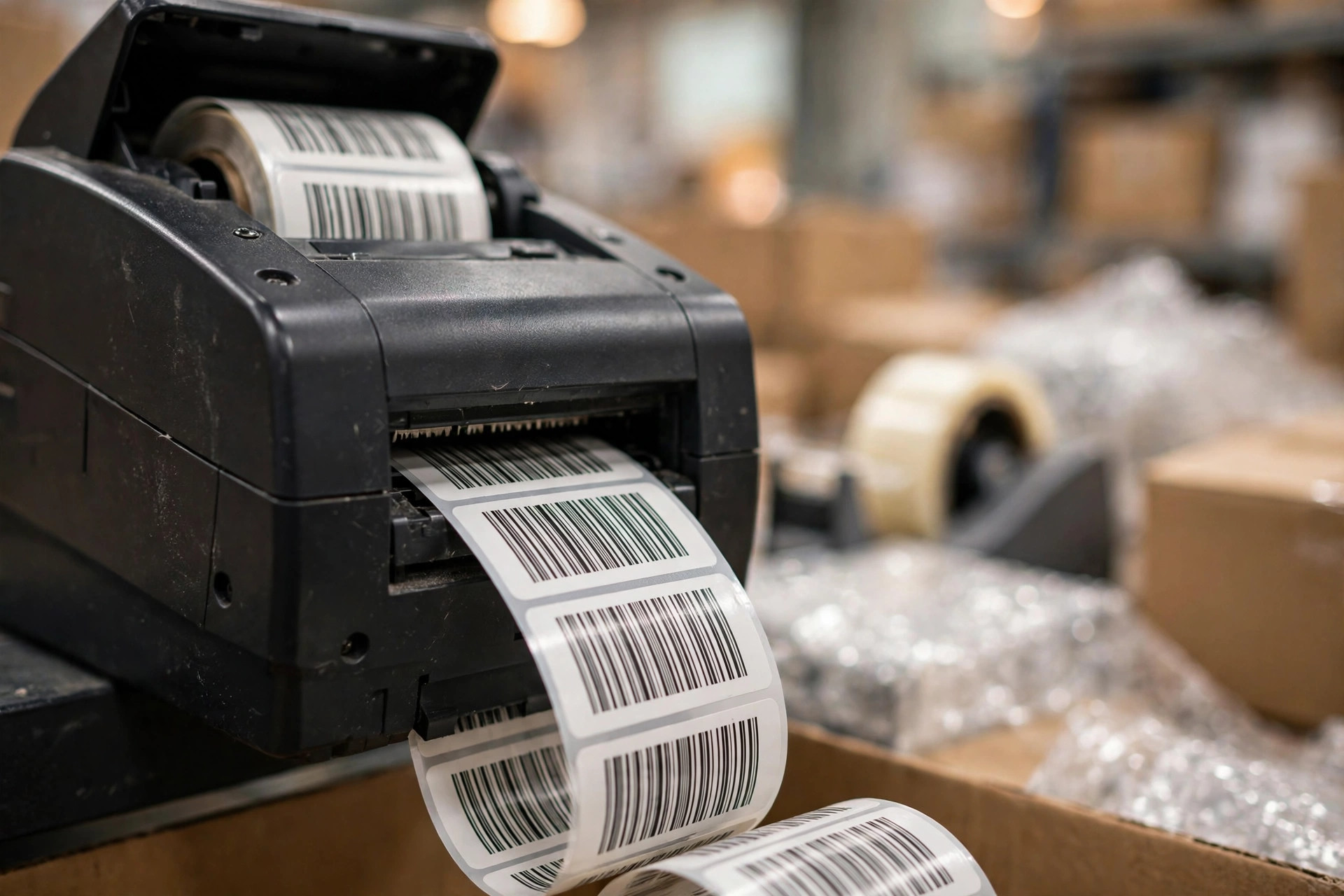
2. Get the right gear. Thermal printer, never inkjet (ink smears; Amazon rejects it outright). We run 300 DPI thermal printers with white, non-reflective adhesive labels, sized 1–2 inches tall by 2–3 wide per Amazon's spec. Too small to scan = labeled for nothing.
3. Cover the original barcodes. Where most people fail. Every existing barcode — UPC, EAN, ISBN — must be fully covered by the FNSKU sticker. A peeking corner means the scanner reads the old code and your unit gets flagged.
4. Stick it right. Flattest face of the package, away from edges, corners, and seams, with at least 6 mm between the label edge and the packaging edge. The label must show the scannable barcode plus FNSKU number, product title, and condition.
5. Spot-check every batch. Pull 20–30 units per batch and scan each one. One unscannable label or wrong SKU mapping = the whole batch goes back.
The six inbound defects we see most
Under the Amazon FNSKU label requirements 2026, Amazon no longer repairs non-compliant shipments — it defects them and charges unplanned prep fees. Third-party prep providers put 2026 unplanned prep fees at roughly $0.40–$1.80 per unit, and inbound defect fees rose sharply this year (check Seller Central's fee schedule for exact figures).
1. Original barcode not fully covered. The number-one offender. Scrappy fix: run your fingernail around each label's edge — lifted edges and peeking corners reveal themselves instantly.
2. Label on a curve or seam. It bubbles and the scanner gives up. Fix: slip the item into a flat poly bag first, then label the bag — pennies versus a defect fee.
3. Inkjet or photocopied labels. We once reworked 3,000 photocopied labels for a seller. The labor bill would've bought three thermal printers.
4. Incomplete label info. Barcode with no FNSKU number or product title, or a title mismatching the backend. After March 31, 2026, it's unit-by-unit verification.
5. Label too close to the edge. Transit friction curls it up; the scanner refuses. Remember the 6 mm rule.
6. Unassembled sets. Amazon's set-assembly service is gone too. One seller shipped a "buy 2 get 1" set held together with a rubber band — it exploded in transit and the whole shipment was rejected.
The math: DIY vs. outsourcing
Numbers below are from my own shop's measurements — plug in your local wages and quotes:
| DIY | Outsourced to a small warehouse / prep center | |
|---|---|---|
| Equipment | Thermal printer $150–$300, lasts years | $0 |
| Consumables | ~$0.02–$0.03 per label | Included |
| Labor | Our measured rate: 15–20 seconds per unit; 1,000 units ≈ 4.5–6 hours × your hourly wage | Included |
| Per-unit all-in | Cheaper at volume, eats your team's time | Our shop: from $0.30/unit for labeling + barcode coverage (volume negotiable; QC/bagging/kitting extra — not a market rate) |
| Hidden costs | Rework + defect penalties (unplanned prep ~$0.40–$1.80/unit, defect fees on top) | Providers usually include first-pass QC |
Steal this framework:
- Under 2,000 units/month, <20 SKUs: DIY. One printer, one skilled person, half a day.
- 2,000–10,000 units/month: Depends on staffing. No dedicated person? Outsource — one defect round pays for months of outsourcing.
- Over 10,000 units/month or 100+ SKUs: Outsource. Your team's hours belong in product selection, not sticker duty.
The contrarian take: labeling looks like a cost, but in 2026 it's the cheapest insurance a reseller can buy. One penalty runs $0.40–$1.80 per unit plus defect fees; your DIY cost is barely ten cents a unit. Get penalized once and you've funded labeling for several hundred units.
Two true stories
Chen's 2,000 "naked" units (April 2026, California). Chen's an old reseller friend. During the commingling era he shipped straight from his supplier on manufacturer barcodes — zero labels, called it "asset-light." When commingling ended March 31, he shrugged and shipped 2,000 units the old way in early April. The whole batch got defected at receiving: no FNSKU labels. Inventory impounded, nothing to sell for two spring weeks, and penalties ran into the low thousands — before counting lost rankings. His new catchphrase: "Asset-light? I ended up with nothing but my underwear."
Our 48-hour rush job (September 2026). Mid-September, 11 PM: a home-goods reseller calls in panic — 8,000 units at an LA forwarder's warehouse, must reach Amazon by early October for Q4, zero labels applied. Four printers, six people, two shifts, 48 hours, 100% scan pass rate. Freight made it on time; he moved his full year's labeling to us after. The work Amazon quit still needs doing — and dirty work like this is exactly what small warehouses do best.
Quick advice before Q4
- Verify Brand Representative status in Brand Registry — lose it and you're labeling like every reseller.
- Don't cheap out on the printer. 300 DPI thermal minimum; matte white adhesive labels only.
- Tape a labeling checklist to the wall — cover old codes, placement, label info, spot-check. Ours is plain A4 paper. Ugly, works.
- Get the workflow smooth now. It's October; don't wait until November when every prep center is slammed.
- Archive label files with shipment plans. Under the Amazon FNSKU label requirements 2026, documentation is your evidence when Amazon comes asking; without it, it's a fine.
Last honest word: the 2026 double-swing killed the "money while you sleep" reseller model. But flip it — with commingling dead, your inventory is truly yours. No one else's counterfeits can ride your listings; every unit shipping under your name is one you actually sent. For sellers who do the work, that's a long-term win.
We're 3,000 square meters with no big-corporation destiny: the work Amazon won't do, we do; the small orders big companies ignore, we treasure. Resellers — labels on, freight prepped, see you in Q4.
Small warehouses have their own way of surviving.
By Xiao Ma, Small Warehouse Owner





