Amazon changed the rules again. This time it's the one that hurts: starting January 2026, FBA Prep service is gone on the US site. Your goods have to arrive fully prepped — weighed, labeled, boxed to spec. Translation: nobody's fixing your overweight boxes for you anymore. Get it wrong and your shipment gets refused at the dock.
If you Google "amazon fba box weight limit requirements," the first hit is Seller Central's packaging requirements page. Don't just bookmark it. Print it and tape it to your prep warehouse wall. Here's the whole thing, decoded.
The Amazon FBA Box Weight Limit Requirements, Line by Line
Standard box: 50 lbs max. Not "about 50." My floor scale reads 51.2 and my guy says "close enough" — I say "take two units out."
Non-conveyable items (oversized, odd-shaped): 25 lbs max. This one catches people off guard. A buddy of mine sells big pet products; in March 2025 he shipped a batch of 32-lb odd-shaped cartons to FTW1. Refused on arrival. Whole truckload came back. Burned over $900 in freight for nothing.
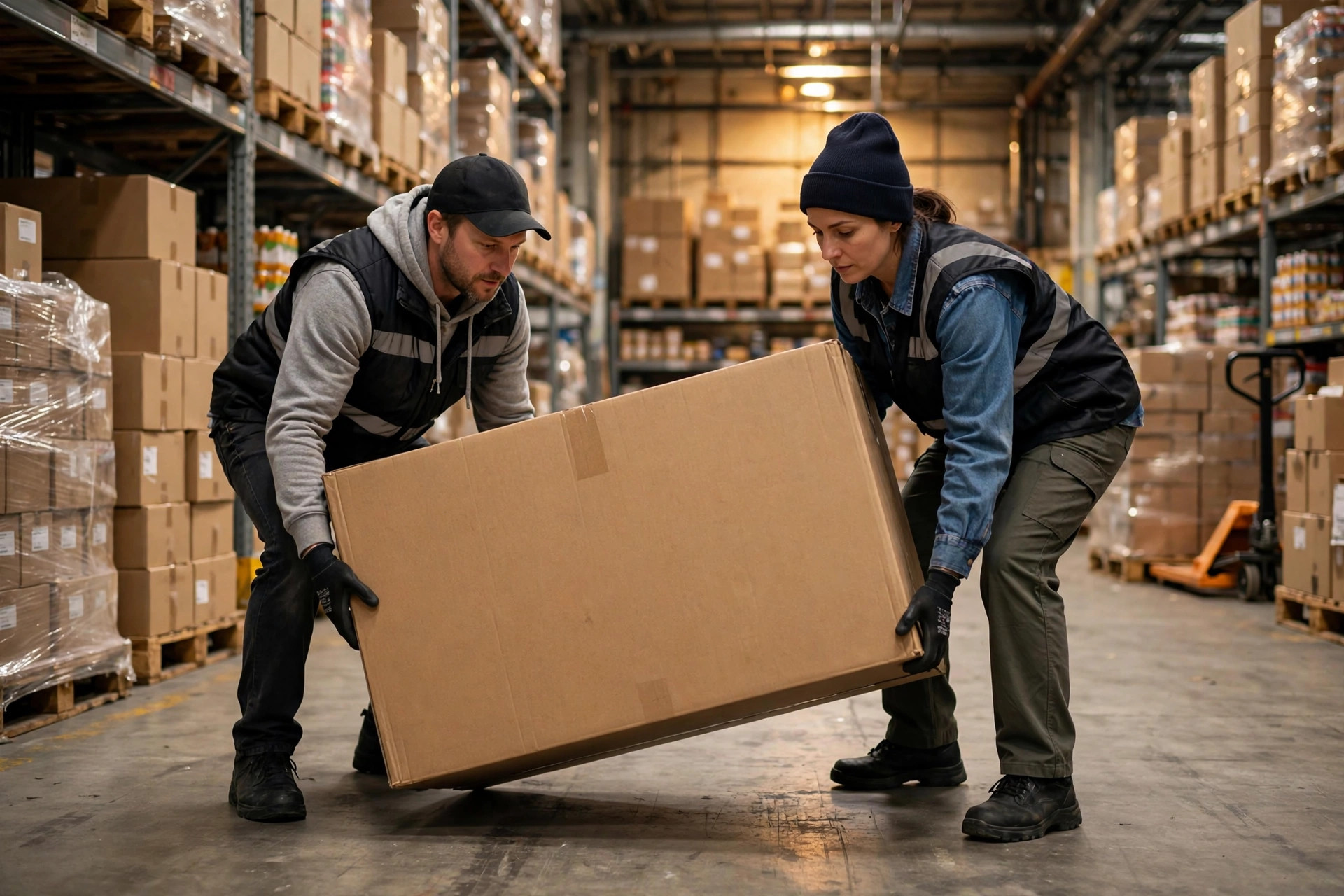
Over 50 lbs: you must slap on Team Lift labels, and I mean on multiple sides — front, back, left, right at minimum. I do all six sides, top and bottom too. The labels cost pennies; a rejection costs hundreds.
Over 100 lbs: Mechanical Lift labels. Jewelry and watches: 40 lbs, hard cap. Don't ask why. Amazon said so.
Dimensions: I've seen multiple versions of the max-side rules over the years. Policies shift every year, so go by whatever Seller Central says today — don't trust any third-party screenshot, including this article, for the exact numbers.
What happens when you break the rules: refusal, or they accept it and hit you with an inbound defect. How much? There's a fee schedule in the backend. I don't memorize fee schedules. I just remember this: one violation costs more than a year's worth of labels.
I've Been Rejected Twice. Tuition Was Paid Both Times
First time: October 2024, prepping for Black Friday. Cookware sets, 2.4 lbs each. My packer got lazy and stuffed 26 units in a box — 62 lbs. Team Lift labels? "Ran out, I'll add them tomorrow." The shipment hit ONT8 and all 40 cartons got refused. They didn't come back to Guangzhou — they went to my US 3PL, got relabeled, got a new appointment. Eleven days of chaos.
The math: $3.50 per carton for rework × 40 = $140. Second inbound freight: $380. And the real killer — I missed the first week of Black Friday traffic. That listing normally does 900 orders that week at $18 margin. That's $16,200 in profit I never saw. Tuition: five figures.
Second time: August 2025. Smarter now — 58-lb boxes, Team Lift labels on. But only on two sides. The FC told me labels have to be visible from multiple sides, charged me a $45 manual handling fee, and delayed the shipment three days. New rule in my warehouse ever since: Team Lift on all six sides. Costs an extra 40 cents a box. Cheap insurance.
The Math: 48 Lbs vs. 62 Lbs — Which Packing Plan Actually Wins?
Real numbers from a September 2025 shipment: 3,000 units, 2.1 lbs each.
Plan A (play it safe): 22 units per box, 48.4 lbs, 137 boxes total. Plan B (push the line + Team Lift): 28 units per box, 60.9 lbs, 108 boxes total.
| Plan A: 48 lbs | Plan B: 61 lbs + Team Lift | |
|---|---|---|
| Total cartons | 137 | 108 |
| Label cost | $0 | ~$43 (108 × $0.40) |
| Rejection risk | Very low | Medium (one bad weigh-in and you're done) |
| LTL pallets | 7 | 6 (saves ~$180 freight) |
| Check-in speed | Normal | 2–3 days slower (manual lane queue) |
See it? Plan B saves $180 on freight, spends $43 on labels — net $137 saved. But it buys you higher risk and 2–3 slower days.
The Counterintuitive Part: Heavy Boxes Are Slower in Q4
Took me two rejections to learn this one. Boxes with Team Lift labels go through the manual handling lane at the fulfillment center. Fine in February. In Q4 that lane is a traffic jam — my 61-lb boxes sat there four days before check-in while the 48-lb boxes flew down the conveyor and were live in two.
So here's my take, and it's the opposite of what most sellers do: in peak season, pack more light boxes instead of riding the 50-lb line. You think you're saving freight; you're actually buying slowness. Three slow days in Q4 means handing your Black Friday traffic to your competitors. Off-season? Push the line all you want. Q4? Everything under 48 lbs. That's in my warehouse SOP now.
One more thing: inbound defect fees change year to year. Check Seller Central for the current schedule — don't trust any article's old numbers, including mine.
What Changed for Me After January 2026
Killing FBA Prep set off a chain reaction. Before, if an overweight box got flagged, the prep warehouse would break it down and repack it for a few bucks a carton. Now there's nobody to clean up your mess — weighing and labeling have to be right in your own warehouse, first time, every time.
My adjustment: in December 2025 I bought a $120 label printer and now print Team Lift labels myself, unlimited supply. Each of my two packers got a laminated red-line card (the 50/25/40 limits plus a six-side labeling diagram). Mislabel once, lose $7 off the bonus. A friend in Shenzhen who sells home goods went the other way — he outsources all prep to his US 3PL at a per-carton fee. He says it costs about 15% more than doing it himself, but he sleeps better. Small volume? Outsource. Big volume? Build the process in-house. Run your own numbers.
The Pitfall Checklist (Tape This to the Wall)
- A floor scale is non-negotiable. $250, best money you'll spend. Weigh every carton. Cap yourself at 48, not 50.
- Buy Team Lift labels by the roll — 500 at a time. Six sides. Don't be cheap.
- Non-conveyable goods: remember the 25-lb line. Weigh oversized items separately.
- Jewelry and watches: 40-lb cap. If you sell these, build a separate packing workflow.
- From January 2026, no more FBA Prep on the US site. Labels, weighing, and all prep happen in YOUR warehouse before the truck leaves.
That's it. Follow these five and rejections stop being your problem. Floor scale plus six-sided labels — battle-tested, two years, zero rejections since.
By Ah K, E-commerce Seller (5 yrs)