If you sell on Amazon, you know the drill: an Amazon A-to-Z claim lands, and it's basically guilty until proven innocent. Buyer clicks "didn't receive it," the money goes back, and the appeal is 100% on you to prove you shipped it.
Last month I got hit again: an FBM order out of my LA-area warehouse, a $39.99 Bluetooth speaker, USPS tracking clearly showing delivered. Buyer says "never got it." Support refunds in seconds. I appeal with tracking screenshots. Denied. The reply, translated into human: insufficient evidence.
Fine. Be mad, then get smart. That order taught me the real game: A-to-Z appeals aren't won with arguments. They're won with a complete warehouse evidence chain. Since then I built a full evidence routine at the pack station. This year through Q3: 11 A-to-Z appeals filed, 9 won back — an 82% win rate. Here's exactly how I do it. All field-tested. Steal the whole thing.
Amazon A-to-Z Claim Appeals Aren't About Being Right
Counterintuitive truth first: the rep reviewing your A-to-Z appeal handles hundreds of cases a day, a few minutes each. Nobody reads your story.
They run a checklist: order number match, tracking delivered, proof of shipment, weight match. One missing item, denied. Your thousand-word essay means nothing. My first appeal died exactly like this — tracking screenshots only, zero proof that "this parcel contained this order's items." Buyer claimed "empty box arrived." Perfect tracking, worthless.
So the evidence chain answers three questions: right items (SKU + quantity), right parcel (weight + condition), right delivery (tracking + signature). All three check out, and the rep has a reason to rule your way. Miss one, and you're donating to the buyer. Reps check whether your file is complete, not whether you were wronged — tattoo that on your brain and you'll lose a lot less money.
The Amazon A-to-Z Warehouse Evidence Checklist: One Table
No fluff. Here's the exact checklist my warehouse runs at the pack station — printed and taped to the wall:
| Evidence | How to capture it | When it saves you | What to write in the appeal |
|---|---|---|---|
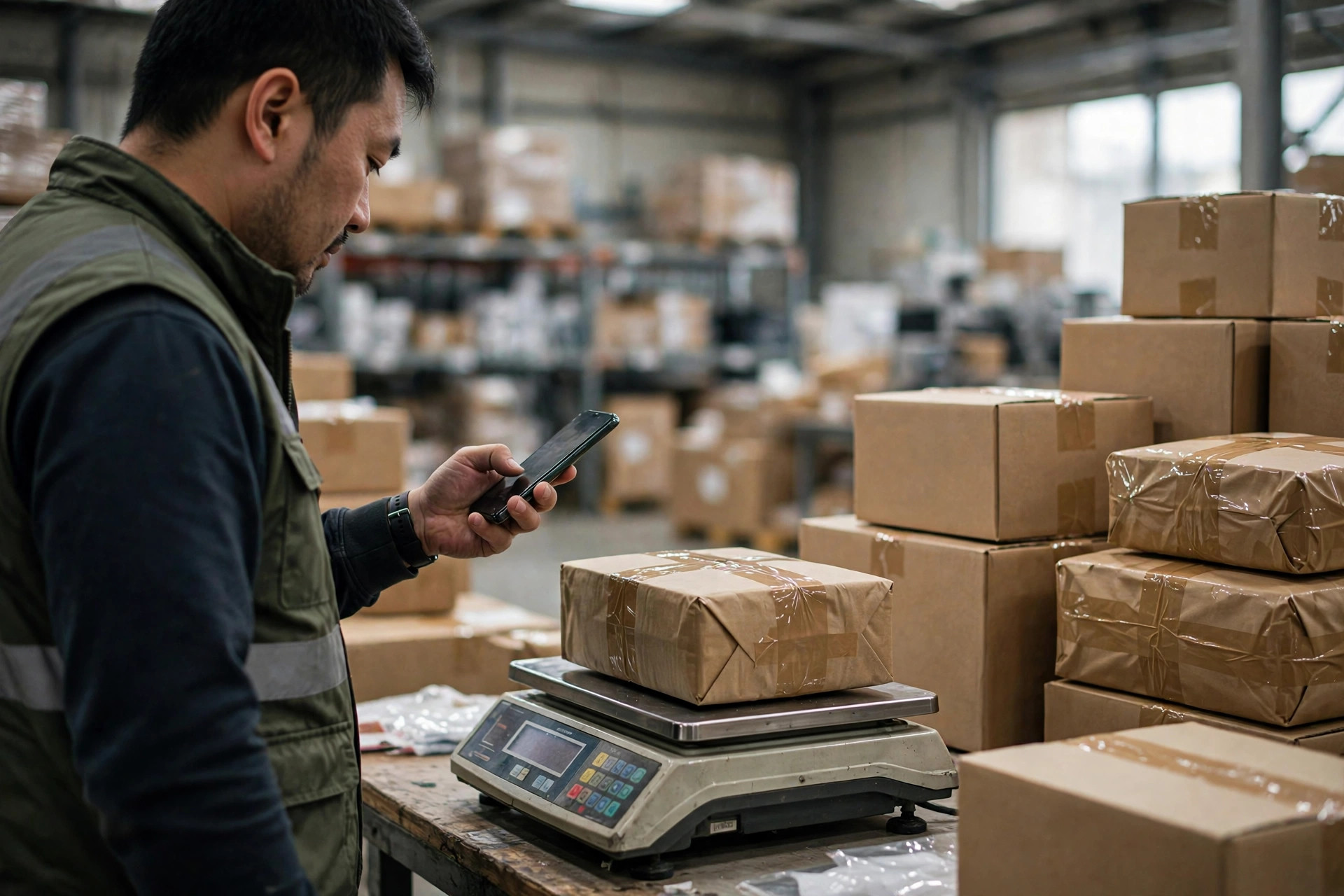
| Weigh photo | Scale reading + shipping label in the same shot | Buyer claims "empty box" | Parcel weighed X lbs, matching carrier handoff weight |
| Pre-seal top-down photo | Shoot straight down with goods loaded, before sealing | Buyer claims "short / wrong item" | Photo shows SKU and quantity matching the order |
| Packing video | Empty box → load → weigh → seal → label, one take | Support asks for "proof of shipment" | Weighing and labeling visible at X:XX in the video |
| Carrier handoff scan | Keep the drop-off / pickup scan record | Tracking goes dark mid-route | Parcel handed to carrier on [date] at [time] |
| Tracking + signed POD | Full-route screenshots, save the signature page separately | Buyer claims "not received" | Tracking shows delivered; signer name matches recipient |
One rule: every piece of evidence must answer at least one of the three questions — items, parcel, delivery. A chain that can't cover all three is a half-built chain.
Two Real Cases: $240 Lost, $900 Won Back
November 2025, the week before Thanksgiving — my busiest week of the year. A New York buyer ordered 6 desk organizers at $39.99 each, $239.94 total. Shipped same day from the California warehouse, UPS Ground, tracking clean all the way: "Delivered. Left at front door."
Three days later: A-to-Z claim, item not received. I appealed with full UPS tracking screenshots. Reply: buyer states parcel not received, please provide proof of shipment. I added the warehouse outbound slip. Denied again. $239.94 gone, plus $18 in shipping down the drain.
Post-mortem, one cause of death: I had zero proof that "the parcel I shipped weighed 4.2 lbs and contained 6 organizers." Tracking proves a parcel arrived. It doesn't prove what was inside. Buyer says never got it, platform believes the buyer. That $240 bought me a lesson: tracking without a weighing record is half an evidence file.
March 2026, same script, different ending. Texas buyer, 3 air fryers, $897 order, FedEx Home Delivery, tracking showed signed delivery. A-to-Z: not received.
This time I had the full set: weigh photo from the pack station — scale reading 31.6 lbs, packing slip in frame, SKU and quantity matching; pre-seal top-down shot, 3 fryers neatly packed; FedEx handoff scan; signed POD.
My appeal letter had zero fluff — evidence pasted in three sections (items / parcel / delivery), one closing line: parcel weighed 31.6 lbs at handoff, matching carrier records; signer name matches the order recipient; please re-review. 48 hours later, the $897 came back. Every cent.
After that one I ran the math: the evidence routine costs my warehouse about 20 extra minutes of labor a day — under $300 a month. This year it's won back 9 claims totaling over $4,100. You do the math on that ROI.
Pitfalls I Already Stepped In (So You Don't Have To)
First: if you run FBA and FBM side by side, don't mix up the evidence logic. FBA fulfillment is on Amazon — lost-package A-to-Z claims usually land on them. FBM is all on you — every single order needs its own paper trail. Early on I got lazy with FBM photos. Guess which orders cost me money.
Second: don't film half the packing process. Some sellers film the boxing but skip sealing and labeling — support still calls it insufficient. Film the whole thing: empty box, load, weigh, seal, label, one continuous take. Phone on a tripod at the pack station. Not hard.
Third: the weigh photo must include the shipping label in frame. A photo of just a number on a scale proves nothing — anyone can photograph a scale. Scale reading + tracking number in the same shot closes the loop.
Fourth: keep the appeal letter short. Reps don't read essays. Numbered exhibits: Exhibit 1 is X, proves Y. Three sections. Shorter hits harder. And if you're unsure about claim windows or policy details, defer to Amazon's latest official policy — don't invent numbers.
Amazon won't change its rules for you, but an evidence chain will speak for you. Nail the three links — items, parcel, delivery — and A-to-Z stops being scary. Tested it myself: an 82% win rate this year says it works.
By Ah K, E-commerce Seller (5 yrs)