
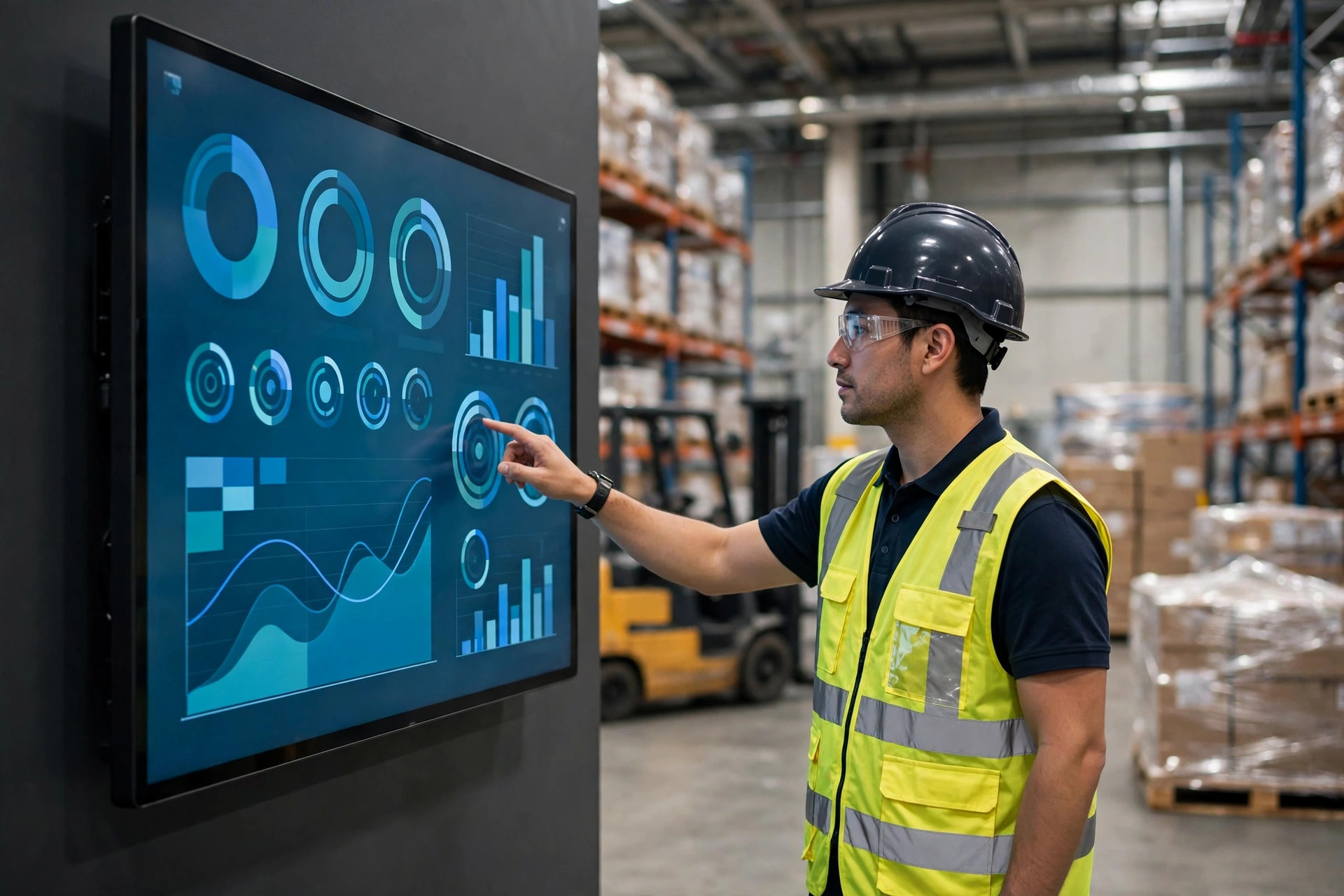
On October 5, 2026, European logistics systems integrator Logistics Reply announced an authority model for AI agents, alongside five pre-built agents designed to write back into the warehouse management system: one diagnoses out-of-stock causes, one balances labor, one recalculates ABC classifications, one books dock-door slots through natural-language conversation, and one pulls camera feeds when a task runs late to check whether something is blocking an AMR's path. This is according to public reporting on the announcement.
This is no longer the same species as the warehouse AI most of us know. For the past two years, AI in the warehouse has mostly meant RAG over SOP documents: a worker asks how the returns process works, and the assistant retrieves a paragraph from the knowledge base. It touches no system and changes no data; a wrong answer costs an eye-roll and a second search. The real dividing line for AI agent warehouse adoption is tool access: permission to call WMS APIs, generate replenishment recommendations, even write updated ABC classes back into the item master.
What separates an AI agent from a chatbot is not intelligence, it is access
Behind the announcement sits a set of survey numbers worth reading closely. According to an ORTEC survey of more than 2,000 logistics executives in North America, conducted in November 2025, 42 percent of logistics organizations were not exploring agentic AI at all, while 23 percent said they planned to start a pilot within the next twelve months. The industry has effectively designated 2026 a test-and-learn year.
A second survey, closer to the warehouse floor, comes from Logistics Reply: only 2.5 percent of respondents said AI currently makes operational decisions autonomously; 82.4 percent said they usually review AI recommendations before acting; nearly three-quarters said employees can override AI recommendations or decisions. When disruptions strike, 47.5 percent said AI flags the issue while people coordinate the response, and just 3.8 percent said AI automatically coordinates a response across systems.
Read together, the pattern is clear: the warehouse AI agent question has moved from whether it can work to whether organizations dare to let it. Model capability is not the bottleneck. Delegated authority is.
Three warehouse tasks where AI agents can genuinely land
From a research perspective, the relevant question was never what AI can do. It is which tasks have a cost-of-error and labor-cost structure that lets machines go first. Publicly documented cases cluster in three categories.
The first is inventory diagnosis and replenishment recommendations. The out-of-stock agent above distinguishes true shortages from temporary conditions, such as goods in transit that have not yet been received, turning manual SKU-by-SKU investigation into machine screening. These tasks take structured inputs (on-hand, in-transit, sales history) and produce recommendations rather than commands; a person confirms, and the cost of an error stays contained.
The second is autonomous exception communication. The dock-scheduling agent lets carriers search for and book dock slots through guided conversation governed by scheduling rules. This used to be dozens of back-and-forth emails a day for a planner, highly repetitive and rule-bound. The AI converts conversation into structured booking actions.
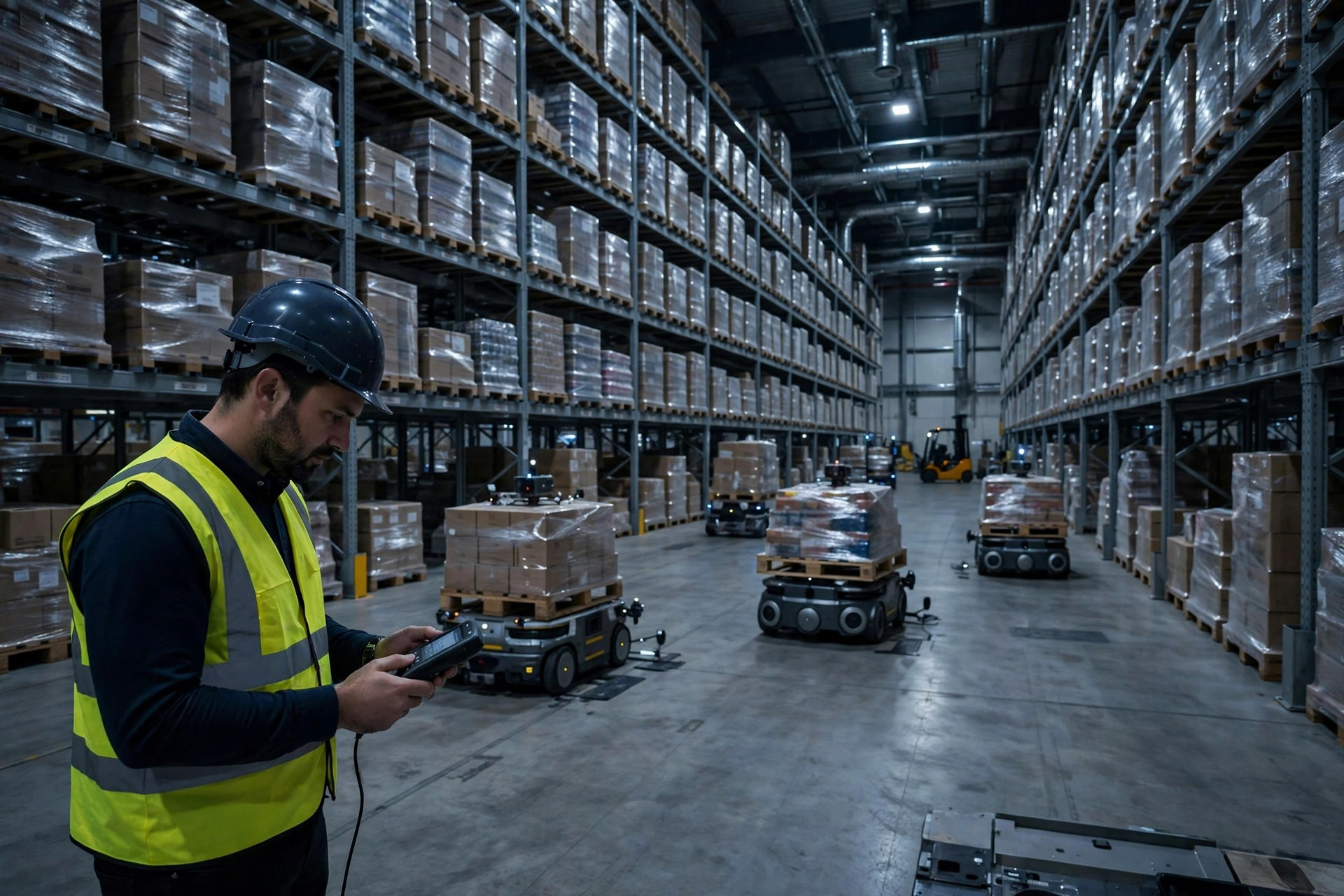
The third is cycle-count triage and master-data maintenance. The ABC rebalancer recalculates classifications from movement data and produces a reclassification report that only writes back to the WMS item master after human approval; the overdue-task agent uses camera input to diagnose delay causes. What these share is high frequency and low per-instance value: work nobody wants to do but someone has to.
The three categories fit into a simple decision framework:
| Task type | Cost of error | Manual cost per instance | Fitting authority level | | Inventory diagnosis / replenishment advice | Medium (recommendations can be intercepted at review) | High (SKU-by-SKU investigation) | Recommend, human approves | | Exception communication / dock booking | Low to medium (reversible within rules) | High (repetitive communication) | Semi-autonomous execution | | Count triage / master data | High (write-backs affect the whole system) | Medium (periodic batch work) | Report, approve, then execute |
The rule of thumb: the closer an action gets to writing into the system, the more it needs a human signature; the closer it stays to screening and recommendation, the sooner the machine can go first.
Why most warehouses still cannot use warehouse AI agents in 2026
The numbers also explain the gap between interest and adoption. A July 2026 survey by inFlow of 400 inventory professionals found that 81 percent want AI in the warehouse, but only 11 percent currently use it; 85 percent still run inventory on spreadsheets as a primary tool.
ORTEC ranked the obstacles: high integration costs with existing systems (32 percent) topped the list, followed by lack of model explainability (26 percent) and poor data quality (22 percent). Forty-two percent said business processes would need redesigning to support autonomous decisions; 22 percent pointed to the need for reliable real-time data feeds.
Three structural barriers emerge.
First, authority and audit. Every write in a WMS carries accountability: who created the purchase order, who changed the ABC class, who answers when it goes wrong. Autonomous execution has no natural owner in today's audit frameworks, and that organizational problem is harder than the technical one.
Second, asymmetric error costs. A chatbot that answers wrong gets a second question. An agent that issues a wrong purchase order or corrupts master data costs real money. A warehouse is an environment where one mistake can stop the line; its tolerance for error is structurally lower than an office's.
Third, the API and data foundation. Many warehouses run WMS platforms whose APIs are incomplete or poorly documented, so agents cannot call them. Inventory accuracy itself is shaky, with 49.5 percent of inFlow respondents naming it their top improvement area. Automation built on dirty data only amplifies the errors.
The counterintuitive finding: what sets the pace of AI agent adoption in warehouses is not how much smarter the models get, but the warehouse's own cost-of-error structure and API maturity. Technology press covers parameters and benchmarks; warehouse managers care about two things: whether the machine needs my sign-off before touching my data, and whether I can undo what it did.
A timeline for AI agents in the warehouse: a researcher's call
Putting it together, here is a timeline judgment, offered for reference.
2026 is the pilot year (basis: 23 percent of firms planning pilots within twelve months in the ORTEC survey). The dominant form this year is the advisory agent: screening, reports, drafts, executed after human approval. Vendors are already selling pre-built agents; buyers are mostly large 3PLs and retailer-owned DCs.
2027 to 2028 brings semi-autonomy: high-frequency, low-risk links in the chain (dock booking, exception triage, replenishment drafting) shift to execute-by-default with humans handling exceptions, provided audit trails and rollback mechanisms catch up. The reasoning: authority models and audit tooling typically mature 12 to 18 months behind model capability.
Fully autonomous task execution as the norm will have to wait until some category of task demonstrates error rates durably below human levels, and contracts and insurance spell out who owns the mistakes. Research discipline says not to date that point precisely, but it is unlikely to arrive before 2028.
So perhaps the question is not when AI agents enter the warehouse. It is this: once machines start making judgments for you, which decisions in your operation are you willing to sign, and which would you rather never look at again? That list is each warehouse's real AI roadmap.
By Dr. Chen, Supply Chain Researcher




